

TL;DR:
- Vessel documentation provides legal proof of ownership, identity, and compliance requirements for maritime activities. Properly matching all details across forms and records prevents delays in obtaining or renewing this crucial documentation. Understanding the distinctions between federal and state registration ensures vessels meet specific operational and jurisdictional needs effectively.
Vessel documentation is the collection of official papers that prove a boat or yacht’s ownership, identity, and legal eligibility for maritime activities. The most critical examples of vessel documentation include the U.S. Coast Guard Certificate of Documentation, Bill of Sale, Builder’s Certificate, and safety compliance certificates such as Load Line and IOPP certificates. Vessels of at least 5 net tons engaged in coastwise trade or fisheries must be federally documented, which means these papers are not optional formalities. The National Vessel Documentation Center (NVDC) manages all federal applications under 46 CFR 67, and getting your paperwork right from the start determines how fast your vessel gets cleared.
1. Examples of vessel documentation: the Certificate of Documentation
The Certificate of Documentation (COD) is the primary federally issued vessel document, and it functions as both an identity record and an ownership verification instrument. Issued by the NVDC, it assigns an official number to the vessel and confirms U.S. citizenship eligibility for the owner. Every documented vessel carries this certificate on board at all times during operation.
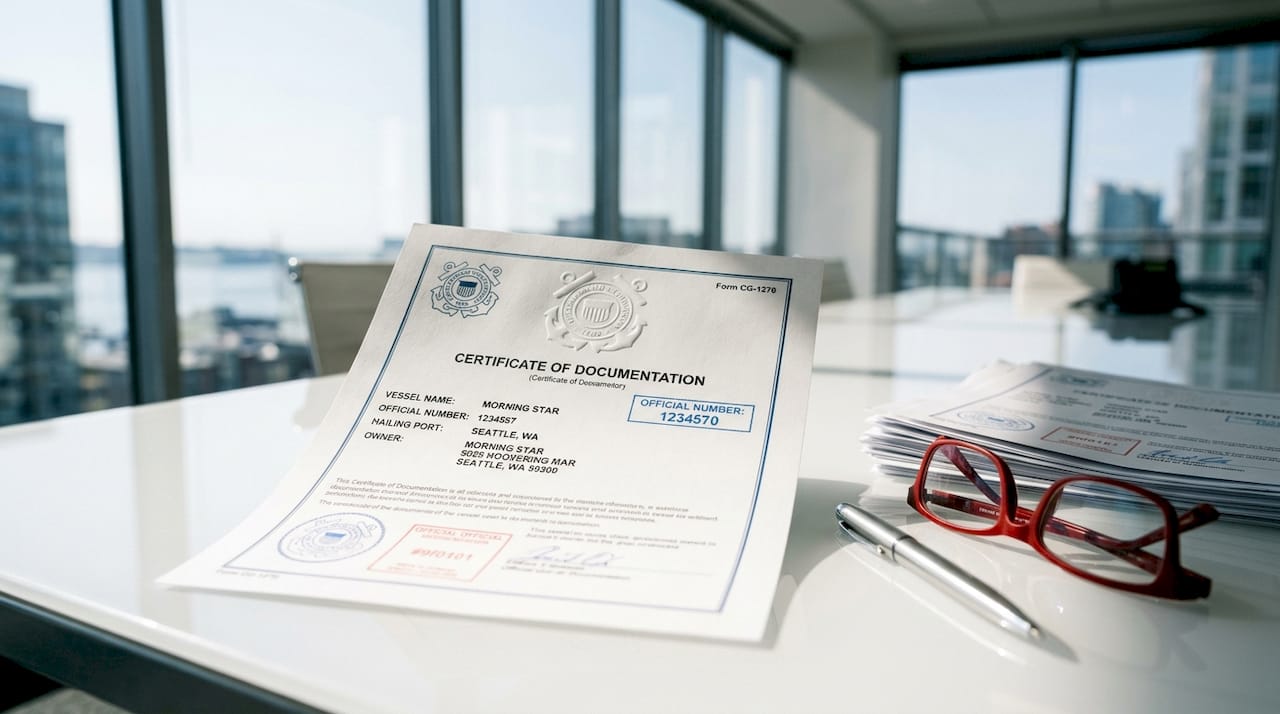
The COD is generated through the CG-1258 form, and the vessel name field requires the name exactly as intended, with the old name in parentheses if you are changing it. This single formatting rule trips up more applicants than almost any other requirement. Getting it wrong means a processing delay, not a rejection, but delays cost time and money.
Documentation endorsements appear directly on the COD and specify what the vessel is legally permitted to do. The four main endorsement types are:
- Recreational: For personal, non-commercial use
- Coastwise: For transporting passengers or cargo between U.S. ports
- Fishery: For commercial fishing operations in U.S. waters
- Registry: For international trade routes
Each endorsement carries different compliance obligations, so selecting the wrong one at application stage creates downstream legal problems. A vessel used for charter work, for example, needs a coastwise endorsement, not a recreational one.
Federally documented vessels must display the vessel name and hailing port legibly on the hull stern, and the official number must appear on an interior structural member. These display requirements are part of the documentation package, not separate obligations. Renewals are annual, and the NVDC sends reminders, but the owner is responsible for keeping the COD current.
Conseil de pro : Photograph your COD and store a digital copy in cloud storage. If the original is lost at sea or damaged, you can request a replacement from the NVDC faster when you have the official number and issue date on hand.
2. Bills of Sale: the ownership transfer document
A Bill of Sale is the legal record that transfers ownership of a vessel from one party to another, and it is a required document in nearly every federal documentation application. Without a properly executed Bill of Sale, the NVDC cannot confirm a clean chain of title. This document is the maritime equivalent of a deed in real estate.
A valid Bill of Sale for vessel documentation purposes must include:
- Full legal names and addresses of both buyer and seller
- Vessel name, Hull Identification Number (HIN), and official number if previously documented
- Purchase price and date of transfer
- Notarized signature of the seller
Ownership proof documents like the Bill of Sale are critical because they establish the legal foundation for all subsequent documentation. A vessel with a broken or unclear chain of title cannot receive a COD until the ownership history is resolved. This is why buyers of used vessels should always request all prior Bills of Sale, not just the most recent one.
Conseil de pro : If you are buying a vessel that was previously documented with the NVDC, request an abstract of title before closing. This document shows the complete ownership history and flags any outstanding liens.
3. Builder’s Certificate and Manufacturer’s Statement of Origin
The Builder’s Certificate, sometimes called the Manufacturer’s Statement of Origin (MSO), is the document that proves where and how a vessel was originally constructed. It is issued by the boat manufacturer and is required for first-time federal documentation of a new vessel. Without it, the NVDC has no way to confirm the vessel’s origin or verify that the HIN is legitimate.
Builders’ Certificates serve as foundational proof that unlocks federal endorsements and facilitates the initial registration. A typical Builder’s Certificate includes the manufacturer’s name and address, the vessel’s model and year, the HIN, and a declaration that the vessel was built in the United States. For imported vessels, the equivalent document is the Manufacturer’s Statement of Origin from the country of manufacture, often accompanied by a customs entry form.
Losing the original Builder’s Certificate creates a significant problem because manufacturers are not always willing or able to issue duplicates years after production. Buyers of new vessels should store this document with the same care as a property deed. Some states also require the MSO to issue a state title, so its importance extends beyond federal documentation.
4. Safety, compliance, and operational certificates
Safety and operational certificates form a distinct category of vessel documentation, and they are mandatory for legal port access and commercial operation. These documents are not issued by the NVDC. They come from classification societies, flag state authorities, and port state control inspectors.
Key safety certificates required for documented vessels include Load Line, IOPP, and ISM compliance documents, all of which are mandatory for port access and legal vessel operation. Here is a summary of the most common ones:
| Certificate | Issuing Authority | Purpose |
|---|---|---|
| Load Line Certificate | Classification society (e.g., Lloyd’s, Bureau Veritas) | Confirms safe loading limits |
| IOPP (International Oil Pollution Prevention) | Flag state or classification society | Certifies pollution prevention compliance |
| ISM (International Safety Management) | Flag state authority | Confirms safety management system compliance |
| ISPS (International Ship and Port Facility Security) | Flag state authority | Certifies security plan compliance |
| Fire Extinguisher Compliance | USCG or flag state | Confirms firefighting equipment meets standards |
Each certificate has a defined validity period and must be renewed through inspection. A vessel missing even one of these documents can be detained at port, which in commercial operations translates directly to financial loss. Recreational yachts operating domestically may not need all of these, but any vessel crossing international waters should carry the full set.
5. Federal documentation versus state registration documents
Federal documentation and state registration are not the same thing, and confusing the two is one of the most common mistakes boat owners make. Federal documentation is issued by the NVDC and applies nationwide. State registration is issued by individual state agencies and applies only within that state’s jurisdiction.
State registration documents typically include a Certificate of Number and a state title, with specific display requirements for the registration number on the hull. Federal documentation, by contrast, assigns an official number that is displayed inside the vessel, not on the hull exterior. This is a practical difference that affects how law enforcement and port authorities identify your vessel.
| Feature | Federal Documentation | State Registration |
|---|---|---|
| Issuing authority | NVDC (U.S. Coast Guard) | State DMV or boating agency |
| Vessel size requirement | 5 net tons or more | Any size |
| Hull display | Name and hailing port on stern | Registration number on bow |
| Required for coastwise trade | Oui | Non |
| International recognition | Oui | Limitée |
Smaller vessels used exclusively on inland waters often only need state registration. A 16-foot fishing boat on a freshwater lake has no practical need for federal documentation. A 45-foot sailing yacht planning to cross to the Bahamas absolutely does. The vessel registration process for international travel requires federal documentation as the baseline credential.
6. How to use documentation examples to prepare your application
Treating official USCG forms as templates is the single most effective way to avoid processing delays. The CG-1258 is not just a form. It is a formatting guide that tells you exactly how the NVDC expects to receive your vessel’s information. Every field has a specific format, and deviating from it causes a mismatch with existing Coast Guard records.
Mismatches on Vessel Identification Number and ownership data are the most common causes of processing hold-ups. Before submitting any application, cross-reference every data point against the NVDC’s existing records for your vessel. If the vessel has been previously documented, pull an abstract of title to confirm the exact spelling of names and numbers on file.
Key checks before submitting your documentation package:
- Vessel name matches exactly across all documents (COD, Bill of Sale, Builder’s Certificate)
- HIN is consistent across all forms and matches the physical number on the hull
- Owner’s legal name matches government-issued ID exactly, including middle names or initials
- Endorsement type matches the vessel’s intended use
- All signatures are notarized where required
Le role of registration documents in maritime compliance extends beyond the initial application. Every renewal, ownership transfer, or endorsement change requires the same level of formatting precision. Building a documentation file that you update consistently saves hours of correction work later.
Conseil de pro : Create a master vessel documentation folder, physical and digital, that contains every document in chronological order. Include the original Builder’s Certificate, all Bills of Sale, every COD issued, and all safety certificates with their expiration dates. This folder becomes your vessel’s legal history.
Key takeaways
Vessel documentation is a layered system where each document type serves a specific legal function, and accuracy across all of them determines whether your registration succeeds or stalls.
| Point | Détails |
|---|---|
| Certificate of Documentation | The core federal document; endorsement type must match the vessel’s actual use. |
| Ownership proof chain | Bill of Sale and Builder’s Certificate must show an unbroken, consistent ownership history. |
| Safety certificates | Load Line, IOPP, and ISM certificates are mandatory for commercial operation and international port access. |
| Federal vs. state registration | Federal documentation is required for vessels over 5 net tons in coastwise trade; state registration covers smaller or inland-only vessels. |
| Formatting precision | Exact data matching across all forms with NVDC records prevents the most common processing delays. |
What years of vessel registration work actually taught me
Most people approach vessel documentation as a paperwork exercise. After working with hundreds of yacht and boat owners across multiple flag jurisdictions, I can tell you the real problem is almost never missing documents. It is inconsistent documents.
The owner who submits a Bill of Sale with “John A. Smith” but whose NVDC record shows “John Smith” will wait weeks for a correction that takes five minutes to prevent. The yacht that lists its name as “SEA BREEZE” on the COD but “Sea Breeze” on the Builder’s Certificate creates a discrepancy that a NVDC reviewer flags immediately. These are not edge cases. They are the norm.
What I have found genuinely useful is treating the CG-1258 as the master template and working backward from it. Every other document in the package should mirror the exact formatting of that form. If the form shows the vessel name in all caps, every supporting document should match. This sounds obvious until you are holding a notarized Bill of Sale that spells the owner’s name differently than their passport.
The other thing most guides skip: safety certificates have expiration dates that do not align with COD renewal dates. A vessel can have a current COD and an expired IOPP certificate simultaneously. Port state control inspectors check both. Building a single calendar that tracks every document’s expiration date, across ownership papers, safety certificates, and registration renewals, is the operational habit that separates prepared owners from detained ones.
— VesselFlag
Get expert vessel registration support from Vesselflag
Pulling together the right documentation for yacht or boat registration takes more than a checklist. It takes knowledge of which documents apply to your vessel type, flag jurisdiction, and intended use. Vesselflag provides end-to-end registration services for yacht and boat owners worldwide, covering everything from initial COD applications to international flag registration under San Marino, Malta, Palau, and more. Whether you are registering a new build or transferring ownership of an existing vessel, the yacht registration guide at Vesselflag walks you through every required document with jurisdiction-specific precision. For commercial operators, the commercial vessel registration service covers safety certificate coordination alongside the core documentation package.
FAQ
What is the most important vessel documentation example?
The Certificate of Documentation issued by the NVDC is the primary vessel document, as it confirms ownership, assigns an official number, and specifies the vessel’s permitted activities through endorsements.
Do all boats need federal documentation?
No. Federal documentation is required for vessels of at least 5 net tons engaged in coastwise trade or fisheries. Smaller vessels or those used only on inland waters typically only need state registration.
What does a Builder’s Certificate prove?
A Builder’s Certificate proves the vessel’s origin and construction details, and it is required for first-time federal documentation of a new vessel. Without it, the NVDC cannot verify the Hull Identification Number or confirm the vessel was built to U.S. standards.
How do I avoid delays in my documentation application?
Exact data matching across all forms with NVDC records is the most effective way to prevent delays. Mismatches in vessel name, HIN, or owner name between documents are the leading cause of processing hold-ups.
What is the difference between a state title and federal documentation?
A state title is issued by a state agency and applies within that state’s jurisdiction, while federal documentation from the NVDC applies nationwide and is recognized internationally for vessels engaged in coastwise trade or foreign voyages.