

TL;DR:
- Vessel corporate registration offers asset protection, tax benefits, privacy, and easier international operation.
- Choosing a reputable white-list flag state like Cayman, Malta, or Marshall Islands is crucial for compliance and safety.
- Proper registration process involves forming a legal entity, selecting a flag, preparing documents, and obtaining provisional certificates.
Owning a yacht or commercial vessel feels straightforward until you try to operate it across international waters. The moment you cross jurisdictions, questions about liability, taxation, and port access multiply fast. Many owners assume a simple private registration covers everything, but it rarely does. Vessel corporate registration, the practice of placing your vessel under a legally recognized business entity before registering it under a chosen flag state, opens doors that private registration simply cannot. This guide breaks down what it means, which flag states lead the field, the real trade-offs involved, and exactly how to get it done right.
Table of Contents
- What is vessel corporate registration?
- Popular flag states and what they offer
- Pros and cons of vessel corporate registration
- Efficient registration: steps, documents, and best practices
- What most guides miss: The smart owner’s approach to vessel corporate registration
- Get expert help with your vessel corporate registration
- Frequently asked questions
Key Takeaways
| Point | Details |
|---|---|
| Flag choice matters | Picking a reputable flag state is critical for smooth operations, lower risk, and better legal standing. |
| Corporate registration benefits | A corporate-owned vessel gains privacy, tax efficiency, and access to more favorable global regulations. |
| Fast-track registration is possible | Some registries offer provisional approval within days, but quality matters more than speed for long-term compliance. |
| Avoid lower-tier flags | Cut-rate registries lead to higher costs and hassles from inspections, insurance issues, and potential sanctions. |
What is vessel corporate registration?
Vessel corporate registration means a company or legal entity, rather than an individual, officially owns and registers the vessel. That entity is typically incorporated in a jurisdiction favorable to maritime business, and the vessel is then flagged under a chosen flag state. The two decisions, where to incorporate and which flag to fly, work together to shape your tax exposure, legal protections, and operational freedom.
This is not a niche strategy for billionaires. Yacht owners, commercial operators, and anyone planning to charter or finance a vessel benefit from this structure. Here is why it matters in practice:
- Asset protection: The vessel sits inside a corporate shell, shielding your personal assets from maritime claims or accidents.
- Tax efficiency: Many flag states impose no capital gains or VAT on vessel sales conducted through a corporate entity.
- Privacy: Ownership records often list the company rather than an individual, reducing public exposure.
- Financing access: Banks and lenders prefer lending against a corporate-owned vessel because the security structure is cleaner.
- Global mobility: A properly structured corporate registration makes chartering, crewing, and port entry in foreign countries far smoother.
The contrast with private registration is significant. A privately registered vessel ties ownership directly to an individual, creating personal liability and often limiting the jurisdictions where the vessel can legally operate commercially. Corporate yacht registration resolves most of those limitations in one move.
As one industry analysis notes, open flags like Cayman and Malta offer efficiency, privacy, and minimized risks when registration is handled through a proper corporate structure. That combination is hard to replicate any other way.
Popular flag states and what they offer
Choosing the right flag state is one of the most consequential decisions in vessel corporate registration. Not all flags are equal. Some carry strong legal reputations, favorable tax treatment, and low inspection rates. Others are cheaper upfront but create friction at every port.
The concept of an open registry is central here. An open registry, sometimes called a flag of convenience (FOC), allows vessels owned by foreign nationals to register under that country’s flag. This gives owners access to the flag’s legal framework, tax rules, and maritime conventions without any nationality requirement.
The Paris MoU white-list is the benchmark for flag state quality. The Paris Memorandum of Understanding on Port State Control ranks flag states by their inspection and detention records. White-list flags have the fewest detentions and the strongest safety records. Flying a white-list flag means fewer surprise inspections and smoother port entries across Europe and beyond.
Here is how the leading flag states compare:
| Flag state | Tax treatment | Provisional registration | Paris MoU status | Notable strength |
|---|---|---|---|---|
| Cayman Islands | Tax neutral | 5-10 days | White-list | Superyacht dominance |
| Malta | EU VAT benefits | 7-14 days | White-list | EU port access |
| Marshall Islands | Tax exempt | 1-7 days | White-list | Speed and flexibility |
| Isle of Man | Low tax | 7-14 days | White-list | UK legal framework |
| Panama | Tax exempt | 1-5 days | Grey-list | Lowest cost entry |
The numbers tell a clear story: 50% of superyachts over 30m are registered in the Cayman Islands, largely for tax-neutral reasons and the flag’s impeccable reputation.

Speed matters too. When a purchase closes or a charter season is about to start, waiting weeks for registration is not an option. Flags like Panama and Marshall Islands can issue provisional registration in as little as 1-7 days, giving you legal authority to operate while full documentation is finalized. Understanding registration validity for global compliance is critical before you commit to any flag. For EU-based operators, the Malta vessel registration guide is worth reviewing in detail.
Pros and cons of vessel corporate registration
No structure is perfect for every owner. Here is the honest picture.
Advantages:
- Legal separation between personal and vessel-related liabilities
- Significant tax savings on income, capital gains, and VAT depending on the jurisdiction
- Stronger privacy protections compared to individual ownership
- Access to reputable legal frameworks that insurers and lenders prefer
- Easier transfer of ownership through share sale rather than vessel re-registration
Drawbacks:
- Corporate maintenance costs: annual filings, registered agents, and accounting
- Some open registries carry reputational risk if they appear on grey or black lists
- Weak oversight in certain FOC flags creates safety and labor compliance gaps
- Shell company structures can attract scrutiny under anti-money laundering regulations
- Higher initial setup costs compared to simple private registration
The impact on insurance is real. Vessels flagged under reputable white-list registries typically attract lower premiums because insurers trust the regulatory environment. A grey-list flag can add 10-20% to your annual insurance cost, erasing any registration fee savings quickly.
Port state control is the other pressure point. Vessels flagged under frequently detained registries face more inspections, longer delays, and higher risk of detention. That is not a theoretical risk for commercial operators: a single detention can cost tens of thousands of dollars in lost charter revenue.
“While open registries increase efficiency and tax savings, they can also contribute to weaker oversight and regulatory risks” — a reality that makes flag state selection the most important decision in the entire registration process.
Pro Tip: Before committing to any flag, check its current Paris MoU performance report. A flag trending toward grey-list status is a warning sign, regardless of how attractive the fees look. Review yacht registration best practices and confirm your registration document requirements match the flag’s current standards.
| Factor | White-list open registry | Grey/black-list registry |
|---|---|---|
| Insurance cost | Lower | Higher |
| Port inspections | Fewer | More frequent |
| Detention risk | Low | Elevated |
| Lender acceptance | High | Variable |
| Reputation | Strong | Risky |
Efficient registration: steps, documents, and best practices
Knowing the process removes the anxiety. Here is how corporate vessel registration works in practice:
- Form your legal entity. Incorporate a company in a jurisdiction compatible with your chosen flag state. Many owners use British Virgin Islands, Cayman Islands, or Malta entities.
- Select your flag state. Match the flag to your operational needs: EU access, tax neutrality, or speed of registration.
- Appoint a registered agent. Most flag states require a local registered agent to handle filings and correspondence.
- Prepare your documentation. This is where most delays happen. Gather everything before submitting.
- Submit your application. For provisional registration, many flags accept digital submissions.
- Receive provisional certificate. This allows the vessel to operate legally while full registration is processed.
- Complete full registration. Final certificates, including the Certificate of Registry and radio license, are issued.
Core documents you will need:
- Proof of corporate ownership (certificate of incorporation, shareholder register)
- Bill of sale or builder’s certificate
- Tonnage measurement certificate
- Safety equipment certificates
- Crew and officer certificates (for commercial vessels)
- Deletion certificate if transferring from another flag
Processing times vary. Provisional status for Panama and Marshall Islands can arrive in 1-7 days. Full registration typically takes 2-6 weeks depending on the flag and document completeness.
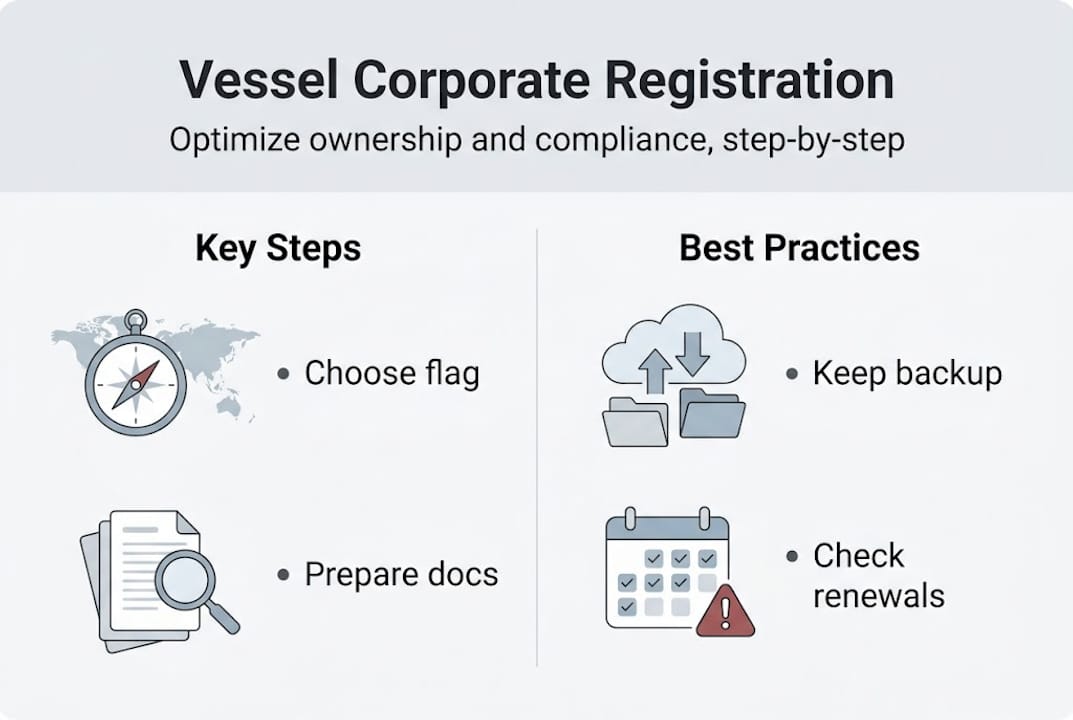
Pro Tip: Keep a digital and physical copy of every certificate on board and backed up offsite. Annual renewals sneak up fast, and an expired certificate at a port state inspection can trigger a detention even if everything else is in order. The commercial vessel registration steps and a solid registration checklist make the process far less stressful. Also review the maritime regulations guide to stay ahead of compliance changes.
What most guides miss: The smart owner’s approach to vessel corporate registration
Most articles on this topic stop at listing flag states and their fees. That misses the real lesson.
We have seen owners choose the cheapest FOC flag to save a few thousand dollars upfront, only to spend far more on insurance surcharges, port delays, and emergency re-flagging within two years. The math never works in their favor. The allure of a fast, inexpensive registration is real, but the downstream costs are invisible until they hit.
The owners who get this right treat flag selection as a long-term business decision, not a one-time transaction. They prioritize reputable white-list flags, work with experienced registration providers, and build a corporate structure that actually holds up under scrutiny from insurers, lenders, and port authorities.
Privacy and fewer port state headaches both start with the first registration. Changing flags later is possible but expensive and disruptive. Getting it right the first time, even if it costs more upfront, is the real shortcut.
As global registration trends continue to shift toward stricter compliance requirements, the gap between well-registered and poorly registered vessels will only widen. The smart move is obvious.
Get expert help with your vessel corporate registration
Vessel corporate registration is one of those decisions where the details matter enormously and the cost of getting it wrong compounds over time.
At VesselFlag.com, we work with yacht owners and commercial operators to match vessels with the right flag, the right corporate structure, and the right documentation from day one. Whether you need a complete yacht registration guide to understand your options, direct access to our flag registration services, or a full walkthrough of the global registration process, our team handles the complexity so you can focus on operating your vessel. Private and commercial clients both get the same level of personalized, efficient support.
Frequently asked questions
What is the main advantage of vessel corporate registration?
The main advantage is combining legal protection, tax efficiency, and access to reputable maritime frameworks for smooth global operation. White-list open flags optimize efficiency and privacy while reducing risks compared to private registration.
Which flag states are best for vessel corporate registration?
Cayman Islands, Malta, Marshall Islands, and Isle of Man are top choices for their strong legal reputations and registration benefits. The Cayman Islands alone account for 50% of superyachts over 30 meters registered globally.
How quickly can I register my vessel under a corporate structure?
Some open registries, such as Panama and Marshall Islands, process provisional registration in 1-7 days. Full registration typically follows within 2-6 weeks depending on document readiness and the flag state chosen.
Are there risks to using open registry or FOC flags?
Yes. While open registries offer tax and efficiency benefits, some carry higher regulatory and reputational risks, particularly those with weak oversight, safety gaps, or connections to sanctions evasion through shell structures.