

Navigating vessel registration across international jurisdictions often overwhelms yacht owners with hidden requirements and bureaucratic delays. Choosing among San Marino, Malta, and Poland flags demands understanding distinct legal frameworks, cost structures, and compliance obligations that directly impact how quickly you can operate legally. This guide walks you through preparation, procedures, and common pitfalls for efficient registration under these three popular flags.
Table of Contents
- Introduction To Vessel Registration Under International Flags
- Prerequisites And Ownership Requirements
- Step By Step Vessel Registration Process
- Costs, Timelines, And Ancillary Services
- Compliance, Safety, And Regulatory Considerations
- Common Mistakes And Troubleshooting
- Expected Outcomes And How To Confirm Successful Registration
- Get Expert Vessel Registration Assistance
Key takeaways
| Point | Details |
|---|---|
| Jurisdiction requirements vary | Understanding San Marino, Malta, and Poland specific rules speeds approval and prevents rejections. |
| Complete documentation prevents delays | Accurate ownership proofs and application forms eliminate the most common processing bottlenecks. |
| Provisional certificates enable quick operation | San Marino and Poland issue provisional registration within 1 to 2 business days for immediate legal sailing. |
| Costs differ significantly | San Marino costs approximately $1200, Malta around 1750 EUR, Poland roughly 1540 EUR with varying renewal structures. |
| Compliance awareness avoids complications | Adhering to maritime labor laws and safety standards protects your operational rights and vessel eligibility. |
Introduction to vessel registration under international flags
Vessel registration establishes your yacht’s legal nationality and determines which maritime laws govern your operations. This formal process creates a binding relationship between your vessel and the flag state, affecting everything from taxation to crew requirements and port access rights worldwide.
San Marino, Malta, and Poland stand out among yacht owners seeking balance between regulatory efficiency and international recognition. Each jurisdiction offers distinct advantages worth examining closely before commitment.
Your flag choice creates immediate operational consequences. Malta offers low registration and tonnage taxes with progressive reductions for younger ships and no restrictions on crew or ownership nationality, making it attractive for commercial operators. San Marino delivers exceptionally fast provisional registration, while Poland eliminates annual renewal fees entirely.
Key benefits by jurisdiction include:
- Malta provides tax incentives and complete flexibility on crew nationality
- San Marino processes provisional certificates within 24 to 48 hours
- Poland offers permanent registration without recurring annual costs
- All three flags maintain strong international port acceptance
- Each jurisdiction supports both commercial and private yacht operations
The flag you select shapes your compliance obligations, crew hiring flexibility, and overall operating costs for years ahead. Commercial vessels benefit from Malta’s tax structure, while private yachts often prefer San Marino’s speed or Poland’s cost predictability. Understanding these nuances before starting registration saves money and prevents operational disruptions.
Prerequisites and ownership requirements
Successful registration starts with proving clear vessel ownership through documentation that satisfies registry standards. You need original or certified copies of purchase agreements, bills of sale, or builder’s certificates establishing unbroken title chain from manufacturer or previous owner to you.
Dormant companies serve as popular ownership structures for liability protection and regulatory compliance across jurisdictions. Setting up a holding company in the flag state or a neutral jurisdiction like Panama or Marshall Islands provides legal separation between personal assets and vessel liabilities while simplifying international transactions.
Essential documentation requirements include:
- Government issued photo identification for all beneficial owners
- Company incorporation certificates and articles of association if using corporate ownership
- Vessel title documents proving clear ownership without liens or encumbrances
- Technical specifications including build year, dimensions, tonnage, and hull material
- Payment confirmation for registration fees and applicable taxes
- Power of attorney documents if using representatives or agents
Pro Tip: Request apostilled or consularized copies of corporate documents before starting your application. Many registries reject standard notarizations, causing weeks of delay while you obtain proper authentication.
Document accuracy matters more than speed. Registry staff scrutinize ownership chains and corporate structures to prevent fraud and money laundering. Incomplete applications sit in review queues for weeks while complete packages move through approval within days. Double check that company names match exactly across all documents and that signatures appear where required.
Local jurisdiction requirements introduce subtle variations. Malta accepts broader corporate structures than Poland, while San Marino requires specific dormant company formats. Verify these nuances with registry officials or experienced agents before finalizing your ownership structure to avoid expensive restructuring later.

Step by step vessel registration process
Registering your vessel follows a structured sequence that transforms raw documentation into legal operating authority. Each jurisdiction implements this process slightly differently, but core steps remain consistent across San Marino, Malta, and Poland.
Select your target flag based on operational needs, budget constraints, and timeline urgency. Compare total costs including initial fees, annual renewals, and mandatory services.
Gather and organize all required documentation using jurisdiction specific checklists. Scan documents at high resolution for digital submission and prepare certified copies for physical delivery where required.
Submit your application through official registry portals or authorized service agents. San Marino registration and Poland registration both offer streamlined digital platforms, while Malta registration combines online submission with traditional processing.
Pay registration fees through approved payment methods specified by each registry. Most accept international wire transfers, with some offering credit card processing through secure portals.
Receive provisional registration certificates within 1 to 2 business days for San Marino and Poland. Malta typically issues provisional documents within 3 to 5 business days depending on application complexity.
Wait for final registration certificates to arrive via courier or digital delivery. Physical documents typically ship within 2 to 4 weeks after provisional approval.
Install required identification including vessel name, port of registry, and registration number according to flag state specifications.
Provisional certificates grant full legal operating authority while formal documents process through final review and printing. You can begin sailing immediately under your new flag once provisional registration arrives, provided you carry the certificate onboard and comply with all safety requirements.
Registry staff review applications for completeness before advancing to approval stages. Incomplete packages generate clarification requests that extend timelines by days or weeks. Anticipate common questions about ownership structures, vessel specifications, and intended use patterns by providing clear explanatory notes with your initial submission.
Costs, timelines, and ancillary services
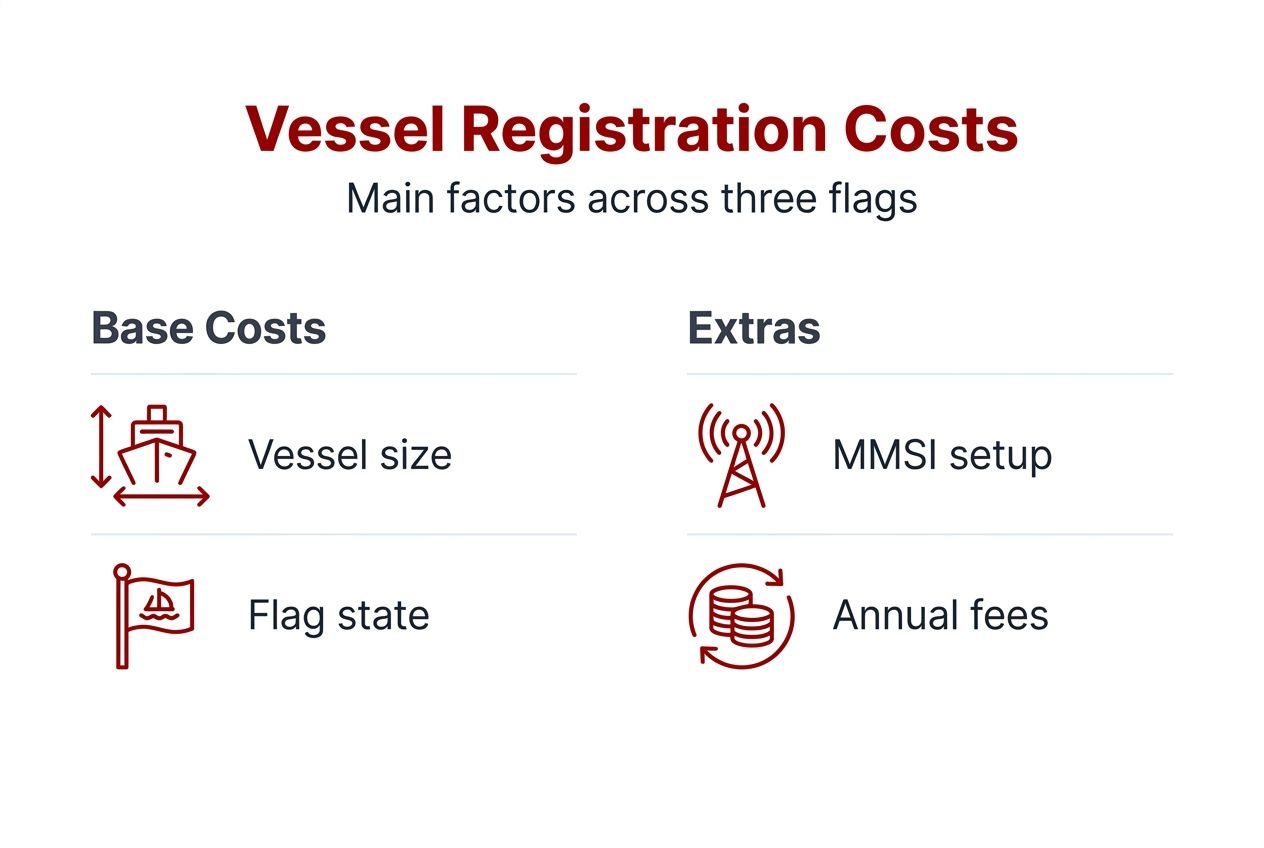
Registration expenses vary significantly based on vessel size, jurisdiction selection, and optional services you include. Understanding total cost structures prevents budget surprises and helps you evaluate true value across flag options.
| Jurisdiction | Initial Cost | Annual Renewal | Provisional Timeline | Final Certificate |
|---|---|---|---|---|
| San Marino | ~$1200 USD | Required | 1 to 2 days | 2 to 3 weeks |
| Malta | ~1750 EUR | Tonnage tax | 3 to 5 days | 3 to 4 weeks |
| Poland | ~1540 EUR | None | 1 to 2 days | 2 to 4 weeks |
Malta offers low registration and tonnage taxes with progressive reductions for younger ships, creating long term savings for newer vessels. The tonnage tax structure decreases annually for vessels under 10 years old, potentially offsetting higher initial registration costs within your first ownership years.
Poland stands out by eliminating annual renewal fees entirely after initial registration. This structure benefits owners planning extended ownership periods, though initial costs sit slightly higher than some competitors. You avoid ongoing administrative burden and renewal processing that other flags require.
Ancillary services expand beyond basic registration:
- MMSI number assignment and AIS configuration for maritime identification
- Insurance document coordination and policy facilitation
- Express courier delivery for physical certificates and documentation
- Corporate registration services for dormant company setup
- Ongoing compliance monitoring and renewal reminders
Pro Tip: Bundle MMSI setup with initial registration to avoid dual processing fees later. Most registries charge 30% to 40% more for MMSI assignment as a standalone service versus including it during initial application.
Timeline expectations shift based on application completeness and registry workload. San Marino and Poland consistently deliver provisional certificates within 48 hours for complete applications, while Malta averages 3 to 5 business days. Final certificates require additional production time for physical document printing, security features, and international shipping.
Factoring boat registration cost factors like vessel length, tonnage, and intended use helps predict total expenses across your ownership timeline. Larger vessels trigger higher tonnage based fees in Malta, while San Marino and Poland use flatter rate structures that benefit owners of bigger yachts.
Compliance, safety, and regulatory considerations
International maritime compliance extends beyond registration paperwork into operational requirements that govern crew treatment, safety equipment, and ongoing documentation. Your flag state determines which conventions and standards apply to your vessel.
Maritime Labor Convention 2006 establishes minimum working conditions for crew members aboard commercial vessels. Even private yachts with paid crew must consider MLC 2006 provisions around employment contracts, working hours, and accommodation standards when operating under certain flags.
Key compliance requirements include:
- Safety equipment meeting flag state specifications for vessel size and operating area
- Valid insurance certificates covering liability, hull damage, and crew protection
- Crew certification appropriate for vessel type and operating waters
- Navigation and communication equipment compliant with international standards
- Regular inspection schedules as mandated by flag state regulations
Crew nationality and labor rules differ substantially between jurisdictions. Malta imposes no restrictions on crew or ownership nationality, allowing you complete flexibility in hiring decisions and corporate structure. San Marino and Poland maintain more conventional requirements but offer pathways for international crew through proper work authorization.
Flag specific documentation accompanies your registration certificate during operations. Most jurisdictions require carrying current insurance certificates, crew certifications, and safety inspection records alongside registration documents. Port authorities worldwide verify these documents during routine checks and clearance procedures.
Compliance failures affect vessel eligibility and operating rights directly. Registries can suspend or revoke registration for serious safety violations, insurance lapses, or crew mistreatment. Maintaining current documentation and adhering to scheduled inspections protects your legal status and prevents expensive remediation efforts.
Safety inspections vary by vessel size and commercial designation. Yachts under 24 meters often qualify for simplified inspection regimes or documentary review instead of physical surveys. Commercial vessels face more stringent examination schedules regardless of size, including annual inspections and periodic dry dock surveys.
Common mistakes and troubleshooting
Common mistakes in vessel registration include incomplete documentation and misunderstanding flag specific commercial versus private use rules, causing delays in processing. Documentation errors alone account for roughly 30% of registration delays across all jurisdictions.
Ownership proof discrepancies create immediate rejection risks. Registry staff compare names, identification numbers, and corporate details across all submitted documents. Minor spelling variations or outdated corporate names trigger clarification requests that pause processing for days or weeks.
Misinterpreting commercial versus private use designations leads to application rejections requiring complete resubmission. Commercial designation applies when you charter your yacht, carry paying passengers, or conduct business operations aboard. Private designation covers personal recreational use only. Choosing wrong classification voids your application and forfeits processing fees.
Prevention strategies include:
- Creating detailed checklists matching jurisdiction specific requirements before document gathering
- Consulting experienced registration agents familiar with flag state nuances
- Double checking that all names, numbers, and dates match exactly across documents
- Clarifying intended vessel use patterns with registry staff before selecting designation
- Requesting preliminary document review before formal application submission
Documentation review by qualified agents before submission catches 85% of common errors that otherwise delay registration by weeks. This upfront investment typically costs less than rush processing fees for fixing rejected applications.
Incomplete applications sit in review queues until applicants provide missing information. Registry staff rarely reach out proactively for minor omissions. Checking your application status regularly and responding immediately to any clarification requests minimizes delays.
Ownership structure complications emerge when corporate documents conflict with individual identification. Using dormant companies requires perfect alignment between beneficial owner identification and corporate registration details. Any mismatch suggests potential fraud and triggers enhanced scrutiny.
Early clarification of flag specific requirements prevents expensive restructuring. Contact registry officials directly with questions about ownership structures, documentation formats, and designation criteria before finalizing your approach. Most registries offer preliminary consultations at no charge to encourage complete initial applications.
Expected outcomes and how to confirm successful registration
Completing registration delivers tangible documentation establishing your vessel’s legal status and operating authority. Understanding what you receive and how to verify authenticity protects against processing errors and documentation fraud.
Provisional registration certificates arrive first, typically within 1 to 2 business days for San Marino and Poland applications. This document grants immediate legal operating authority under your new flag while formal certificates process through final production stages. You can begin sailing internationally once provisional registration arrives, provided you carry the certificate onboard.
Formal registration documents confirm permanent vessel nationality under your chosen flag. These physical certificates include security features like watermarks, official seals, and unique identification numbers traceable through registry databases. Original certificates must remain aboard during vessel operations for inspection by port authorities.
Legal operating timelines compress dramatically with provisional certificates:
- Same day approval possible for urgent San Marino applications with complete documentation
- Average 1 to 2 days from submission to provisional certificate receipt
- Immediate international sailing authority upon provisional certificate issuance
- Final certificates arrive within 2 to 4 weeks via express courier
Verification methods confirm registration authenticity through official channels. Most registries maintain online databases where you can search vessel details using registration numbers or vessel names. Cross referencing your documents against registry records ensures accuracy and detects potential fraud.
Compliance documents accompany registration certificates for complete operational readiness. Organize insurance certificates, crew certifications, and safety inspection records in waterproof folders alongside registration documents. Port authorities expect immediate access to this complete documentation package during clearance procedures.
Confirming successful registration involves checking that vessel details match exactly across all documents. Registry name, port designation, registration number, and vessel specifications should appear identically on provisional certificates, final documents, and online registry records. Any discrepancies require immediate clarification with registry officials to prevent operational complications.
Get expert vessel registration assistance
Professional registration services eliminate guesswork and accelerate approval timelines through deep expertise in jurisdiction specific requirements. Specialized agents understand documentation nuances that trip up first time applicants and maintain direct relationships with registry officials for rapid clarification.
VesselFlag.com offers comprehensive support from initial consultation through final certificate delivery. Their platform provides detailed jurisdiction comparisons, cost calculators, and processing timelines to inform your flag selection decision.
Access step by step guidance through their complete yacht registration guide covering documentation requirements, application procedures, and compliance obligations. The yacht registration checklist breaks down essential tasks into manageable steps preventing common oversights.
Expert assistance ensures compliance and prevents the costly delays caused by incomplete applications or incorrect designations. Vessel Flag registration services handle document preparation, application submission, and follow up communications with registry officials, freeing you to focus on vessel preparation rather than bureaucratic details.
FAQ
What documents are essential for vessel registration under international flags?
Ownership proof through bills of sale or builder’s certificates forms the foundation. Add government issued identification, completed application forms, company incorporation documents if using corporate ownership, and payment confirmation. Requirements vary slightly by jurisdiction but these documents provide the base package all registries expect.
Can I get provisional registration quickly before full registration is complete?
San Marino and Poland both issue provisional registration within 1 to 2 business days of complete application submission. This provisional certificate grants full legal operating authority, allowing you to sail internationally while awaiting formal registration document production and delivery.
Is physical inspection always required for international vessel registration?
Flags like San Marino and Poland allow complete online registration without physical vessel inspections for yachts under 24 meters. This documentary review process dramatically speeds approval timelines and eliminates travel requirements for inspection appointments, reducing both time and costs.
Are there nationality restrictions for crew and ownership under these flags?
Malta imposes no restrictions on crew or ownership nationality, offering complete flexibility for international operations. San Marino and Poland maintain more conventional requirements but provide pathways for international crew through proper authorization. Corporate ownership structures further expand flexibility across all three jurisdictions.