

En bref :
- Corporate vessel ownership places legal title within a company, protecting assets and optimizing taxes for high-value vessels. Properly managed structures, especially in offshore jurisdictions with active compliance, ensure liability isolation, tax benefits, and smooth succession through share transfers. Ongoing maintenance by qualified CSPs and careful jurisdiction selection are crucial for maximizing the advantages of corporate vessel ownership.
Corporate vessel ownership is the legal framework that places a maritime asset inside a corporate entity, separating it from personal ownership and shielding investors from direct liability. This structure is the dominant model in high-value maritime investment: 37% of superyachts are held via corporate structures, compared to 35% by individuals and 28% by families. The role of corporate vessel ownership extends well beyond paperwork. It determines how liability is allocated, how charter income is taxed, and how ownership transfers when a business changes hands. For any investor managing a vessel above entry-level value, understanding this framework is not optional.
What is the role of corporate vessel ownership?
Corporate vessel ownership, known in the industry as corporate maritime asset holding, places legal title to a vessel inside a company rather than in an individual’s name. The owning entity can take several forms: an offshore company, a Limited Liability Company (LLC), a Special Purpose Vehicle (SPV), or a multi-tier holding structure. Each form carries distinct implications for tax exposure, liability, and governance obligations.
The core purpose of this structure is separation. When a vessel is owned by a company, the company bears the legal and financial consequences of that vessel’s operations. Personal assets held by the investor or business owner sit outside the reach of any claim arising from the vessel. Advisors recommend corporate structures for all vessels over 24 meters, citing tax efficiency, succession planning, and access to favorable offshore registries as the primary drivers.
Corporate Service Providers (CSPs) are the professional firms that manage the ongoing legal and compliance obligations of the owning entity. Their role is as consequential as the choice of flag state. A poorly managed corporate structure creates regulatory exposure that can negate every financial advantage the structure was designed to deliver.
How do corporate structures protect vessel assets?
Asset protection is the most immediate and concrete benefit of corporate maritime holding. Each vessel held in a separate SPV isolates its liabilities from the parent company and from every other vessel in a fleet. This is standard practice across global commercial shipping, and it applies with equal force to private yacht ownership.

Consider a collision incident in international waters. If the vessel is owned personally, the injured party’s legal claim reaches the owner’s entire estate, including unrelated business assets and real property. If the vessel is held inside a dedicated SPV, liability sits with the owning company, ring-fencing everything outside it. The practical difference between these two outcomes can be measured in millions of dollars.
Key mechanisms that corporate structures use to protect vessel assets include:
- SPV isolation: One company per vessel prevents cross-contamination of liabilities across a fleet or portfolio.
- Balance sheet separation: The vessel and its associated debt do not appear on the investor’s personal balance sheet, protecting creditworthiness.
- Operational ring-fencing: Crew employment contracts, charter agreements, and port liabilities attach to the corporate entity, not the individual.
- Succession insulation: Ownership passes through share transfer rather than vessel re-registration, reducing legal friction at transition points.
Conseil de pro : Structure each vessel inside its own SPV from day one, even if you currently own only one vessel. Retrofitting a structure after an incident or fleet expansion is significantly more expensive than building it correctly at the outset.
What are the tax advantages of corporate vessel ownership?
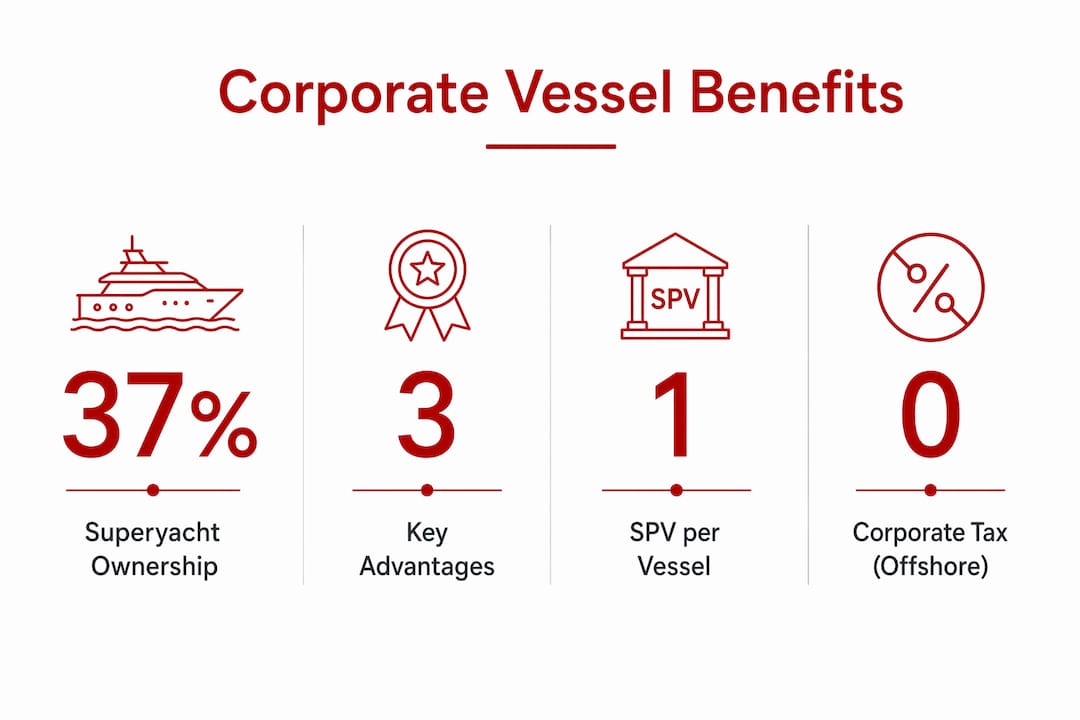
Tax optimization is the second major driver of corporate maritime holding, and the advantages are substantial when the right jurisdiction is selected. Offshore jurisdictions including the Cayman Islands, Isle of Man, Jersey, and Guernsey operate zero or near-zero corporate tax regimes, making them the preferred domiciles for charter-generating vessels. Charter income routed through these entities avoids the tax drag that would apply under most onshore corporate regimes.
US-based investors frequently use LLCs for vessel holding because of pass-through taxation. An LLC does not pay corporate income tax at the entity level. Profits and losses flow directly to the members’ personal returns, which can create significant advantages when a vessel generates losses in its early operating years. This structure also avoids the double taxation that applies to C-corporations.
The table below compares the most common ownership models and their tax treatment:
| Ownership model | Tax treatment | Best suited for |
|---|---|---|
| Offshore company (Cayman, Isle of Man) | Zero or near-zero corporate tax | Charter income, international operations |
| US LLC | Pass-through taxation, no entity-level tax | US-based investors, mixed personal/charter use |
| Family trust | Tax-deferred wealth transfer, estate planning | Multi-generational succession, private use |
| Multi-tier SPV structure | Layered tax optimization across jurisdictions | Large fleets, institutional investors |
| Onshore company | Standard corporate tax rates apply | Domestic commercial operations |
Corporate ownership also simplifies succession by enabling transfer of company shares rather than vessel re-registration. This distinction matters enormously in practice. Re-registering a vessel triggers stamp duties, port authority fees, and potential VAT assessments in many jurisdictions. Transferring shares in the owning company avoids all of these costs. For high-value assets, the savings on a single transfer can exceed six figures.
Conseil de pro : Before selecting a jurisdiction, model the full tax lifecycle of the vessel, including acquisition, charter income, operating losses, and eventual sale. The jurisdiction that minimizes acquisition costs is not always the one that minimizes lifetime tax exposure.
What compliance obligations come with corporate vessel management?
Compliance is where corporate vessel ownership becomes genuinely complex, and where most investors underestimate the ongoing burden. Economic substance and transparency requirements have become stricter, particularly in offshore jurisdictions that previously operated with minimal oversight. Cayman Islands, Isle of Man, and Jersey all now require owning entities to demonstrate real economic activity, not just a registered address.
The compliance obligations that a corporate vessel owner must manage on an ongoing basis include:
- Economic substance filings: Annual demonstration that the owning entity has genuine management and control in its jurisdiction of incorporation.
- Beneficial ownership registers: Disclosure of the natural persons who ultimately own or control the corporate entity, required under anti-money laundering frameworks in most jurisdictions.
- AML and KYC procedures: Anti-Money Laundering and Know Your Customer checks on all parties connected to the vessel, including charterers in commercial operations.
- Flag state registration maintenance: Annual renewal of vessel registration, compliance with the flag state’s safety and inspection requirements, and timely reporting of ownership changes.
- Déclarations annuelles des entreprises : Financial statements, director confirmations, and registered agent renewals in the jurisdiction of incorporation.
A competent CSP manages all of these obligations. CSPs handle economic substance filings, beneficial ownership registers, AML/KYC, bank accounts, and flag state interactions as core services. The distinction between a CSP and a yacht manager is important: a yacht manager handles the physical vessel, crew, and charter operations, while a CSP manages the legal entity that owns the vessel. Both roles are necessary, and neither substitutes for the other.
Multiple SPVs can complicate consolidated financial reporting, obscuring true leverage and profitability at the group level. Investors managing a fleet across several corporate entities need consolidated reporting frameworks that cut across the individual SPV structures. This is a governance requirement, not just an accounting preference.
What ownership structures work best for different vessel types?
The choice of corporate structure depends on the vessel’s intended use, the investor’s tax residency, and the scale of the operation. No single model fits every situation, and the cost of choosing the wrong structure is measured in both tax dollars and compliance hours.
Offshore companies registered in the Cayman Islands or Isle of Man suit charter-generating superyachts operated internationally. These structures minimize tax on charter income and provide access to well-regarded flag states. Shipping joint ventures increasingly use bespoke multi-tier structures with equity-linked incentives to align operational performance and risk management across multiple investors. This model works well for commercial vessels where two or more parties share ownership and want performance-based returns tied to the vessel’s operating results.
Family trusts serve a different purpose. They are not primarily tax vehicles but succession tools. Placing a vessel inside a trust removes it from the estate for inheritance purposes, allowing the asset to pass to the next generation without triggering estate taxes or re-registration costs. The trustee holds legal title, the beneficiaries hold economic interest, and the vessel continues operating without interruption.
The table below summarizes the strategic fit of each model:
| Structure | Primary advantage | Typical use case |
|---|---|---|
| Offshore company | Tax minimization on charter income | Commercial charter superyachts |
| US LLC | Pass-through taxation, operational flexibility | US-based private or charter vessels |
| Family trust | Succession planning, estate tax mitigation | Multi-generational private use vessels |
| Multi-tier SPV | Liability isolation across large fleets | Institutional fleet investors |
| Joint venture entity | Shared equity, performance-linked returns | Co-owned commercial vessels |
For investors considering corporate yacht registration in 2026, the selection of both structure and flag state should happen simultaneously. The flag state determines which compliance framework applies, and some structures are better suited to specific flags than others. Malta, for example, offers EU flag access with a favorable tax tonnage regime, making it a strong choice for charter operators who want European market access.
Key takeaways
Corporate vessel ownership delivers asset protection, tax efficiency, and succession clarity only when the structure is properly built and actively maintained.
| Point | Détails |
|---|---|
| Corporate structure is the majority model | 37% of superyachts use corporate ownership, making it the most common form for high-value vessels. |
| SPVs isolate liability per vessel | Each vessel in its own SPV prevents one incident from threatening an entire portfolio. |
| Jurisdiction selection drives tax outcomes | Cayman Islands, Isle of Man, and Jersey offer near-zero tax on charter income for qualifying structures. |
| CSP quality determines compliance success | A competent CSP manages substance filings, KYC, flag registration, and beneficial ownership registers. |
| Structure must match vessel use | Charter vessels, private yachts, and fleet investments each require a different corporate model. |
The compliance burden is larger than most investors expect
At Vesselflag, we work with investors at every stage of corporate vessel ownership, and the pattern we see most often is this: the structure gets set up correctly, and then it gets neglected. Owners treat the initial incorporation as the finish line. It is not. It is the starting line for an ongoing compliance program that requires active management every year.
The jurisdictions that offer the best tax treatment, Cayman Islands, Isle of Man, Jersey, are precisely the ones that have tightened their economic substance requirements most aggressively over the past five years. The deal is no longer “register here, pay no tax, do nothing.” The deal is “register here, pay no tax, and demonstrate genuine management and control annually.” That second part requires a CSP who knows what they are doing.
We also see investors underestimate the interaction between the corporate structure and the flag state. The vessel registration process is not separate from the corporate structure. The flag state needs to know who owns the vessel, who controls the owning entity, and whether the entity is in good standing. A gap in corporate compliance creates a gap in registration validity, and a gap in registration validity creates an operational problem that no amount of tax savings can offset.
The investors who get the most value from corporate vessel ownership are the ones who treat it as a business, not a paperwork exercise. They appoint a qualified CSP, they maintain their corporate records, and they review their structure every two to three years as regulations evolve. That discipline is what separates a structure that delivers on its promise from one that creates more problems than it solves.
— VesselFlag
Register and manage your corporate vessel with Vesselflag
Vesselflag provides corporate vessel registration and compliance support across multiple international flag states, including Malta, UK Part 1, San Marino, Palau, and Langkawi. Whether you are setting up a new ownership structure or bringing an existing vessel into compliance, the platform covers the full process from flag selection to beneficial ownership registration.
For investors who want to understand the differences between yacht and boat registration before committing to a structure, Vesselflag’s registration guides cover every major jurisdiction with current 2026 requirements. The platform also supports corporate registration as a bundled service, pairing flag state registration with entity setup and ongoing compliance management. Explore the Guide complet sur l'immatriculation des yachts to map out your ownership structure before the first document is signed.
FAQ
What is corporate vessel ownership?
Corporate vessel ownership is the practice of holding legal title to a vessel inside a corporate entity rather than in an individual’s name. The structure separates vessel liabilities from personal assets and enables tax optimization through jurisdiction selection.
Why do advisors recommend corporate structures for large yachts?
Advisors recommend corporate ownership for vessels over 24 meters because the structure provides liability protection, access to favorable offshore tax regimes, and simplified succession through share transfer rather than vessel re-registration.
What does a Corporate Service Provider do for vessel owners?
A CSP manages the legal entity that owns the vessel, handling economic substance filings, beneficial ownership registers, AML/KYC compliance, bank accounts, and flag state interactions on an ongoing basis.
Which jurisdictions offer the best tax treatment for charter vessels?
The Cayman Islands, Isle of Man, Jersey, and Guernsey operate zero or near-zero corporate tax regimes that are well suited to vessels generating charter income from international operations.
How does corporate ownership simplify succession planning?
Corporate ownership transfers through share assignment rather than vessel re-registration, avoiding stamp duties, VAT assessments, and port authority fees that would otherwise apply when ownership changes hands.