

Boat registration costs confuse even experienced yacht owners. A 40-foot vessel might cost $50 to register in one state and $300 in another, with hidden fees for titles, taxes, and inspections adding hundreds or thousands more. Understanding these variables helps you budget accurately and choose the most cost-effective registration strategy. This guide breaks down US state fees, federal documentation costs, international flag options, and strategic approaches to minimize expenses while maintaining full compliance across jurisdictions.
Table des matières
- Key takeaways
- Understanding boat registration fee structures in the US
- Federal USCG documentation and its cost implications
- Navigating boat registration beyond fees: taxes, inspections, and exemptions
- Strategic registration choices for yacht owners: Delaware, international flags, and tax benefits
- Explore expert yacht registration services
- FAQ
Principaux enseignements
| Point | Détails |
|---|---|
| State cost variance | Registration fees vary widely by state and depend on vessel length and registration period. |
| Hidden costs add up | Titles, taxes, and inspections can push the total cost higher than the base registration. |
| USCG benefits | Federal documentation offers international recognition and can simplify some operations, but most states still require registration. |
| Delaware advantage | Delaware is popular for tax advantages and yacht registration via corporations. |
| Flag option variety | International flags provide different compliance benefits and cost structures compared with US registration. |
Understanding boat registration fee structures in the US
US states use three primary boat registration cost structures: flat fees, length-based fees, and value-based fees. Length-based systems dominate, charging more as vessel size increases. Florida exemplifies this approach, charging $11.25 for boats under 12 feet and escalating to $195.50 for vessels over 65 feet. The median base fee across states sits at $28.15, but the range spans from Florida’s minimum $5.50 to Oregon’s $95.20.
Registration periods significantly impact annual costs. Some states offer one-year terms while others provide two or three-year options at discounted rates. A two-year registration might cost 1.8 times the annual fee rather than double, creating savings for owners who plan to keep their vessel registered long-term. California and Washington use this model, incentivizing longer commitments.
Common fee structures by state:
- Flat fee states charge the same amount regardless of vessel size
- Length-based states tier fees by foot ranges (most common approach)
- Value-based states calculate fees as a percentage of purchase or assessed value
- Hybrid states combine length tiers with additional value-based components
| State | Base Fee Range | Registration Period | Title Fee |
|---|---|---|---|
| Floride | $5.50 – $195.50 | 2 years | $5.25 |
| Californie | $20 – $120 | 2 years | Included |
| Texas | $32 – $140 | 2 years | $15 |
| Washington | $24 – $120 | 3 years | $12 |
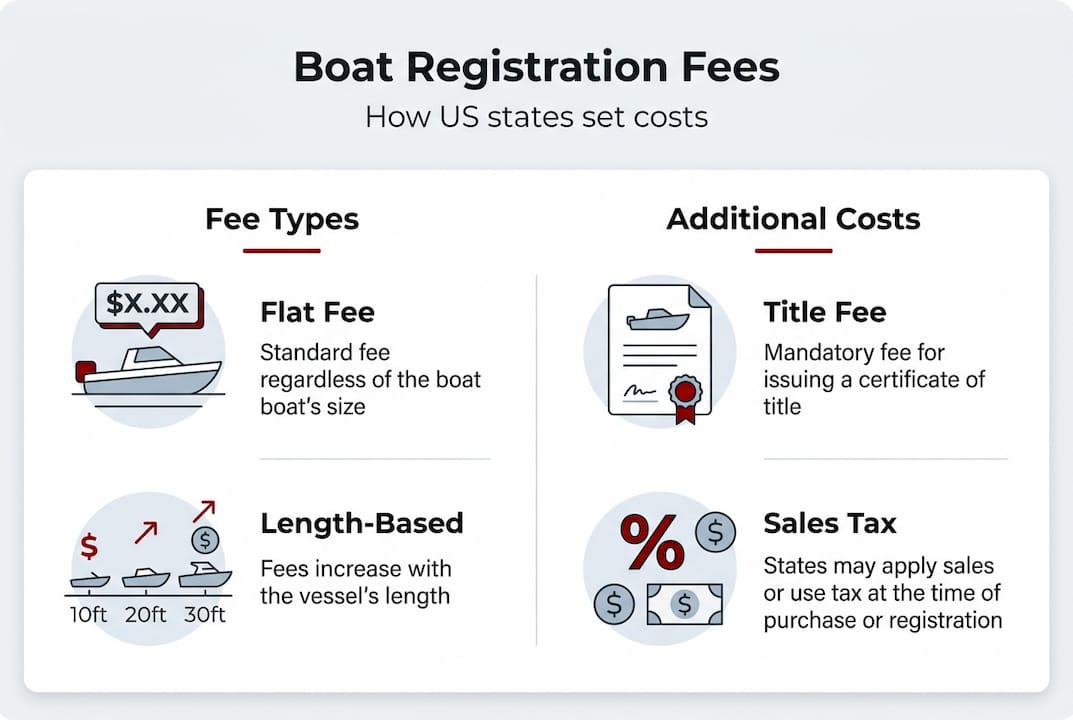
Title fees represent another cost layer. States requiring separate boat titles charge $5 to $25 for the document. Some states like California include titling in the registration fee, while others like Florida and Texas bill separately. This seemingly small expense adds up over multiple renewals and vessel ownership transfers.
Pro Tip: Always verify the registration period length when comparing state costs. A $60 two-year registration costs less annually than a $40 one-year fee.
Federal USCG documentation and its cost implications
The US Coast Guard offers federal vessel documentation as an alternative to state registration for qualifying vessels. This system charges a flat $26 for initial documentation or annual renewal, with multi-year options available: $52 for two years, $78 for three years, $104 for four years, and $130 for five years. Vessels measuring at least 25 feet qualify for this program, which provides international recognition and simplifies certain commercial operations.
Federally documented vessels display the USCG documentation number on the hull interior rather than state registration numbers on the exterior. This exempts owners from displaying state decals, creating a cleaner aesthetic many yacht owners prefer. However, the exemption from state numbers does not eliminate state registration requirements in most jurisdictions.
Key USCG documentation benefits:
- International recognition in foreign ports and waters
- Simplified commercial fishing and passenger operations
- Easier financing through maritime mortgages
- Exemption from displaying state registration numbers
- Permanent vessel identification number
Most states still require registration for tax collection purposes even when vessels carry federal documentation. Texas, Florida, and California all mandate state registration alongside USCG documentation, charging full registration fees despite the federal status. Only a handful of states fully exempt documented vessels from registration requirements, making dual registration the norm for yacht owners.
Le boat registration process becomes more complex with dual requirements. Owners must track separate renewal dates, maintain two sets of documentation, and ensure both registrations remain current. Missing either renewal can result in fines, operating restrictions, or complications during port inspections.
Pro Tip: Review both federal and state requirements before choosing documentation to avoid unexpected dual registration costs and administrative burden.
Navigating boat registration beyond fees: taxes, inspections, and exemptions
Base registration fees represent only part of total ownership costs. Sales tax hits buyers in most states, ranging from 0% in states like Delaware and Montana to over 10% in some localities when combining state and local rates. A $500,000 yacht purchase in a 7% sales tax state adds $35,000 to the transaction cost, dwarfing annual registration fees.

Property tax creates ongoing expenses in certain jurisdictions. States assess boat values annually and charge tax rates similar to real estate, typically 0.5% to 2% of assessed value. A $300,000 vessel in a 1% property tax state costs $3,000 yearly beyond registration fees. Some states exempt boats from property tax entirely, making them attractive for yacht registration.
Additional cost categories:
- Title fees: $5 to $25 depending on state requirements
- Sales tax: 0% to 10%+ based on purchase price and jurisdiction
- Property tax: 0% to 2% of assessed value annually where applicable
- Inspection fees: $50 to $200 when required for initial registration or transfers
- Lien search fees: $10 to $30 for title verification
| State | Title Required | Sales Tax | Property Tax | Inspection Required |
|---|---|---|---|---|
| Delaware | Non | 0% | Non | Non |
| Floride | Oui | 6% + local | Non | Varies by county |
| Texas | Oui | 6.25% | Non | Hull ID verification |
| Californie | Oui | 7.25% + local | Non | Initial only |
| Rhode Island | Oui | 7% | Yes (varies) | Non |
Inspection requirements vary widely. Some states mandate hull identification number verification for all new registrations, charging $50 to $100 for law enforcement or marine patrol inspection. Others require safety equipment checks or environmental compliance inspections, particularly for larger vessels or commercial operations. These one-time or periodic costs surprise owners unfamiliar with local regulations.
Certain vessel types escape registration requirements entirely. Non-motorized boats like kayaks, canoes, and rowboats typically need no registration in most states. Sailboats under specific lengths sometimes qualify for exemptions. Temporary visitors from other states or countries often receive short-term exemptions, usually 60 to 90 days, before requiring local registration. Understanding these legal registration impacts helps owners determine actual obligations.
Pro Tip: Calculate total cost of ownership including all taxes, fees, and inspections rather than focusing solely on base registration fees when budgeting for yacht ownership.
Strategic registration choices for yacht owners: Delaware, international flags, and tax benefits
Delaware dominates yacht registration strategy discussions due to its 0% sales tax and corporate registration structure. Owners establish a Delaware corporation or LLC to purchase and register vessels, avoiding sales tax on the transaction and benefiting from low annual registration fees. This Delaware flag registration approach saves tens of thousands on expensive yacht purchases, with corporate formation costs typically under $1,000.
International open registries offer alternative strategies for yacht owners planning global cruising or charter operations. Marshall Islands provides low-cost registration with minimal annual tonnage taxes, while Cayman Islands delivers prestige and banking advantages at higher cost. These flags facilitate international operations, simplify customs procedures, and sometimes reduce tax burdens compared to US registration.
State versus offshore registration comparison:
- State registration: Lower setup costs, simpler compliance, familiar legal system
- State registration: Higher sales and property taxes in most jurisdictions, limited international recognition
- Offshore registration: International acceptance, potential tax advantages, prestige flags available
- Offshore registration: Higher initial setup costs, complex compliance requirements, annual tonnage taxes
Dual registration scenarios complicate planning. Yacht owners often maintain both USCG documentation for US operations and state registration for tax compliance, or combine offshore flag registration with temporary US permits for domestic cruising. Each jurisdiction imposes separate requirements, renewal dates, and documentation standards. Tracking multiple registrations requires careful yacht registration best practices to avoid lapses.
Trade-offs extend beyond immediate costs. Delaware corporate registration requires annual franchise taxes and registered agent fees, typically $300 to $500 yearly. International flags demand periodic surveys, safety inspections, and compliance with flag state regulations. Some registries require physical inspections every five years, costing thousands in surveyor fees and potential repairs to meet standards.
Delaware remains the top choice for US yacht owners seeking tax advantages because corporate registration eliminates sales tax while maintaining straightforward compliance and legal protections unavailable in many offshore jurisdictions.
Owners must verify whether their chosen registration satisfies insurance requirements. Some insurers refuse coverage for certain flags or demand higher premiums for offshore registrations. Lenders similarly restrict financing options based on flag state, with US banks preferring USCG documentation or state registration over international alternatives. These practical considerations often outweigh pure cost analysis when selecting boat registration cost factors.
Explore expert yacht registration services
Navigating multi-jurisdictional registration requirements challenges even experienced yacht owners. Professional registration services streamline the process by handling documentation, ensuring compliance across jurisdictions, and identifying cost-saving opportunities specific to your vessel and operations. Expert guidance prevents costly mistakes like missed renewal deadlines, incorrect tax filings, or non-compliant flag choices that trigger fines or operating restrictions.
Specialized yacht registration providers understand nuances between state requirements, federal documentation procedures, and international flag regulations. They manage timeline coordination, document preparation, and communication with maritime authorities, saving owners dozens of hours researching requirements and completing paperwork. This expertise proves particularly valuable for owners maintaining vessels in multiple locations or planning international cruising.
Pro Tip: Partnering with specialized yacht registration services simplifies compliance management and often uncovers tax advantages or registration strategies that offset service costs through long-term savings.
Professional services also provide ongoing compliance monitoring. Registration renewals, safety certificate updates, and regulatory changes require constant attention. Expert providers track these requirements automatically, sending reminders and handling renewals before deadlines pass. This yacht registration validity service prevents lapses that could ground your vessel or create legal complications during port calls. Using a comprehensive liste de contrôle pour l'enregistrement des yachts ensures nothing falls through the cracks.
FAQ
What factors most affect boat registration costs?
Vessel length drives most state fee structures, with longer boats paying significantly more than smaller craft. Registration period length impacts annual costs, as multi-year terms often provide discounts. Sales tax on purchase price, property tax where applicable, and title fees add substantial expenses beyond base registration. State-specific requirements for inspections or safety equipment create additional variable costs.
Do USCG documented vessels still need state registration?
Most states require registration for tax collection purposes despite federal USCG documentation. Texas, Florida, California, and many other jurisdictions mandate full state registration alongside federal documentation, charging complete registration fees. Only a small number of states fully exempt documented vessels. Always verify specific state requirements before assuming USCG documentation eliminates state obligations.
What are common exemptions from boat registration fees?
Non-motorized vessels like kayaks, canoes, and rowboats typically escape registration requirements in most states. Some jurisdictions exempt sailboats under specific lengths or inflatable boats below certain sizes. Temporary visitors from other states or countries usually receive 60 to 90-day exemptions before requiring local registration. Commercial vessels sometimes face different registration rules with separate exemption criteria.
Why do yacht owners choose Delaware for registration?
Delaware offers 0% sales tax through corporate registration structures, saving tens of thousands on expensive yacht purchases. The state charges low annual registration fees and requires no property tax on vessels. Delaware flag registration provides straightforward compliance, familiar US legal protections, and simple corporate formation processes. These advantages make Delaware the preferred choice for cost-conscious yacht owners operating primarily in US waters.
Recommandé
- Coût de l'immatriculation d'un bateau : Facteurs clés pour les propriétaires
- Explication de la procédure d'immatriculation des bateaux : Impact juridique à l'étranger
- Conformité de l'immatriculation des bateaux : Pourquoi c'est important au niveau mondial
- Boat registration guide 2026: efficient international flags
- Master marine radio protocols for safe UK boating in 2026