

Choosing the right flag for your yacht can feel like navigating a maze of rules and expenses. International yacht owners face wide-ranging registration fees and paperwork, all tied to jurisdiction and vessel size. Boat registration connects your ownership with your legal rights and compliance standards whether you sail under the Malta flag or seek the credibility of the United Kingdom. This guide explains what drives costs, clarifies registration types, and highlights how flag selection shapes your operating flexibility and legal protection.
Table of Contents
- Defining Boat Registration Cost And Purpose
- Types Of Registration And Cost Variations
- Registration Process And Required Documents
- Legal, Tax, And Compliance Factors
- Comparing Popular Flags: Malta, UK, Poland
Key Takeaways
| Point | Details |
|---|---|
| Importance of Boat Registration | Boat registration is legally required and establishes ownership and operating authority, impacting compliance and jurisdictional rights. |
| Cost Variations Based on Factors | Registration costs vary significantly based on vessel type, length, and chosen jurisdiction, making it crucial for owners to understand these factors. |
| Different Registry Types | National registries impose stricter ownership rules and often higher costs, while open registries offer competitive pricing and easier access for foreign owners. |
| Ongoing Legal and Compliance Obligations | Registration entails ongoing legal responsibilities, including taxes and compliance with safety regulations, which can incur additional costs beyond initial registration fees. |
Defining Boat Registration Cost and Purpose
Boat registration is far more than paperwork. It’s a legal requirement that connects you, your vessel, and your jurisdiction in a binding relationship that affects how you operate, where you can travel, and what compliance obligations apply.
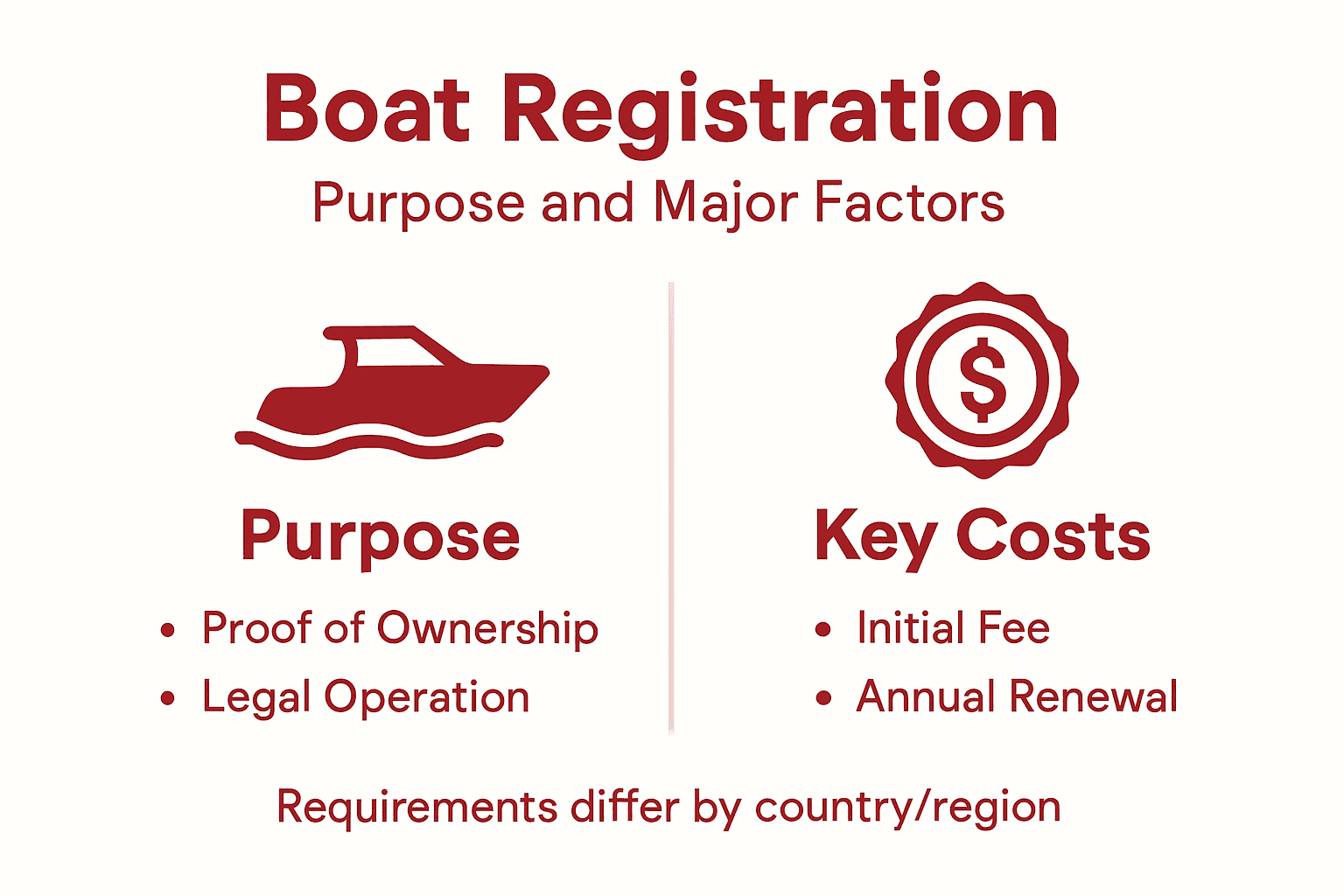
At its core, boat registration serves two critical functions:
- Establishes your legal right to operate the vessel
- Creates an official record linking ownership to jurisdiction
Proof of Ownership and Operation Authority
When you register a boat, you receive official documentation proving you own the vessel and have legal permission to operate it. This isn’t optional for most vessels—registration is mandatory for mechanically powered boats or those operating on federal and navigable waters. The registration documents must stay aboard your vessel at all times.
Your boat receives a unique identification number displayed on the hull. This registration number serves the same function as a vehicle license plate—it identifies your specific vessel across all maritime records.
Jurisdictional Authority and Law Enforcement
Boat registration enables states and maritime authorities to exercise legal control over your vessel. They can enforce safety standards, environmental regulations, and maritime laws. Ship registration establishes your vessel’s nationality and enables the State to protect the ship and regulate its activities under international law.
Without proper registration, you lose legal protection and face serious penalties including fines, impoundment, or loss of operating privileges.
Why Costs Vary Dramatically
Registration fees differ significantly based on several factors:
- Vessel length and tonnage
- State or flag jurisdiction selected
- Type of vessel (commercial vs. recreational)
- Registration duration (annual vs. multi-year)
- Additional services required
For international yacht owners, flag selection dramatically impacts registration cost. United Kingdom Part 1 registration, Malta registration, and other international options present different fee structures and compliance requirements.
Understanding your vessel’s registration purpose protects you legally and ensures compliance with the jurisdiction where you operate.
Pro tip: Determine your primary operating region before registering—this decision affects both initial costs and long-term compliance expenses, especially for vessels traveling across multiple jurisdictions or internationally.
Types of Registration and Cost Variations
Boat registration isn’t one-size-fits-all. Different registration systems exist worldwide, and your choice dramatically affects costs, compliance requirements, and operational flexibility. Understanding these distinctions helps you select the right option for your vessel and budget.
National Registries vs. Open Registries
Registries fall into two main categories with vastly different cost structures. National registries restrict ownership to citizens or vessels with national ties, while open registries accept foreign-owned vessels without citizenship requirements.
Open registries typically offer competitive pricing to attract international vessel owners. This competitive advantage comes from simplified administrative processes and streamlined compliance requirements. Closed registries focus exclusively on national vessels and may impose higher costs reflecting stringent controls.
For international yacht owners, open registries represent significant cost savings. Malta and United Kingdom Part 1 registries operate as open systems, allowing non-resident ownership while maintaining robust safety and environmental standards.
Here’s a concise overview of key differences between national and open boat registries:
| Registry Type | Ownership Restrictions | Administrative Process | Typical Cost Structure |
|---|---|---|---|
| National Registry | Citizens or resident entities | More rigorous, detailed | Often higher with added controls |
| Open Registry | Foreign ownership allowed | Simplified, faster | Lower, competitive fees |
This summary helps clarify how registry type affects accessibility and expense.
Cost Factors That Vary by Registration Type
Fee structures depend on vessel size, type, and ownership status. Several factors influence what you’ll actually pay:
- Vessel length and gross tonnage
- Commercial versus recreational classification
- Residency requirements in the jurisdiction
- Annual versus multi-year registration periods
- Additional services like AIS installation or corporate registration
Motorized vs. Non-Motorized Classifications
Many jurisdictions charge differently based on propulsion type. Motorized vessels typically cost more than non-motorized boats because they require additional safety and environmental compliance. This distinction matters significantly for yacht owners—a sailing yacht with an auxiliary engine often costs more than the same vessel registered as pure sail.

Titling and Ownership Documentation
Some states offer concurrent titling with registration, providing legal proof of ownership beyond just operational permission. This dual documentation adds security but may increase initial costs. International registries like Malta and UK Part 1 don’t require separate titling, simplifying the process.
Your registration choice affects not just immediate costs but ongoing compliance expenses, insurance premiums, and operational flexibility across jurisdictions.
Comparing International Options
If you operate internationally, flag selection matters more than jurisdiction residency. UK Part 1 registration offers established credibility and reasonable fees. Malta registration provides EU benefits and competitive pricing. Both accept non-resident owners and allow vessel operation globally.
Pro tip: Compare total ownership costs across three years, not just initial registration fees—some registries charge lower upfront fees but higher renewals, while others front-load costs for better long-term value.
Registration Process and Required Documents
The registration process varies slightly by jurisdiction, but the fundamental steps remain consistent. You’ll need to gather specific documents, complete applications, and pay fees to get your vessel officially registered and authorized for operation.
Essential Documents You’ll Need
Every registration requires proof of ownership. Acceptable ownership documents include titles, bills of sale, or Manufacturer’s Statements of Origin. The document you submit depends on whether your vessel is new, used, or inherited.
Additional documentation often required includes:
- Proof of residency (driver’s license or utility bill)
- Proof of safety course completion (some jurisdictions)
- Hull Identification Number (HIN) verification
- Notarized signatures (for certain vessel types)
- Insurance documentation (increasingly common)
Application and Submission Options
The registration application process can be completed in person, by mail, or online. Online submission offers convenience, while in-person visits allow you to clarify requirements immediately with officials.
You’ll complete a standardized application form detailing vessel information, ownership details, and intended use. Most applications take less than 30 minutes to prepare once documents are gathered.
Processing and Fees
Registration fees are paid at application time. Processing typically takes 1-4 weeks depending on jurisdiction and submission method. Some jurisdictions offer expedited processing for additional fees.
After approval, you’ll receive:
- Registration certificate
- Decals or registration numbers
- Documentation proving legal operation status
Display Requirements
Your vessel must display registration numbers on the hull prominently and legibly. The current registration sticker or decal must be visible. These visible marks prove your registration is current and valid to law enforcement and maritime authorities.
Special Requirements for Larger Vessels
Yachts above certain length thresholds often require titling in addition to registration. Some jurisdictions mandate safety inspections or completion of boating safety courses before registration approval.
International registrations like Malta and UK Part 1 have streamlined documentation requirements compared to domestic registrations. These registries often accept notarized copies of documents rather than originals, simplifying the process for non-resident owners.
Keep all registration documents aboard your vessel—you’re legally required to produce them during law enforcement stops or inspections.
Pro tip: Gather and photocopy all documents before starting the application to avoid delays; verify your jurisdiction’s specific requirements online or by phone first, as requirements vary considerably between states and international registries.
Legal, Tax, and Compliance Factors
Registration cost extends far beyond the initial fee. Legal obligations, tax liabilities, and compliance requirements create ongoing financial and administrative responsibilities that vary significantly based on your registration choice and vessel location.
Flag State Jurisdiction and Legal Authority
Registration establishes flag State jurisdiction and control over your vessel, enabling authorities to enforce safety standards, environmental protection, and international maritime law. Your flag State assumes responsibility for inspecting your vessel, issuing safety certificates, and enforcing compliance with international conventions.
This legal relationship creates obligations you must meet. Non-compliance results in detention, fines, or loss of operating permits. International yacht owners choosing Malta or UK Part 1 registration accept these jurisdictions’ enforcement standards.
Tax Obligations by Jurisdiction
Tax liability depends entirely on where your vessel is registered and where you operate it. Common tax types include:
- Annual property or use taxes
- Registration renewal fees (often tied to vessel value)
- Fuel taxes or marina taxes
- Income taxes on charter earnings (if applicable)
- VAT or sales taxes on purchases and upgrades
Some jurisdictions impose property taxes based on vessel mooring location, not registration jurisdiction. This creates complexity for owners with vessels in multiple locations.
Safety and Environmental Compliance
Compliance with local safety standards and environmental regulations is mandatory. Many states require invasive species prevention programs, pollution control equipment, and regular inspections.
These compliance measures carry costs:
- Safety equipment upgrades
- Inspection and certification fees
- Pollution prevention system maintenance
- Documentation and reporting expenses
Renewal and Continuous Compliance
Registration isn’t permanent. Renewal requirements vary by jurisdiction—some require annual renewal, others multi-year registrations. Failure to renew creates legal exposure and prevents lawful operation.
International registries like Malta and UK Part 1 typically require annual renewals with straightforward processes. Domestic registrations vary considerably in complexity and cost.
Ownership Transfer and Documentation
When selling your vessel, proper documentation proving ownership is essential for legal transfer. Missing or incomplete documentation complicates sales and may require legal intervention.
Maintaining organized registration files protects you during sales and reduces transfer costs. Keep all original documents, renewal receipts, and compliance certificates.
Compliance costs often exceed registration fees over time—budget for inspections, renewals, and potential penalties when calculating true ownership expenses.
Pro tip: Request a complete compliance and tax liability summary from your chosen registry before registering—this reveals hidden costs and helps you understand long-term financial obligations beyond the initial registration fee.
Comparing Popular Flags: Malta, UK, Poland
Choosing a registration flag is one of the most consequential decisions you’ll make as a yacht owner. Malta, the United Kingdom, and Poland represent distinctly different approaches to vessel registration, each with unique cost structures, regulatory frameworks, and operational benefits.
Malta: The International Open Registry
Malta operates a well-established open registry accepting foreign-owned vessels without citizenship restrictions. This Mediterranean jurisdiction attracts international yacht owners seeking favorable tax treatment and streamlined administrative processes.
Malta registration advantages include:
- Competitive initial registration fees
- Low annual renewal costs
- EU flag benefits for operations within European waters
- Strong safety and environmental standards
- Simplified documentation for non-resident owners
- Fast processing—often completed within 7-10 business days
The Malta registry prioritizes efficiency without sacrificing compliance. Your vessel receives full international recognition and can operate globally with minimal restrictions.
United Kingdom Part 1: Traditional Credibility
The UK Part 1 registry represents one of the world’s oldest and most respected vessel registries. It attracts owners valuing established maritime heritage and recognized international standing.
UK registration characteristics:
- Moderate registration and annual fees
- Widely recognized flag with strong international credibility
- Comprehensive safety oversight and port state control
- Detailed documentation requirements but streamlined renewal
- Full access to UK maritime support services
- Stability—UK regulations rarely change dramatically
UK Part 1 works well for owners prioritizing reputation and long-term stability over cost minimization. The flag commands respect in all global ports.
Poland: Traditional National Registry
Poland maintains a traditional registry prioritizing national vessels with stricter ownership criteria. This approach differs fundamentally from Malta and UK registries.
Polish registration features:
- Stricter ownership and residency requirements
- Lower fees reflecting limited international focus
- National registry orientation rather than open registry
- More complex documentation processes
- Limited appeal for international yacht owners
Cost Comparison Across Flags
Initial registration and annual renewal costs vary significantly:
To help you select an international flag, here’s a side-by-side comparison of Malta, UK Part 1, and Poland vessel registries:
| Registry | Residency Requirement | Documentation Complexity | Suitability for Intl. Owners |
|---|---|---|---|
| Malta | No residency required | Streamlined, efficient | Very high |
| UK Part 1 | No residency required | Robust, traditional | High with strong credibility |
| Poland | Residency often required | More complex, national | Limited unless national ties |
Each registry offers unique benefits, so your operating region and ownership structure should guide your choice.
- Malta: Lower upfront fees, competitive renewals
- UK Part 1: Moderate fees across registration and renewals
- Poland: Lowest fees but restricted accessibility
For international yacht owners, Malta and UK registries offer well-established frameworks with favorable tax treatment and high safety standards. Poland suits different operational needs and ownership structures.
Making Your Selection
Consider your primary operating region, ownership structure, and long-term goals. Mediterranean-based owners often prefer Malta for EU access. International operators value UK credibility. Polish registration appeals to specific ownership situations.
Flag selection impacts registration costs, renewal expenses, insurance premiums, and operational flexibility—it’s your most important registration decision.
Pro tip: Request detailed cost comparisons including initial fees, annual renewals, compliance expenses, and ancillary services like MMSI setup before deciding—total five-year costs often reveal surprising differences between seemingly similar registries.
Simplify Your Boat Registration Journey with Expert Guidance
Navigating the complex world of boat registration costs and requirements can feel overwhelming. Whether you are trying to understand varying fee structures, select the right flag like Malta or UK Part 1, or ensure full legal compliance, the challenges are real. Key concerns include managing registration fees, meeting jurisdictional demands, and avoiding hidden taxes or renewal surprises. Our dedicated Flag Registration services are designed to address these exact pain points by providing clear, fast, and compliant registration solutions tailored to your vessel’s needs.
Start your stress-free registration now at VesselFlag.com, where expert consultancy and streamlined processes help yacht and boat owners worldwide. Discover a comprehensive platform that not only explains cost factors but actively manages documentation, flag selection, and ongoing compliance so you can focus on enjoying your vessel. Don’t wait to secure legal operation and save on costs—explore our Flag Registration options and get your boat registered with confidence today.
Frequently Asked Questions
What is the purpose of boat registration?
Boat registration establishes your legal right to operate the vessel and creates an official record linking ownership to jurisdiction.
Why do registration costs vary between different boat registries?
Registration costs vary based on factors like vessel length and tonnage, type of vessel (commercial vs. recreational), jurisdiction requirements, and additional services needed.
What documents are required for boat registration?
Essential documents include proof of ownership (titles or bills of sale), proof of residency, hull identification number verification, and sometimes safety course completion or insurance documentation.
How often do I need to renew my boat registration?
Renewal requirements vary by jurisdiction, with some needing annual renewal while others may offer multi-year options. Failing to renew can lead to legal penalties.