
What Is Yacht Registration Tax – Costs and Global Rules

Many yacht owners underestimate how registration taxes affect their total ownership costs. These aren't just administrative fees – they determine legal ownership, navigation rights, and insurance eligibility. Understanding global tax requirements helps you avoid expensive mistakes and keep your vessel compliant.
Table of Contents
- Defining Yacht Registration Tax and Its Purpose
- Types of Yacht Registration Taxes Worldwide
- How Yacht Registration Tax Is Calculated
- Legal Requirements and Tax Compliance
- Costs, Exemptions, and Common Mistakes
Defining Yacht Registration Tax and Its Purpose
Yacht registration tax is a government fee that vessel owners pay to legally document their maritime property. Beyond revenue generation, it creates a framework for asset management and regulatory compliance.
This tax formalizes your yacht's legal status within a jurisdiction. It provides governments a way to track vessels, maintain records, and support maritime infrastructure. For owners, the benefits include:
- Legal proof of ownership
- Official maritime documentation
- Navigation rights in territorial waters
- Access to international maritime protections
The registration process gives authorities oversight of vessel movements and safety standards while providing owners with legal recognition for their investments.
Types of Yacht Registration Taxes Worldwide
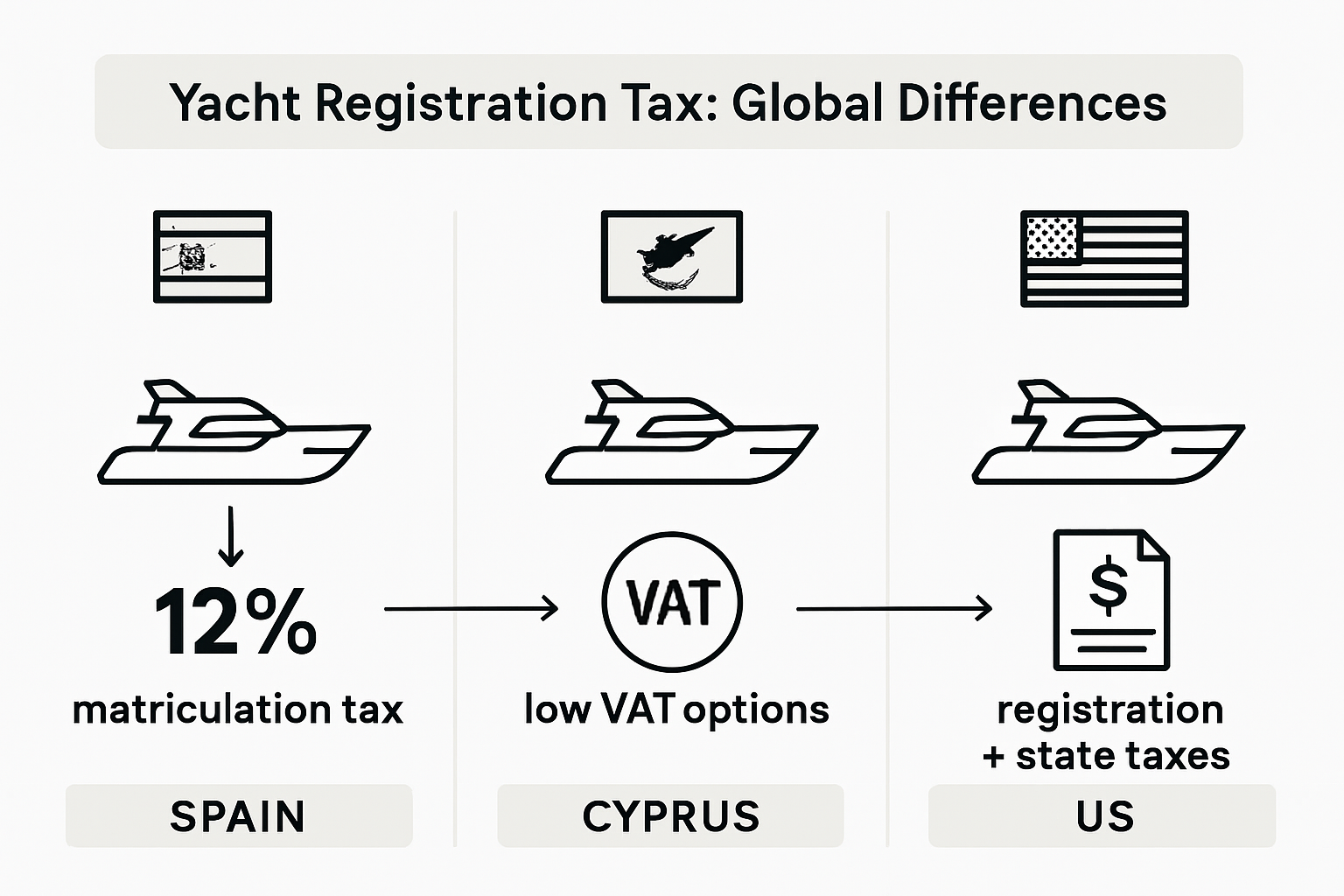
Tax structures vary significantly between countries. The tonnage tax system calculates fees based on a vessel's net tonnage rather than income, giving shipping companies predictable costs and encouraging registration.
Spain, for example, charges a 12% matriculation tax on vessels over 8 meters used by residents or commercially. Other countries use different approaches:
- Flat-rate registration fees
- Value-based percentage taxes
- Annual tonnage taxes
- Separate rates for commercial versus private vessels
These variations reflect each country's maritime policy goals and economic strategies. Langkawi's yacht registration shows how regions create customized taxation frameworks.
How Yacht Registration Tax Is Calculated

Calculation methods differ by jurisdiction. Malta's registration system considers vessel size, age, type, and intended use to determine tax amounts.
Key factors that influence calculations include:
- Vessel length and net tonnage
- Market value
- Age and condition
- Primary usage (commercial or private)
- Registration location
- Country of origin
Spanish regulations demonstrate value-based taxation with their 12% fee on larger vessels. Flag registration choices significantly impact your final tax bill.
Legal Requirements and Tax Compliance
Yacht owners must navigate complex international regulations. Foreign-flagged yachts in Spanish waters face specific obligations, including that 12% matriculation tax for resident-used or commercial vessels.
Compliance considerations include:
- Jurisdiction-specific tax requirements
- How residency affects tax obligations
- Proper documentation of vessel usage
- Accurate registration and financial records
- Monitoring changes in maritime tax laws
- Cross-border taxation implications
Cyprus offers favorable VAT schemes with rates as low as 3.4% under certain conditions. This shows why researching different jurisdictions pays off.
Costs, Exemptions, and Common Mistakes to Avoid
Total registration costs include base fees, tonnage assessments, value-related taxes, and ongoing compliance expenses. Flag registration choices determine these financial obligations.
Common mistakes yacht owners make:
- Overlooking jurisdiction-specific rules
- Poor documentation of vessel usage
- Misunderstanding residency tax impacts
- Ignoring cross-border requirements
- Inadequate financial record-keeping
- Assuming taxes are uniform everywhere
Smart tax planning means identifying exemptions, maintaining clear documentation, and consulting maritime tax specialists. Yacht registration services can guide you through these complex requirements.
Get Expert Help with Yacht Registration Tax
Yacht registration tax doesn't have to be overwhelming. Whether you're dealing with tonnage calculations, residency obligations, or choosing the right flag jurisdiction, professional flag registration services can simplify the process.
Visit Vesselflag.com for clear pricing, fast processing, and expert guidance on global maritime regulations.
Frequently Asked Questions
What is yacht registration tax?
It's a government fee vessel owners pay to legally document maritime property ownership, providing proof of ownership and access to international maritime regulations.
How is yacht registration tax calculated?
Calculations vary by jurisdiction but typically consider vessel size, age, type, usage, and market value. Some regions charge fixed fees while others use percentage-based taxes.
What mistakes should I avoid with yacht registration tax?
Common errors include overlooking local tax rules, poor usage documentation, misunderstanding residency impacts, and inadequate financial record-keeping.
Are there exemptions for yacht registration tax?
Exemptions vary by jurisdiction and may depend on intended use, residency status, or other criteria. Consult maritime tax specialists to identify potential exemptions.