A yacht survey exemption is a flag administration’s permission to skip a specific mandatory survey or certificate, usually because of the vessel’s size, use or waters of operation. It is not a blanket waiver. Exemptions are narrow, written into each flag’s own rules, and almost always come with conditions, a duty to notify changes and other certificates that still apply. This guide explains how exemptions work, how they differ from a voluntary pre-purchase survey, how flags handle them, and what to check before you rely on one.
TL;DR
- A survey exemption is a regulator’s permission to skip a required survey. A pre-purchase survey is something a buyer chooses to commission. They are different things.
- Exemptions are set flag by flag. Australia, Malta, the Cayman Islands and San Marino all handle them differently, and none treats an exemption as a free pass.
- Even an exempt yacht usually keeps other duties: registration documents, tonnage certificates, COLREG and MARPOL compliance, and notifying the regulator when something changes.
- Breaking an exemption’s conditions can be an offence, and the approval can be revoked.
- Get the exemption in writing from the flag, and keep your insurer and buyer in the loop.
Table des matières
- What a survey exemption actually is
- Who typically qualifies
- How exemptions differ by flag
- What still applies when you are exempt
- What happens if you operate outside the exemption
- Survey, exemption and the sale of a yacht
- Our perspective
- Choosing a flag with the survey question in mind
- How we can help
- FAQ
- Sources
What a survey exemption actually is
Two different ideas get mixed up under the word “survey”.
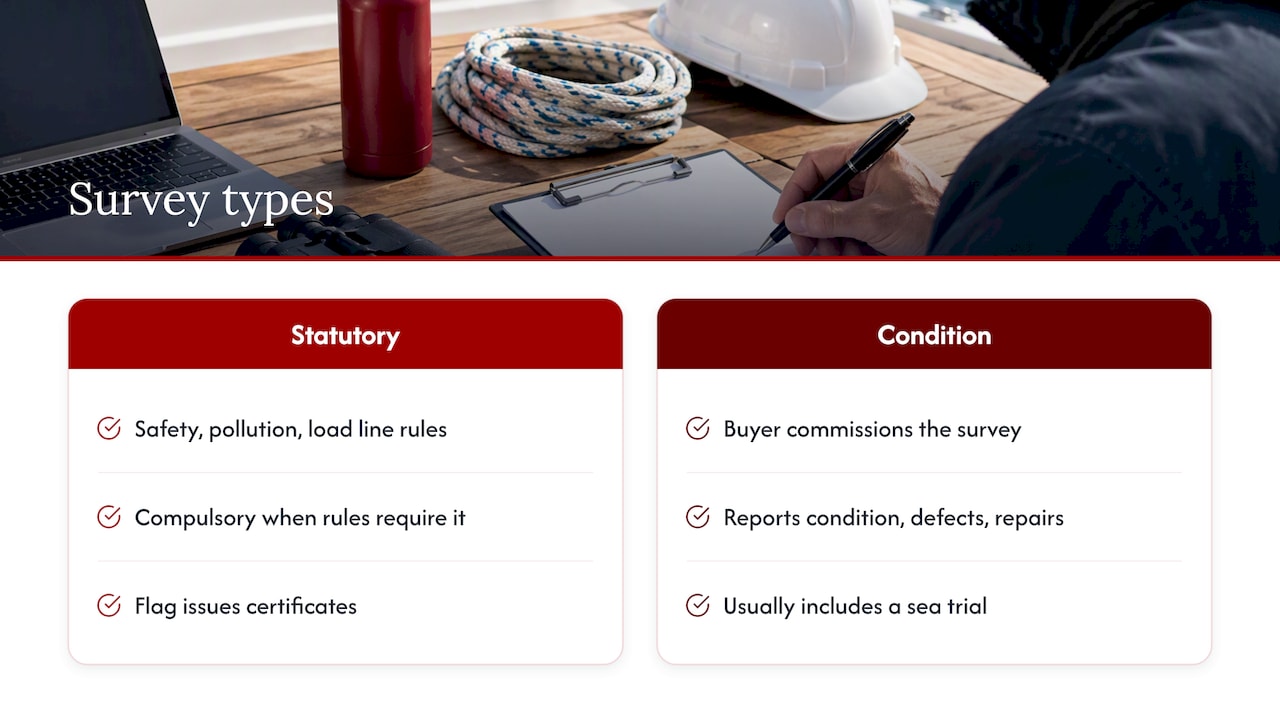
The first is the statutory survey. A flag state, or a recognized organization acting for it, inspects the vessel against the safety, pollution and load line rules that apply to it, then issues certificates. This is compulsory when the rules say it is. An exemption removes, or modifies, one of those requirements for a defined class of vessel or a defined situation.
The second is the condition survey, often called a pre-purchase survey. A buyer commissions it, and it reports the boat’s condition, defects and repair recommendations. These surveys usually inspect the vessel comprehensively and, in most cases, include a sea trial. No flag exempts you from this in any legal sense, because no flag requires it. It is a commercial decision, and it works for you, not for the regulator.
This distinction matters in practice. A yacht can be fully exempt from a statutory survey and still be a bad purchase. Equally, a clean condition survey does not substitute for a certificate the flag requires.
Who typically qualifies
Exemptions follow a logic that is the same almost everywhere, even though the thresholds differ: smaller, simpler, lower-risk vessels get lighter treatment.
The clearest published example comes from Australia. Under the Australian Maritime Safety Authority’s Exemption 02, eligible domestic commercial vessels include tenders, certain vessels operating only in sheltered waters, human-powered vessels and certain sailing vessels. Many of these need no formal approval document, though some classes must apply and pay a fee. The underlying instrument allows operation without a Certificate of Survey if the vessel meets predefined conditions or receives specific regulatory approval.
Three factors decide eligibility under most regimes:
- Size. Length and tonnage thresholds are the first filter. Many safety codes have a 24 metre line, and the rules change on either side of it.
- Use. Private pleasure use is treated differently from charter or other commercial activity. Whether a yacht counts as private or commercial depends on how it is used, not on how it is paid for, which we cover in our piece on private versus commercial yacht registration.
- Operating area. Sheltered or coastal waters are lower risk than ocean passages, and some regimes reflect that.
Note that the Australian example concerns domestic commercial vessels. A US or European owner of a private yacht will not be reading the same instrument, so use it to understand the logic, not as your own rulebook.
How exemptions differ by flag
There is no single international exemption. The SOLAS convention sets the framework, and the administration’s responsibility to guarantee the completeness and efficiency of surveys remains absolute, even when it delegates the work to recognized organizations. Each flag then decides how much to waive and how.
| Pavillon | How exemptions work | What stays in force |
|---|---|---|
| Malte | Under the Commercial Yacht Code, an exemption request for a specific requirement must be reviewed and accepted by the Administration | A monitoring, audit and enforcement programme covers inspections delegated to recognized organizations and appointed surveyors |
| Îles Caïmans | Yachts under 24 metres not engaged in trade follow a lighter track | COLREG and MARPOL still apply, and a Cayman Certificate of Survey and Tonnage Certificate are required |
| Saint-Marin | Large yacht safety code with owner responsibility for upkeep | The owner is responsible for proper maintenance, survey and certification under the Code |
| Royaume-Uni | Registration of a pleasure vessel is optional for a UK national keeping the boat in UK waters | Registered pleasure vessels of 24 metres and over need a Certificate of Registry, Certificate of Measurement and International Tonnage Certificate |
| Australie | Exemption 02 for certain domestic commercial vessels | Conditions of the exemption, plus an offence for breaching them |
The pattern is consistent. An exemption is requested, reviewed and conditional. Where it is automatic, it is automatic only for a precisely defined class.
Malta: exemptions are case by case
Malta’s approach is the most explicit for larger yachts. The Commercial Yacht Code lets an owner ask to be excused from a particular requirement, but the request is reviewed by the Administration, and acceptance is what makes it valid. Nothing is assumed. If you register a charter yacht in Malta and want to depart from a Code requirement, you make the case for the specific item, usually with equivalent safety arrangements.
If Malta is on your shortlist, our Enregistrement d'un yacht à Malte page sets out the process and published fees, and our guide to the Malta radio license for yachts covers the MMSI paperwork that often trips owners up.
Cayman: smaller private yachts, still certificated
The Cayman Islands draws the line at 24 metres for yachts not engaged in trade. Below it the regime is lighter, yet the owner still must comply with COLREG and MARPOL and obtain a Cayman Certificate of Survey and a Cayman Tonnage Certificate. In other words, a “lighter” category still involves survey and certification. It is a reduction in scope, not an absence of it.
San Marino: the owner carries the responsibility
San Marino’s Large Yacht Safety Code puts the duty on the owner for proper maintenance, survey and certification. Its Load Line, SOLAS and MARPOL certificates are valid for five years, with no extension beyond that period. That hard stop is a good reminder that any exemption or equivalence you obtain should be tracked against a renewal calendar.
United Kingdom: registration itself is optional for many
For a UK national keeping a pleasure vessel in UK waters, registration is not compulsory. A yacht under 24 metres that does register gets a Certificate of Registry under Part I or Part III. At 24 metres and over, the paperwork grows: a Certificate of Registry, a Certificate of Measurement and an International Tonnage Certificate, plus a signed Declaration of Antifouling Systems. Above 400 GT, record books and management plans are added. So the UK shows exemption working as a threshold, with more documents as the yacht gets bigger.
Owners who want the UK flag for a yacht used internationally will find the steps on our UK Part 1 yacht registration page.
What still applies when you are exempt
Owners often hear “exempt” and stop reading. Before you do, check this list.
- Collision and pollution rules. COLREG and MARPOL follow the yacht, as the Cayman example shows.
- Registration and tonnage documents. Exemption from an inspection rarely removes the need for a Certificate of Registry or a tonnage certificate.
- Maintenance duty. In San Marino, the owner stays responsible for keeping the yacht in survey and certification as the Code requires.
- Radio and identification. A licensed MMSI and correct call sign are independent of survey status.
- Notification of change. Under the Australian framework, owners of non-survey vessels must notify the regulator of changes such as transfer of ownership, alterations or modifications to operation, because these can invalidate the exemption or require reassessment.
That last point catches more owners than any other. A yacht exempt as a private vessel can lose that status the moment it starts earning charter income. A refit that changes the vessel’s length, engines or intended area can do the same.
What happens if you operate outside the exemption
The consequences are concrete. In Australia, breaching an exemption condition is an offence, and the National Regulator may revoke an approval. Under SOLAS, if corrective action is not taken, the relevant certificate should be withdrawn and the Administration notified immediately.
In practice, you meet the consequence in a port, not in a courtroom. A port state inspector asks for certificates, finds a document that does not match the yacht’s use, and the vessel is held. For a charter yacht that means cancelled bookings. For a yacht being sold, it means a buyer’s surveyor finds the problem and the price drops. Insurers can also treat undisclosed non-compliance as a reason to contest a claim, so tell yours what exemption you rely on.
Survey, exemption and the sale of a yacht
Buyers and brokers should keep the two ideas apart. If a yacht is statutorily exempt, a buyer still has every reason to commission a condition survey, and many insurers ask for one on older vessels. A seller who says “the flag does not require a survey” has told you something about regulation, not about the hull.
A few practical habits help the survey go smoothly, whoever orders it:
- Have the exemption or equivalence letter available, not only the certificate it relates to.
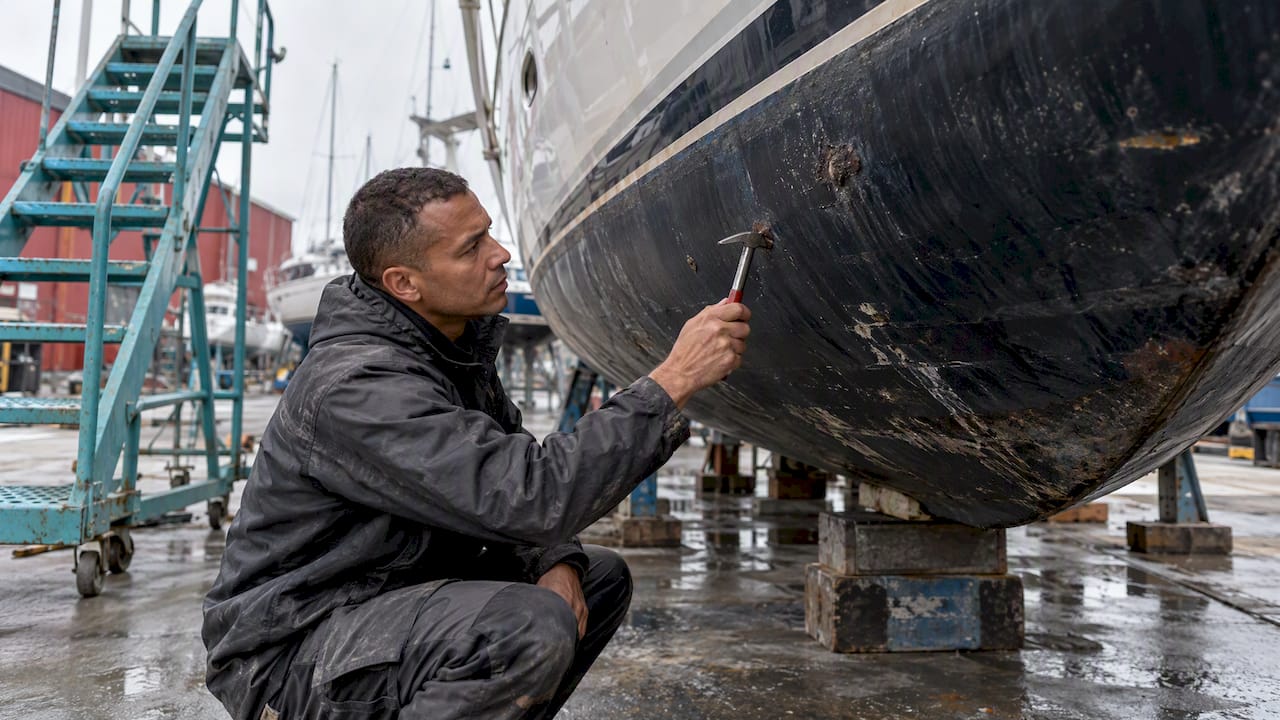
- Schedule the haul-out for when the hull is accessible, and clean the hull ahead of the haul-out so the surveyor can see the real surface rather than growth.
- Collect maintenance records, previous survey reports and engine hours before the surveyor arrives.
- Confirm which flag’s rules the vessel will be assessed against. A move between flags can change the answer.
Owners moving a yacht from one registry to another should also plan the paperwork around the change: a Transfer of Ownership is 630 EUR and a Deletion Certificate is 220 EUR through our Langkawi service, and foreign-language documents may need translation, covered in our guide to yacht document translation for registration.
Our perspective
We handle registrations across six major registries every day, and the same misunderstanding comes up again and again: owners treat the flag choice and the survey question as separate. They are not. The flag decides which survey regime applies, how much of it can be waived, how long certificates last and who inspects.
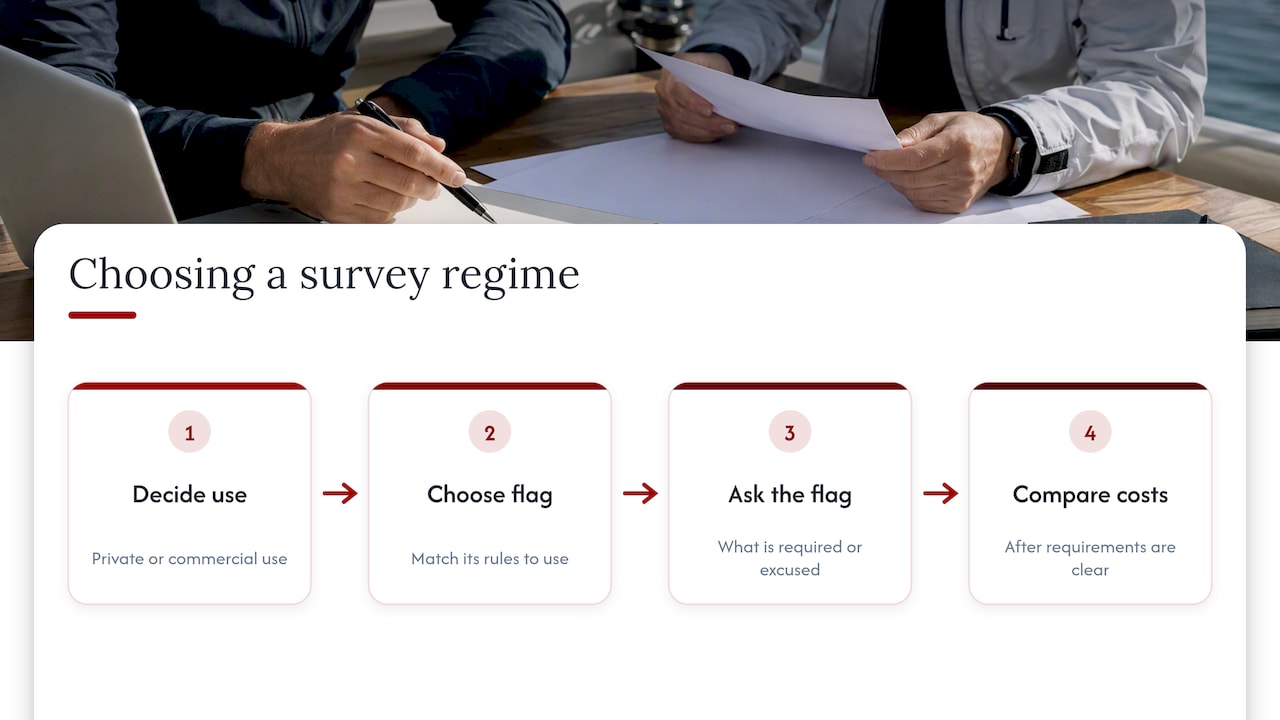
Our advice is to work in this order. First, decide how the yacht will be used, private or commercial, now and in the next two or three years. Second, pick the flag whose rules fit that use. Third, ask that flag, in writing, what is required and what can be excused. Only then compare costs. A cheaper registry that forces a survey you did not budget for is not cheaper, and our five-year cost comparison of San Marino and Poland shows how running costs shape the real figure.
We would also say that a provisional registration, which we can often arrange within one to seven days, is not a reason to skip the survey conversation. It gets you flying a flag quickly. It does not make an exemption appear.
— VesselFlag
Choosing a flag with the survey question in mind
Use these criteria when you compare registries:
- Vessel length and tonnage. Check which side of the 24 metre and 400 GT lines your yacht sits on.
- Use. Private pleasure, occasional charter or full commercial use change the regime.
- Cruising area. Ask whether the flag’s lighter track assumes limited waters.
- Certificate validity. Five-year certificates need a renewal plan.
- Delegation. Find out whether the flag uses recognized organizations or appointed surveyors, and what that costs you.
- Exemption process. Is it automatic, or by application, and how long does a decision take?
How we can help
We register yachts and boats under San Marino, Poland, UK Part 1, Malta, Palau, Langkawi, and also Dutch, Gibraltar and Panama flags, and we manage the paperwork from application to provisional certificate. Published one-off fees run from 290 to 2990 EUR for San Marino, 320 to 550 EUR for Poland, 550 to 1050 EUR for UK Part 1, 780 to 2420 EUR for Malta, 705 to 4600 EUR for Palau and 870 to 1320 EUR for Langkawi, depending on the vessel and package. If you are unsure which flag fits your yacht’s use, we will tell you before you pay.
Tell us the yacht’s length, use and cruising area on our services page, and we will point you to the registry and survey route that fits.
FAQ
Does an exempt yacht still need a pre-purchase survey?
Not legally, because no flag requires a buyer’s condition survey. It is still wise, since it reports condition, defects and repair recommendations for the buyer and usually includes a sea trial. Insurers often ask for one on older vessels.
Is a survey exemption the same in every country?
No. Each flag sets its own thresholds and process. Malta reviews requests case by case, the Cayman Islands uses a 24 metre line for yachts not in trade, and Australia has a defined exemption for certain domestic commercial vessels.
Can I lose an exemption?
Yes. Changes such as a transfer of ownership, an alteration or a change in how the vessel operates can invalidate it or require reassessment. Under Australia’s framework, breaching conditions is an offence and an approval can be revoked.
Does the 24 metre limit mean no survey below it?
No. In the Cayman Islands, yachts under 24 metres not engaged in trade still need a Certificate of Survey and a Tonnage Certificate. The threshold changes the regime, not whether certificates exist.
Sources
- Everything you need to know about yacht surveys, Motor Boat & Yachting
- Non-survey vessel approval or exemption, AMSA
- Marine Safety (Certificates of survey) Exemption 2025, AMSA
- Commercial Yacht Code 2025, Transport Malta
- Yacht Survey and Audit Certification, Cayman Islands Shipping Registry
- San Marino Large Yacht Safety Code
- SOLAS Chapter I
- MGN 599 (M) Amendment 1, Pleasure vessels, GOV.UK
- UK hull cleaning steps and timing, Diamondbrite