
Your yacht owes U.S. import duty the moment it becomes part of U.S. commerce, but arrival alone doesn’t trigger that. A Cruising License under 19 CFR 4.94 or proof of prior duty payment can defer or eliminate the bill entirely. Either way, the first move is the same: report your arrival to CBP under 19 U.S.C. 1433 and hold onto every document that proves your vessel’s status.
En bref :
- Most pleasure yachts only owe U.S. import duty if they enter U.S. commerce with the intent to remain, which can be challenged if the vessel is for sale or charter within a year.
- A Cruising License allows foreign-flagged yachts to operate in U.S. waters for up to one year without formal entry or duty payment, provided they do not engage in trade or charter activities.
- Proper reporting upon arrival and documentation, including proof of foreign origin and ownership, are essential to avoid longer inspections, penalties, or duty reassessment.
- The baseline import duty rate is around 1.5 percent ad valorem, but additional duties from trade measures or origin can significantly increase the total cost.
- State taxes, such as Florida’s 6 percent sales and use tax, apply separately from federal duty and are owners’ responsibility regardless of duty status.
Table des matières
- Which Arrivals Trigger Yacht Import Duty in the USA?
- Cruising License and Temporary Admission: What They Actually Cover
- Reporting Your Arrival: The Steps That Keep You Compliant
- How Import Duty on Your Yacht Gets Calculated
- Don’t Forget State Taxes: The Florida Example
- What Happens When CBP Flags a Yacht
- When Foreign Flagging Makes More Sense Than Formal Import
- Sources
- FAQ
Which Arrivals Trigger Yacht Import Duty in the USA?
Importation, in customs terms, happens when a foreign vessel enters U.S. commerce with the intent to stay. For U.S. residents, there’s a working presumption that a yacht brought into the country is meant to remain here, which makes it dutiable unless the owner proves otherwise. Nonresidents get more slack, but the rules watch ownership as closely as they watch the vessel itself.
Customs rulings have gone after a common workaround: a foreign corporation set up mainly to hold title to a yacht. If that corporation is majority owned by U.S. residents and the vessel is essentially its only asset, CBP treats the boat as owned by a U.S. resident for duty purposes, corporate paperwork or not.
Intent matters just as much as ownership. Offer the yacht for sale or charter within a year of a duty-free entry, and you’ve effectively told CBP the vessel is part of U.S. commerce. That flips it into a dutiable event, retroactively.
In practice, the problem shows up most often at brokerage. A yacht changes hands, the new owner assumes duty was settled years ago, and nobody can produce a CBP Form 7501 proving it. Compare that to a returning U.S. resident who bought a boat abroad and sailed it home versus a foreign visitor stopping for six weeks. Same vessel, same waters, completely different duty exposure, all depending on residency and intent.
Cruising License and Temporary Admission: What They Actually Cover
A Cruising License lets a foreign-flagged yacht arrive, depart, and move through designated U.S. waters for up to one year without formally entering and clearing customs each time or paying duty on the vessel itself. It’s one of the most useful tools in 19 CFR 4.94, but it comes with one hard condition: the yacht cannot engage in trade or charter while operating under it.
To get one, owners typically need:
- An application filed with the CBP port director at the first port of arrival
- Proof of foreign registry and ownership
- Evidence that the owner’s home country grants reciprocal privileges to U.S.-flagged vessels
Violate the terms, chartering, offering the boat for sale, or using it commercially, and CBP can revoke the deferral outright, exposing the owner to duty on the full value of the yacht.
Conseil de pro : Keep the Cruising License itself, along with registration papers and any charter agreements (or lack thereof), physically on board at all times. CBP officers checking a vessel mid-cruise won’t take your word for it.
Reporting Your Arrival: The Steps That Keep You Compliant
Skipping the reporting step is the fastest way to turn a routine arrival into an enforcement problem. Here’s the sequence that keeps you on the right side of it:
- Determine entry type. Vessels staying under 90 days for display, testing, or a non-commercial race can often skip formal entry. Longer stays typically require a bond or a full consumption entry within 48 hours.
- Check the vessel user fee. Documented pleasure vessels 30 feet or longer generally owe an annual CBP user fee, with some exemptions for decal holders and specific entry types.
Miss step one, and everything downstream gets harder. Yachts that arrive without reporting properly tend to face longer inspections and more paperwork demands later.
How Import Duty on Your Yacht Gets Calculated
Pleasure yachts fall under HTS 8903, and the baseline duty for most vessels in this classification runs around 1.5% ad valorem. That’s the starting point, not the final number.
Country of origin changes everything. Many trading partners actually carry a 0% most-favored-nation rate on HTS 8903, but Section 301 and Section 232 measures can stack additional duties on top depending on where the yacht was built. Skipping this check before you estimate landed cost is one of the most common ways owners get blind sided.
Duty is also just one line item. Landed cost typically includes:
- Merchandise Processing Fee (MPF)
- Harbor Maintenance Fee (HMF), where applicable
- Customs broker fees for filing the entry
Example, illustrative only: A yacht valued at $2,000,000, built in a country with 0% MFN treatment and no additional origin-based measures, would owe roughly $30,000 in baseline duty at 1.5% ad valorem, before MPF, HMF, and broker costs. Change the country of origin, and that number can move substantially.
Don’t Forget State Taxes: The Florida Example
Clearing federal duty doesn’t mean you’re done. States tax vessels used or stored within their borders, separately from anything CBP collects, and owners are on the hook to self-report when tax wasn’t collected at the point of sale.
Florida is the clearest example. The state applies a 6% sales and use tax to boats used or stored there, with specific caps and exemptions depending on the transaction. A yacht that sails through federal customs duty-free can still generate a real state tax bill the moment it’s docked in Florida for any length of time.
A basic compliance checklist for state-level obligations:
- Register the vessel with the state where it will be based or stored
- Remit use tax directly to the state if it wasn’t collected at purchase
- Keep receipts, the CBP entry documentation, and proof of any prior tax paid in another jurisdiction
What Happens When CBP Flags a Yacht
Most enforcement problems trace back to three mistakes: failing to report arrival, structuring ownership through a shell corporation to dodge residency presumptions, or offering a duty-free yacht for sale or charter too soon. CBP catches these through routine inspections, brokerage sale records, and cross-referencing registration data.
The consequences scale with the violation. Owners can face duty reassessed against the full value of the vessel, seizure, or monetary penalties layered on top of back duty under HTSUS and CFR enforcement provisions.
If your vessel gets flagged, move fast: assemble every ownership and entry document you have, and bring in a customs broker or maritime attorney before responding to CBP. Waiting rarely helps.
When Foreign Flagging Makes More Sense Than Formal Import
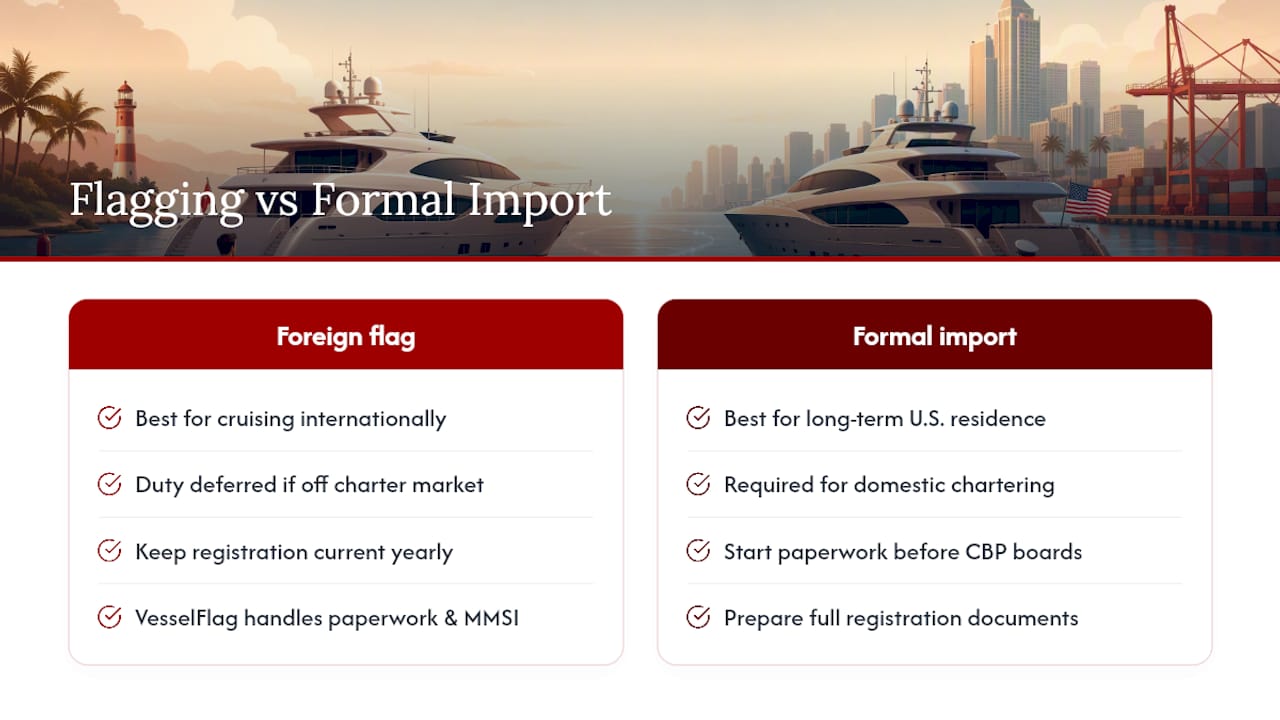
Not every yacht owner should be racing to file a formal entry. If you’re cruising internationally and only touching U.S. waters occasionally, a Cruising License paired with a foreign flag usually beats importing outright, since it keeps duty deferred as long as you stay off the charter market.
Formal importation makes more sense when the yacht will live in the U.S. long term, especially if chartering domestically is part of the plan. Vesselflag typically works with owners at exactly this fork: helping decide which flag jurisdiction fits the cruising pattern, handling the paperwork trail CBP will eventually ask for, and coordinating MMSI and insurance details so the registration stays valid year over year.
Complex ownership structures or planned sale/charter arrangements are where this gets legally sticky. That’s the point to loop in a customs broker or maritime counsel before, not after, CBP asks questions.
Before you settle on a path, it helps to know what separates a boat registration from a full yacht registration under a foreign flag, since the two carry different duty and compliance implications depending on how you plan to use the vessel. Owners who decide formal U.S. import is the right call often start with a step-by-step registration guide to line up the paperwork before CBP gets involved. For yachts that will stay under foreign flag while cruising U.S. waters seasonally, keeping the registration current across jurisdictions matters just as much as the initial filing. And if the vessel needs a fresh coat of attention below the waterline before any of this paperwork starts, a proper hull cleaning schedule before arrival avoids inspection delays tied to visible marine growth.
The rules reward owners who plan ahead of arrival, not after it. A yacht’s duty status is decided by intent and documentation long before CBP ever boards it.
— VesselFlag
This article is general information, not a substitute for advice from a qualified financial advisor. Consult a qualified financial professional about your own circumstances before acting on anything here.
Sources
FAQ
Does Every Yacht Entering the USA Owe Import Duty?
No. A yacht only owes duty when it enters U.S. commerce with intent to stay, and mechanisms like the Cruising License under 19 CFR 4.94 let foreign-flagged yachts cruise U.S. waters for up to a year without triggering it.
What’s the Baseline U.S. Import Duty Rate for Yachts?
Most pleasure yachts classified under HTS 8903 carry a baseline rate around 1.5% ad valorem, though origin-based measures like Section 301 or 232 can add significantly more depending on where the vessel was built.
Do I Still Owe State Tax if My Yacht Clears Federal Customs Duty-Free?
Yes. States tax vessels separately from federal duty. Florida, for example, applies a 6% sales and use tax on boats used or stored in the state, regardless of federal duty status.
What Happens if I Chartered My Yacht Under a Cruising License?
Chartering or offering the vessel for sale while under a Cruising License violates its terms and can retroactively make the yacht dutiable, potentially exposing the owner to duty on its full value plus penalties.
How Long Does a U.S. Cruising License Last?
A Cruising License issued under 19 CFR 4.94 is valid for up to one year from the date of issuance, provided the vessel avoids trade or charter activity during that period.