

Commercial vessel certification is the formal system of surveys, inspections, and official documents that prove a ship meets international and U.S. safety, environmental, and operational standards — covering everything from IMO conventions like SOLAS and MARPOL to domestic rules under 46 CFR enforced by the U.S. Coast Guard’s Office of Commercial Vessel Compliance (OCMI). Without valid certificates, a vessel can be detained by Port State Control, denied insurance coverage, or barred from commercial trade. This article walks through the U.S.-specific process, the certificates that matter most, and a practical owner checklist.
Table des matières
- Why does commercial vessel certification exist?
- What certificates and documents does your vessel need?
- How does the U.S. certification process work, step by step?
- Which vessels actually need commercial certification?
- Owner’s pre-certification checklist
- What happens when you get it wrong?
- When should you hire a specialist?
- Principaux enseignements
- The case for treating certification as an asset, not a burden
- Vesselflag makes certification coordination straightforward
- Useful sources and further reading
- FAQ
Why does commercial vessel certification exist?
Le USCG frames certification as a risk-management tool, not a paperwork exercise. Certificates are operational controls that prove a vessel is safe to carry passengers, cargo, or crew before it ever leaves the dock.
The core purposes break down like this:
-
Safety: Structural integrity, fire suppression, lifesaving equipment, and stability all require documented verification.
-
Security: ISPS Code compliance and International Ship Security Certificates protect ports and crew.
-
Environmental protection: MARPOL compliance covers oil discharge, garbage management, and air emissions.
-
Legal nationality: Flag State registration establishes which country’s law governs the vessel.
-
Commercial permissions: Coastwise trade, chartering, and passenger carriage each require specific certificates before they are lawful.
Enforcement comes from multiple directions. The IMO sets the conventions — SOLAS, MARPOL, Load Lines, Tonnage — and flag State administrations implement them. Port State Control officers then inspect vessels in foreign ports and can detain any ship whose certificates are missing, expired, or inconsistent with actual vessel condition.
What certificates and documents does your vessel need?
The specific certificates depend on ship type, voyage pattern, gross tonnage, and flag. The table below covers the principal documents U.S. commercial vessel owners encounter.
| Certificate | Purpose | Typical Applicability | Issuing Authority |
|---|---|---|---|
| Certificate of Inspection (COI) | Confirms vessel meets U.S. safety standards | U.S. domestic commercial vessels | USCG / OCMI |
| Certificat de tonnage international | Establishes gross and net tonnage | Vessels on international voyages | Flag State / RO |
| International Load Line Certificate | Sets maximum safe loading depth | Cargo/passenger vessels on international routes | Flag State / RO |
| Passenger Ship Safety Certificate | SOLAS compliance for passenger vessels | Passenger vessels operating internationally | Flag State / RO |
| Safety Management Certificate (SMC) | ISM Code compliance | Most vessels 500 GT+ internationally | Flag State / RO |
| International Ship Security Certificate (ISSC) | ISPS Code compliance | Vessels on international voyages | Flag State / RSO |
| MARPOL documents (IOPP, Garbage Mgmt. Plan) | Pollution prevention compliance | Varies by size and voyage | Flag State / RO |
Some documents are voyage- or equipment-based rather than vessel-class certificates. The Oil Record Book and Garbage Management Plan must be carried on board at all times and are subject to PSCO inspection — an officer can detain a vessel for incomplete record books just as readily as for a missing safety certificate.
How does the U.S. certification process work, step by step?
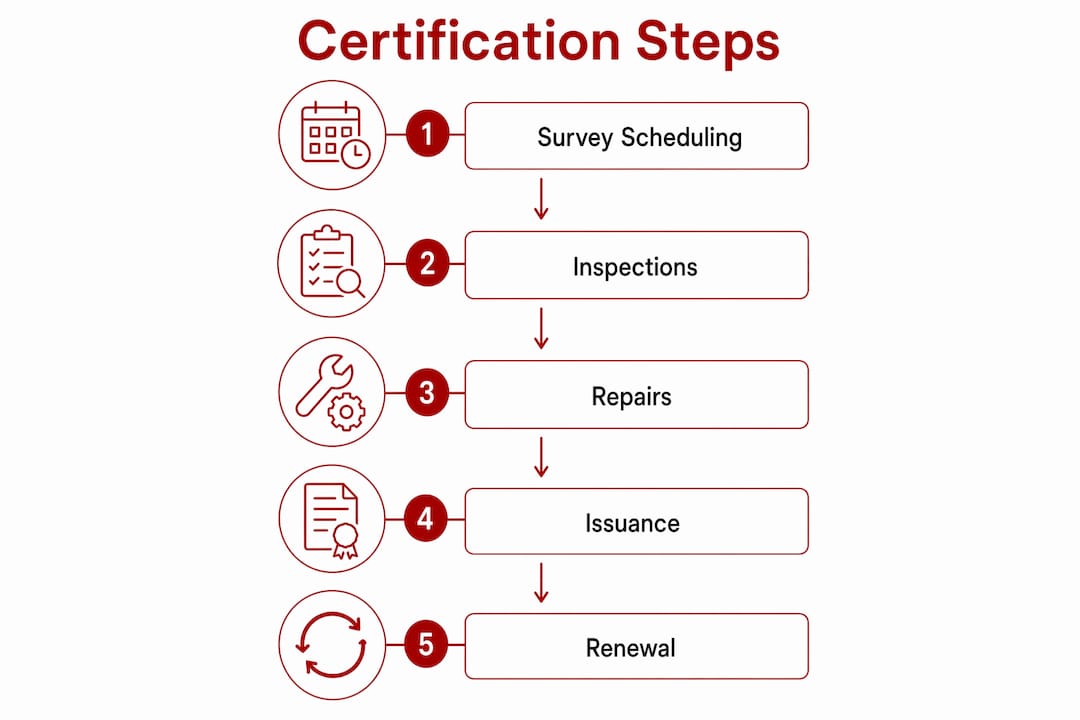
U.S. certification runs under 46 CFR through the USCG OCMI and typically results in a Certificate of Inspection for domestic commercial vessels, or acceptance of SOLAS-compliant international certificates for vessels operating internationally. Here is the practical sequence:
- Determine applicable subchapter. 46 CFR organizes vessel categories into subchapters (H, I, K, L, T, U, and others). Your vessel type and intended trade determine which subchapter governs your COI and inspection scope.
- Prepare pre-survey documentation. Gather your Certificate of Documentation, stability booklet, construction drawings, equipment manuals, and crew credentials before contacting the OCMI.
- Submit application to the OCMI. Applications go to the Officer in Charge, Marine Inspection, for your region. Certificates currently held are surrendered during inspection; exemptions from specific requirements can be requested from the Commandant.
- Complete surveys and inspections. The OCMI or an authorized Recognized Organization (RO) conducts hull, machinery, fire safety, and lifesaving equipment inspections. Deficiencies must be corrected before a certificate is issued.
- Receive and carry certificates. Once issued, certificates must be available on board. For vessels making international voyages, plan for both a domestic COI and the relevant SOLAS-compliant certificates — the two can overlap but neither replaces the other.
Timeline and cost factors: Survey scheduling is the biggest variable. Repairs identified during inspection add weeks. Vessels under 79 feet may use simplified measurement rather than formal tonnage measurement, which reduces administrative time. Classification society or RO fees vary by vessel size and scope of survey.
Which vessels actually need commercial certification?
Certification requirements turn on three axes: intended use, gross tonnage, and the waters the vessel will operate in. A vessel used purely for private recreation has no commercial certification obligation. The moment it carries passengers for hire, operates as a charter, or engages in coastwise trade, the picture changes entirely.
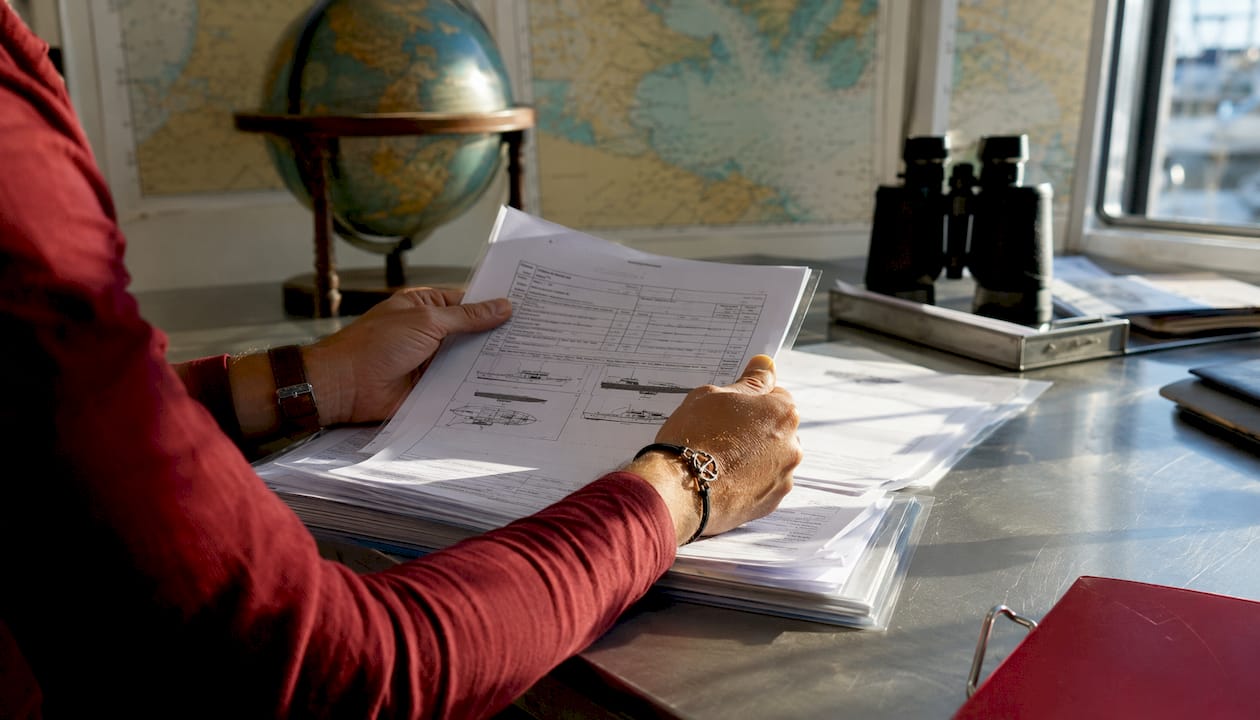
A charter yacht under 79 feet operating in U.S. coastal waters typically needs a COI under 46 CFR Subchapter T and must carry evidence of tonnage measurement — either a formal tonnage certificate or a completed CG-5397 simplified measurement application. A documented vessel engaged in coastwise trade needs its Certificate of Documentation to establish nationality and trade eligibility. A vessel making international voyages triggers SOLAS, MARPOL, and Load Line requirements regardless of its U.S. documentation status.
One persistent misconception: a Certificate of Documentation (COD) is not commercial certification. The COD establishes U.S. nationality, supports preferred mortgages, and qualifies a vessel for coastwise trade — but it says nothing about safety equipment, structural integrity, or environmental compliance. Those require separate certificates. See the role of registration documents for a fuller breakdown of how the two interact.
Owner’s pre-certification checklist
Before booking a survey, pull these together:
- Certificate of Documentation (COD) or state registration, confirming vessel identity and nationality
- Tonnage evidence: formal tonnage certificate, completed CG-5397 (simplified measurement), or Builder’s Certification (CG-1261) for vessels under 79 feet
- Crew certificates: STCW endorsements, OUPV or Master license as applicable, medical certificates
- Safety equipment inventory: current inspection tags on fire extinguishers, flares within date, life raft service records, EPIRBs registered and in date
- SMS/ISM documentation if the vessel is 500 GT or above or operates internationally
- Insurance documentation and MMSI/radio station license
- Stability booklet and any existing survey reports
Conseil de pro : Carry a completed CG-5397 or Builder’s Certification (CG-1261) on board before your inspection. Surveyors can verify tonnage on the spot without scheduling a separate measurement visit, which can shave days off your timeline.
Le maritime documentation checklist on Vesselflag’s site covers additional documents for owners preparing for international flag registration alongside U.S. certification.
What happens when you get it wrong?
Non-compliance rarely stays a paperwork problem for long. Port State Control officers board vessels in foreign ports and compare certificates against actual vessel condition. A missing MARPOL certificate, an expired life raft service record, or an Oil Record Book with unexplained gaps can each trigger a detention order — meaning the vessel cannot sail until deficiencies are corrected to the officer’s satisfaction.
Incomplete garbage or oil record books are among the most common triggers for PSCO action, partly because they are easy to check and partly because gaps suggest broader operational failures. Expired crew certifications are another frequent finding; a vessel with a valid COI but an unlicensed master is still out of compliance.
A detention order does more than delay your voyage. It creates a public record in the Paris or Tokyo MOU database, flags your vessel for enhanced scrutiny on future port calls, and can void your commercial insurance coverage for incidents that occur while certificates are invalid. Correct deficiencies before departure, not after a PSCO boards.
Le common pitfalls in yacht registration and compliance guide covers additional scenarios owners encounter when moving between flag jurisdictions.
When should you hire a specialist?
Hire a specialist when you lack direct experience with flag-specific survey requirements, formal tonnage measurement, or international certificate coordination. The complexity compounds fast: IMO notes that certification scope varies significantly by vessel size, tonnage, and voyage profile, and an unexpected survey finding mid-process can cost more in delays than a specialist’s fee would have.
A qualified registration and compliance provider adds real value in several areas: coordinating with ROs and classification societies, fast-tracking flag registration under jurisdictions that accept electronic certificates, setting up corporate ownership structures, and aligning insurance coverage with certificate status.
When evaluating providers, ask:
- Which flag administrations and ROs do you work with directly?
- Can you provide documented examples of prior certificate coordination for vessels of my type?
- Are your fees fixed or open-ended?
- Do you handle MMSI licensing and insurance coordination, or only registration?
Red flags: providers who cannot name the specific RO they use for a given flag, quote fees that shift after engagement begins, or offer no written record of prior work.
Principaux enseignements
Commercial vessel certification requires matching the right certificates to your vessel’s use, tonnage, and intended waters — then keeping them current.
| Point | Détails |
|---|---|
| COD ≠ commercial certification | A Certificate of Documentation proves nationality; safety and environmental certificates are separate and required. |
| U.S. process runs through OCMI | Applications go to the Officer in Charge, Marine Inspection; 46 CFR subchapter determines your certificate regime. |
| International voyages add layers | SOLAS, MARPOL, Load Line, and ISM certificates apply on top of any domestic COI for vessels going offshore. |
| Small vessels still have obligations | Vessels under 79 feet can use simplified measurement (CG-5397) but still must meet applicable safety standards. |
| Vesselflag coordinates the full process | Vesselflag handles flag registration, RO coordination, MMSI licensing, and insurance alignment for owners planning international operations. |
The case for treating certification as an asset, not a burden
Most owners approach certification the way they approach a dental appointment — something to get through, not something to get right. That framing is expensive. A vessel with clean, current certificates commands better charter rates, qualifies for broader insurance coverage, and moves through foreign ports without the enhanced scrutiny that follows a detention record.
The more interesting argument is about flag choice. U.S. owners who register under an international flag — San Marino, Malta, Palau, and others — gain access to flag administrations that often delegate surveys to well-regarded ROs with global networks. That can actually simplify the survey process compared to navigating OCMI queues for a vessel that spends most of its time outside U.S. waters. The catch is that the chosen flag’s RO must be accepted by the ports you intend to call, and your insurer must recognize the certificates the RO issues. Getting that alignment right before you commit to a flag is where specialist advice pays for itself.
Certification is not a one-time event either. Certificates carry validity periods — typically one to five years depending on type — and periodic surveys are required to renew them. Owners who treat the first survey as the finish line routinely find themselves scrambling when renewal comes due and the vessel has accumulated deficiencies that were never addressed.
Vesselflag makes certification coordination straightforward
Certification paperwork is manageable when you know exactly what you need. Vesselflag works with yacht and boat owners to handle enregistrement du drapeau under multiple international jurisdictions, coordinate with Recognized Organizations for survey scheduling, and manage MMSI licensing and insurance alignment in one place.
Owners planning international voyages get end-to-end support: corporate ownership setup, tonnage measurement guidance, certificate coordination, and ongoing compliance monitoring so renewals don’t catch you off guard. For owners comparing registration routes, the commercial vessel registration guide lays out timelines, costs, and flag options clearly. Contact Vesselflag to get a quote and confirm which certificates your vessel needs before your next survey.
Useful sources and further reading
These are the primary references for U.S. commercial vessel certification. Official sources govern; use them to verify current certificate requirements and renewal schedules before any survey.
| Source | Description | Best Used For |
|---|---|---|
| 46 CFR § 2.01-25 (Cornell LII) | U.S. federal regulation on required certificates and OCMI application process | Understanding which subchapter applies to your vessel |
| IMO Surveys and Certification | IMO overview of international certificate types and flag State issuance | Identifying required international certificates |
| IMO Survey Verification (ROs) | Guidance on Recognized Organizations authorized to survey and issue certificates | Choosing an RO and confirming flag State authorization |
| USCG CG-CVC | USCG Office of Commercial Vessel Compliance policy and standards | Enforcement context and U.S. compliance standards |
| USCG MSC Tonnage Brochure | Simplified measurement rules and CG-5397 guidance for vessels under 79 feet | Pre-survey tonnage documentation for smaller vessels |
| Vesselflag Compliance Guide | Practical checklist for owners preparing for surveys and international registration | Read before booking your first survey |
Check each official source directly for current certificate validity periods and renewal schedules — these are updated periodically and the version you read last year may not reflect current requirements.
FAQ
What is commercial vessel certification, exactly?
Commercial vessel certification is the process of obtaining official surveys and documents that prove a vessel meets applicable safety, environmental, and operational standards under IMO conventions and U.S. law (46 CFR). Certificates must be carried on board and are verified by Port State Control officers.
Who issues commercial vessel certificates in the United States?
The USCG Officer in Charge, Marine Inspection (OCMI) issues the Certificate of Inspection for U.S. domestic commercial vessels. For international certificates, flag State administrations or their authorized Recognized Organizations issue documents such as the International Tonnage Certificate and Passenger Ship Safety Certificate.
Does a Certificate of Documentation replace commercial certification?
No. A Certificate of Documentation establishes U.S. nationality and supports coastwise trade eligibility, but it does not satisfy safety, environmental, or SOLAS requirements. Those require separate certificates issued after inspection.
How long are commercial vessel certificates valid?
Validity periods vary by certificate type. A USCG Certificate of Inspection is typically valid for up to five years with periodic intermediate surveys. SOLAS-related certificates generally run one to five years depending on vessel category and flag State rules.
When should a yacht owner hire a registration specialist?
Hire a specialist when your vessel will operate internationally, when you are registering under a foreign flag, or when you are unfamiliar with which RO surveys are accepted by your intended ports and insurers. Vesselflag coordinates flag registration, RO selection, and certificate management for owners in exactly this situation.

[…] handles MMSI radio licensing and pairs it with broader vessel compliance work, which matters most for owners managing multiple flags, fleets, or an international cruising […]
[…] Commercial Vessel Certification: What U.S. Owners Must Know […]