

Yes, San Marino accepts commercial yacht registration, and the process runs on three pillars: a resident agent for non-resident owners, a clean documentation package built around Form 01, and an initial Flag State Inspection completed before your provisional registration expires. Owners need a bill of sale, proof of prior deletion if applicable, and a radio license application (Form 03). The fastest next step is gathering those core documents and contacting a resident agent, or a registration partner like Vesselflag, to open the provisional file.
En bref :
- Registration for yachts over 24 meters requires a Recognised Organisation survey, which can take several weeks depending on vessel location and surveyor availability.
- Non-resident owners must appoint a San Marino Resident Agent and provide updated corporate documents, including a company extract no older than six months.
- The registration process involves submitting core documents like Form 01, bill of sale, and owner identification, with delays often caused by incomplete paperwork or outdated certificates.
- Survey scheduling and inspection timing are the main bottlenecks, not the administrative process or registration fees.
- Using a professional service can reduce paperwork processing time by around 30 percent and streamline coordination with surveyors and authorities.
Table des matières
- What Types of San Marino Commercial Yacht Registration Exist?
- Why Register a Commercial Yacht Under the San Marino Flag?
- What Documents Do I Need to Register a Commercial Yacht?
- Who Can Register, and What Does a Resident Agent Do?
- When Do Inspections and Recognised Organisations Come Into Play?
- How Does the Registration Process Actually Work Step by Step?
- How Vesselflag Supports Your San Marino Registration
- Where to Verify San Marino’s Commercial Registration Rules
- Get Your San Marino Commercial Yacht Registered Without the Paperwork Headache
- Sources
- FAQ
What Types of San Marino Commercial Yacht Registration Exist?
San Marino splits commercial vessels into two safety codes based on load line length, and which one applies determines almost everything downstream: survey requirements, certification pathway, and who signs off on your paperwork.
- Small Yacht Safety Code: covers commercial yachts under 24 meters load line length.
- Large Yacht Safety Code: applies to vessels 24 meters or greater, with stricter survey obligations.
- Passenger and cargo limits: under SMSR rules, commercial yachts in either category cannot carry more than 12 passengers or any cargo at the time of registration.
- Provisional registration: the starting point for almost every commercial applicant, valid while the flag state completes its inspection requirements.
- Permanent registration: issued once the initial Flag State Inspection and any required RO surveys are complete.
Vendors sometimes advertise one-year or multi-year registration windows, but the practical reality for most commercial owners is provisional first, permanent second. There’s no shortcut around the inspection step, no matter what the marketing copy implies.
Why Register a Commercial Yacht Under the San Marino Flag?
San Marino built its registry to be digital from the ground up, and that shows in how certificates move. The register issues e-certificates in line with SMSR’s streamlined administrative model, which cuts down on the paper chase that older flag jurisdictions still require.
- Digital, e-certificate based registration process.
- Yacht Safety Codes framed as equivalent arrangements under major conventions like Load Lines, SOLAS, and STCW, which keeps commercial certification internationally coherent.
- Competitive registry fees relative to comparable open registries.
- A workable fit for charter operations that need recognized statutory certification without the overhead of a legacy maritime bureaucracy.
The catch is that “streamlined” describes the registry’s own administrative steps, not the survey and inspection timeline, which depends on Recognised Organisation availability and your vessel’s category.
Conseil de pro : Don’t judge a flag jurisdiction by its fastest advertised timeline. Judge it by how quickly its Recognised Organisations can actually schedule your survey. That’s the real bottleneck.
What Documents Do I Need to Register a Commercial Yacht?
Missing paperwork is the single biggest cause of delay in commercial registration, and most of it traces back to a handful of predictable gaps. Here’s the priority order.
- Application Form 01 — the core registration application filed with SMSR.
- Bill of sale or builder’s certificate — proof of ownership and vessel origin.
- Deletion certificate from the previous flag state, if the yacht was previously registered elsewhere.
- Form 03 — application for the ship radio station license.
- Owner documentation — passports for individuals; for corporate owners, a company register extract and UBO details, with extracts no older than six months.
- Power of attorney, if a third party is filing on the owner’s behalf.
- Translated and notarized copies of any document not already in English or Italian.
- Prior statutory certificates (tonnage, CSR) when the vessel is transferring flags and those documents already exist.
Corporate owners get scrutinized harder than individuals here. Six-month-old company extracts are a real requirement, not a suggestion, and a document dated seven months back will bounce the whole submission back to you.
Who Can Register, and What Does a Resident Agent Do?
San Marino accepts owners of any nationality, and registration works for both individuals and companies. That openness is one reason brokers steer international clients toward the flag in the first place.
- Individuals and corporate entities both qualify for commercial registration.
- Non-resident owners must appoint a San Marino Resident Agent using Form 02, and this isn’t optional. SMSR classifies it as a mandatory legal requirement for anyone without a San Marino residence.
- The resident agent handles formal communications with the registry and covers local administrative duties an owner abroad simply can’t perform in person.
- Non-resident corporate owners need director lists and UBO documentation alongside the standard company extract, since San Marino applies extra scrutiny to entities without a local presence.
Appointing the agent before you submit anything else pays off. A good agent pre-checks your notarizations and translations, which means fewer applications bounce back for paperwork the registry considers incomplete.
When Do Inspections and Recognised Organisations Come Into Play?
Every commercial yacht under the San Marino flag faces an initial Flag State Inspection, and the timing matters more than owners expect. That inspection must happen on board before the provisional registration expires, and it often functions as the gatekeeper for permanent status.
- Yachts under 24 meters can generally rely on authorized surveyors within the Small Yacht Safety Code pathway.
- Vessels 24 meters or larger must use a San Marino-authorized Recognised Organisation for certification surveys, with no exceptions.
- RO selection and port availability directly affect how fast you move from provisional to permanent.
- Survey lead time for large yachts commonly runs two to six weeks depending on the RO and where the vessel is berthed.
Conseil de pro : Book your RO survey slot the moment your provisional registration goes through, not after. Waiting even two weeks to start that conversation can push your permanent registration back by a full survey cycle.
How Does the Registration Process Actually Work Step by Step?
The sequence rarely changes, but the pacing depends entirely on how prepared your paperwork is before you file.
- Prepare documents — Form 01, bill of sale, deletion certificate if applicable, and owner identification or corporate records.
- Appoint a Resident Agent if you’re a non-resident owner, filing Form 02 alongside your main application.
- Submit Form 01, Form 02, and Form 03 together with the registration fee payment.
- Receive provisional registration, which opens the window for arranging your inspection and survey.
- Complete the Flag State Inspection and any required RO survey, scheduled around vessel location and RO availability.
- Obtain permanent registration once inspection and survey results clear.
Vendor sites love to promote 48-hour provisional turnaround, and that figure isn’t necessarily false, but it describes the paperwork submission step, not the inspection and survey process that follows. Fee structures typically break into four buckets: the registry fee itself, the resident agent’s fee, RO or survey costs, and radio/MMSI licensing. Marketing pages that quote a single flat fee are frequently excluding the survey and RO line items entirely, which is where most of the real cost and time actually sits.
How Vesselflag Supports Your San Marino Registration
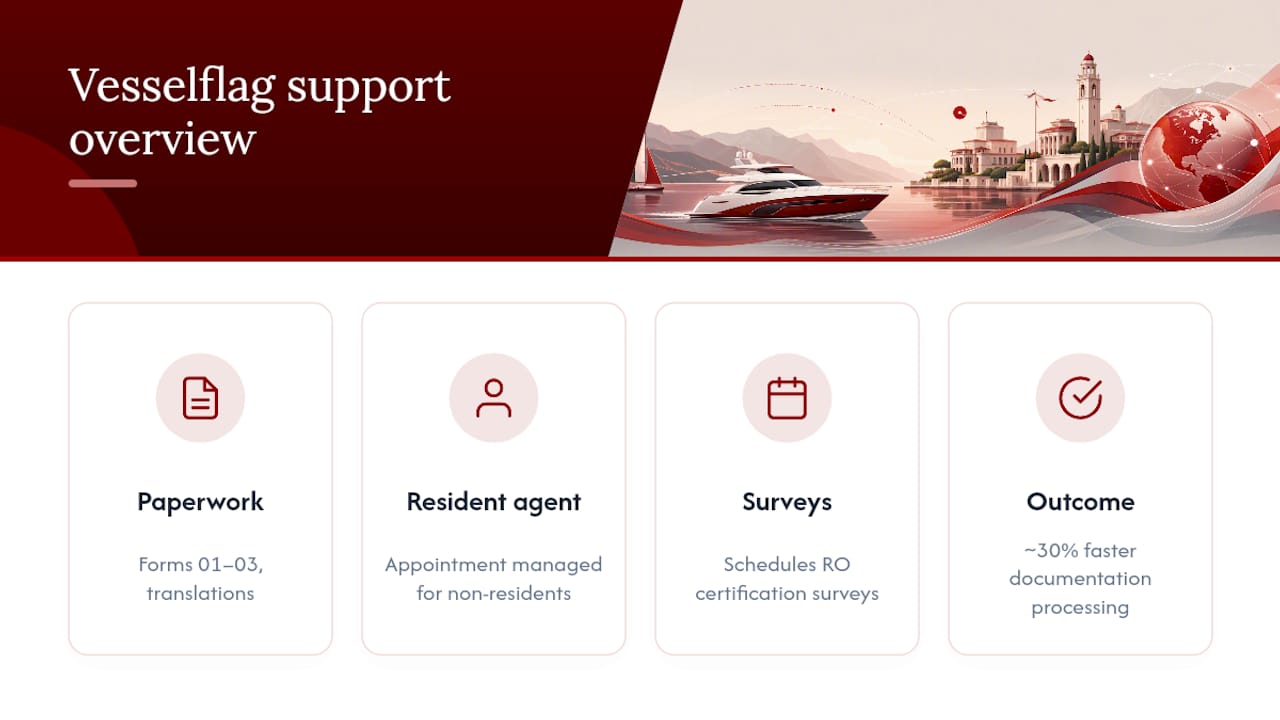
Paperwork is where most commercial registrations stall, not the law itself. Vesselflag handles Form 01, Form 02, and Form 03 preparation directly, coordinates translations for non-English or non-Italian documents, and manages the resident-agent appointment so a non-resident owner never has to chase local administrative contacts alone.
On the survey side, Vesselflag liaises with Recognised Organisations to schedule certification surveys around your provisional registration window, and handles MMSI and radio licensing as part of the same engagement. Internal process data shows that streamlined documentation workflows cut top yacht documentation processing time by roughly 30 percent compared to unmanaged submissions. Before reaching out, owners should have their bill of sale, any prior deletion certificate, and corporate extracts on hand. The first engagement typically delivers a document review checklist and a realistic provisional-registration timeline estimate.
— Vessel Flag
Where to Verify San Marino’s Commercial Registration Rules
For anyone who wants to check the legal detail directly rather than take a vendor’s word for it, three primary sources cover nearly everything.
- Le SMSR guide to commercial yacht registration explains safety code thresholds and RO requirements.
- The SMMAR 2025-ADM-005 registration guidelines PDF covers inspection timing and formal procedure.
- Le SMSR application procedure page lists the actual forms, including Form 02 for resident agents.
Get Your San Marino Commercial Yacht Registered Without the Paperwork Headache
Every step covered here, the forms, the resident agent requirement, the inspection scheduling, is manageable on your own, but it’s also exactly where most owners lose weeks to avoidable back-and-forth with the registry. Vesselflag exists to close that gap: a single point of contact that prepares your Form 01, Form 02, and Form 03 package, appoints your resident agent, and coordinates directly with Recognised Organisations so your survey slot doesn’t sit at the bottom of someone’s inbox.
If you’re a broker or owner ready to move from research to action, the fastest route is to register a commercial vessel through Vesselflag’s guided process, which starts with a document review against San Marino’s actual checklist rather than a generic template. Reach out with your bill of sale and ownership records in hand, and you’ll get a realistic provisional timeline back before you commit to anything.
Sources
- Guide to commercial yacht registration | Ship Register
- Yacht registration application procedure | Ship Register
FAQ
Can a Non-Resident Own a San Marino Commercial Yacht?
Yes. San Marino accepts owners of any nationality, but non-resident individuals and companies must appoint a San Marino Resident Agent using Form 02.
How Long Does Provisional Registration Last?
Provisional registration lasts until the initial Flag State Inspection is completed, which must happen before it expires and often gates permanent registration.
Do All Commercial Yachts Need a Recognised Organisation Survey?
Only yachts 24 meters or greater in load line length require certification surveys from a San Marino-authorized Recognised Organisation; smaller vessels typically use authorized surveyors instead.
What’s the Passenger Limit for a San Marino Commercial Yacht?
Commercial yachts under either the Small or Large Yacht Safety Code cannot carry more than 12 passengers or any cargo at the time of registration.
Can Vesselflag Handle the Entire Registration on My Behalf?
Vesselflag prepares Form 01, Form 02, and Form 03, coordinates resident-agent appointment, and liaises with Recognised Organisations, handling the documentation workflow end to end for owners.

[…] Tip: If your vessel needs RO sign-off, book that inspection early. A delayed survey is the single most common bottleneck owners run into, and it has nothing to do with insurance […]