

En bref :
- Maintaining a yacht’s classification significantly boosts its market value and access to commercial use. Suspended or withdrawn class can reduce resale value by at least 25 to 40 percent and limit insurance and financing options. Continual, clean class status is essential for higher valuation, easier sale, and international trading compliance.
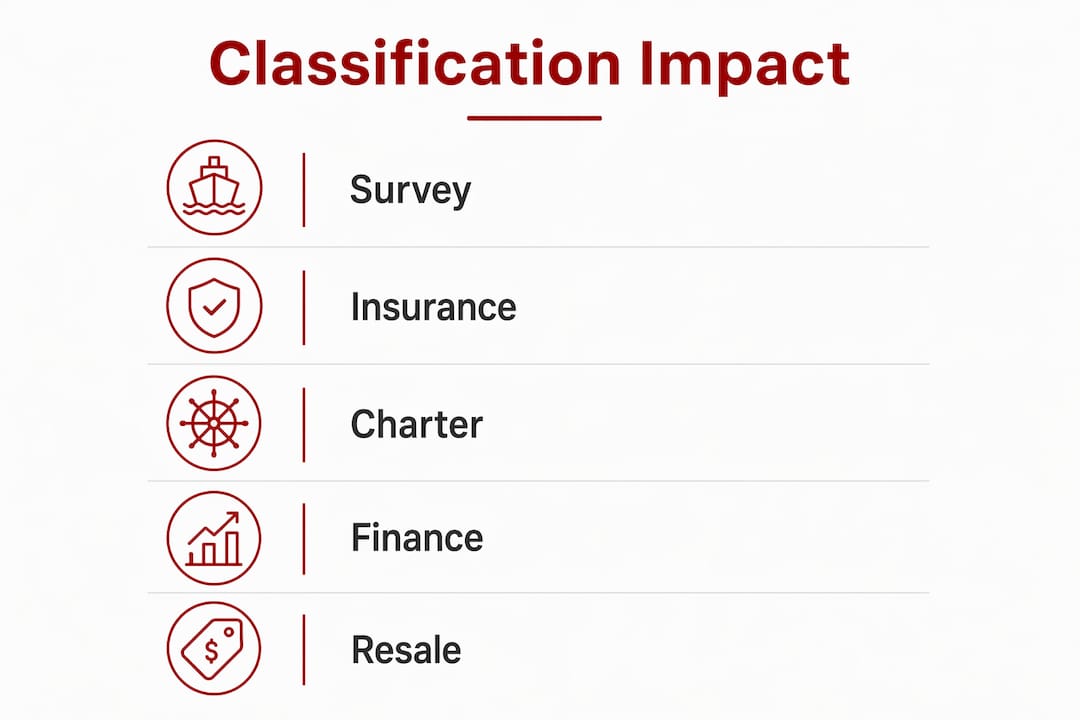
Classification materially increases a yacht’s market value, and the effect is not gradual. It is binary. Buyers, lenders, and underwriters treat class status as the first filter, not a nice-to-have detail buried in the survey file.
- Resale and valuation: A clean class record supports full market comparables; suspended or withdrawn class typically forces discounts of 25–40% or more.
- Insurance and lenders: Most commercial underwriters require class for hull and machinery coverage, and mainstream lenders treat class as baseline collateral hygiene before approving a marine mortgage.
- Charter and commercial eligibility: Class is the gate to commercial chartering. Without it, a yacht is restricted to private pleasure use regardless of its condition or age.
Table des matières
- How does classification actually affect yacht value?
- What classification does to insurance, charter, lenders, and resale
- When is classification effectively mandatory?
- What does classification cost, and how long does it take?
- How flag choice and classification interact for U.S. owners
- How brokers and appraisers treat classification in valuation reports
- Step-by-step checklist: how to class a yacht
- When can you skip classification, and what are the trade-offs?
- Principaux enseignements
- The part most owners get wrong about classification
- Vesselflag helps you register, classify, and stay compliant
- Useful sources and further reading
- FAQ
How does classification actually affect yacht value?
A classification society is an independent technical organization that writes the rules a yacht must be built and maintained to, and then verifies compliance across the vessel’s life. That verification produces the class certificate, which is the credential buyers, insurers, and lenders check first.
The five societies that dominate the superyacht sector are Lloyd’s Register (LR), DNV, Bureau Veritas (BV), RINA, and ABS. All five sit within the International Association of Classification Societies (IACS) and in 2024 formed the Yacht Safety and Environmental Consortium (YSEC). Classification is distinct from flag state registration. Your flag (Cayman, Malta, Marshall Islands) sets the regulatory regime; the class society writes and enforces the technical rules.
The class certificate is supported by three recurring outputs:
- Annual surveys: Confirm ongoing compliance with class rules.
- Intermediate surveys: Typically at 2.5 years, covering hull and machinery in more depth.
- Five-year special survey: The most comprehensive and costly lifecycle event.
What classification does to insurance, charter, lenders, and resale
Insurance premiums and coverage
Underwriters set hull and machinery (H&M) premiums based on class status, survey history, and any outstanding conditions of class. Classed vessels attract more favorable premiums and a wider choice of insurers. A lapsed or conditional class record compresses insurer appetite and can push a policy into the surplus-lines market at materially higher cost. Understanding how yacht insurance underwriting responds to class status is worth reviewing before any survey gap develops.
Charter and commercial use
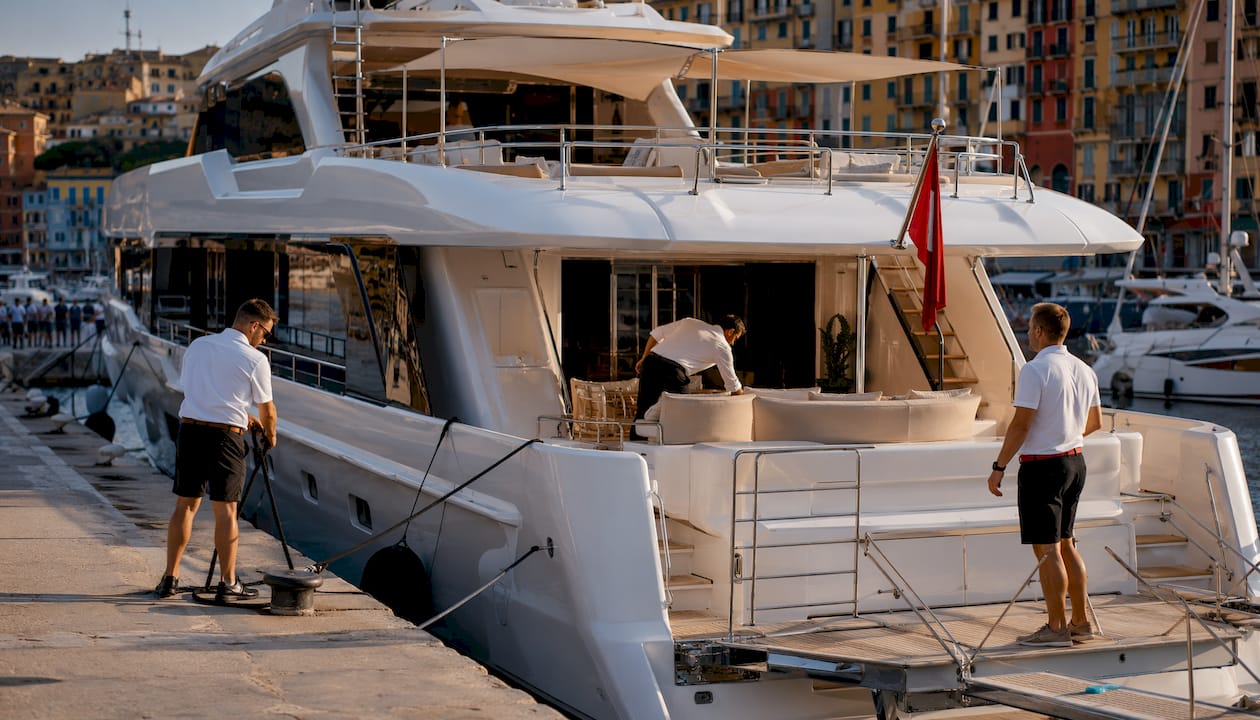
A yacht used for commercial chartering must be classed. Refitting a non-classed vessel to qualify for classification after the fact is generally more expensive than building or maintaining class from the start. The commercial yacht status threshold matters here: once a yacht crosses into commercial operation, class is not optional.
Lender and finance acceptance
Mainstream marine lenders treat class as collateral hygiene. A vessel without current class is difficult to finance on market terms. Charter-backed finance, where projected charter revenue supports the loan, is essentially unavailable without a valid class certificate.
Resale value
Lloyd’s Register’s global yacht segment director has stated that working with LR is claimed to add 5% to resale value. A clean class record supports full market comparables; conditions of class are visible in the survey file and priced in by every serious buyer. Suspended or withdrawn class typically forces discounts of 25–40% or more.
Conseil de pro : If you are selling a yacht with outstanding conditions of class, get a written cost estimate for rectification before listing. Buyers will discount for the uncertainty, not just the actual repair cost. A firm quote narrows that gap.
Operational flexibility
Class influences international trading, port acceptance, and refit requirements. Major refit work affecting hull scantlings, machinery, or fire integrity requires class oversight to preserve the certificate. Port state control (PSC) records are public and searchable, and multiple detentions can reduce valuation by a small margin independent of class status.
When is classification effectively mandatory?
As vessel size and operational ambition rise, classification shifts from optional to essential. The question stops being “Why class?” and becomes “Why not?”
Run through this checklist to decide:
- Length over 24 meters: Large yacht conventions and most flag-state codes make class the market norm at this threshold.
- Commercial charter plans: Class is required. No exceptions for mainstream insurers or charter brokers.
- Flag-state delegation: Many flags (including popular U.S.-owner choices like Cayman, Malta, and Marshall Islands) delegate statutory surveys to class societies. Without class, you carry those surveys separately at additional cost.
- Lender requirement: If you need a marine mortgage, confirm the lender’s class requirement before closing.
- International trading: Port state control inspections in the U.S., Europe, and Asia-Pacific check class certificates. Repeated PSC deficiencies compress value.
What does classification cost, and how long does it take?
The cost of achieving and maintaining class depends on vessel size, age, and condition at the time of initial survey. There is no single published rate, but the structure is consistent.
| Survey Type | Frequency | Relative Cost Weight | Notes |
|---|---|---|---|
| Annual survey | Every 12 months | Low | Condition check; minor items |
| Intermediate survey | ~30 months | Medium | Hull and machinery in depth |
| Five-year special survey | Every five years | Élevé | Drydock, full structural review |
| Docking survey | With special survey | Included in special | External hull, propellers, rudder |
The five-year special survey is the single largest scheduled financial event in a yacht’s operational life. Failing to plan for it leads to forced price concessions at sale, because buyers discount for upcoming survey costs they will inherit.
Conseil de pro : Maintain a dedicated reserve fund for the five-year special survey and align its timing with market conditions. Selling a yacht six months before a major survey due date, without the reserve to fund it, is one of the most common causes of forced-sale discounts.
How flag choice and classification interact for U.S. owners
Flag registration and classification are separate but interdependent decisions. Getting one right without considering the other creates regulatory mismatches and unexpected costs.
| Dimension | Flag State | Classification Society |
|---|---|---|
| Primary role | Legal jurisdiction, regulatory regime | Technical rules, construction and maintenance standards |
| Issues | Ship’s registry certificate, radio license | Class certificate, survey reports |
| Enforces | SOLAS, MARPOL, STCW, MLC | Society-specific construction and equipment rules |
| Delegates | Statutory surveys (often to class) | Nothing — class is the technical authority |
For U.S.-based owners operating internationally, the practical notes are:
- Popular flag choices (Cayman, Malta, Marshall Islands, and international flag options) all delegate statutory surveys to IACS class societies, which simplifies compliance.
- Switching from a non-IACS society to an IACS member typically lifts valuation and broadens insurer acceptance.
- Aligning flag, class society, and intended trading area before the first survey avoids re-survey costs later. The flag registration cost factors interact directly with class lifecycle expenses.
How brokers and appraisers treat classification in valuation reports
Valuers apply different methodologies depending on class state. A yacht in clean class is valued on market comparables. A yacht with conditions of class is discounted for the cost and uncertainty of rectification. Suspended or withdrawn class pushes the valuation toward scrap or forced-sale approaches, where the discount typically ranges from 25–40% or more.
A clean, current class record from LR or DNV commands a premium over lapsed or conditional class. Classification gaps are the single most common survey finding that compresses final price below asking.
Sellers should assemble this document package before listing:
- Current class certificate and society correspondence
- Full survey file (annual, intermediate, and special survey reports)
- Repair and rectification invoices tied to survey findings
- Port state control inspection history (USCG, Tokyo MOU, Paris MOU)
- Outstanding conditions of class with written cost estimates for closure
Step-by-step checklist: how to class a yacht
- Commission a class-gap survey. An independent surveyor assesses the vessel against the target society’s rules and produces a gap list with estimated rectification costs.
- Select a classification society. For U.S. owners, ABS, LR, DNV, BV, and RINA are the primary options. Consider your flag state’s preferred society and your intended trading area.
- Submit design plans and documentation. The society reviews hull, machinery, electrical, and safety system drawings before approving the classification scope.
- Complete rectification work under class attendance. A society surveyor attends the shipyard or refit facility to verify that gap items are closed to class rules.
- Pass the initial in-service survey. The society issues the class certificate once all items are cleared.
- Align flag registration with class status. Notify your flag registrar of the class certificate and confirm statutory survey delegation. Vesselflag can coordinate this step across multiple flag jurisdictions.
- Schedule ongoing surveys. Set calendar reminders for annual, intermediate, and five-year special surveys. Brief your insurer and lender on the survey schedule.
- Maintain the survey file. Keep all survey reports, repair invoices, and class correspondence in a single accessible file for buyers, lenders, and insurers.
When can you skip classification, and what are the trade-offs?
Smaller private yachts under 24 meters used exclusively for pleasure are the most common case where owners forgo class. CE marking (for European-built vessels) and ABYC standards provide baseline safety validation, but neither is a substitute for the lifecycle assurance that class delivers.
The trade-offs are concrete:
- Insurance: Most commercial underwriters restrict coverage or decline to quote without class. Private pleasure policies may still be available, but coverage limits and exclusions are typically broader.
- Chartering: No class means no commercial charter, period.
- Resale: Buyers at the 24-meter-and-above market expect class. Below that threshold, the discount varies, but an independent condition survey and clear buyer disclosure are the minimum risk mitigation.
If you skip class, document everything: independent condition surveys, maintenance logs, and repair invoices. Buyers and their surveyors will look for evidence that the vessel has been maintained to a standard, even without a class certificate.
Principaux enseignements
Classification is the single most consequential credential in yacht valuation: in-class vessels support full market comparables, while suspended or withdrawn class forces discounts of 25–40% or more and closes the door on commercial chartering and mainstream finance.
| Point | Détails |
|---|---|
| Classification is binary | In-class supports full market value; suspended or withdrawn class forces discounts of 25–40% or more. |
| Five-year survey is the key financial event | Plan a dedicated reserve fund and align special-survey timing with market conditions to avoid forced-sale pricing. |
| Charter requires class | No classification means no commercial chartering, regardless of vessel condition or age. |
| Flag and class must align | Choose a flag that delegates statutory surveys to your class society to avoid duplicate survey costs. |
| Vesselflag coordinates the process | Vesselflag handles registration, flag liaison, and class coordination across multiple jurisdictions for U.S.-based owners. |
The part most owners get wrong about classification
The conventional wisdom treats classification as a cost center. Pay the surveyor, fix the items, get the certificate, repeat. That framing misses the real leverage point.
Classification is most valuable when it is continuous and clean, not when it is restored. A yacht that has maintained class without gaps or conditions commands a meaningfully different buyer conversation than one that was re-classed six months before listing. Buyers and their surveyors read the survey file chronologically. A gap, a condition that took two years to close, or a society transfer without explanation all raise questions that compress offers, regardless of the vessel’s current physical condition.
The owners who extract the most value from classification treat the survey schedule as a financial planning tool, not a compliance obligation. They align the five-year special survey with refit cycles, time the market around survey completion, and keep the file clean enough that a buyer’s surveyor has nothing to flag. That discipline is what separates a yacht that sells at asking from one that sits.
Vesselflag helps you register, classify, and stay compliant
Getting classification right means coordinating a class society, a flag registrar, an insurer, and often a lender, all on overlapping timelines. Most owners underestimate how much friction lives in that coordination, especially when operating across multiple jurisdictions.
Vesselflag handles the registration and compliance side of that equation: flag registration under jurisdictions including Malta, Marshall Islands, Cayman, and others; class liaison and survey coordination; MMSI and AIS setup; and insurance introductions. If you are converting a private yacht to commercial use, the commercial vessel registration process involves class, flag, and insurer steps that Vesselflag manages end to end.
The practical next step is a class-gap assessment: a written gap list and cost estimate that tells you exactly what it takes to bring your vessel to clean class, or to maintain it. Start with Vesselflag’s yacht registration guide to align your flag and class strategy, then contact the team for a consultation on your specific vessel and trading area.
Useful sources and further reading
- Classification Societies, Superyacht Partners Glossary — definitions, IACS context, and survey schedule overview
- Lloyd’s Register yacht buyer’s guide, YachtBuyer — LR’s role in valuation, financing, and flag compliance
- Classification Society Status and Vessel Value, Macreal International — valuation methodology and discount ranges by class state
- Understanding Yacht Classification, Megayacht News — industry expert perspectives on when class becomes indispensable
- Tokyo MOU port state control records — searchable PSC inspection database
- Superyacht Classification, Registration and Flags, Edmiston — owner and charterer guide to flag and class interaction
- Vesselflag flag registration services — flag options, timelines, and costs for U.S.-based owners
- Vesselflag international compliance guide — step-by-step registration and class alignment
FAQ
Does classification increase a yacht’s resale value?
Yes. Working with a recognized society like Lloyd’s Register is claimed to add approximately 5% to resale value, and a clean class record supports full market comparables versus the forced-sale discounts that follow suspended or withdrawn class.
What happens to a yacht’s value if class is suspended?
Suspended or withdrawn class typically forces significant discounts, often pushing valuation toward scrap or forced-sale approaches rather than market comparables.
Which classification societies do U.S. yacht owners use most?
The five IACS societies active in the superyacht sector are Lloyd’s Register, DNV, Bureau Veritas, RINA, and ABS. ABS is U.S.-headquartered, but all five are accepted by major flag states and insurers operating in U.S. waters.
Can a yacht be chartered without classification?
No. Commercial chartering requires class certification. A yacht restricted to private pleasure use cannot legally generate charter revenue under mainstream flag-state and insurer requirements.
How often does a classed yacht need to be surveyed?
Annual surveys confirm ongoing compliance; an intermediate survey occurs around the 30-month mark; and the five-year special survey is the most comprehensive and costly event, typically requiring drydock and a full structural review.

[…] Role of Classification in Yacht Value: Guide for Owners […]