

Ready to register under the Malta flag? Vessel Flag handles everything – private yachts from €849, commercial from €2,500, provisional certificate in 2–3 days. See Malta yacht registration prices and requirements →
Malta Blue Card insurance, in the maritime registration sense, means the hull, liability, and P&I cover a Malta-flag vessel must hold, backed by an insurer-issued certificate that meets Transport Malta’s limitation-of-liability rules. Registration officers and port state control officers can ask to see that certificate at any point. Before you register or sail into a Maltese port, contact a marine broker or a registration specialist like Vessel Flag to confirm your policy wording and secure that certificate.
En bref :
- Most Malta-flag vessels require an insurer-issued certificate showing coverage that meets or exceeds Malta’s limitation-of-liability ceiling for maritime claims.
- Certificates must include specific details such as ship name, IMO number, insurer identity, cover type, and explicit mention of conformity with limitation amounts or the Athens Convention.
- U.S. owners should work with experienced marine brokers and obtain the actual policy language, ensuring the certificate matches Malta’s strict format before submission.
- Missing or vague certificate details, or using a policy that doesn’t explicitly reference Malta’s limitation rules, can lead to delays or registration rejection.
- Employing a registration specialist early can reduce the risk of rejection, save time, and ensure compliance with all Malta-specific insurance documentation requirements.
Table des matières
- What Does Transport Malta Require for Vessel Insurance?
- Which Types of Cover Do Malta-Flag Vessels Need?
- How Do You Get Compliant Insurance From the U.S.?
- What Belongs on Your Malta Insurance Certificate Checklist?
- What Mistakes Delay Malta Insurance Approval?
- When Does a Registration Specialist Reduce Insurance Risk?
- Get Your Malta Insurance Certificate Right the First Time
- Where Can You Verify Malta’s Insurance Rules Directly?
- Sources
- FAQ
What Does Transport Malta Require for Vessel Insurance?
Transport Malta’s rules define “insurance” broadly enough to include indemnity insurance, International Group P&I cover, or other effective financial security. What matters is the amount and the proof. The regulations governing ship insurance require that cover for maritime claims subject to limitation equal the relevant maximum amount per incident under the limitation regulations, which trace back to the Merchant Shipping (Limitation of Liability for Maritime Claims) framework. A policy that covers less than that ceiling will not satisfy the Registrar General, regardless of how comprehensive it looks on paper.
The Registrar General also holds discretion over what counts as adequate proof. Owners can’t simply submit a policy summary or a broker’s cover note. Transport Malta wants a certificate.
Here’s what that certificate has to establish:
- The vessel carries insurance covering maritime claims subject to limitation
- The insured amount per incident matches or exceeds the applicable limitation ceiling
- The certificate is issued by the insurance provider itself, not a third party
- The document is available on board for inspection at any time
Provisional registration adds a wrinkle here. Vessels typically enter Malta’s registry provisionally for a period typically lasting several months while documentation gets finalized, but insurance certificates aren’t something you can defer. Port state control officers will ask for them during that window just as readily as after permanent registration.
Which Types of Cover Do Malta-Flag Vessels Need?
Hull insurance and P&I cover solve different problems, and conflating them is one of the most common mistakes owners make when shopping for a policy.
Hull cover protects the vessel itself: damage from grounding, collision, fire, or weather. P&I (protection and indemnity) cover handles what hull insurance doesn’t touch: third-party liability, crew injury and illness claims, wreck removal, and pollution liability. A Malta-flag commercial vessel or larger yacht typically needs both, and Transport Malta’s insurance regulations were written with P&I-style cover specifically in mind, since the rules explicitly reference International Group P&I as a recognized form of qualifying security.
If your vessel carries passengers for hire, a third layer applies. Malta transposes the Athens Convention into its own rules, and Article 4bis coverage becomes mandatory for passenger liability. The Registrar General can refuse to issue a certificate if there’s doubt about the insurer’s ability to pay out on that obligation, so insurer standing matters as much as the policy limit.
A few practical distinctions worth keeping straight:
- Hull cover: physical damage to the vessel, usually valued at agreed hull value
- P&I cover: third-party claims, crew liability, pollution, wreck removal
- Athens Convention cover: mandatory only for passenger-carrying vessels
- International Group P&I membership: common for larger commercial tonnage, though other effective financial security can satisfy Transport Malta for smaller craft
Conseil de pro : Don’t assume your U.S. hull policy automatically satisfies Malta’s limitation-linked minimums. Ask your broker to confirm the per-incident amount against Malta’s limitation ceiling before you submit anything to the registry.
How Do You Get Compliant Insurance From the U.S.?
Buying insurance that satisfies a foreign flag state’s certificate rules isn’t the same transaction as buying a standard yacht policy, and U.S. owners often discover the gap only after their broker’s first certificate draft gets rejected.
Start with who to call. U.S. marine insurance brokers with international placement experience, London market underwriters, and P&I clubs that already write Malta-flag business are your three realistic starting points. Not every domestic yacht insurer has ever issued a Transport Malta certificate, and that inexperience shows up as delays.
- Gather your vessel documents first. Classification certificates, builder’s certificate, proof of ownership, and any existing safety statutory certificates. Insurers and brokers will ask for these before quoting.
- Request formal policy wording, not a summary. A cover note or binder letter won’t satisfy the Registrar General. You need the actual policy language available for review.
- Obtain the insurer-issued certificate directly. The certificate has to come from the provider, listing ship name, IMO number, owner details, and cover type and duration.
- Confirm the wording against Transport Malta’s requirements before you submit anything. This step catches missing limitation-amount language before it becomes a registration delay.
Timing matters as much as the paperwork itself. Since provisional registration generally runs for a period of several months before permanent registration, owners who wait until week five to start the insurance conversation routinely blow past that window. Coordinate the insurance timeline with your registration agent from day one, not as an afterthought once the vessel is already flagged.
- Confirm your broker has prior experience with Malta-flag certificates
- Request draft certificate language in writing before binding the policy
- Build in at least two to three weeks for wording review and revisions
What Belongs on Your Malta Insurance Certificate Checklist?
Transport Malta’s certificate requirements are specific, and missing even one field can send the document back for correction. The certificate itself, issued by the provider, has to include:
- Ship name and IMO number
- Shipowner’s name and principal place of business
- Insurer’s name and principal place of business
- Type and duration of the cover
- A clear statement that cover meets the applicable limitation amount, or the relevant convention (Athens Convention 4bis for passenger vessels)
Registering owners typically submit this alongside classification certificates, proof of ownership, and applicable safety statutory certificates as part of the broader registration document package. Keep in mind that the Registrar General charges issuance fees tied to registration and certification, so budget for those alongside the insurance premium itself rather than treating them as a separate line item that shows up unexpectedly.
What Mistakes Delay Malta Insurance Approval?
The single most common failure is a certificate that describes the coverage in general terms without tying the insured amount to Malta’s limitation ceiling. Reviewers cannot verify compliance from vague language, and they will bounce it back.
Other recurring problems:
- Missing certificate fields, especially IMO number or insurer’s principal place of business
- Policy documents that never reference the limitation regulations or, for passenger vessels, the Athens Convention
- Using an insurer whose financial standing or domicile raises questions the Registrar General won’t overlook
Red flags worth watching for include informal certificate wording that reads like marketing copy rather than a regulatory document, an insurer with no track record backing large maritime claims, and any delay that threatens your provisional registration deadline. The insight from Transport Malta’s own passenger liability rules is instructive here: the Registrar General can refuse certificate issuance outright if there’s reasonable doubt about an insurer’s ability to meet its obligations, so insurer capacity isn’t a footnote, it’s a gating requirement.
Conseil de pro : Get your certificate wording confirmed in writing by a specialist before you submit it, not after Transport Malta rejects the first draft. A second submission round can cost you weeks you don’t have during a provisional registration window.
If your vessel operates across multiple jurisdictions or moves crew between ports frequently, it’s also worth understanding how cross-border crew and transport rules interact with your insurance obligations, since coverage gaps often surface at the exact moments a vessel changes hands or crosses a border.
When Does a Registration Specialist Reduce Insurance Risk?
Owners who’ve never dealt with Transport Malta’s certificate format tend to underestimate how particular it is. A policy that would satisfy a U.S. state registry or a private lender often gets rejected here for missing a single required field.
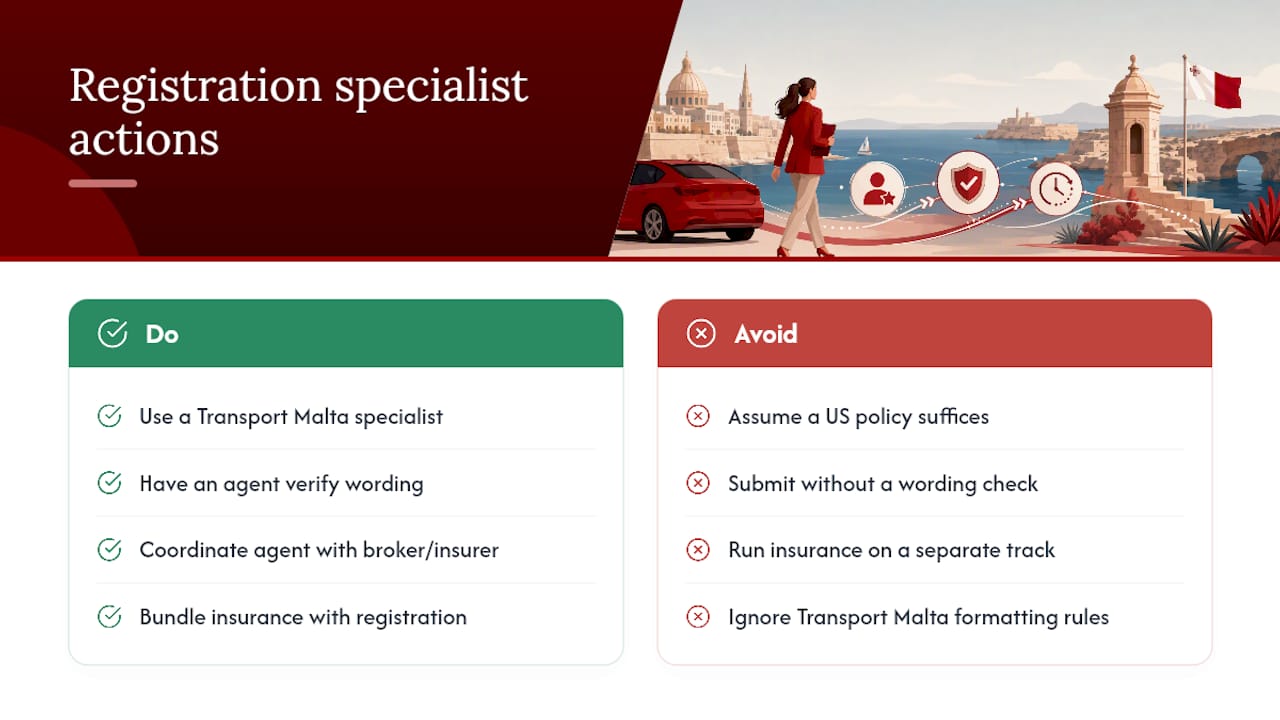
That’s where working with a specialist changes the outcome. VesselFlag provides yacht and boat registration services across multiple flag jurisdictions including Malta, and that cross-jurisdiction experience means recognizing what a Transport Malta reviewer will flag before it costs you a resubmission. A registration agent can verify certificate wording, coordinate directly with your broker or insurer, and make sure formatting matches what the Registrar General expects the first time.
Owners buying insurance directly should still lean on a specialist for wording review. Those handling registration end to end, including MMSI and AIS setup and corporate registration, often find it faster to bundle insurance verification into the same process rather than run it as a separate track.
— VesselFlag
Get Your Malta Insurance Certificate Right the First Time
A rejected certificate doesn’t just cost you paperwork time. It can stall a provisional registration clock that’s already running, and in the yacht chartering world, a delayed registration means a delayed season.
Some registration services handle parts of Malta registration that can challenge first-time owners: checking insurer’s certificate language satisfies Transport Malta’s limitation and Athens Convention requirements, liaising with brokers and underwriters on wording gaps, and packaging insurance documentation alongside MMSI/AIS setup and the rest of the registration file. That’s a different path than assembling every piece yourself and hoping the Registrar General’s office doesn’t send it back. Whether you’re weighing yacht versus boat registration options or you already know Malta is your flag, the next step is the same: get your documentation reviewed before you submit it, not after a rejection. Start with VesselFlag’s flag registration services to line up your insurance certificate with the rest of your Malta paperwork.
Where Can You Verify Malta’s Insurance Rules Directly?
Transport Malta’s own insurance and certificate regulations and Athens Convention provisions are the primary references behind every requirement covered here.
Sources
- Transport Malta: Sea Ship Registration Legislation & Insurance provisions
- Lexology summary: Ship registration in Malta
FAQ
What Is Malta Blue Card Insurance for Vessels?
It refers to the hull, liability, and P&I insurance a Malta-flag vessel must carry, backed by an insurer-issued certificate that meets Transport Malta’s limitation-of-liability and, where applicable, Athens Convention requirements.
Does Every Malta-Flag Vessel Need P&I Cover?
Most commercial vessels and larger yachts need P&I cover alongside hull insurance, since Transport Malta’s rules specifically recognize International Group P&I cover as qualifying security for third-party and pollution liability.
When Is Athens Convention Cover Mandatory?
Athens Convention Article 4bis cover becomes mandatory only for vessels carrying passengers for hire, and the Registrar General can refuse a certificate if there’s doubt about the insurer’s ability to meet that obligation.
Can I Use My U.S. Yacht Insurer for Malta Registration?
Only if that insurer can issue a certificate matching Transport Malta’s exact format, including ship name, IMO number, owner details, and language tying the insured amount to the limitation ceiling; many U.S. insurers can’t without guidance.
How Long Does Provisional Registration Last While Insurance Is Finalized?
Malta typically issues provisional registration for six months, and insurance certificates need to be in place well before that window closes to avoid delaying permanent registration.
Can professional registration services help verify My Insurance Certificate?
Yes. Such services review certificate wording against Transport Malta’s requirements and coordinate with brokers and insurers as part of broader Malta registration support.
Recommandé
- Enregistrement d'un yacht à Malte : Avantages, exigences et accès plus rapide à Vessel Flag
- Pourquoi choisir le drapeau maltais pour les propriétaires de yacht ?
- Why register in Malta? Top advantages for yacht owners
- Enregistrement des bateaux à Malte : Coûts, avantages et raisons pour lesquelles tant de yachts choisissent le pavillon maltais