

Choosing a flag? See our complete guide Comment choisir le bon pavillon pour votre yacht with prices for 6 flags, or compare Poland vs San Marino vs UK Part 1.
Choosing a port of registry comes down to matching a reputable, well-administered registry to how you actually use the vessel and to what your insurer or lender will accept. Before signing anything, check the registry’s standing on the Paris MoU flag performance list and, if you’re weighing a domestic option, confirm requirements with the relevant national documentation authority.
En bref :
- Choosing a reputable registry with a strong Paris MoU performance record reduces the risk of port state detention and operational delays.
- The flag’s enforcement and inspection history are more critical than fee costs, as weak oversight increases inspection frequency and detention risk.
- Proper documentation, including a deletion certificate and proof of ownership, is essential for a smooth port of registry change and to avoid delays.
- The long-term resale value depends on a vessel’s clean registration history and a well-regarded flag’s reputation for compliance and inspection performance.
- Confirming the registry’s legitimacy and direct communication with authorities helps prevent fraud and hidden fees during the registration process.
Table des matières
- What “port of registry” means and where the law comes from
- Flag state duties versus port state inspections
- Practical checklist: what to weigh before you pick a registry
- Documentation basics if you’re considering a domestic flag
- Common pitfalls and red flags to avoid
- How VesselFlag helps owners move faster with less risk
- Process and documentation requirements for changing a ship’s port of registry
- How registry choice affects resale value and buyer perception
- Checking whether a registry authority is legitimate
- What most owners get wrong about picking a flag
- Starting your registration with VesselFlag
- Sources
- FAQ
What “port of registry” means and where the law comes from
A port of registry is the place where a vessel’s ownership, nationality, and technical details are officially recorded, a definition the Cambridge Dictionary states plainly. That record determines which flag the ship flies and which state’s laws govern it on the water.
The legal foundation sits in the United Nations Convention on the Law of the Sea, which requires a “genuine link” between a ship and the state whose flag it flies, though how strictly that link is enforced varies across jurisdictions. Registration is what creates the formal connection between a vessel and a state, according to the International Maritime Organization, which also runs audit schemes and identification-number measures meant to strengthen flag-state accountability. In practice, this means the flag you choose is not just a formality: it sets the rulebook your vessel operates under for its entire working life, or until you re-register.
Flag state duties versus port state inspections
These two roles get confused constantly, and the confusion costs owners money. The flag state, explained by MITAGS, is the country where your ship is registered and whose safety, crewing, and technical rules apply to it. The port state is any country your ship visits, and its authorities can board and inspect foreign-flagged vessels to check compliance regardless of where the ship is registered.
This is why registry choice matters beyond paperwork. A flag with a poor enforcement record draws more attention from port state control (PSC) officers, and more inspections mean more chances for a detention. The Paris MoU tracks this directly: its 2025 annual report puts the overall detention rate close to the reported figure. Flags with weak oversight tend to sit well above that average on the performance list. A detention means lost days, unplanned repair bills, and sometimes a flag on your insurance file that follows the vessel into future underwriting conversations.
Practical checklist: what to weigh before you pick a registry
Marketing pages love to promise speed and low fees. What actually protects you is administrative substance, so work through these points in order before committing to a flag.
- Operational fit: decide whether the vessel is for private cruising, commercial charter, or fishing, since some flags restrict coastwise or cabotage trade to domestically registered ships.
- Administrative quality: look for fast processing, functional online services, English-language support, and a registry that answers its phone or email promptly.
- Compliance burden: check expected inspection frequency, crewing requirements, and whether the flag demands national endorsements beyond standard international certificates.
- Insurance and financing: confirm in writing that your insurer and any lender will accept the flag before you file paperwork, since underwriters vary in what they’ll cover.
- Costs and timing: total the one-off registration fee, renewal cadence, and any administrative charges that don’t appear until year two.
- Legal and tax fit: check whether the registry supports corporate ownership structures such as an LLC, and whether that structure suits your residency and tax position.
Conseil de pro : Treat any registry that leads with “cheapest” or “fastest” in its marketing as a starting point for research, not a reason to sign, until you’ve verified its inspection record independently.
A registry’s own sales copy is the least reliable source of information about its administrative quality. Insiders note that owners who prioritize clear procedural checklists and reliable points of contact over small fee differences, as industry commentary on registration incentives points out, tend to have fewer operational headaches later. If you’re weighing an open registry against a traditional one, our guide to flag of convenience arrangements breaks down the tradeoffs in more detail.
Documentation basics if you’re considering a domestic flag
For owners weighing a domestic option, the mechanics are worth understanding before you compare it to a foreign flag. The National Vessel Documentation Center (NVDC), run by the Coast Guard, manages federal vessel documentation, issues a permanent Official Number to each documented vessel, and requires a hailing port marked on the hull. Applications and renewals run through the NVDC’s eStorefront system, which is the standard route for both new documentation and transfers of an existing Certificate of Documentation.
Renewals typically follow a set cadence set by the NVDC, and missing one can lapse a documentation that then has to be reinstated rather than simply renewed. Not every vessel needs federal documentation: many recreational boats are fine with state registration alone, and federal documentation becomes relevant mainly for vessels used in trade, for financing purposes, or above a certain size threshold. If you’re preparing an initial application or a transfer, expect to gather proof of ownership, a builder’s certification or bill of sale, and any existing Certificate of Documentation. Our step-by-step commercial registration guide walks through the paperwork side in more depth.
Common pitfalls and red flags to avoid
Weak or fraudulent registries share a handful of warning signs, and catching them early saves months of trouble later.
- Opaque fee structures that only reveal add-on charges after you’ve started the application.
- No verifiable physical address or phone contact for the registry administration.
- Inconsistent or unverifiable vessel records when you ask for confirmation of a prior Certificate of Documentation or Official Number.
- No listing or acknowledgment in IMO registration frameworks for vessels that should carry an IMO number.
Before committing, check the registry against the Paris MoU list, confirm its national authority contact independently rather than through an intermediary’s link, and ask directly how long provisional registration typically takes and what happens if a document is rejected.
How VesselFlag helps owners move faster with less risk
We work across multiple registries and offer services including MMSI and AIS setup and corporate structuring for ownership. Because the team handles these applications daily, it can flag insurer or mortgagee acceptance issues before you file rather than after a rejection. If you’re ready to move, the practical next step is gathering your ownership documents and requesting an eligibility check for the flag you’re considering.
Process and documentation requirements for changing a ship’s port of registry
Re-registering a vessel under a new flag is not simply a matter of filing new forms. Most registries first require proof that the vessel is free of the prior registry, typically a Deletion Certificate confirming the ship has been formally removed from its previous flag’s records. Without it, the new registry generally won’t proceed, since a vessel legally can’t be registered under two flags at once.
Beyond the deletion document, expect to provide a current bill of sale or proof of ownership, a tonnage measurement certificate, any existing safety and classification certificates, and, for company-owned vessels, incorporation documents for the owning entity. Some registries also require a survey or inspection before accepting a transfer, particularly for older vessels or those moving from a registry with a weaker inspection history.
Timelines vary by registry and by how complete the paperwork is on first submission. Provisional registration can often be issued quickly once the deletion certificate and ownership proof are in hand, with permanent documentation following once the registry completes its own review. Missing paperwork is the single biggest cause of delay in a flag change, so confirming the exact document list with the receiving registry before starting the deletion process avoids a gap where the vessel is registered nowhere at all.

How registry choice affects resale value and buyer perception
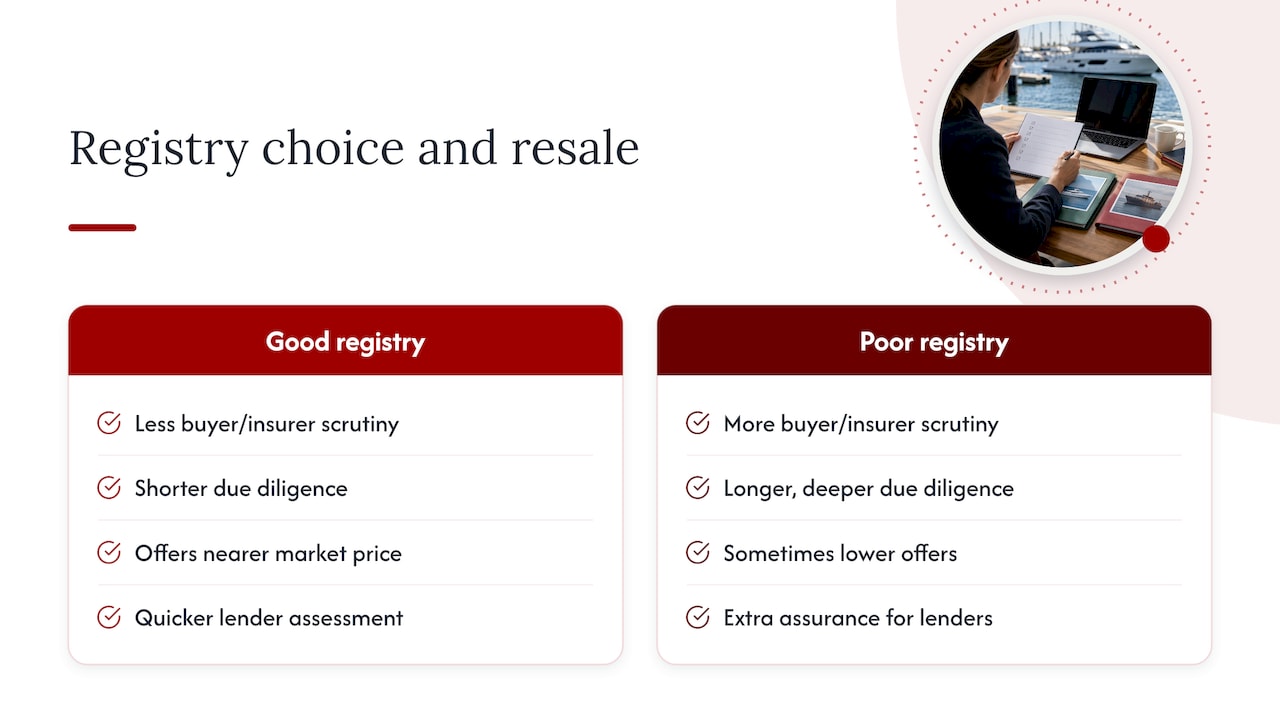
Flag history follows a vessel through its life, and brokers and buyers notice. A vessel with a documentation history under a well-regarded registry, one with a strong Paris MoU inspection record, generally presents better in a sale because it signals fewer compliance questions for a prospective buyer’s surveyor or insurer to chase down.
The opposite is also true. A vessel that’s changed flags repeatedly, or that carries documentation from a registry with a poor detention record, can prompt more scrutiny during a sale, longer due diligence, and sometimes a lower offer simply because the buyer’s insurer wants extra assurance. Financing is affected too: lenders assessing a vessel for a marine mortgage look at documentation history as part of their risk picture, and a clean, well-documented registry trail makes that conversation shorter.
None of this means a specific flag guarantees a higher resale price. It means that administrative cleanliness, consistent paperwork, no lapsed renewals, a verifiable Official Number or equivalent, and a registry without a reputation for detentions, removes friction from the eventual sale. Owners planning to sell within a few years should weigh that friction the same way they’d weigh a maintenance record.
Checking whether a registry authority is legitimate
Verifying a registry before you commit takes less time than untangling a bad registration afterward. Start with the Paris MoU flag performance list, which shows detention rates and inspection history for flags operating in the region it covers.
Next, confirm the registry appears in IMO registration frameworks where applicable, since IMO identification-number schemes are part of how flag-state accountability gets tracked internationally. A registry that can’t confirm its own participation in these frameworks, or that dodges the question, is a signal to slow down.
Beyond the official lists, ask for direct contact with the registry administration rather than routing every question through a broker or agent. A legitimate registry authority will confirm processing times, fee structures, and required documents without evasion, and it should be able to produce sample certificates or confirm a prior vessel’s Official Number on request. If an intermediary discourages direct contact with the registry, treat that as a reason to verify independently before paying anything.
What most owners get wrong about picking a flag
Most owners spend more time comparing registration fees than comparing administrative quality, and that’s backward. A few hundred euros saved on a cheaper flag means little if that registry’s detention rate pushes your vessel into extra PSC inspections every time it enters a new port. The registries worth choosing are the ones with clean paperwork trails, responsive administrators, and a record insurers already trust. Run the Paris MoU and, where relevant, NVDC checks first, and bring in a specialist the moment coastwise rules or eligibility questions get complicated.
— VesselFlag
Starting your registration with VesselFlag
Once you’ve settled on a flag that fits how you use the vessel, the paperwork is where most delays happen, and that’s the part VesselFlag handles directly. We register vessels under Saint-Marin, Pologne, Royaume-Uni, 1re partie, Malte, Palau, and Langkawi, with MMSI licensing and corporate setup available alongside each.
Provisional registration typically moves within days once ownership documents and any deletion certificate are ready. Get in touch to request an eligibility check for your vessel and flag of choice.
Sources
- Paris MoU flag performance list and 2025 annual report
- Registration of ships and fraudulent registration matters — IMO
- Flag State vs. Port State — MITAGS
FAQ
What does port of registry mean?
Port of registry is the official location where a vessel’s ownership and nationality details are recorded, which determines the flag it flies and the laws that govern it. The Cambridge Dictionary defines it as the place where a ship’s details are officially recorded.
How do I choose the best port of registry for my vessel?
Match the registry to how you’ll use the vessel, then confirm your insurer and lender will accept that flag before filing anything. Check the registry’s standing on the Paris MoU flag performance list and verify its administrative responsiveness directly rather than through marketing claims.
What’s the difference between a flag state and a port state?
A flag state is the country where a vessel is registered and whose rules govern its operation, while a port state is any country the vessel visits and can inspect it under. This distinction, explained by MITAGS, matters because a poorly regarded flag can trigger more frequent port state inspections.
How long does changing a port of registry usually take?
Timelines depend on the registry and how complete your paperwork is, particularly the deletion certificate from the prior flag and proof of ownership. Provisional registration can move quickly once those documents are in order, with permanent documentation following after the registry’s review.
Does the port of registry affect a vessel’s resale value?
A clean documentation history under a well-regarded registry generally reduces friction during a sale, since buyers and their insurers scrutinize compliance history. A record of lapsed renewals or registration under a flag with a poor detention record can slow a sale or draw a lower offer.