A builder’s certificate is the shipyard’s signed statement that it built your yacht, identifying the hull and naming the first owner. For a new yacht it is the root of your title, and almost every registry asks for it before it will register the vessel. If you are buying, registering, financing or reflagging a yacht, this is the document to check first.
Below we cover what the certificate contains, who can sign it, how it differs from the papers it gets confused with, and what to do when the original is missing.
TL;DR
- A builder’s certificate proves who built the yacht and to whom it was first delivered. It is the foundation of the ownership chain, and a bill of sale is the next link in that chain.
- It must be signed by someone with personal knowledge of the build. In the US, that is spelled out in 46 CFR § 67.99.
- Each owner passes the original on to the next one. Buy a yacht without it and you will be asking the registry for a waiver.
- A manufacturer’s certificate of origin does not automatically replace it for US federal documentation.
- If the yard has closed, ask the registry what alternative evidence it accepts before you spend money on affidavits or surveys.
Table des matières
- What a yacht builder’s certificate actually proves
- What the certificate normally contains
- Builder’s certificate vs. bill of sale vs. other documents
- When you will be asked for it
- Builder’s certificate and a manufacturer’s certificate of origin
- Getting a certificate when the yard has closed or the original is lost
- Practical rules for buyers and brokers
- US owners registering under a foreign flag
- Our perspective
- How we help with registration paperwork
- FAQ
- Sources
What a yacht builder’s certificate actually proves
The certificate answers three questions. Who built this vessel? Which vessel is it, exactly? Who did the builder deliver it to? It says nothing about the vessel’s condition, its safety compliance or any later sale.
Under US rules, evidence of the facts of build can be a completed Coast Guard form CG-1261 or another document containing the same information. It must be executed by a person with personal knowledge, meaning someone who constructed the vessel, supervised its construction, or examined the builder’s records as an officer or employee of the builder (46 CFR § 67.99). Other flags use different forms but the principle is the same. The registry wants a statement from the source, not a broker’s summary.
That is why the certificate sits at the start of the paperwork. A registry can only accept a sale from someone who owned the boat, and the owner can only show that by tracing the title back to the builder.
What the certificate normally contains
There is no single worldwide template, but the content converges. The Gibraltar registry’s builder’s certificate form, for example, records the yacht’s name, yard and hull numbers, year, country of build, type, dimensions, construction material, engine details, tonnage, the builder’s details, and the person or company the yacht was built for (Gibraltar Ship Registry form).
Production yacht builders issue their own versions. One European builder’s help page explains that its certificate states that the yard built the yacht, identifies it by model and serial number, and gives its propulsion mode and characteristics (Prestige Yachts help center).
Before you submit anything, check these points against the yacht itself:
- Hull identification number or serial number. It must match the number on the transom or hull, character for character.
- Builder name and address. It should match the yard’s legal entity, not a trade name or a dealer.
- Year of build and delivery. Registries use these to calculate age limits and to date the title.
- Dimensions and tonnage. They should agree with the survey or measurement certificate.
- First owner. The certificate should name the person or company the yacht was delivered to, with a signature, date and the signer’s position.
Builder’s certificate vs. bill of sale vs. other documents
Owners mix these up constantly, and a registry will reject the wrong one. Here is how they differ.
| Document | Issued by | What it shows | Replaces the builder’s certificate? |
|---|---|---|---|
| Builder’s certificate | The shipyard | How, where and by whom the yacht was built, and first owner | n/a |
| Acte de vente | The seller | Transfer of ownership from one party to another | Non |
| Declaration of Conformity | The builder or manufacturer | The yacht was built to an approved design or standard | Non |
| Safety or survey certificate | Surveyor or authority | Condition and compliance on a given date | Non |
| Certificate of registry | The flag registry | The yacht is registered under that flag | Non |
A German yacht-finance firm puts the distinction plainly: the builder’s certificate proves how and where the vessel was built, while the bill of sale documents the transfer between parties (Yacht-Finanz). A UK finance guide adds that the original certificate carries the boat details, the ID numbers and who the title has passed to, while the original bill of sale is what transfers title (Promarine Finance).
The Declaration of Conformity is a separate matter. In Europe a CE certificate can be issued for a boat model, and a Declaration of Conformity then covers each boat built and marketed under that model (Yacht-Finanz). Australia’s maritime authority likewise requires a builder’s declaration of conformity for each vessel built to a type-approved design (AMSA). These documents speak to compliance. They do not establish title.
The UK Ship Register lists safety certificates separately from the builder’s certificate and bill of sale among the documents needed to register a boat (GOV.UK). Expect the same split in most registries: title documents on one side, compliance documents on the other.
When you will be asked for it
New build, first registration. The builder’s certificate is the core title document. In the US, for registry or recreational endorsements, the first owner’s title evidence is the builder’s certification on form CG-1261 (46 CFR Part 67). Foreign registries ask for the same thing in their own form.
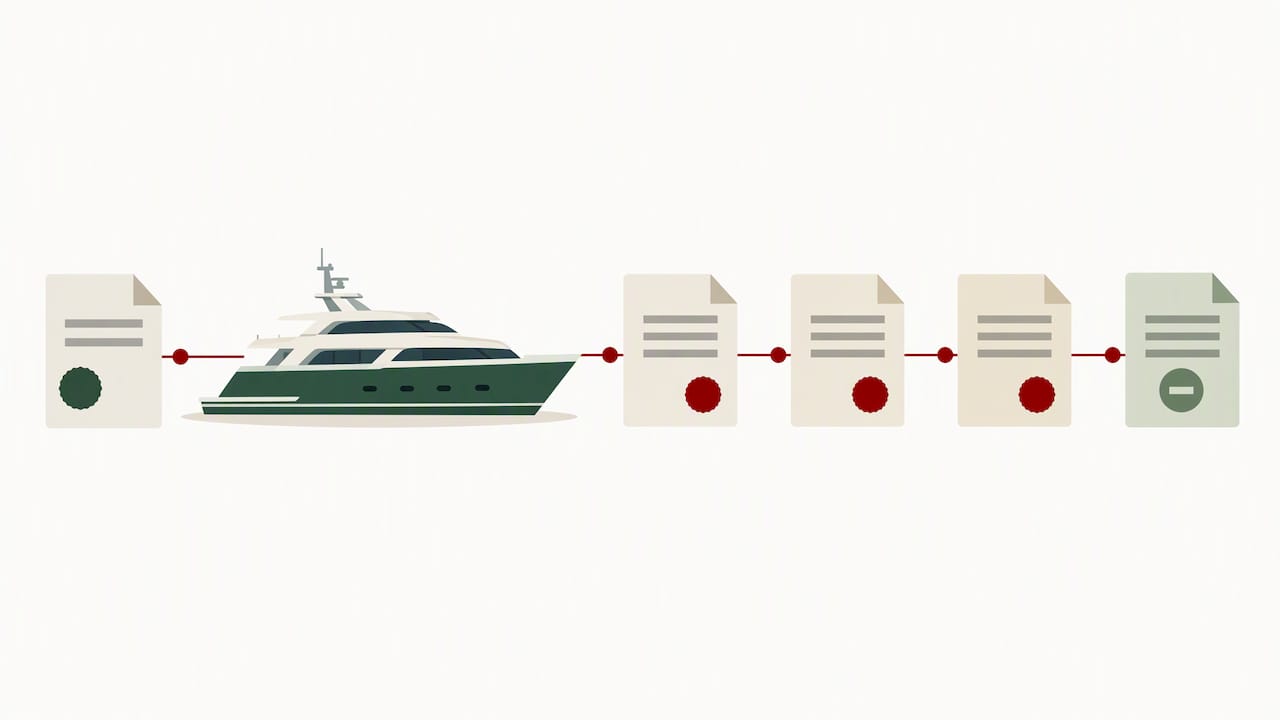
Second-hand purchase with a flag change. The registry will want to see the chain: builder’s certificate, then each bill of sale, then a deletion certificate from the previous flag if there was one. Each owner must pass the original builder’s certificate to the next owner (Yacht-Finanz). A copy often leads to extra questions.
Financing. Lenders want clear title before they register a mortgage. One legal explainer warns that errors or omissions in the certificate can cause long-term title problems, mortgage delays or roadblocks at registration (LegalClarity).
Several builders. If a hull came from one yard and was completed by another, each builder should supply its own certificate for its phase of the work. The US rule requires the owner to file a separate certificate from each builder involved (46 CFR § 67.99). This is common with bare hulls finished elsewhere and with large refits that count as new construction.
Builder’s certificate and a manufacturer’s certificate of origin
Smaller production boats often come with a manufacturer’s certificate of origin (MCO) instead. For US federal documentation, an MCO is not treated as equivalent to a builder’s certificate, because the rule requires formal evidence of the facts of build from a person with personal knowledge (46 CFR § 67.99; LegalClarity). Other flags set their own rules. Ask the registry in advance rather than assuming a dealer’s document will do.
Getting a certificate when the yard has closed or the original is lost
This is the most common problem we see on pre-owned yachts, especially ex-charter boats that have changed hands several times. Work through it in this order.
- Ask the previous owner and the broker. The original may sit in a file or a safe. Ask for the whole set of ownership papers.
- Contact the builder or its successor. Many yards that have closed or been sold still keep archives. A successor can often issue a replacement or a confirmation letter from the hull records.
- Check the previous registry. If the yacht was registered before, the old registry file may hold a copy of the certificate, and you can request a certified copy.
- Ask the registry about a waiver. In the US, an owner can apply to the National Vessel Documentation Center for a waiver. It requires a written explanation and alternative, persuasive evidence of construction, such as surveys, affidavits or historical records (LegalClarity). Other registries have their own substitutes, so ask first.
- Build the evidence file. A surveyor’s report identifying the hull, sworn statements from people who know the history, old registration papers and photographs of the hull plate all help.
The point to remember: a registry decides what counts as persuasive. We recommend settling that question before you pay for any survey or notarization.
Practical rules for buyers and brokers
- Ask for the builder’s certificate before you pay a deposit. If it cannot be produced, you need to price in the cost and delay of a waiver.
- Match the numbers. Compare hull number, builder name and dimensions against the boat, the survey and the existing registration.
- Keep the original safe. You will need to hand it to the next buyer. Scan it, but treat the paper as the title document.
- Check translations. If the certificate is not in the registry’s language, many registries want a certified translation. Our guide on yacht document translation for registration lists what to translate.
- Check use as well as flag. How you use the yacht affects which register fits. See private vs. commercial registration.
US owners registering under a foreign flag
US owners often register abroad for reasons such as Mediterranean cruising, charter coding, or a company structure. The builder’s certificate matters just as much there. The foreign registry will want the original or a certified copy, and a US-built yacht may also need the US documentation record dealt with before it changes flag. Our guide to foreign yacht registration for US owners walks through the sequence.
Our perspective
We handle registrations under several flags every week, and the builder’s certificate is where timelines most often slip. The delay is rarely the registry. It is usually a certificate that names the wrong entity, carries a hull number that differs from the hull plate, or does not exist at all because the yard closed years ago.
Our advice is simple. Review the ownership chain before you commit to a flag, not after. Different registries accept different substitutes when a certificate is missing, so the best flag for a given yacht sometimes depends on its paperwork as much as on tax, size or use. If the certificate is clean, provisional registration can move quickly. If it is not, a clear plan for the evidence saves weeks.
— VesselFlag
How we help with registration paperwork
If you have a builder’s certificate and want to register, we manage the paperwork for you under the flag that suits the yacht. Published fixed fees include San Marino from 290 to 2990 EUR, Poland from 320 to 550 EUR et UK Part 1 from 550 to 1050 EUR. Malta, Palau, Langkawi and other flags are listed on our site.
If the owner is a company, we can also set up the ownership structure, with a UK LTD. at 349 EUR or a USA LLC at 499 EUR. Send us your documents and we will tell you which flag fits and what is missing. Start on our registration page.
FAQ
Is a builder’s certificate the same as proof of ownership?
It proves the yacht’s origin and first owner, which is the start of ownership. Later owners show title with bills of sale that link back to it. A certificate of registry on its own is also not proof of ownership.
Can a dealer or broker sign the builder’s certificate?
Not unless they are the builder. Under US rules the signer must have personal knowledge, as someone who built or supervised the build or examined the builder’s records as an officer or employee (46 CFR § 67.99). A dealer can sign a bill of sale, which is a different document.
What if my yacht was built by a company that no longer exists?
Check for a successor company that holds the archive, then ask your registry about alternative evidence. The US documentation center, for instance, can grant a waiver when you submit a written explanation and persuasive substitute evidence such as surveys, affidavits or historical records (LegalClarity).
Do I need a builder’s certificate for a home-built boat?
You will still need to show how the boat was built, but the signer is usually the owner-builder and the registry may ask for build photographs or a surveyor’s inspection. Rules differ by country, so ask the registry you plan to use.
Is a Declaration of Conformity a substitute?
No. It shows the yacht meets a design standard, not who built it or who owns it. Registries treat the two documents as separate requirements.
Sources
- 46 CFR § 67.99, Evidence of build (Cornell LII)
- 46 CFR Part 67, Documentation of Vessels (eCFR)
- Gibraltar Ship Registry builder’s certificate form
- Prestige Yachts help center, builder’s certificate
- LegalClarity, What is a builder certificate
- Yacht-Finanz, Builders Certificate and Bill of Sale
- Promarine Finance, Documentation guide
- AMSA, Instructions to surveyors
- GOV.UK, The UK Ship Register