
Yes, yachts used in the EU VAT territory are normally liable for VAT, either at purchase or at import. The main lawful ways around that liability are Temporary Admission for non-EU owners with non-EU flagged vessels, Returned Goods Relief for boats re-entering within three years, and standard VAT payment on import through release for free circulation. The European Commission’s 2026 Guidance Note clarifies how each of these applies in practice, but it doesn’t change the underlying obligation.
TL;DR:
- Temporary Admission allows non-EU flagged yachts owned by non-EU residents to stay in EU waters for up to 18 months without paying VAT, but strict eligibility and re-export documentation are essential.
- Returning a yacht within three years in the same condition and ownership can qualify for Returned Goods Relief, provided owners keep thorough export and refit records as proof.
- VAT liability generally depends on owner establishment and vessel registration, with EU residents always liable if the yacht stays in EU waters, while non-EU owners outside EU VAT zones have more options.
- The 2026 EU guidance formalizes the presumption that EU-flagged yachts hold Union goods status, though it does not reduce the necessity for proper paperwork or legal compliance.
- Proper documentation such as original VAT invoices, customs declarations, and continuous ownership records are critical for proving yacht VAT status during purchase or border crossings.
Table des matières
- What EU VAT Rules Actually Say About Yachts
- Who Actually Owes VAT On A Yacht?
- How Long Can A Foreign-Flagged Yacht Stay Under Temporary Admission?
- What Is Returned Goods Relief And Who Qualifies?
- Which Documents Prove A Yacht’s VAT Status?
- A Practical Pre-Purchase And Ownership Checklist
- Why The 2026 Guidance Changes Less Than Owners Think
- Get Your Yacht’s Documentation And Registration Sorted
- Where This Guidance Comes From
- Sources
- FAQ
What EU VAT Rules Actually Say About Yachts
A yacht sitting in a marina in Palma or Antibes carries a status the same way a car carries a title. That status is called “customs status of Union goods,” and the industry shorthand for it is simply “VAT paid status.” A boat with Union goods status has already had VAT accounted for somewhere in the EU, or it qualifies for a recognized exemption. One without it is treated as a non-Union good, meaning VAT (and possibly duty) is still owed if it stays in EU waters beyond what the rules allow.
Importation triggers VAT liability under Council Directive 2006/112/EC, the EU’s VAT Directive, the moment a vessel is formally “released for free circulation.” That’s the customs procedure that converts a non-Union good into a Union good once VAT and any duty have been paid.
Here’s a wrinkle that catches new buyers off guard: EU customs territory and EU VAT territory aren’t identical. The Canary Islands sit inside Spain’s customs territory but outside the EU VAT area, so a yacht purchased there doesn’t automatically carry EU VAT paid status even though it’s technically in an EU member state. The same kind of mismatch shows up in a handful of other overseas territories, which is why “bought in the EU” and “VAT paid in the EU” aren’t always the same sentence.
Who Actually Owes VAT On A Yacht?
Establishment and flag registration decide almost everything here, more than nationality or where the deal closes.
If you’re established in the EU (meaning your normal residence or business base is inside the bloc) and you keep your yacht in EU waters, VAT is due on purchase or import in nearly every case. There’s no meaningful workaround for this group beyond the standard reliefs covered later. EU residents who try to dodge VAT by registering a yacht offshore while living in France or Italy and using it there routinely trigger enforcement action once customs notices the mismatch between owner residence and vessel use.
Non-EU-established owners get more room to maneuver, but only if two conditions line up together:
- The yacht is registered outside the EU
- The owner is established (resident or headquartered) outside the EU
Both boxes need checking. A non-EU citizen who moves to Spain and keeps a Cayman-flagged yacht there doesn’t qualify for relief, because the owner’s establishment has shifted into the VAT territory even though the flag hasn’t.
Charter changes the calculus again. Running a yacht commercially, even part-time, can shift VAT obligations toward the charter’s country of supply rather than the owner’s residence, and it usually requires separate commercial registration, a charter license, and evidence the vessel is genuinely operated as a business rather than dressed up to dodge private-use VAT. Tax authorities in France and Italy have both pursued owners who used charter structures on paper while keeping the yacht for personal use most of the season.
How Long Can A Foreign-Flagged Yacht Stay Under Temporary Admission?
Non-EU registered yachts owned by non-EU established individuals can use Temporary Admission (TA) to cruise EU waters for up to 18 months without paying import VAT, under Article 217(e) of the UCC Delegated Act. The vessel stays classified as non-Union goods the entire time. TA isn’t a loophole; it’s a formal customs procedure with its own paperwork trail, and getting it wrong turns an 18-month grace period into a VAT bill with penalties attached.
- Confirm eligibility first. Both the non-EU flag and the owner’s non-EU establishment must hold true for the full period, not just at entry.
- Register the TA with customs at first port of entry, or be ready to demonstrate eligibility if boarded at sea.
- Expect a possible guarantee or security deposit, especially at ports with less experience handling pleasure craft TA claims.
- Track the clock. The 18 months typically resets only after the vessel genuinely leaves the customs territory and later re-enters; hopping between EU ports doesn’t restart it.
- Re-export correctly before the deadline, with customs discharge paperwork that proves the boat actually left, not just that it planned to.
A related resource on Temporary Admission and the 18-month rule walks through renewal mechanics and common timing mistakes in more depth.
What Is Returned Goods Relief And Who Qualifies?
Returned Goods Relief (RGR) lets a yacht that left the EU regain Union goods status without a fresh VAT bill, but only if it clears three tests at once. It has to return within three years of export, the same person who exported it has to be the one re-importing it, and the vessel has to come back in essentially the same state it left in, under Article 203 of the UCC and Article 143(1)(e) of the VAT Directive.
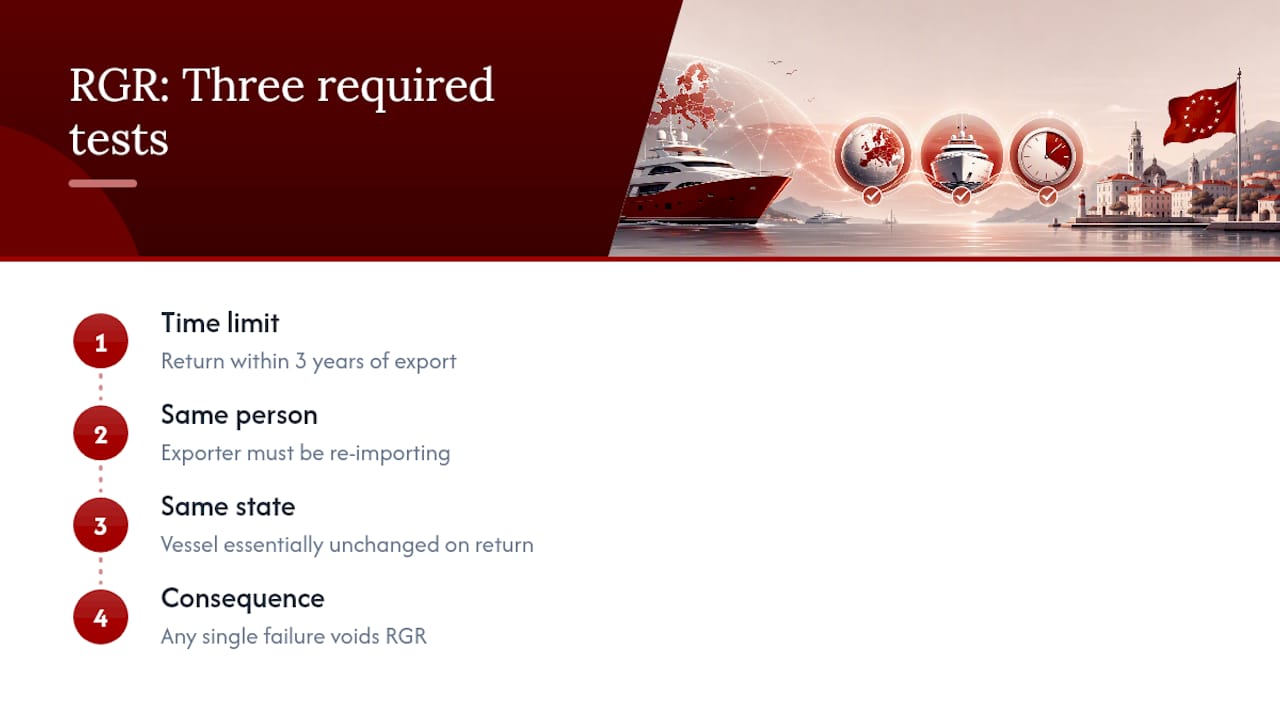
Each condition has bitten real owners. A refit done in Turkey or the Caribbean that goes beyond routine maintenance can be read as changing the vessel’s “state,” voiding the relief even if the boat looks identical from the dock. A sale that happens while the yacht is outside EU waters breaks the “same person” requirement outright, no matter how minor the ownership change seems on paper. And if you can’t produce clean export records, customs has no baseline to compare the boat against on return, which puts the whole claim at risk regardless of what actually happened.
The safest practice is treating RGR like an insurance claim you might have to prove years later: keep dated photographs, refit invoices, and export declarations together from day one, not scrambled together after a customs officer asks.
Which Documents Prove A Yacht’s VAT Status?
Every claim in this article, from Union goods presumption to TA eligibility to RGR, ultimately gets tested against paper. Buyers, brokers, lenders, and insurers all want to see roughly the same core set.
- Original purchase invoice showing VAT charged and paid, or clearly marked as VAT-exempt with the legal basis stated
- Customs import declaration confirming release for free circulation, where applicable
- T2L or T2LF document, which is the specific customs form proving Union status for goods moved by sea
- Registration extracts from the flag state showing continuous ownership history
- Builder or manufacturer certificates, especially for EU-built vessels where these substantiate origin and VAT liability at first sale
- Bank payment records and manifest/freight documentation tying the paper trail to an actual transaction, not just a claim
Conseil de pro : If a seller can’t produce the original VAT invoice, don’t accept a verbal assurance. Ask for a broker escrow arrangement and file a direct customs enquiry before closing. A missing invoice today becomes your unpaid VAT bill in five years.
For a fuller breakdown of what each document proves and how to request it, see VesselFlag’s guide to yacht documentation requirements.
A Practical Pre-Purchase And Ownership Checklist
Buying a used yacht without checking VAT status is the maritime equivalent of buying a house without a title search. Here’s the sequence worth following before money changes hands, and after.
- Run a chain-of-title check covering every prior owner, not just the immediate seller.
- Request customs release documents and the original VAT invoice in writing, before signing any deposit agreement.
- Ask for a written declaration of VAT status from the seller or broker, ideally backed by the documents above rather than a bare assertion.
- Log every EU entry and exit once you own the boat, especially if you plan long voyages outside the customs territory.
- Avoid major refits while outside the EU unless you’re prepared to document them thoroughly for RGR purposes.
- Keep time-stamped photos of the vessel’s condition before departure and on return, as backup evidence if the “same state” test is ever challenged.
| Risk area | What protects you |
|---|---|
| Missing VAT invoice | Broker escrow, direct customs enquiry before purchase |
| Long non-EU voyage | Export records, dated photos, minimal alterations |
| Ownership change abroad | Confirm RGR eligibility before any sale outside the EU |
| TA overstay | Calendar tracking, re-export discharge paperwork |
A registration and compliance provider can help pull these pieces together: collating documents, comparing flag options, arranging MMSI and AIS setup, and liaising directly with customs where a claim needs clarification.
Why The 2026 Guidance Changes Less Than Owners Think
The Commission’s 2026 note cuts daily friction by formalizing the presumption that EU-based boats hold Union goods status, so you’re not proving VAT payment at every port call. It does not remove the underlying paperwork burden. Port-level interpretation still varies, as industry commentary has noted, so a customs specialist or legal review still earns its cost before any cross-border purchase or long voyage.
— VesselFlag
Get Your Yacht’s Documentation And Registration Sorted
VesselFlag exists for the exact gap this article just walked through: knowing the VAT rules is one thing, having the paperwork to prove your position at a border or during a sale is another. A registration and compliance provider can help pull these pieces together: collating documents, comparing flag options, arranging MMSI and AIS setup, and liaising directly with customs where a claim needs clarification.
If you’re buying a yacht and need clarity on what documents you’ll actually need before or after purchase, start with VesselFlag’s step-by-step registration guide, which walks through the process flag by flag. Owners weighing charter programs against outright ownership can also compare options through Virgin Charter Yachts, a partner covering ownership structures and their VAT consequences of special territories. Request a document review with VesselFlag before your next purchase closes, not after.
Where This Guidance Comes From
The core legal basis throughout comes from the European Commission’s Guidance Note (TAXUD.A.1.003/EC) and the TAXUD FAQ on private boats, with practical interpretation from Boat Industry and Marine Project.
This article is general information, not a substitute for advice from a qualified financial advisor. Consult a qualified financial professional about your own circumstances before acting on anything here.
Sources
- Guidance note for pleasure craft — European Commission (TAXUD.A.1.003/EC)
- VAT and customs on pleasure boats: Brussels finally clarifies several rules — Boat Industry
- The new EU guidance on VAT status for pleasure craft: what it means for yacht owners and buyers — Marine Project
FAQ
Do I Need To Pay EU VAT On My Boat?
If your yacht is used in EU VAT territory and doesn’t qualify for Temporary Admission or Returned Goods Relief, yes, VAT is due either on purchase or on import into the EU.
Do Americans Have To Pay VAT In Europe On A Yacht?
American owners can use Temporary Admission for up to 18 months if the yacht carries non-EU registration and they remain established outside the EU; otherwise standard VAT rules apply the same way they do for EU residents.
How Can I Legally Avoid VAT On A Boat?
The lawful routes are Temporary Admission for qualifying non-EU owners, Returned Goods Relief for vessels re-imported within three years in the same state and by the same person, and structuring genuine commercial charter use where applicable, not informal workarounds.
What Is The 12-Person Rule On A Yacht?
Passenger-carrying restrictions under maritime safety and commercial certification rules determine whether a vessel needs commercial passenger certification, which is a separate question from its VAT status.
Does Chartering My Yacht Change Its VAT Treatment?
Yes, commercial charter use can shift VAT liability toward the charter’s country of supply and typically requires separate commercial registration and licensing, distinct from the private-use rules covered above.