
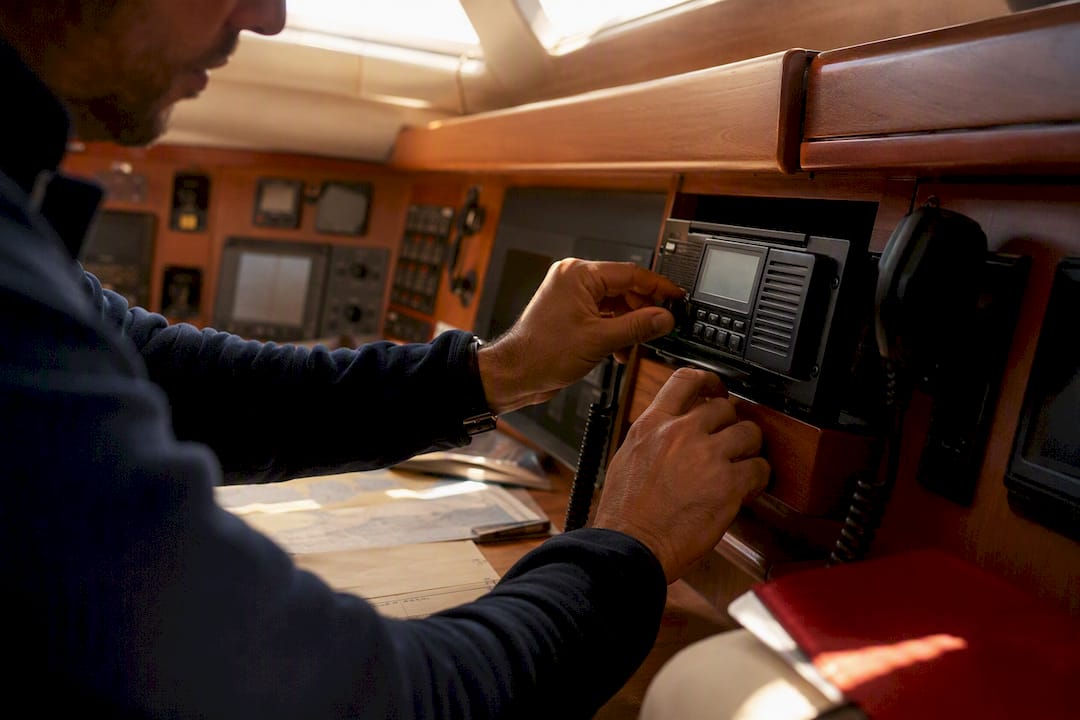
An MMSI for a foreign yacht is the nine-digit ship identity your vessel carries under its flag state, not under U.S. registration. The first three digits, called the Maritime Identification Digits (MID), tie that number permanently to whichever country’s registry issued it. If your yacht flies a foreign flag, your immediate job is to confirm the flag state has issued (or reassigned) an MMSI that matches its MID, or to get one started.
Do this now:
- Check your current MMSI’s first three digits against your flag state’s MID.
- If they don’t match, contact the flag registry or a resident agent (VesselFlag can act as one) to start reassignment.
- Confirm your AIS, DSC radio, and EPIRB are all programmed with the correct number before your next international passage.
Getting this wrong isn’t just a paperwork problem. The U.S. Coast Guard Navigation Center relies on accurate MMSI records to identify vessels in distress, and a mismatched or stale number can slow down search and rescue at the worst possible moment.
Principaux enseignements
A flag-issued MMSI is only valid when its MID matches the yacht’s current flag, and reassignment is required every time that flag changes.
| Point | Détails |
|---|---|
| Check the MID first | Match your MMSI’s first three digits to your current flag state before assuming it’s still valid. |
| Reflagging means reassignment | ITU rules require a new or reassigned MMSI whenever a vessel changes flag state. |
| Registries handle it differently | Some bundle MMSI with registration; others require a separate radio license application. |
| Program every device separately | AIS, DSC radio, and EPIRB each need the correct MMSI entered and verified independently. |
| VesselFlag manages the process | VesselFlag coordinates document prep, resident agents, and MMSI verification for foreign-flag yachts. |
Table des matières
- What Makes a Flag-Linked MMSI Different From a Domestic One?
- When Do You Actually Need a Foreign-Flag MMSI?
- How Do You Get or Transfer an MMSI for a Foreign-Flag Yacht?
- Do All Flag Registries Handle MMSI the Same Way?
- Getting AIS and DSC Devices Right
- What Documents, Timelines, and Fees Should You Expect?
- Keeping Your MMSI Current: Risks of Letting It Lapse
- MMSI for Foreign Yacht: How to Get and Register a Flag-Issued MMSI
- Let VesselFlag Handle Your MMSI Application End to End
- Sources
- FAQ
What Makes a Flag-Linked MMSI Different From a Domestic One?
Every MMSI is nine digits, but where those digits come from matters enormously. The first three form the MID, and under ITU-R Recommendation M.585, that MID always identifies the administering country, not the vessel’s home port or owner’s nationality.
A handful of practical distinctions follow from that:
- A U.S.-issued MMSI carries a U.S. MID and is registered in the FCC’s system, not the flag state’s.
- Some group and coastal station identities follow an “ends in zero” numbering convention that differs from standard ship MMSIs.
- A foreign flag state assigns its own MID-prefixed number through its own maritime administration or an appointed agent.
- Reflagging a yacht almost always means the MMSI has to change to match the new MID.
When Do You Actually Need a Foreign-Flag MMSI?
Not every cruising plan requires a new number, but three scenarios make it non-negotiable.
- You’re reflagging to a non-U.S. registry. The moment your yacht’s official flag changes, its MMSI has to be reassigned to match the new MID. Keeping the old number is not a shortcut. It’s a compliance gap.
- You’re voyaging internationally or relying on services like Inmarsat. Foreign port authorities, coastal stations, and satellite communication providers all check MMSI validity against ITU records, and a domestic-only number can fail that check.
- Your AIS, DSC, or EPIRB needs international recognition. Search and rescue coordination depends on a number that resolves correctly wherever the vessel travels, not just within one country’s coast guard database.
The FCC is explicit that some domestic MMSIs are never entered into the international database at all, meaning they simply won’t work once you’re operating under a foreign flag.
How Do You Get or Transfer an MMSI for a Foreign-Flag Yacht?
The process varies by registry, but the sequence is consistent enough to plan around.
- Check the registry’s MMSI policy. Some flag states issue MMSIs as part of vessel registration; others route it through a separate radio licensing office. Find out which applies before you gather documents.
- Identify the authorized issuer. This might be the flag’s maritime administration, a licensed radio authority, or a private registrant working on the flag state’s behalf.
- Collect your documents. Expect to need the vessel’s registration certificate, proof of ownership, technical details on your radio and AIS equipment, and, if you’re using a resident agent, a signed authorization letter.
- Submit the application. You can do this directly if the registry allows foreign applicants, or through a resident agent or a managed service like VesselFlag, which handles the step-by-step MMSI licensing process on the owner’s behalf.
- Confirm the ITU update. Under ITU-R M.585, the flag administration should notify the Radiocommunication Bureau once the number is reassigned. Verify your new MMSI shows up correctly in the flag registry and, where relevant, in Navcen’s lookup tools.
- Program and test your equipment. Update your AIS transponder, DSC radio, and EPIRB with the new number, then check that it broadcasts correctly on a public AIS viewer before you leave port.
Conseil de pro : Test your AIS signal against a free public tracking site like MarineTraffic before your first offshore leg under the new flag. Catching a programming error dockside beats discovering it mid-passage.
Do All Flag Registries Handle MMSI the Same Way?
They don’t, and that’s where a lot of owners get tripped up. Some registries, San Marino among them, bundle the ship radio license and MMSI issuance directly into the vessel registration package. Others treat radio licensing as an entirely separate step handled by a different authority.
Watch for these variables when comparing flags:
- Whether MMSI issuance is included in the registration fee or billed separately.
- Whether reflagging requires reassigning the MMSI to match a new MID, which is standard practice under ITU rules.
- Whether the registry requires a resident agent to submit paperwork on your behalf.
- Whether documents need certified translation or notarization before submission.
A registry that bundles everything can save weeks. One that doesn’t isn’t necessarily worse, but it does mean budgeting extra time for a second application.
Getting AIS and DSC Devices Right
Programming your MMSI correctly across every device is where compliance either holds up or falls apart. Each piece of equipment needs the exact same nine digits, entered without transposition errors.
- Program the MMSI into your AIS transponder, your DSC-enabled VHF radio, and your EPIRB separately. Each device stores it independently.
- Verify the number is broadcasting correctly using a public AIS aggregator, and cross-check it against your flag registry’s records or, where applicable, Navcen’s database.
- Watch for the most common failure: a leftover domestic MMSI still sitting in an old chartplotter or radio after reflagging.
- Double-check for transposed digits. A single-digit typo means your vessel effectively disappears from accurate identification.
- Confirm your EPIRB registration was updated, not just the AIS and radio. It’s the device most often forgotten.
Conseil de pro : After any equipment swap or reflagging, do a full DSC test call to a nearby vessel or marina. It’s the fastest way to confirm your new MMSI is actually transmitting, not just programmed.
For a deeper technical walkthrough, VesselFlag’s guide to MMSI and AIS compliance essentials covers device-specific programming steps in more detail.
What Documents, Timelines, and Fees Should You Expect?
Most flag states and radio issuers ask for a consistent core set of paperwork: the vessel’s registration certificate, proof of ownership, technical specifications for onboard radio equipment, and, when a resident agent is involved, a signed authorization.
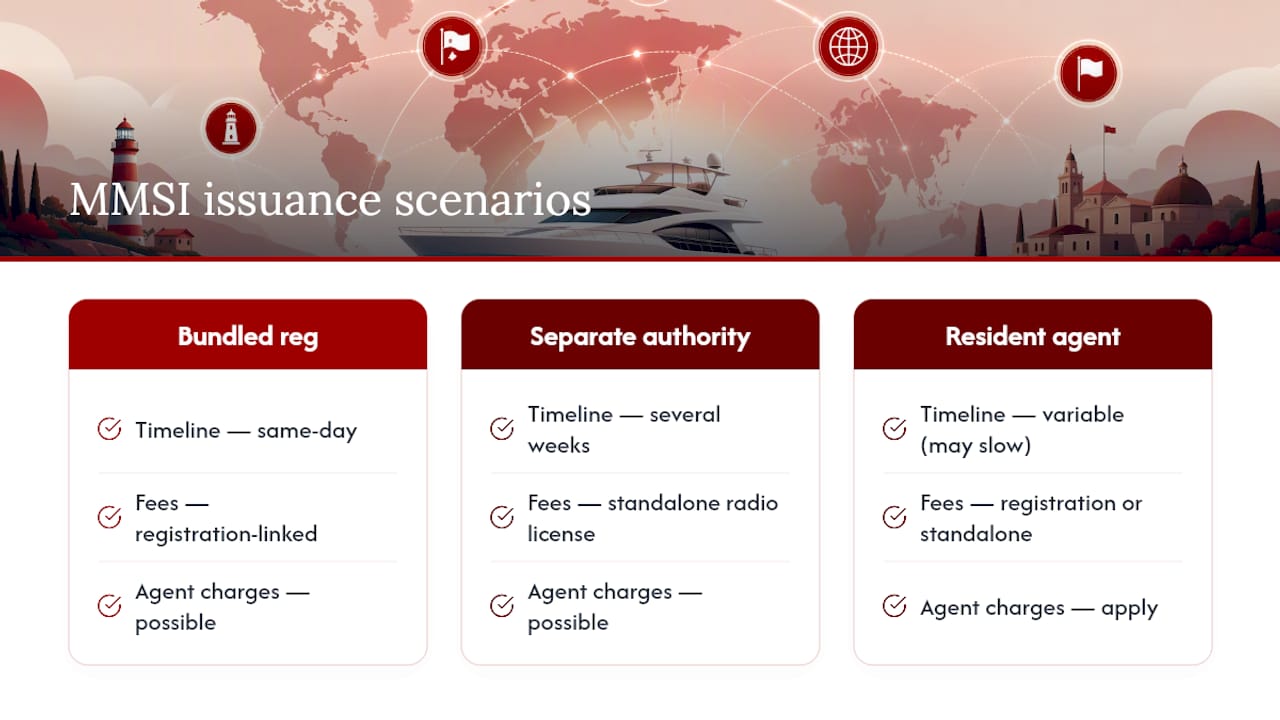
Timelines vary widely. Some registries process MMSI issuance same-day when it’s bundled with registration; others take several weeks if the radio license runs through a separate national authority. Fees typically break into three categories: a registration-linked fee, a standalone radio license fee, and agent or resident-agent charges where required. Budget for the slower, split-process registries rather than assuming the fastest option is standard.
Keeping Your MMSI Current: Risks of Letting It Lapse
An outdated MMSI isn’t a minor administrative loose end. Search and rescue coordination depends on accurate records, and Navcen has been direct about how much SAR effectiveness hinges on that accuracy. Misuse or neglected updates can also draw regulatory enforcement, ranging from fines to complications with insurance claims if equipment records don’t match the vessel’s actual identity.
Update your MMSI registration whenever any of the following happens:
- Ownership of the vessel transfers to a new party.
- The yacht’s name changes.
- The vessel reflags to a different registry, which under ITU rules requires reassignment to match the new MID.
- Radio or AIS equipment is replaced or upgraded.
A good habit: verify your MMSI against the flag registry and your AIS broadcast once a year, even if nothing has obviously changed.
MMSI for Foreign Yacht: How to Get and Register a Flag-Issued MMSI
Most guidance on this topic treats MMSI issuance as an afterthought to flag registration, something you’ll “handle later” once the paperwork on ownership and tonnage clears. That’s backward. The MMSI is the piece of the process most likely to fail quietly, because a vessel with a mismatched or outdated number doesn’t throw an error message. It just sits there, technically non-compliant, until a search and rescue scenario or a port authority check exposes the gap.
The conventional advice to “get an MMSI when you flag the boat” glosses over how differently registries actually handle it. Some fold it into registration; others don’t, and owners who assume otherwise end up scrambling for a separate radio license mid-season. The smarter approach is to ask the MMSI question before choosing a flag, not after.
If you take one thing from this: verify your MID against your current flag before you assume your existing number still works. Reassignment after reflagging is a rule, not a courtesy, under ITU-R M.585. Whether you handle that directly or through a resident agent, don’t let it be the last box you check.
Let VesselFlag Handle Your MMSI Application End to End
Chasing down the right issuer, formatting documents to a foreign registry’s exact requirements, and confirming your equipment broadcasts the correct number is a lot to manage solo, especially from a different country than the one issuing your MMSI. VesselFlag runs this process directly: document preparation, resident-agent coordination where the flag requires it, submission of the MMSI and radio license application, and verification that the number appears correctly across flag and ITU records once issued.
Beyond the application itself, VesselFlag also walks owners through programming AIS transponders, DSC radios, and EPIRBs so the new MMSI is live and confirmed before departure, not discovered broken at sea. If you’re reflagging or registering a yacht under a foreign flag for the first time, start with a look at how yacht registration works step by step and request a quote for MMSI licensing alongside your registration package.
Sources
- Maritime Mobile Service Identity | Navigation Center
- Assignment and use of identities in the maritime mobile service (ITU‑R Rec. M.585)
- Maritime Mobile Service Identities – MMSI | Federal Communications Commission
FAQ
What Is an MMSI for a Foreign Yacht?
It’s a nine-digit ship identity issued under the vessel’s flag state, with the first three digits (the MID) indicating which country’s registry assigned it.
Can I Keep My U.S. MMSI After Reflagging Abroad?
No. Under ITU-R M.585, the MMSI should be reassigned to match the new flag’s MID whenever a vessel reflags.
How Long Does It Take to Get a Flag-Issued MMSI?
It ranges from same-day, when the flag bundles MMSI issuance with registration, to several weeks if the radio license is handled by a separate authority.
Does VesselFlag Handle MMSI Applications Directly?
Yes. VesselFlag manages document preparation, resident-agent coordination, and MMSI application submission as part of its step-by-step MMSI licensing service.
What Happens if My MMSI Is Outdated or Wrong?
An inaccurate MMSI can delay search and rescue identification and may trigger regulatory enforcement, according to Navcen guidance on registration accuracy.
Recommandé
- What Is an MMSI Number – Complete Registration Guide and Requirements – Vessel Flag
- Obtention d'une licence MMSI : Guide étape par étape pour les propriétaires de yachts
- Services d'immatriculation des yachts - Pavillon du navire
- Enregistrement de pavillon pour yachts — Obtention rapide du numéro MMSI et de l'assurance dans le monde entier