

En bref :
- Fast-track yacht registration options reduce documentation time from 30-60 days to as little as 1-3 days by selecting responsive flag states like San Marino and Malta. Success depends on submitting complete, accurate documents; incomplete paperwork remains the main delay factor despite expedited processes. Using professional agents streamlines the application, ensuring faster approval and reliable timelines for vessels cruising across Europe, the Caribbean, and beyond.
Yacht registry fast-track options are expedited registration procedures that reduce vessel documentation time from the standard 30–60 days down to as little as 1–3 working days. Flag states including San Marino, Malta, and Panama have built these accelerated pathways specifically for yacht owners who need legal authority to operate without waiting two months for paperwork. The International Maritime Organization sets the compliance framework, but individual flag states control the speed. Choosing the right jurisdiction and preparing complete documentation are the two variables that determine whether you get a provisional certificate in 72 hours or 72 days.
What are the main yacht registry fast-track options by jurisdiction?
The fastest expedited yacht registration results come from a short list of flag states that have deliberately reduced bureaucratic friction. Provisional certificates within 1–3 working days are achievable under San Marino and Malta when documentation is complete. That speed is not a marketing claim. It reflects how these registries have structured their intake processes.
Here is how the leading jurisdictions compare on speed and practical fit:
- San Marino: Issues provisional certificates within 1–3 working days. Favored for its strong compliance record and protection of owner rights. Well suited for owners who want EU-adjacent credibility without the longer timelines of traditional European registries. Vesselflag covers the San Marino registration process in detail.
- Malta: Offers simplified captain licensing and minimal documentation requirements. The EU flag status makes Malta the top choice for yachts operating regularly in European waters. Vesselflag’s Malta registration guide outlines the full procedure.
- Panama: Provides minimal taxes and no strict technical requirements, making re-registration fast for owners switching flags. Ideal for owners cruising the Americas who want low ongoing costs.
- Seychelles: Allows registration without the owner’s physical presence, which matters when you are already at sea. Multiple double taxation treaties add financial efficiency.
- Marshall Islands: Completes full registration in 2–3 weeks with simple crew employment rules. A practical choice for private yachts in the Caribbean.
- Cayman Islands: Recognized as the leading offshore superyacht registry, supporting full registration, provisional registration, and demise chartering. Preferred when prestige and institutional recognition matter.
- Isle of Man: Offers the Yacht Engaged in Trade scheme from 2025, allowing limited chartering and temporary EU water access without VAT for up to 8 months.
Conseil de pro : If your yacht operates primarily in Mediterranean waters, Malta gives you EU flag status with one of the fastest provisional certificate timelines available. That combination is difficult to beat for European cruising.
What documentation is required for fast-track yacht registration?

Complete, accurate documentation is the single biggest factor in whether your fast-track application succeeds or stalls. Missing documents cause significant delays even in expedited processes. A registry that can issue a certificate in 24 hours will still hold your application for days if a single item is absent.
| Document | Purpose | Common Pitfall |
|---|---|---|
| Proof of ownership | Establishes legal title to the vessel | Bill of sale not notarized or apostilled |
| Builder’s certificate | Confirms vessel origin and specifications | Missing for older or resale yachts |
| Tonnage certificate | Required for flag state measurement compliance | Outdated measurement standard used |
| Safety inspection report | Confirms vessel meets flag state safety rules | Report issued by non-approved surveyor |
| Crew licensing documentation | Verifies captain and crew qualifications | Licenses not recognized by chosen flag state |
| Insurance certificate | Mandatory for most flag state registrations | Coverage limits below flag state minimums |
| Corporate ownership documents | Required if vessel is owned through a company | Incomplete corporate registry extracts |
Each flag state publishes its own required document list, and these lists differ. Panama’s requirements are lighter than Malta’s. Malta’s requirements align with EU maritime law. Checking the specific flag state checklist before you begin saves days of back-and-forth.
Insurance prerequisites deserve particular attention. Many yacht owners focus on the vessel documents and overlook crew licensing. A captain whose license is not recognized by the chosen flag state will block the entire application regardless of how complete the vessel paperwork is.
Conseil de pro : Prepare a certified copy of every document before submission. Flag state authorities frequently request additional copies, and having them ready eliminates a round of courier delays.
How does the step-by-step process for expedited yacht registration work?
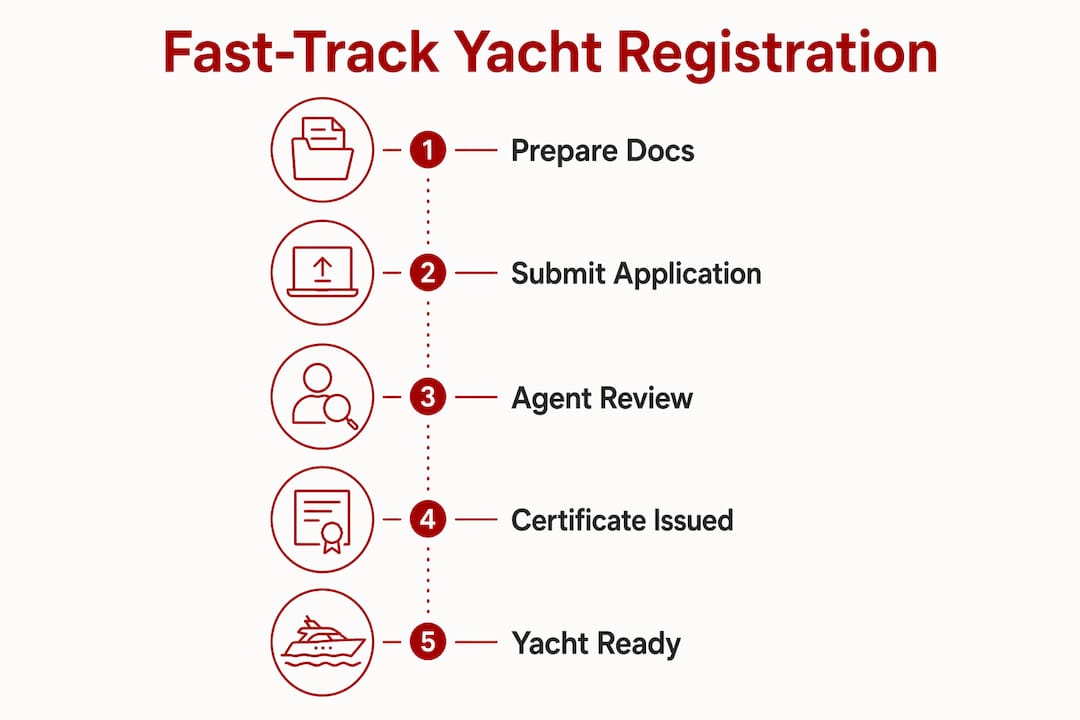
Fast yacht registration follows a defined sequence. Skipping or rushing any step creates the delays that owners are trying to avoid.
- Assess eligibility and select your flag. Confirm your yacht meets the flag state’s size, age, and safety requirements. Consider where you cruise, your tax situation, and whether you need EU flag status. This decision drives every step that follows.
- Gather and certify all required documents. Use the flag state’s official checklist. Apostille or notarize documents as required. Translate any documents not in the flag state’s accepted language.
- Submit your application. Most fast-track registries accept online submissions or agent-assisted filing. Vesselflag’s registration checklist covers what a complete submission looks like.
- Pay registration fees. Expedited registration typically costs 15%–25% more than standard processing. That premium buys priority handling and faster flag state review.
- Receive your provisional certificate. For San Marino and Malta with complete documentation, this arrives within 1–3 working days. The provisional certificate gives you full legal authority to operate while the permanent certificate is finalized.
- Complete full certification. The permanent certificate follows after the flag state completes its full review. This typically takes the remaining portion of the standard 30–60 day window.
| Stage | Fast-track timeline | Standard timeline |
|---|---|---|
| Document preparation | 1–5 days | 1–5 days |
| Application review | 1–3 days | 10–30 days |
| Provisional certificate | 1–3 days | Not always issued |
| Full certificate | 10–14 days | 30–60 days |
Working with a professional registration agent compresses the application review stage significantly. Agents know exactly what each flag state expects and submit complete packages the first time.
For yacht owners arranging logistics around a registration, services like luxury yacht transfers on the French Riviera often coordinate with registration timelines, making the provisional certificate date a practical planning anchor.
What are the common challenges in fast-track yacht registration?
Speed creates pressure, and pressure creates mistakes. The most common reason a fast-track application fails to deliver on its timeline is incomplete or inaccurate documentation submitted in haste.
- Incorrect vessel measurements. Tonnage certificates based on outdated measurement conventions are rejected by most flag states. Verify the measurement standard before ordering the survey.
- Ownership chain gaps. If the yacht changed hands more than once, every transfer must be documented. A missing intermediate bill of sale stops the application.
- Non-compliant safety surveys. Flag states maintain approved surveyor lists. A survey from an unlisted firm is not accepted regardless of its quality.
- Regulatory changes in 2026. Several flag states updated their documentation requirements this year. An agent or platform current with 2026 rules prevents last-minute surprises.
- Timing against operational schedules. Submitting an application two days before a charter season begins leaves no buffer. Build at least a one-week margin around your provisional certificate target date.
Rushing the document preparation phase to save a day at the start routinely costs a week at the review stage. The registries that move fastest are also the most precise about what they accept. Submitting a complete, accurate package on day one is the only reliable way to get a certificate in 72 hours.
Conseil de pro : Review the fast-track compliance timelines for your target flag state at least 30 days before you need the certificate. Regulatory updates in 2026 have changed document requirements in several jurisdictions.
Principaux enseignements
Selecting the right flag state and submitting complete documentation are the two actions that determine whether fast-track yacht registration delivers a certificate in days or drags into weeks.
| Point | Détails |
|---|---|
| Speed depends on jurisdiction | San Marino and Malta issue provisional certificates in 1–3 working days with complete documents. |
| Documentation is the bottleneck | Missing or incorrect documents delay even the fastest registries regardless of the expedited fee paid. |
| Expedited registration costs more | Fast-track processing typically adds 15%–25% to standard registration fees. |
| Agent assistance reduces errors | Professional registration agents submit complete packages and liaise directly with flag authorities. |
| Flag choice affects operations | EU flag status, tax treatment, and cruising area access all vary by jurisdiction and must match your use case. |
What I have learned from handling yacht fast-track registrations
The yacht owners who get the most out of expedited registration are not the ones who move fastest. They are the ones who prepare most thoroughly before they submit anything. Speed at the application stage is a product of preparation, not urgency.
The jurisdictions that attract the most fast-track applications, San Marino, Malta, and Panama, have earned that volume by being consistent. They process complete applications quickly and reject incomplete ones immediately. That consistency is a feature, not a flaw. It means you can plan around their timelines with confidence.
The choice of flag state deserves more strategic thought than most owners give it. A flag that saves two weeks on registration but creates complications in your primary cruising waters is a poor trade. Malta makes sense for Mediterranean operators. Panama makes sense for Caribbean and transatlantic routes. The Marshall Islands works well for owners who prioritize minimal ongoing compliance burden. Match the flag to how and where you actually use the vessel.
Digitalization is accelerating this entire process. Several flag states now accept fully digital document submissions with electronic apostilles. That shift is reducing the courier delays that used to add 3–5 days to every application. Owners who build a digital document archive, certified copies, scanned originals, electronic certificates, are positioned to submit a complete application within hours of deciding to register.
— Vessel Flag
How Vesselflag supports your expedited yacht registration
Vesselflag specializes in fast, compliant yacht registration across multiple international flag states, including San Marino, Malta, Panama, and others with proven expedited processes.
The platform guides yacht owners through every stage, from selecting the right flag for their cruising area to submitting a complete document package that meets 2026 flag state requirements. Vesselflag’s Guide complet sur l'immatriculation des yachts covers the full process in plain language, and the team handles direct liaison with flag authorities to keep your timeline on track. Whether you need a provisional certificate in 72 hours or a full registration with corporate ownership structure, Vesselflag provides the expertise to get it done correctly the first time.
FAQ
How fast can I register a yacht under a fast-track option?
San Marino and Malta can issue provisional certificates within 1–3 working days when all documentation is complete and accurate.
What is the cost difference for expedited yacht registration?
Fast-track processing typically costs 15%–25% more than standard registration fees, but reduces total processing time to 10–14 days from the normal 30–60 day window.
Can I register a yacht without being physically present?
Seychelles allows registration without the owner’s physical presence, and most fast-track registries accept online or agent-assisted submissions from any location.
What documents do I need for fast-track yacht registration?
Core documents include proof of ownership, a builder’s certificate, a tonnage certificate, a safety inspection report from an approved surveyor, crew licensing documentation, and a valid insurance certificate.
Do I need a registration agent for expedited yacht registration?
A registration agent is not legally required, but professional agents submit complete packages, liaise with flag authorities, and significantly reduce the risk of delays caused by documentation errors.
Recommandé
- 2025 Processus d'immatriculation des bateaux - Guide stratégique complet pour les propriétaires de yachts - Vessel Flag
- Vessel registration checklist: fast-track compliance for yacht owners
- Top yacht documentation requirements in 2026: 30% faster
- Enregistrement des yachts d'entreprise : simplifier la propriété en 2026