

Dual registration lets an owner run a yacht under a single flag while switching between private and limited commercial (charter) status, using temporary operational certificates rather than a full commercial conversion. That flexibility comes with a catch: the registry’s paperwork only works if local charter law, VAT rules, and Port State Control still get satisfied every time the vessel changes mode. Get the switch wrong and you risk detention or fines, not just an awkward conversation with a boarding officer.
TL;DR:
- Owners must ensure their vessel maintains current class certificates and surveys year-round to avoid enforcement issues during port inspections.
- Proper documentation includes active temporary commercial certificates, filed log entries, and customs paperwork specific to the vessel’s operating jurisdiction.
- The Cayman YET program allows up to 84 charter days annually, but compliance gaps like lapsed surveys or missing paperwork can lead to detention.
- Handling dual registration requires advanced planning, reliable record-keeping, and coordination with specialists to meet different regional legal and operational requirements.
- Insurance policies must cover both private and commercial modes, with explicit endorsement for charter activity, to prevent coverage lapses during operations.
Table of Contents
- How Dual-Use Registration Regimes Actually Work
- What Eligibility and Safety Standards Apply?
- What Documents and Customs Paperwork Do You Need?
- Operational Checklist for Switching Between Modes
- What Are the Enforcement Risks and Compliance Gaps?
- VesselFlag’s Role in Dual-Registration Support
- Step-by-Step: Registration Procedures, Authorities, and Timelines
- Cost Implications and Fee Structures
- Insurance Requirements for Dual-Registered Yachts
- Cross-Border Legal Considerations
- Handling Disputes and Enforcement Actions
- Why Dual Registration Makes Sense for the Right Owner
- Ready to Register Your Yacht for Dual Use?
- Sources
- FAQ
How Dual-Use Registration Regimes Actually Work
Most dual-use programs fall into a handful of recognizable models. PYLC (Pleasure Yacht/Limited Charter, sometimes called PYET, Pleasure Yacht Engaged in Trade) lets a privately registered yacht take on paying charter guests for defined periods without re-flagging. YET (Yacht Engaged in Trade) programs, most notably the Cayman Islands version, work the same way but with their own eligibility and paperwork trail. Both rely on issuing a temporary commercial certificate, or suspending the private Certificate of Registry, rather than starting the registration process from scratch.
The mechanics matter more than the label. When a yacht shifts into commercial mode, the registry typically issues a temporary Certificate of British Registry (or equivalent) alongside a Certificate of Compliance, while the private certificate goes into a filed, inactive state. Switch back, and the process reverses.
- The Cayman YET program allows qualifying yachts to charter up to 84 days per year under a temporary CoBR.
- Antigua & Barbuda’s dual-mode PYET circular requires separate certificate sets for each mode.
- Maritime Cook Islands requires owners to declare their intent to dual register at the application stage, not after the fact.
What Eligibility and Safety Standards Apply?
Registries don’t hand out dual-use status to anything that floats. Length overall and gross tonnage minimums are the first filter. Many programs set the bar around 24 meters, and most expect the vessel to hold classification society status under a recognized code such as the Large Yacht Code (LY3) or its equivalent REG Yacht Code.
Eligibility is really a proxy for one question: can this yacht meet commercial safety standards continuously, not just during the charter window?
- Classification and survey certificates must stay current year round, not just during chartered periods.
- Manning levels need to satisfy Maritime Labour Convention requirements whenever the vessel operates commercially.
- “In-class” status means the yacht has passed the surveys required to keep its class certificate valid, a status insurers and Port State Control both check.
Pro Tip: Book your annual class survey a few months before your first planned charter window, not the week before. A lapsed survey date is the single most common reason a yacht gets bumped out of commercial mode right when its owner needs it most.
What Documents and Customs Paperwork Do You Need?
Chartering under a dual registration regime means carrying two paper trails: one for the vessel’s legal status, one for the fiscal side. Miss either, and you’re exposed the moment a customs officer or class surveyor asks a question.
- Temporary commercial certificate. This is the temp CoBR or YET certificate that activates the yacht’s commercial mode, plus its accompanying Certificate of Compliance.
- Charter agreement. A signed contract identifying the vessel, dates, guests, and fee structure, kept aboard for the duration of the charter.
- Customs and Temporary Admission paperwork. If the yacht is operating in EU waters without VAT paid, Temporary Admission rules restrict commercial use; chartering under VAT-paid status avoids that conflict but changes the tax exposure.
- TACA and clearance documents. The Cayman YET guidance note spells out how customs clearance interacts with YET status, and most owners use a customs broker to keep this current in each jurisdiction they visit.
Owners, not registries, carry the responsibility for confirming that local law even permits private-yacht charters in the first place, a point registry advisories repeat often enough that it’s worth taking seriously.
Operational Checklist for Switching Between Modes
Getting the paperwork right once isn’t the hard part. Doing it correctly every single time a yacht flips between private and commercial status is where owners slip up.
- Notify the registry in advance. Antigua & Barbuda’s circular, like most dual-mode programs, requires advance notice of a mode change, including the intended charter dates and vessel location.
- Display the active certificate; file the inactive one. Only one certificate set should be visible and operative aboard at a time.
- Log the switch. Registries expect a logbook entry recording exactly when the mode change happened and who authorized it.
- Confirm insurance and crew before departure. Verify the policy covers commercial charter use and that manning meets MLC requirements for the mode you’re entering.
- Close out customs on exit. File the customs departure entry, archive the charter paperwork, and formally return the vessel to private mode once guests disembark.
Pro Tip: Keep a single physical folder (or a shared drive, if the captain prefers digital) with both certificate sets, the current survey report, and the last three logbook mode-change entries. When a Port State Control officer boards, that folder is the difference between a five-minute check and a half-day delay.
What Are the Enforcement Risks and Compliance Gaps?
Port State Control doesn’t grade on a curve because a yacht spends part of the year in private mode. Inspectors apply commercial-standard scrutiny the moment a vessel is operating, or shows signs of having recently operated, under its charter certificate. That’s the uncomfortable truth many owners discover only after a boarding.
The gap between what owners assume and what inspectors check tends to show up in a few recurring places:
- Class certificates that lapsed weeks earlier because a survey got postponed.
- Missing MLC or SOLAS documentation left aboard from the private-mode filing instead of the commercial set.
- Manning that satisfies private-mode minimums but falls short of commercial requirements.
- Customs or TACA paperwork that was never filed for the jurisdiction the yacht is currently in.
One insight from registry guidance is worth repeating directly: the biggest enforcement risk sits at the Port State Control boarding during commercial-mode periods, where inspectors apply full commercial criteria regardless of how few days the yacht charters each year.
Mitigation is less about paperwork volume and more about consistency: keep class and survey status current year round, file certificate sets correctly every time, and use a fiscal agent or customs broker in jurisdictions where the rules shift by port.
VesselFlag’s Role in Dual-Registration Support
Handling a dual-use application yourself means juggling registry correspondence, class documentation, and customs contacts across multiple offices. Specialist services can manage that coordination directly for owners.
- Flag selection guidance based on charter plans, vessel size, and tax exposure.
- Certificate management, from provisional registration through commercial-mode paperwork.
- MMSI and AIS setup, corporate structuring, and insurance introductions as coordinated services.
Processing timelines vary by flag and vessel complexity, so owners should have survey reports, ownership documents, and prior registration history ready before applying. Engaging a specialist makes the most sense when a charter deadline is fixed and there’s no room to redo a rejected filing.
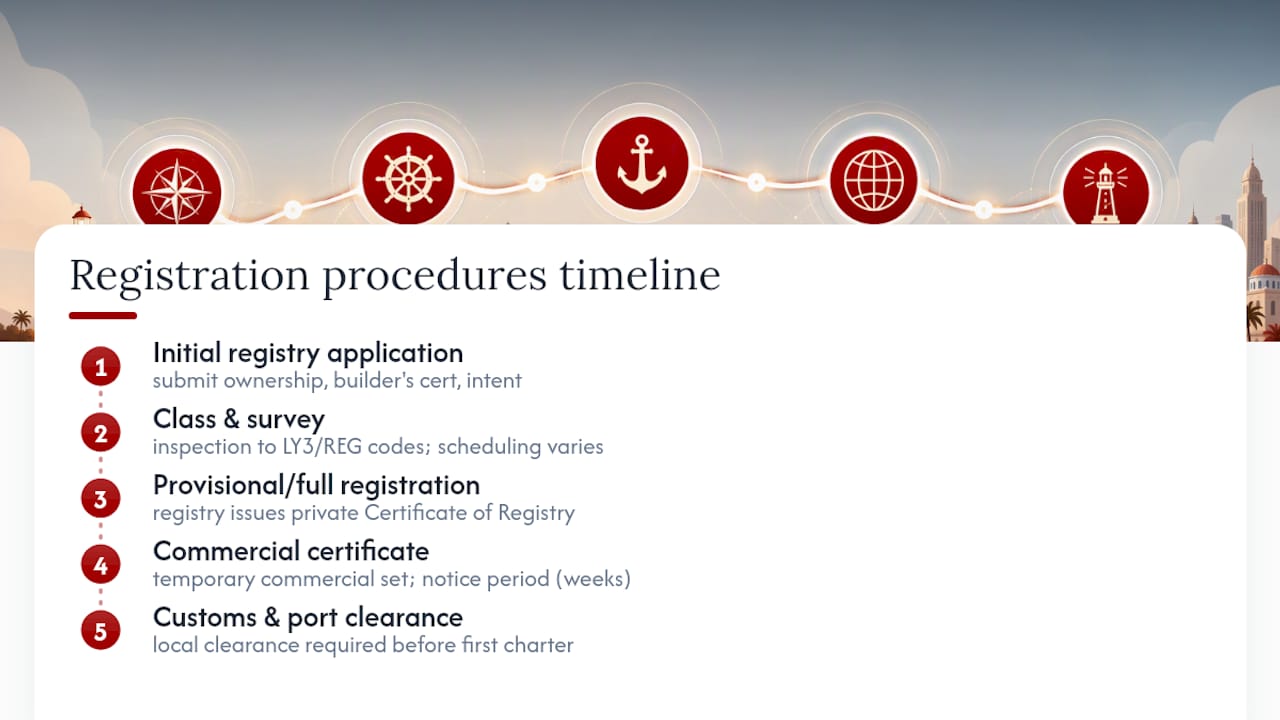
Step-by-Step: Registration Procedures, Authorities, and Timelines
Registering a yacht for dual use starts before the boat ever touches water under its new flag. The sequence typically runs through three authorities: the flag registry, a recognized classification society, and (once chartering begins) the port or customs authority in whatever jurisdiction the charter takes place.
Step 1: Initial registry application. The owner submits ownership documents, a builder’s certificate or bill of sale, and a stated intent to register for dual use where the registry offers that option upfront, as Maritime Cook Islands requires. This stage typically takes a few days to a couple of weeks depending on the flag.
Step 2: Class and survey scheduling. A recognized classification society inspects the vessel against the applicable code (LY3, REG Yacht Code, or equivalent) if it isn’t already in class. This step often runs in parallel with the registry paperwork but can take longer if surveys need scheduling around the yacht’s location.
Step 3: Provisional or full registration. The registry issues the private Certificate of Registry once ownership and technical documents clear. Some flags, including several Vesselflag works with directly, issue provisional registration within days.
Step 4: Commercial certificate activation. When the owner is ready to charter, the registry issues the temporary commercial certificate set, often requiring a notice period of a few weeks rather than same-day approval.
Step 5: Customs and local port clearance. Before the first charter guest boards, the vessel needs clearance from whatever jurisdiction it’s operating in, a step separate from the flag registration entirely.
Cost Implications and Fee Structures
Dual registration costs stack in layers, and owners who budget for only the flag fee get surprised later. The base registration fee depends entirely on the flag chosen. Vesselflag lists San Marino registration at 290 to 2,990 EUR, Malta registration at 780 to 2,420 EUR, and UK Part 1 registration at 550 to 1,050 EUR, with the range typically tracking vessel size and complexity.
On top of the base fee, owners should plan for:
- MMSI licensing. A Polish MMSI license runs 149 EUR, while UK Part 1 MMSI (OFCOM) registration is 150 EUR, and Malta’s MMSI application fee is 649 EUR.
- Class and survey costs, which vary by surveyor and vessel size and aren’t part of any flag’s registration fee.
- Customs broker or fiscal agent fees in each jurisdiction where the yacht charters, since these are local costs outside the registry’s control.
- Corporate setup, if ownership runs through a company rather than an individual. Vesselflag prices a UK Ltd. setup at 349 EUR and a USA LLC setup at 499 EUR.
None of these figures include insurance, which gets priced separately based on vessel value, cruising area, and charter exposure.
Insurance Requirements for Dual-Registered Yachts
A private pleasure policy and a commercial charter policy are not the same product, and running a dual-registered yacht without both is one of the fastest ways to void coverage exactly when you need it. Private hull and liability policies typically exclude commercial activity outright, which means the moment a yacht takes a paying charter guest aboard under its temporary commercial certificate, the private policy’s exclusions can kick in.
The safer structure is a policy, or a policy endorsement, that explicitly covers both operating modes and matches the vessel’s registered status at any given time. Insurers generally want to see the same documentation Port State Control checks: current class certificates, valid manning documents, and proof the commercial certificate is active before charter liability coverage applies. Some underwriters require notification each time the vessel switches modes, mirroring the registry’s own notification requirement.
Liability limits also tend to jump for commercial operation, since a paying guest carries different legal exposure than a private guest. Owners chartering internationally should confirm the policy’s geographic scope covers every jurisdiction on the charter itinerary, not just the flag state.
Cross-Border Legal Considerations
A flag state’s registration doesn’t travel with blanket permission to operate everywhere. Under the international framework, each state sets its own conditions for ship nationality and registration, and that same principle means coastal states retain authority over what happens in their own waters regardless of what flag is flying.
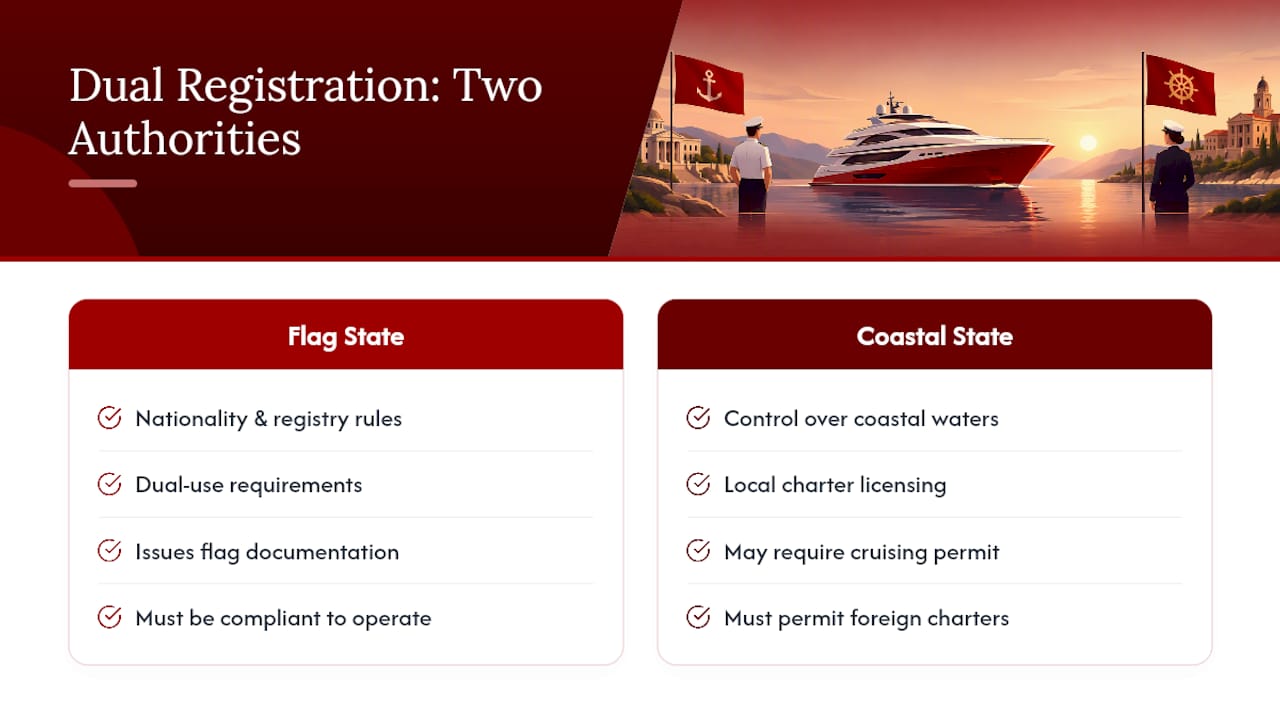
That distinction trips up more owners than any paperwork gap. A yacht correctly registered and dual-mode compliant under its flag state can still be operating illegally if the coastal state where it’s chartering doesn’t permit foreign-flagged private charters, or requires a local cruising permit the owner never applied for. NOAA’s guidance on jurisdiction over vessels lays out how national and coastal authority interact, a framework that applies well beyond U.S. waters in principle even where the specific rules differ.
Practically, this means checking two separate rulebooks before every charter: the flag registry’s dual-use requirements, and the destination country’s own charter licensing rules. Some jurisdictions require a local charter license entirely separate from the yacht’s flag documentation, and that license has nothing to do with whether the vessel is properly dual-registered.
Handling Disputes and Enforcement Actions
When a Port State Control officer flags a discrepancy, the yacht’s paper trail becomes the entire case. Detentions during commercial-mode inspections typically start with a documentation review, and if the temporary commercial certificate, survey records, or manning documents don’t match what’s required for that mode, the vessel can be held until the gap is resolved.
The fastest path out of a detention is having the registry’s contact information on hand and being able to produce the missing document immediately, whether that’s a current survey report or the customs entry proving legal Temporary Admission status. Owners who filed their certificate sets correctly, as most registry circulars require, generally resolve these disputes in hours rather than days.
Charter-guest disputes are a separate matter entirely, usually resolved through the charter agreement’s own arbitration or jurisdiction clause rather than through the flag registry. That’s one more reason the charter agreement itself needs to be airtight and aboard the vessel at all times, not filed away in an office somewhere. Repeated compliance gaps, on the other hand, can prompt a registry to suspend dual-use privileges altogether, which is a far more serious and lasting consequence than a single detention.
Why Dual Registration Makes Sense for the Right Owner
Dual registration solves a real problem: it lets an owner offset ownership costs with charter income without committing to the full administrative weight of permanent commercial conversion. That’s a genuine trade, not a loophole, but it only works when the owner treats compliance as a year round job rather than a charter-season task.
The mistake Vesselflag sees most often is owners who prepare paperwork only when a charter is booked, then scramble when a survey has lapsed or a certificate wasn’t filed correctly. The fix is simple: build your class survey calendar around your registry’s requirements, not your charter calendar.
— VesselFlag
Ready to Register Your Yacht for Dual Use?
Sorting out flag choice, temporary commercial certificates, MMSI setup, and customs coordination across multiple offices eats weeks most owners don’t have before a charter season starts. Vesselflag handles that coordination as one process instead of five separate applications, working across major registries including San Marino, Malta, the UK, and Poland.
Owners typically start with a flag consultation to match vessel size, charter plans, and tax exposure to the right registry, then move into provisional registration, which several flags process within days rather than weeks. If your yacht needs a genuinely EU-linked option, San Marino registration starts at 290 EUR and includes access to corporate setup services for owners structuring through a company. Request a consultation through Vesselflag to get a timeline specific to your vessel and intended charter jurisdictions before your next booking window closes.
Sources
- IMO — Registration of ships and fraudulent registration matters
- NOAA — Jurisdiction over vessels
- Mondaq — Private Yacht YET Regime overview for Cayman Islands flagged vessels
- Antigua & Barbuda Ship & Yacht Registry — Miscellaneous Circular 2025-002 PYET
- Maritime Cook Islands — Dual Registration
FAQ
What Is the 10% Rule for Yachts?
For dual-registration purposes, the figures that actually matter are the registry’s own eligibility thresholds on length and tonnage, which vary by flag.
Can a Boat Be Titled in One State and Registered in Another?
Yes, in many jurisdictions title and registration are handled separately, and a boat can be titled in one state while registered or documented elsewhere, though the rules differ by country and by flag. For dual-registration purposes, what matters most is which flag registry holds the vessel’s Certificate of Registry, since that registry sets the eligibility and compliance rules that govern private and commercial operation.
What Is the 12-Person Rule on a Yacht?
The rule generally refers to passenger limits that trigger stricter commercial passenger vessel regulations once a yacht carries more paying guests. Yachts operating under dual-use charter regimes typically stay under this threshold specifically to avoid triggering full commercial passenger vessel classification, keeping them within the lighter PYLC or YET framework instead.
How Long Can a Dual-Registered Yacht Charter Each Year?
Charter day limits depend on the specific registry program, but the Cayman Islands YET regime caps qualifying yachts at 84 charter days per year. Other dual-mode programs, including Antigua & Barbuda’s PYET circular, set their own limits and eligibility criteria, so owners need to check the specific flag’s current rules rather than assume one cap applies everywhere.
Does Vesselflag Handle Dual-Registration Paperwork Directly?
Vesselflag manages flag selection, certificate documentation, MMSI and AIS setup, and corporate structuring for owners pursuing dual-use registration. Pricing depends on the flag chosen, with options like Poland Flag Registration starting at 320 EUR; current pricing for each flag is listed on Vesselflag’s site.