

TL;DR:
- VAT is a consumption tax triggered by yacht import, purchase, transfer, or registration, with high costs in the EU.
- Choosing private or commercial registration significantly impacts VAT liability and potential exemptions.
- Proper documentation, flag selection, and expert planning are essential to ensure compliance and optimize VAT costs.
Even experienced yacht owners are routinely blindsided by VAT when registering under a new flag. The rules vary sharply by jurisdiction, registration type, and how you actually use the vessel, and the financial stakes are enormous. A misstep on a 30-meter yacht can mean a six-figure tax bill appearing out of nowhere. This guide cuts through the confusion, explains what VAT really means across popular flag states, and shows you how to structure your registration so you stay compliant and avoid costly surprises. Whether you’re registering privately or commercially, the distinctions matter more than most people realize.
Table of Contents
- VAT basics in yacht registration: What you need to know
- Key differences: Private vs. commercial yacht registration and VAT
- Popular flag states and how VAT is treated
- Special VAT schemes and legal pitfalls to avoid
- Key steps to compliant, VAT-optimized yacht registration
- The hidden complexities of VAT: What most yacht owners miss
- Get expert help for stress-free VAT yacht registration
- Frequently asked questions
Key Takeaways
| Point | Details |
|---|---|
| VAT varies by flag and use | The VAT owed depends on your flag choice and whether your yacht is private or commercial. |
| Commercial exemptions are strict | Only genuine commercial operations qualify for VAT exemption and must meet rigorous requirements. |
| Flag selection impacts costs | Registering under Malta, France, or Spain can significantly change VAT outcomes for yacht owners. |
| Documentation protects you | Careful paperwork and compliance checks help prevent costly audits and invalid registrations. |
| YET and special regimes | Special schemes like YET offer VAT relief but involve precise qualifying rules and risks. |
VAT basics in yacht registration: What you need to know
Let’s start with the basics: what VAT actually means for yacht owners.
VAT (Value Added Tax) is a consumption tax that many countries apply when a yacht is purchased, imported, or transferred in ownership. It is not a registration fee. It is a tax on the economic value of the vessel entering a taxable jurisdiction. That distinction matters because registration and VAT are two separate events, and confusing them is one of the most common mistakes owners make.
In the European Union, VAT applies to most yacht registrations and carries significant cost implications. Standard EU VAT rates on yachts typically range from 18% to 27% depending on the member state. On a vessel worth €1 million, that is between €180,000 and €270,000 in tax exposure. Outside the EU, many popular flag states impose no VAT at all, which is a major reason owners look at offshore registration.
Here is when VAT is typically triggered in the EU context:
- On import: When a non-EU yacht enters EU waters and stays beyond the temporary admission period (usually 18 months)
- On purchase: When a yacht is bought from a VAT-registered seller within the EU
- On ownership transfer: When a vessel changes hands and the new owner is based in an EU country
- On first registration: In some jurisdictions, registration itself triggers a VAT assessment
Understanding yacht registration tax rules before you commit to a flag is essential. The jurisdiction you choose determines not just registration costs but your entire VAT exposure. Non-EU flags like Palau or San Marino do not impose VAT on the vessel itself, but they do not shield you from EU VAT if you sail into European waters and stay.
The key takeaway: VAT liability follows the vessel’s use and location, not just where it is registered.
Key differences: Private vs. commercial yacht registration and VAT
Understanding basic VAT principles, the next step is to see how the rules change based on registration type.
Private use means the vessel is used exclusively for personal enjoyment, with no chartering or commercial activity. In this case, VAT is almost always due when the yacht enters a VAT jurisdiction. There is no exemption pathway for purely private yachts in the EU.

Commercial use is where the rules get more nuanced. If a yacht is genuinely chartered out to paying clients, registered as a commercial vessel, and meets the relevant safety and crewing requirements, it may qualify for a VAT exemption. Commercial registration allows VAT exemption if the vessel is genuinely commercial, registered appropriately, and meets safety and crewing rules, with flags like Malta, France, and Spain being popular choices, often requiring operation partly outside EU waters.
| Feature | Private registration | Commercial registration |
|---|---|---|
| VAT on import (EU) | Almost always due | Potentially exempt |
| Chartering allowed | No | Yes |
| Safety/crewing rules | Basic | Stricter standards |
| VAT rate exposure | Full rate (18-27%) | Reduced or zero if compliant |
| Audit risk | Lower | Higher |
Exploring private vs commercial registration in detail helps you map the right path before you commit. The financial difference between these two routes can be enormous, especially for high-value vessels.
“The commercial exemption is only valid when the chartering activity is genuine, documented, and substantive. Regulators are experienced at identifying arrangements that exist on paper but not in practice.”
Pro Tip: If you are considering commercial registration under a flag like Malta as a flag state, make sure your charter contracts, crew records, and operational logs are complete from day one. Retroactive documentation is a red flag in any audit.
Popular flag states and how VAT is treated
Once you know your use case, your choice of flag can make or break your VAT position.
Flags like Malta, France, and Spain are popular for VAT strategies because commercial registration under these flags provides exemption pathways when requirements are met. Each has its own nuances.
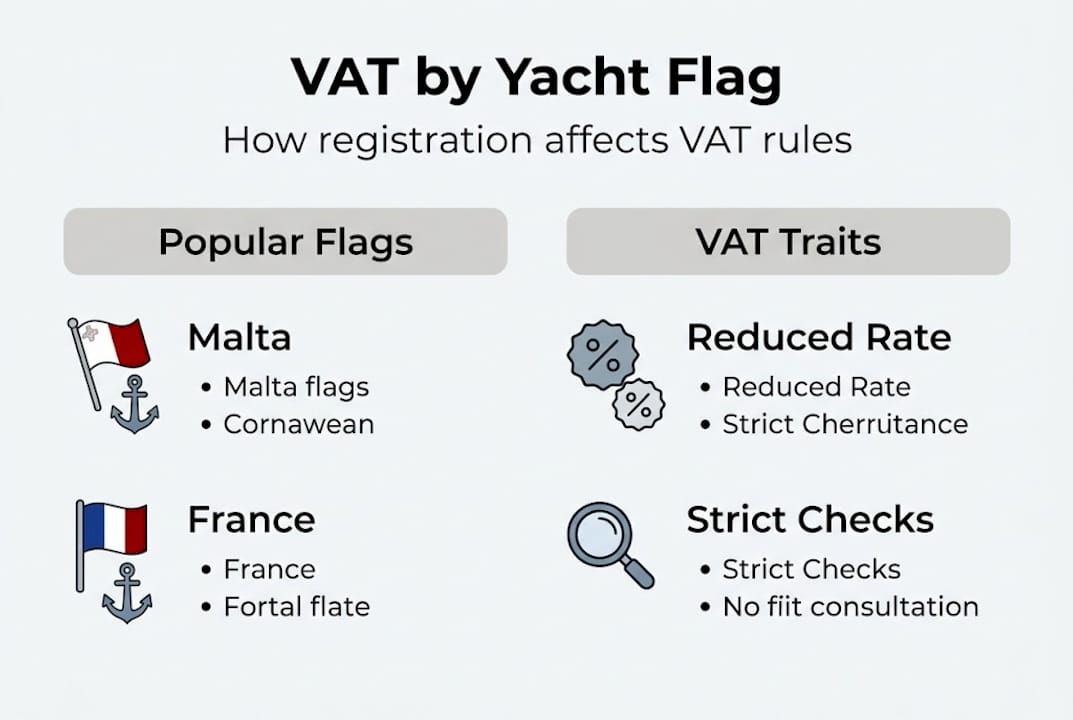
| Flag state | VAT rate | Private yacht | Commercial yacht |
|---|---|---|---|
| Malta | 18% | VAT due on import | Exempt if commercial criteria met |
| France | 20% | VAT due | Reduced exposure with proper structure |
| Spain | 21% | VAT due | Exempt with commercial proof |
| UK (post-Brexit) | 20% | VAT due | Exempt for qualifying vessels |
| British Virgin Islands | 0% | No VAT | No VAT |
Here is a quick breakdown of how each flag handles VAT from a practical standpoint:
- Malta: Strong legal framework, EU membership, and a well-established commercial registration track. Widely used for large charter yachts.
- France: Strict documentation requirements but recognized VAT treatment for commercial vessels operating in the Mediterranean.
- Spain: Popular for charter operations in the Balearics; requires genuine chartering activity and proper licensing.
- UK: Post-Brexit rules apply; VAT-paid status from before Brexit may still be recognized in some cases.
- British Virgin Islands: Zero VAT environment, but EU waters still trigger EU VAT rules regardless of flag.
Review Malta and UK registration requirements if you are weighing those two options. For a 30-meter yacht registered commercially in Malta, the VAT exemption on import can save hundreds of thousands of euros, but only if the commercial activity is real and documented.
Understanding all flag options for yachts side by side helps you make a decision based on total cost, not just registration fees.
Special VAT schemes and legal pitfalls to avoid
Aside from mainstream rules, several special schemes and traps are often misunderstood.
The Yachting Engaged in Trade (YET) scheme is one of the most misapplied mechanisms in yacht VAT planning. The YET scheme permits limited commercial activity for non-EU charterers but is tightly regulated. It is not a blanket VAT holiday. It applies in specific jurisdictions, to specific charterers, under specific conditions.
Here are the top legal pitfalls that lead to audits, back taxes, and invalidated exemptions:
- Artificial leasing arrangements: Setting up a lease between a related company and the owner to simulate commercial use. Tax authorities have seen this structure hundreds of times.
- Improper chartering documentation: Charter agreements that are vague, backdated, or not supported by actual payments and activity logs.
- Flag hopping: Repeatedly changing registration to reset VAT clocks or exploit transitional rules. Authorities track vessel history.
- Misdeclarations on use: Declaring a yacht as commercial when it is primarily used privately, even occasionally.
- Ignoring the substance test: Regulators apply a substance over form analysis. If the commercial structure does not reflect real economic activity, it will not hold up.
A failed audit does not just mean paying the VAT you avoided. It typically includes interest, penalties, and in serious cases, potential criminal liability. Understanding pain points in yacht registration before you register can save you from these scenarios entirely.
Pro Tip: Treat every year of ownership as a potential audit year. Keep a running file of charter contracts, crew logs, maintenance records, and financial transactions related to the vessel.
Key steps to compliant, VAT-optimized yacht registration
To avoid pitfalls, the following best practices lay a clear path forward.
Multiple elements including flag choice, use type, and regular documentation are critical to legal VAT management. Here is a practical framework:
- Assess your use case first. Decide honestly whether the vessel will be used privately, commercially, or both. This single decision shapes every other choice.
- Analyze flag options based on your VAT position. Do not choose a flag solely for low registration fees. Model the total VAT exposure under each option.
- Estimate total VAT liability before purchase. Work with a maritime tax advisor to calculate your worst-case and best-case VAT scenarios before signing any purchase agreement.
- Build your documentation infrastructure. Set up systems for charter contracts, crew records, maintenance logs, and financial records from day one.
- Consult maritime legal and tax experts. Yacht VAT law is specialized. A general tax advisor is rarely sufficient for complex cross-border situations.
- Schedule annual compliance reviews. Laws change. Enforcement priorities shift. What was a safe structure in 2023 may be under scrutiny in 2026.
Using a registration compliance checklist keeps you organized across jurisdictions. And regularly checking how to ensure registration validity means you catch problems before they become expensive.
Proactive planning is always cheaper than reactive damage control.
The hidden complexities of VAT: What most yacht owners miss
While the practical steps cover compliance, understanding the real-world risks is crucial.
Most owners and managers underestimate how quickly VAT exposure can materialize when enforcement priorities shift. The EU has been steadily tightening yacht VAT enforcement, and jurisdictions that were once considered gray areas are now under active scrutiny. Structures that worked five years ago are being challenged today.
The popular belief that picking the lowest-tax flag solves the VAT problem is a false economy. Three traps catch owners repeatedly: choosing a flag without understanding the EU nexus rules, relying on outdated legal opinions that have not been reviewed since the vessel’s use changed, and underestimating how much operational evidence regulators actually demand.
We have seen cases where owners had technically valid commercial registrations but lost their VAT exemption because their charter logs were incomplete. The structure was right. The paperwork was not.
Understanding real registration cost factors means looking beyond the registration fee to the full compliance cost over the vessel’s life. Build documentation as if a tax inspector will review it every single year. That mindset is the most effective VAT risk management tool available.
Get expert help for stress-free VAT yacht registration
If managing VAT and global compliance still feels daunting, expert support is one click away.
VAT planning is not a one-time task. It is an ongoing part of responsible yacht ownership, and getting it right from the start protects your investment for years to come.
VesselFlag.com provides detailed yacht registration guides, jurisdiction-specific resources, and expert support for complex or high-value registrations. Whether you need to understand the difference between yacht or boat registration categories or want a full compliance assurance review, the platform connects you with the tools and expertise to move forward with confidence. Start with the right flag, the right structure, and the right documentation.
Frequently asked questions
Is paying VAT always required when registering a yacht in the EU?
VAT is generally due unless the yacht qualifies for a genuine commercial exemption or falls under a special scheme like YET. The burden of proof for any exemption rests with the owner.
What happens if a yacht registered as commercial is not truly used commercially?
Artificial leasing arrangements to avoid VAT are scrutinized and may be invalidated, triggering back taxes, interest, and penalties. Documented proof of real chartering activity is non-negotiable.
How does the YET scheme affect VAT on private yachts?
The YET scheme is only for limited use and is highly regulated, permitting certain private yachts to engage in commercial activity with limited VAT relief, primarily benefiting non-EU charterers under strict criteria.
Which flags are most popular for VAT optimization in yacht registration?
Malta, France, and Spain are the leading choices due to flexible VAT handling for commercial yachts, established legal frameworks, and recognized special regimes for qualifying vessels.