

Choosing a flag? See our complete guide How to Choose the Right Flag for Your Yacht with prices for 6 flags, or compare Poland vs San Marino vs UK Part 1.
TL;DR:
- Choosing a reputable yacht flag reduces inspection risks, insurance costs, and long-term compliance issues.
- Open flags like Marshall Islands offer low cost but may face more port scrutiny and higher premiums.
- Proper preparation and expert support ensure smoother registration, lower total costs, and global compliance.
Many yacht owners assume the cheapest flag is the smartest flag. It’s an understandable shortcut, but it’s also one of the most expensive mistakes you can make in vessel ownership. Your yacht’s flag determines which country’s laws govern your vessel, how port state control officers treat you at every anchorage, and what your insurer thinks of your risk profile. The right flag can streamline operations, reduce tax exposure, and open doors across international waters. The wrong one can cost you far more in detentions, higher premiums, and compliance headaches than you ever saved on registration fees.
Table of Contents
- What is a flag of convenience and why does it matter?
- Comparing top yacht registration flags and their benefits
- Required documents and the registration process explained
- Cost factors: what you really pay and how to budget
- The uncomfortable truth: why the ‘cheapest flag’ rarely wins
- Unlock global compliance and confidence with expert yacht registration solutions
- Frequently asked questions
Key Takeaways
| Point | Details |
|---|---|
| Flag impacts more than cost | The chosen flag affects your yacht’s taxes, compliance, and global mobility—not just fees. |
| Not all flags offer equal reputability | Higher-prestige flags reduce risk of delays, detentions, and insurance complications. |
| Prepare documentation for speed | Having all documents ready can cut registration time by weeks and reduce hassle. |
| Budget beyond sticker price | Annual fees, compliance, and hidden costs should be weighed—cheap flags can be costly long-term. |
What is a flag of convenience and why does it matter?
Your yacht’s “flag” refers to the national registry it sails under, which determines the legal framework governing everything from crew requirements to safety standards. It’s not just a piece of cloth on the stern. It’s a legal identity for your vessel on the global stage.
A “flag of convenience” (often abbreviated FOC) describes registering your yacht in a country that allows foreign owners to fly its flag, typically with fewer restrictions and lower costs. Panama, Marshall Islands, and Liberia are classic examples in commercial shipping. For yachts, popular open registries include Marshall Islands, Palau, and others that attract owners with streamlined processes and flexible ownership rules.
Why do owners choose open registries? A few compelling reasons:
- Speed: Many open registries process applications in days rather than weeks.
- Cost: Initial and annual fees are often lower than traditional maritime nations.
- Flexibility: Fewer restrictions on crew nationality and vessel use.
- Privacy: Some registries allow corporate ownership with minimal disclosure.
But there are real tradeoffs. Open flags like Marshall Islands are flexible with lower regulatory burdens but viewed by some port state control authorities as “convenience” flags, which can trigger more frequent inspections. Insurers may also apply higher premiums to vessels under certain open registries, viewing them as higher risk due to less rigorous oversight.
“The flag you choose is your vessel’s legal passport. A reputable one opens doors; a questionable one invites scrutiny at every port.”
Understanding registration cost factors before you commit is essential. Reputable flags often cost more upfront but save significantly on compliance friction, insurance costs, and port delays over time. The math usually favors quality over bargain hunting.
Comparing top yacht registration flags and their benefits
Not all flags are created equal, and the differences go well beyond annual fees. Here’s how the most popular yacht registration options stack up across the metrics that actually matter to operators.
| Flag | Reputation | Avg. annual cost | VAT benefit | Processing time |
|---|---|---|---|---|
| Malta | Very high (EU) | €10,000 to €18,000 | Yes, exemptions/deferrals | 2 to 4 weeks |
| Marshall Islands | Moderate | $5,000 to $10,000 | No | 1 to 2 weeks |
| UK (Red Ensign Group) | Very high | £8,000 to £15,000 | Varies by territory | 3 to 6 weeks |
| Poland | High (EU) | €4,000 to €8,000 | EU VAT rules apply | 2 to 4 weeks |
| San Marino | High | €3,000 to €7,000 | Favorable | 1 to 3 weeks |
Malta yacht benefits stand out for Mediterranean operators. Malta offers EU flag status, tax exemptions and deferrals, and strong global recognition, though costs run higher at €10,000 to €18,000 annually. For owners cruising European waters regularly, that investment pays back through smoother port entries and favorable VAT treatment.

Poland and San Marino are underrated choices. Both carry EU or European credibility, competitive annual registration costs, and faster processing than many assume. San Marino, despite being landlocked, maintains a recognized maritime registry that offers real advantages for owners who want European credibility without Malta’s price tag.
Key things to evaluate beyond the fee schedule:
- Port state control acceptance: How do major port authorities view this flag?
- Insurance implications: Does your preferred insurer charge more for this registry?
- Crew nationality rules: Are there restrictions on who can serve aboard?
- Tax and VAT structure: Does the flag allow legitimate tax optimization?
Review the full registration requirements for each flag before making any assumptions. What looks cheap on paper can carry hidden costs in compliance complexity.
Pro Tip: If you charter your yacht commercially, flag reputation directly affects charterer confidence and marina access in premium destinations. A well-regarded flag is a marketing asset, not just a legal formality.
Required documents and the registration process explained
Once you’ve narrowed down your flag options, the registration process itself follows a fairly consistent structure across most jurisdictions. Knowing what’s required in advance saves time and prevents costly delays.
Registration usually requires proof of ownership, a tonnage certificate, and possibly a survey, with the full process taking anywhere from one to eight weeks depending on the flag and your preparation.
Here’s a typical step-by-step flow:
- Confirm eligibility: Verify that you or your corporate entity qualifies to register under the chosen flag.
- Gather ownership documentation: Bill of sale, builder’s certificate, or deletion certificate from a previous registry.
- Obtain a tonnage measurement: Required by nearly all flags; some accept third-party certificates.
- Commission a survey: Not always mandatory, but often required for vessels over a certain age or size.
- Submit the application: Via the flag’s maritime authority or through a licensed registration agent.
- Receive provisional certificate: Most flags issue a temporary certificate while the full registration is processed.
- Obtain the full certificate of registry: Valid for one to five years depending on the flag.
| Document | Required by most flags | Notes |
|---|---|---|
| Proof of ownership | Yes | Bill of sale or builder’s cert |
| Tonnage certificate | Yes | Issued by approved measurer |
| Survey report | Often | Age and size dependent |
| Corporate documents | If applicable | For company-owned vessels |
| Deletion certificate | If re-flagging | From previous registry |
Using a corporate structure to own your yacht can accelerate the process significantly. The corporate registration benefits include cleaner ownership chains, easier transfer of ownership, and in some jurisdictions, more favorable tax treatment. Many experienced owners register vessels under a dedicated single-purpose company for exactly these reasons.
For a detailed walkthrough of the full submission process, the process compliance guide covers jurisdiction-specific requirements and timelines in depth.
Pro Tip: Prepare all documents in certified, translated form before submitting. Incomplete or non-certified paperwork is the single biggest cause of registration delays across every flag state.
Cost factors: what you really pay and how to budget
The registration fee you see advertised is rarely the full picture. Understanding the complete cost structure helps you budget accurately and avoid surprises that derail your plans.
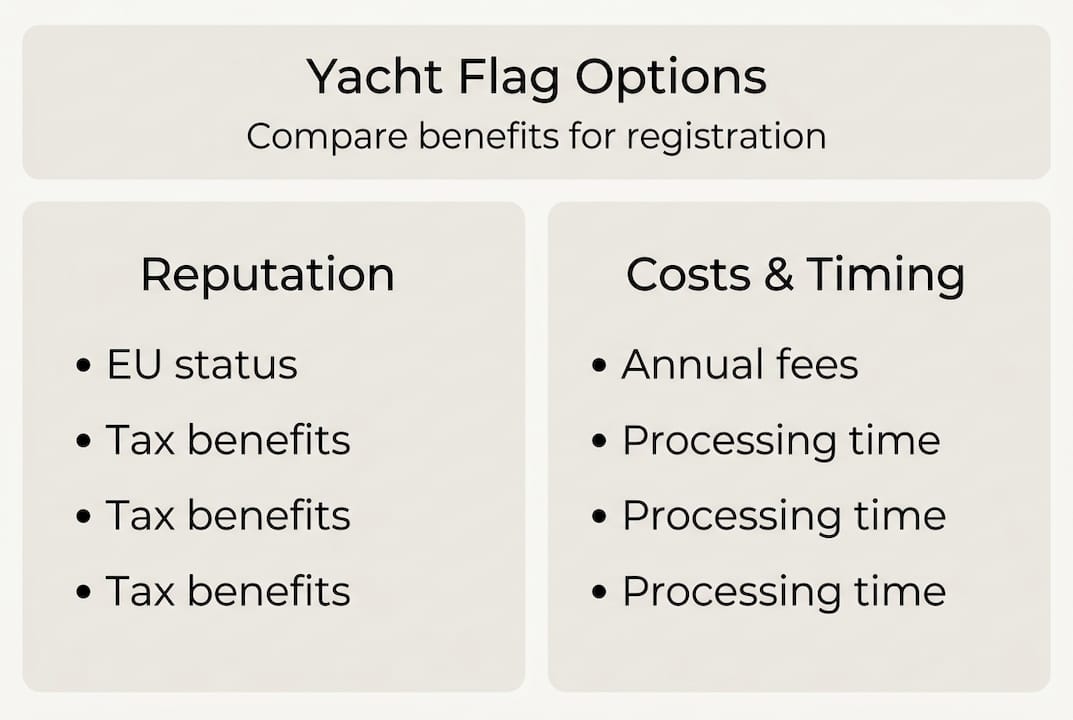
Costs scale with tonnage and typically range from $5,000 to $15,000 annually for yachts over 24 meters. But that figure is just the start.
Here’s what actually contributes to your total cost:
- Initial registration fee: Paid once, varies by flag and vessel size.
- Annual renewal fees: Recurring, often tonnage-based.
- Agent or consultancy fees: If you use a registration service (usually worth it).
- Survey costs: One-time or periodic depending on flag requirements.
- Tonnage measurement fees: Often a separate charge from the registration itself.
- VAT or import duties: Depends on where the vessel operates and the flag’s tax treatment.
- Compliance costs: Safety equipment, crew certification, and documentation updates.
- Insurance premiums: Indirectly influenced by flag reputation.
Bargain flags can backfire in ways that aren’t obvious upfront. A vessel flagged under a registry with a poor port state control record faces a higher probability of detention during inspections. Even a single detention costs you far more in lost charter revenue, legal fees, and reputation damage than years of registration savings.
The cost factors guide breaks down how to compare total cost of ownership across different flags, accounting for both direct and indirect expenses. Use it as a planning tool, not just a reference.
Pro Tip: Always request an itemized cost breakdown from any registration provider before committing. Ask specifically what is and isn’t included in their quoted fee, including annual renewal support and compliance updates.
The uncomfortable truth: why the ‘cheapest flag’ rarely wins
We’ve worked with enough yacht owners to recognize a pattern. The ones who chose their flag based purely on the lowest quote often come back to us later, frustrated by problems that were entirely predictable.
Port state control inspections are not random. Vessels flagged under registries with poor compliance records get targeted more frequently. When an inspection finds deficiencies, the consequences go beyond a fine. Your vessel can be detained, your charter schedule collapses, and your reputation with marina operators takes a hit that takes seasons to recover from.
Insurers are equally unforgiving. Underwriters track flag state performance closely, and certain registries carry surcharges that quietly inflate your annual premium. Owners who prioritize reputable flags over the cheapest options consistently avoid these port state control risks and insurance complications.
What we’ve seen repeatedly: owners who invest in quality registration and ongoing compliance support spend significantly less on mitigation, fines, and downtime over a five-year period than those who optimized for the lowest initial cost. The flag is only part of the equation. The support structure around it, including compliance monitoring, document renewals, and expert guidance, is what keeps you sailing without interruption.
Explore best compliance practices to understand what ongoing compliance actually looks like in practice and how to build it into your operational budget from day one.
Unlock global compliance and confidence with expert yacht registration solutions
Choosing the right flag is one of the most consequential decisions you’ll make as a yacht owner, and it deserves more than a quick internet search. VesselFlag.com connects you with proven registration expertise across multiple international flags, from Malta and Poland to San Marino and beyond.
Whether you’re registering a new vessel, re-flagging an existing one, or simply auditing your current compliance posture, we provide transparent, end-to-end support that covers documentation, flag selection, corporate structuring, and ongoing renewals. Start with the complete yacht registration guide for a full overview, compare your options using our yacht vs boat registration resource, and take concrete steps to ensure registration compliance before your next voyage.
Frequently asked questions
What is a yacht flag of convenience?
A flag of convenience means registering your yacht in a country that permits foreign ownership under its flag, typically with fewer restrictions and lower costs. Open flags like Marshall Islands are popular for their flexibility and lower regulatory burdens, though they may attract more port state scrutiny.
Which flag is best for VAT optimization on a yacht?
Malta is the leading choice for VAT optimization, particularly for yachts operating in Mediterranean waters. Malta offers EU flag status with structured VAT exemptions and deferrals that can produce meaningful savings for qualifying vessels.
How long does yacht registration take?
Vessel registration processes range from one to eight weeks depending on the flag state and how completely you’ve prepared your documentation before submitting.
What documents are required to register a yacht?
You typically need proof of ownership, a tonnage certificate, and survey documentation, plus corporate registration papers if the vessel is owned by a company. Registration generally needs these core documents across most flag jurisdictions.
Are cheap flags really worth it?
Rarely. Prioritize reputable flags over the cheapest option to avoid port state control risks, insurance surcharges, and compliance complications that typically cost far more than the initial savings.