

Yes, you can register a mortgage on a yacht by recording it with the vessel’s registry, and doing so is what turns a private loan agreement into a legally protected security interest. In the United States, that means filing with the U.S. Coast Guard’s National Vessel Documentation Center and attaching Form CG-5542 to the mortgage instrument. Before you file anything, confirm the yacht’s Certificate of Documentation is current, since a mortgage cannot be recorded against a vessel whose documentation status is unclear.
TL;DR:
- Recording a mortgage against a yacht establishes priority based on filing date and time, not loan amount or negotiation terms.
- A mortgage must be submitted with a properly completed Form CG-5542 and match the vessel’s documentation details to avoid rejection delays.
- Filing fees are calculated per page, making longer documents with exhibits more costly to record, and complete paperwork speeds up processing.
- Priority among liens is fixed by the recording timestamp, so filing immediately after closing is crucial to protect the lender’s claim.
- Foreign-flagged vessels or if the lender is not eligible for preferred mortgages require additional steps, such as trustee arrangements or legal review.
Table of Contents
- Why recording a mortgage matters to owners and lenders
- The U.S. process: NVDC, preferred mortgages, and Form CG-5542
- Documents, formalities, and common filing mistakes
- What to expect after you file: timeline and costs
- Priority, enforcement, and cross-jurisdictional issues
- Mortgage trustees and preferred mortgage eligibility
- Step-by-step checklist to file a mortgage with the NVDC
- Owners can prepare mortgage instruments, complete CG-5542 attachments accurately, coordinate notarization, and manage interactions with registries to ensure filings proceed cleanly the first time. That matters because the most common delays stem from identifier mismatches, missing acknowledgments, or incomplete CG-5542 forms, all avoidable with a careful first pass. Professional services may include document review, filing, follow-up, and delivery of the recorded copy once the registry returns it.
- Practical priorities for owners and lenders
- Mortgage filing errors often cause delays unrelated to loan terms, but proper document preparation, accurate CG-5542 completion, and notarization coordination can help keep a mortgage moving through the registry on the first attempt, ideally with a single point of contact from drafting to receiving the recorded copy.
- Sources
- FAQ
Why recording a mortgage matters to owners and lenders
Recording a mortgage is not paperwork for its own sake. It creates public notice of the lender’s claim and fixes the mortgage’s rank against other creditors from the moment it enters the registry.
Without recordation, a lender’s interest exists only as a private contract between two parties, invisible to a future buyer, a second lender, or a court. That gap matters because unpaid maritime liens, such as those for repairs, fuel, or crew wages, can attach to a vessel regardless of who holds the loan. A recorded mortgage does not erase those liens, but it gives the lender a documented position from which to compete for repayment if the vessel is sold or arrested.
- Recordation establishes priority ranked by date and time of filing, not by loan amount or negotiation.
- A mortgage is a consensual security interest; a maritime lien can arise automatically from unpaid services or claims against the vessel.
- The registry’s reputation for enforcement and transparency affects how confidently a lender will extend financing against that flag.
The U.S. process: NVDC, preferred mortgages, and Form CG-5542
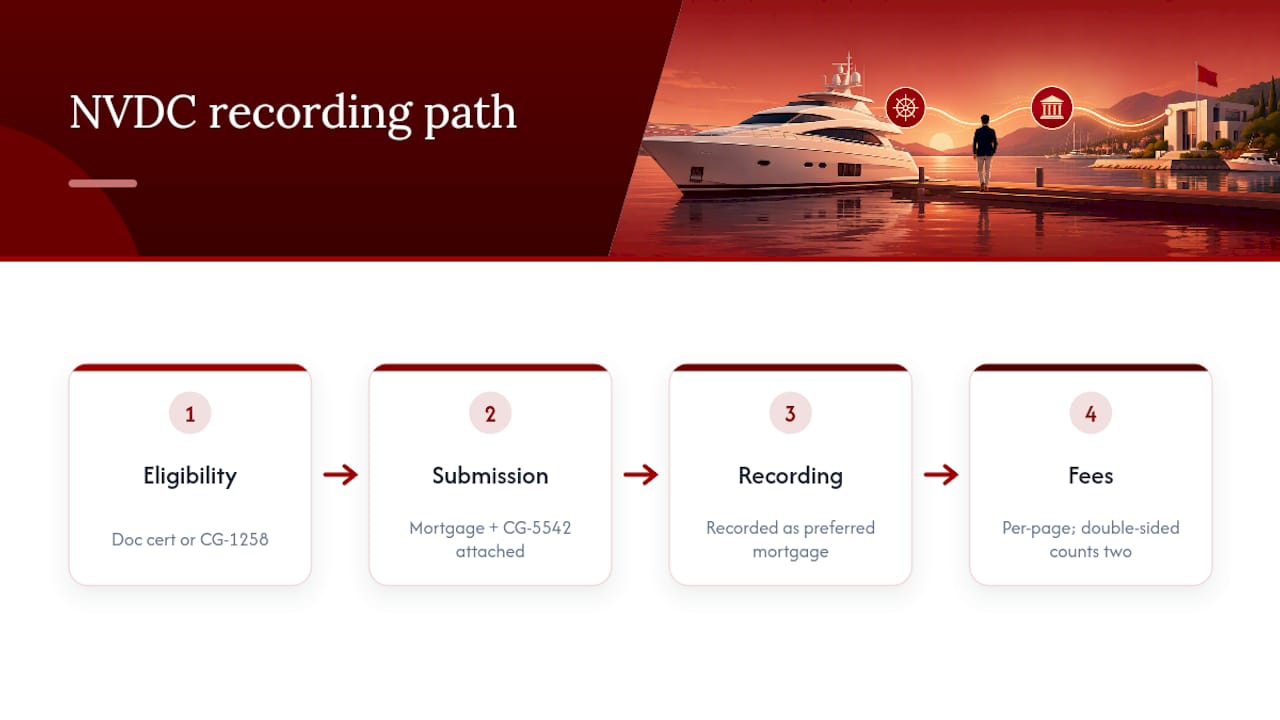
The National Vessel Documentation Center is the federal office that records mortgages against documented vessels, and its filings create what the law calls a preferred mortgage, a status that gives the lender priority ranking above most other claims that arise after recording. There is no standalone government mortgage form. Instead, the mortgage instrument is drafted to meet statutory content requirements and submitted with Form CG-5542 attached.
Filing fees run a small per-page recording fee for mortgage documents, with a page printed on both sides counted as two pages for fee purposes, according to NVDC instructions. That per-page structure means a longer mortgage instrument, with exhibits and schedules attached, can cost noticeably more to record than a short one.
Two conditions determine whether the NVDC will accept your filing at all. First, the vessel must carry a valid Certificate of Documentation, or have an Application for Initial Issue (CG-1258) already on file. Second, if CG-5542 is properly completed and attached, the NVDC will file and record the instrument without further review, which is the fastest path to a clean recording.
Documents, formalities, and common filing mistakes
A mortgage instrument submitted to the NVDC needs specific content to be accepted, and skipping any one item is the most common reason filings bounce back for correction.
- Full legal names and addresses of both the mortgagor (borrower) and mortgagee (lender).
- The vessel’s name along with its official number or hull identification number, written exactly as it appears on the Certificate of Documentation.
- The principal sum secured by the mortgage, stated in the instrument itself.
- Signatures from all parties, with a notary public’s acknowledgment attached to each signature.
- Proof of ownership, such as a bill of sale or prior title, when the vessel’s documentation record does not already establish it.
Filings most often fail for one of a few avoidable reasons: an unsigned or unacknowledged instrument, a vessel identifier that does not match the documentation record, or a mortgage submitted without CG-5542 attached. Each of these triggers additional review or outright rejection rather than a straightforward recording.
Pro Tip: Double-check the hull number and official number against the current Certificate of Documentation before you draft the mortgage. A single transposed digit is enough to delay recording by weeks.
For a fuller breakdown of what owners need to gather before filing, VesselFlag’s guide to key vessel registration documents walks through the paperwork in more detail.
What to expect after you file: timeline and costs
Processing speed depends heavily on how the mortgage is submitted and whether the paperwork is complete on the first pass.
- Electronic submission through the NVDC’s filing channels generally moves faster than mailed paper submissions, which must be physically received and logged before review begins.
- Once recorded, the NVDC returns an endorsed copy of the mortgage to the filer, and that endorsement is the legal marker of the recording date and time, which is what fixes priority.
- Direct costs are dominated by the $4.00-per-page recording fee, but budget for notary charges, courier or delivery costs if filing by mail, and any legal review of the instrument itself.
A clean CG-5542 attachment and a well-paginated instrument keep the per-page fee predictable and avoid the added cost of a rejected filing that has to be corrected and resubmitted.
Priority, enforcement, and cross-jurisdictional issues
Priority among competing mortgages is generally set by the date and time a mortgage is recorded, not by when the loan was signed or funded. That is why a lender wants the shortest possible gap between closing and filing.
- Some registries outside the United States, including the Cayman Islands Shipping Registry, allow a priority notice that reserves a mortgage’s ranking for a limited period before the full mortgage is registered.
- A recorded mortgage gives the lender a documented, enforceable position and puts third parties on notice, which matters if the vessel is later sold, refinanced, or arrested over unrelated debts.
- When a yacht flies a flag other than the one where the loan originated, enforcement and recognition of the mortgage depend on that flag state’s own laws and registry practice, not on U.S. rules.
Owners moving a yacht between flags, or financing a purchase on a foreign-flagged vessel, should treat the registry’s own mortgage rules as the controlling framework rather than assuming U.S. practice transfers automatically.
Mortgage trustees and preferred mortgage eligibility
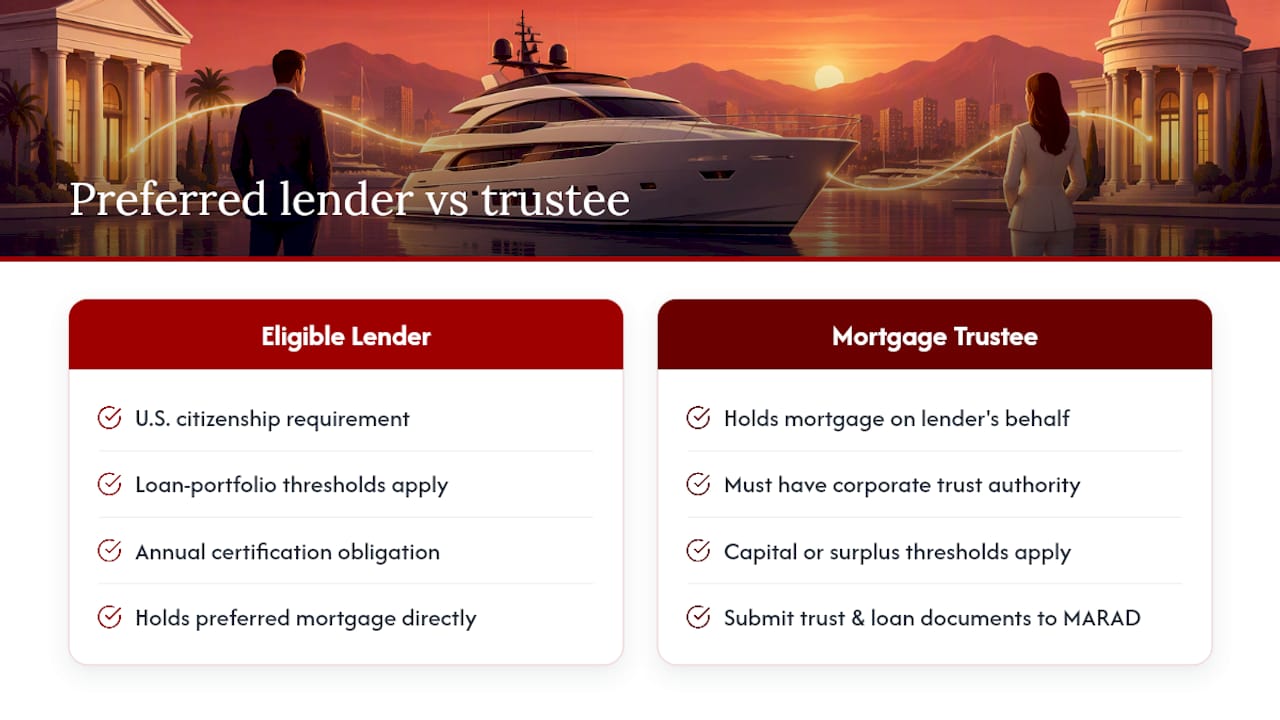
Not every lender qualifies to hold a preferred mortgage directly under U.S. rules. 46 CFR §356.19 sets out the eligibility categories, including U.S. citizenship requirements and loan-portfolio thresholds for commercial lenders, along with annual certification obligations for those who hold preferred mortgages.
When a lender does not fit one of those categories, a qualified mortgage trustee can hold the mortgage on the lender’s behalf. 46 CFR §356.27 requires trustees to meet corporate trust authority and capital or surplus thresholds, and to submit trust agreements and loan documents to MARAD’s Citizenship Approval Officer for review.
A mortgage trustee must submit trust agreements, loan documents, and the preferred mortgage instrument for review when the beneficiary does not itself qualify as an eligible commercial lender.
That review exists to prevent arrangements that would effectively transfer control of a U.S.-flagged vessel to a party who could not otherwise hold the mortgage.
Step-by-step checklist to file a mortgage with the NVDC
Filing cleanly the first time saves weeks compared to correcting a rejected submission.
- Confirm the vessel’s Certificate of Documentation is current, or that an initial-issue application (CG-1258) is on file.
- Gather ownership evidence, including bills of sale or prior title documents, in case the documentation record needs support.
- Draft the mortgage instrument with all statutory content: party names and addresses, vessel identifiers, principal sum, and signature blocks.
- Sign the instrument and have it acknowledged by a notary public.
- Attach Form CG-5542 to the completed instrument.
- Submit through the NVDC’s eStorefront or by mail, with the correct per-page fee included.
- Track the filing and confirm receipt of the recorded, endorsed copy, which establishes your recording date for priority purposes.
VesselFlag’s broader guide on how to register a yacht covers the documentation steps that come before this checklist for owners who have not yet finalized their vessel’s registration.
Owners can prepare mortgage instruments, complete CG-5542 attachments accurately, coordinate notarization, and manage interactions with registries to ensure filings proceed cleanly the first time. That matters because the most common delays stem from identifier mismatches, missing acknowledgments, or incomplete CG-5542 forms, all avoidable with a careful first pass. Professional services may include document review, filing, follow-up, and delivery of the recorded copy once the registry returns it.
Practical priorities for owners and lenders
Correctness beats speed every time in mortgage filing. A rejected instrument costs more in delay and legal fees than the extra day it takes to check vessel identifiers, confirm notarization, and attach CG-5542 properly before submission.
If a lender does not clearly meet U.S. preferred-mortgage eligibility, raise the trustee question early rather than after a rejection. And for anything involving a foreign flag or a contested claim, bring in counsel or a registry specialist before signing rather than after a dispute surfaces.
— VesselFlag
Mortgage filing errors often cause delays unrelated to loan terms, but proper document preparation, accurate CG-5542 completion, and notarization coordination can help keep a mortgage moving through the registry on the first attempt, ideally with a single point of contact from drafting to receiving the recorded copy.
That same document discipline applies whether you are registering the underlying vessel under San Marino, Malta, or another flag, and before financing a purchase, it is worth confirming safety and equipment readiness such as the checks outlined in Banshee Battery’s marine installation guide. Request a document review or a quote through VesselFlag’s services page to get a clear timeline before you file.
FAQ
How much will monthly payments run on a $100,000 boat loan?
Monthly payments depend on the loan term, interest rate, and down payment, none of which are fixed figures, so there is no single number that applies across lenders. A loan officer or marine lender can generate an exact figure once your rate and term are set.
What happens if a boat is not properly registered?
An unregistered or improperly documented vessel cannot have a mortgage recorded against it, since the NVDC requires a valid Certificate of Documentation or a pending initial-issue application on file before it will accept a mortgage filing. State-level registration requirements for recreational boats vary and operate separately from federal documentation, so check your state’s rules directly.
Is it difficult to get approved for a boat loan?
Approval depends on the lender’s own criteria, including creditworthiness, the vessel’s age and value, and the loan amount relative to that value, so difficulty varies by borrower and lender rather than being uniform. Preferred mortgage eligibility rules under 46 CFR §356.19 add a separate layer that applies to the lender, not the borrower.
How long can financing terms run on a large yacht loan?
Loan terms are set by the lender and vary by vessel value, age, and the borrower’s financial profile, so there is no fixed maximum term that applies universally. A marine lender can confirm what terms are available for a specific loan amount and vessel.
Does a recorded mortgage affect resale or title transfer?
Yes, a recorded mortgage remains attached to the vessel’s registry record until it is formally satisfied or released, and a buyer’s title search will reveal it before a sale closes. Clearing the mortgage of record, or arranging for its release at closing, is a standard step in transferring clean title.