

TL;DR:
- Foreign flag registration involves enrolling a vessel under a foreign country’s jurisdiction, providing benefits like tax savings, crewing flexibility, and regulatory advantages. However, choosing a reputable flag with strong legal protections is essential, as it affects financing, port inspections, and market access; cost savings should be balanced with long-term operational considerations. Proper execution and ongoing compliance are critical, and consulting maritime legal experts ensures optimal flag choice aligned with commercial goals.
Foreign flag registration is the legal process of enrolling a vessel under the jurisdiction of a country other than the owner’s home nation, granting that country full authority over the ship’s legal identity, safety standards, and tax treatment. This practice explains why register under a foreign flag has become one of the most searched questions among yacht owners and commercial operators alike. Approximately 75–80% of the global merchant fleet now operates under foreign registries, with Panama, Liberia, and the Marshall Islands leading the field. The reasons range from significant tax savings to crewing flexibility, legal protections, and access to better financing terms.
Why register under a foreign flag? the core benefits
The advantages of registering under foreign flag registries are concrete and measurable, not theoretical. Foreign flag registration can generate operating cost savings of up to $3.5 million per ship annually. Those savings come from three main sources: lower crew wage structures, reduced registration fees, and optimized tax treatment.
Here is what drives most owners to make the switch:
- Tax exemptions. Many open registries offer full corporate and income tax exemptions on shipping income. Panama, for example, allows online registration with no nationality requirements and no tax on internationally earned revenue.
- Lower crew costs. Foreign flags remove the requirement to hire nationals, letting operators recruit from lower-wage maritime labor markets in the Philippines, India, or Eastern Europe.
- Reduced registration fees. Open registries charge significantly less than most national registries, and administrative processes are faster and less bureaucratic.
- Regulatory flexibility. Some flags align more closely with IMO conventions while still offering lighter administrative burdens than strict national registries.
- Faster processing. Registries like Panama and the Marshall Islands offer streamlined digital processes that can complete registration in days rather than weeks.
Turkey’s TUGS registry is a strong example of a flag that combines cost benefits with credibility. Turkey’s TUGS registry offers corporate tax and income tax exemptions with no stamp duties, and it ranked 10th globally in 2026. That combination of financial incentives and recognized standing makes it a compelling option for owners who want savings without sacrificing reputation.
Pro Tip: Before choosing a flag purely for cost, calculate your total operating cost including crew wages, insurance premiums, and Port State Control inspection frequency. The cheapest flag on paper is rarely the cheapest flag in practice.

How do different foreign flags compare in legal strength?
Not all foreign flags deliver the same legal protections. The five largest open registries control over 50% of global shipping tonnage, but their legal frameworks vary considerably. Choosing the wrong flag creates operational friction, delays, and hidden long-term costs that erode the initial savings.
The table below compares key flags across four dimensions that matter most to vessel owners and lenders:
| Flag | Legal Framework | Financing Friendliness | Port State Inspection Risk | Charterer Acceptance |
|---|---|---|---|---|
| Panama | Established, widely recognized | High | Moderate | High |
| Marshall Islands | Strong, U.S.-aligned | Very High | Low | Very High |
| Liberia | Solid, internationally respected | High | Low | High |
| Turkey (TUGS) | Strong, EU-adjacent | Moderate | Low | Moderate |
| UK Part 1 | Excellent, common law | Very High | Very Low | Very High |
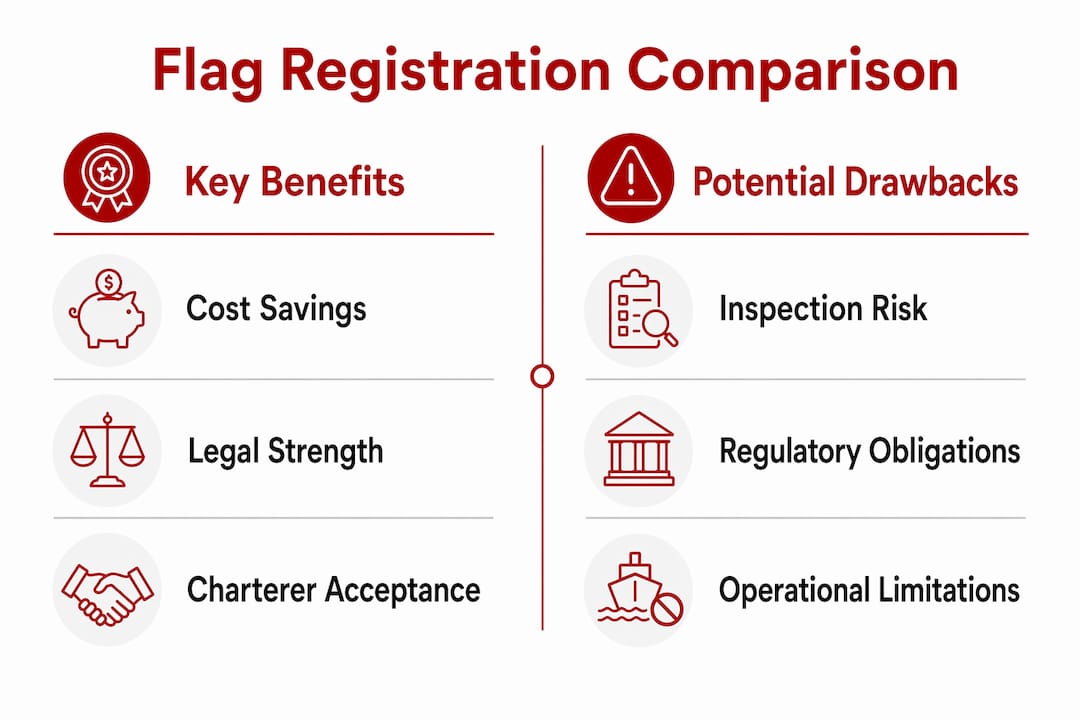
A strong flag state’s legal framework provides dispute resolution mechanisms and diplomatic protections that weaker convenience flags simply cannot match. The UK Part 1 registry, for instance, gives vessel owners access to English common law courts, which most international lenders and charterers treat as the gold standard for contract enforcement.
Flag selection shapes financing opportunities directly. Lenders require flags with transparent and efficient mortgage registration systems before they will advance funds. A vessel flying an obscure flag may find its financing options limited or its loan terms significantly worse than a comparable vessel under the Marshall Islands or Liberia.
Charterers maintain approved flag lists that exclude vessels flying low-quality flags. This restriction affects charter rates, employment frequency, and long-term profitability regardless of how much the owner saved on registration fees. A vessel that cannot access major charterers has a fundamentally limited commercial life.
Pro Tip: Check your target charterers’ approved flag lists before committing to a registry. A flag that saves $50,000 in fees but locks you out of a $500,000 charter contract is a poor trade.
What regulatory obligations come with a foreign flag?
Foreign flag registration does not mean escaping regulation. It means choosing which regulatory authority governs your vessel. Under UNCLOS, the flag state exercises full jurisdiction and legal responsibility over its vessels, including enforcement of safety, environmental, and labor regulations. That responsibility transfers entirely to the chosen flag state.
The regulatory landscape in 2026 has become more demanding across the board. The IMO’s updated emission and safety frameworks require flag states to enforce stricter standards on vessel exhaust, ballast water treatment, and crew certification. Flag states with weak enforcement capacity create compliance gaps that expose vessel owners to Port State Control detentions when they enter foreign ports.
Key regulatory factors to evaluate before choosing a flag:
- IMO convention ratification. Confirm the flag state has ratified SOLAS, MARPOL, and the MLC 2006. Gaps in ratification create compliance exposure.
- Port State Control track record. Flags with high detention rates signal weak oversight. The Paris MOU and Tokyo MOU publish annual flag performance reports that are publicly available.
- Survey and certification capacity. The flag state must be able to issue and renew certificates efficiently. Delays in certification create operational downtime.
- Enforcement consistency. Some flags ratify conventions but enforce them inconsistently, which creates uncertainty for owners trying to maintain compliant operations.
The types of maritime registrations available to vessel owners range from fully open registries with minimal nationality requirements to closed national registries with strict ownership rules. Understanding where each flag sits on that spectrum is the starting point for any compliance strategy.
How does a foreign flag affect operational flexibility?
Operational flexibility is one of the most underappreciated advantages of registering under a foreign flag. Most national registries impose strict rules on crew nationality, trading routes, and vessel ownership structures. Foreign flags remove or relax most of those restrictions.
The practical operational gains include:
- International crew hiring. Flags like Panama and the Marshall Islands impose no nationality requirements on crew, allowing owners to hire from global labor markets. This directly reduces payroll costs and expands the talent pool. For owners building a crew from scratch, resources like yacht crew hiring guides can help structure that process efficiently.
- Unrestricted trading routes. Most open registries allow vessels to trade globally without route restrictions, unlike some national flags that limit vessels to domestic or regional waters.
- Corporate ownership structures. Many foreign flags accept corporate ownership, allowing owners to register vessels through holding companies for liability protection and tax planning purposes.
- Insurance cost management. Flag choice directly affects insurance premiums. Insurance premiums depend heavily on registry reputation for oversight and compliance. Obscure registries may carry higher premiums that offset their lower registration fees entirely.
Shipowners face increased inspections and vetting when vessels fly low-quality flags. Port State Control authorities target flags with weaker compliance records, which raises operational costs through detention time, repair requirements, and reputational damage with charterers. The operational freedom a low-quality flag appears to offer often disappears the moment the vessel enters a major port.
The commercial vessel registration benefits available through well-regarded foreign flags extend well beyond cost savings. Access to global charter markets, favorable financing terms, and reduced inspection frequency all contribute to a vessel’s long-term commercial viability.
Key takeaways
Foreign flag registration is a strategic legal and financial decision that shapes every aspect of vessel ownership, from tax liability to charter market access.
| Point | Details |
|---|---|
| Cost savings are real but conditional | Savings of up to $3.5 million annually depend on flag quality, crew structure, and insurance outcomes. |
| Legal framework determines financing access | Lenders prefer flags with transparent mortgage systems; weak flags inflate borrowing costs. |
| Charterer approval lists limit market access | Low-quality flags can block vessels from major charter contracts regardless of registration savings. |
| Regulatory compliance is non-negotiable | Flag states must enforce IMO conventions; gaps in enforcement create Port State Control detention risk. |
| Flag choice is a long-term commitment | Switching flags mid-operation is costly; align your flag with your vessel’s commercial strategy from the start. |
The uncomfortable truth about flag shopping
Most owners approach foreign flag registration as a cost-cutting exercise. That framing is understandable but incomplete. After working with vessel owners across dozens of jurisdictions, the pattern is clear: the owners who get the most value from foreign registration are the ones who treat it as a legal and commercial positioning decision, not a fee-reduction tactic.
The Marshall Islands and Liberia are not popular because they are cheap. They are popular because they combine reasonable costs with legal frameworks that lenders trust, charterers accept, and Port State Control authorities respect. That combination is worth far more than the marginal savings from a lower-tier registry.
The trade-off between cost and reputation is real. A flag that saves $20,000 in annual fees but triggers two Port State Control detentions per year will cost far more in lost charter revenue and repair obligations. The math rarely favors the bargain option.
Flag selection also shapes your vessel’s legal identity in ways that matter when things go wrong. Dispute resolution, crew claims, and mortgage enforcement all run through the flag state’s legal system. A flag state with weak courts or limited diplomatic reach leaves owners exposed in ways that are difficult to quantify until a dispute actually arises.
The right approach is to consult maritime law specialists and flag advisory services before committing. Vesselflag works with owners who have made both the right and wrong choices, and the difference in long-term outcomes is significant. Treat your flag as a founding decision for your vessel’s commercial life.
— Vesselflag
Start your foreign flag registration with confidence
Choosing the right flag is only the first step. Executing the registration correctly, maintaining compliance, and keeping your documentation current are where most owners run into problems.
Vesselflag provides full-service flag registration across multiple jurisdictions including San Marino, Malta, UK Part 1, Palau, and Langkawi, with transparent timelines and compliance support built into every process. Whether you are registering a yacht or a commercial vessel, the complete yacht registration guide covers every step from document preparation to certificate issuance. For commercial operators, the step-by-step commercial vessel guide walks through jurisdiction selection, corporate structuring, and fast-track processing options. Vesselflag’s team handles the complexity so you can focus on operating your vessel.
FAQ
What does registering under a foreign flag mean?
Foreign flag registration is the process of enrolling a vessel under the legal jurisdiction of a country other than the owner’s home nation. The chosen country becomes the flag state and assumes full legal authority over the vessel under UNCLOS.
Which foreign flags are most widely used in 2026?
Panama, Liberia, and the Marshall Islands are the three most widely used foreign flags, collectively controlling a majority of global shipping tonnage. Turkey’s TUGS registry ranked 10th globally in 2026 and offers strong tax exemptions alongside recognized legal standing.
How much can foreign flag registration save per year?
Foreign flag registration can generate operating cost savings of up to $3.5 million per ship annually, with savings coming from lower crew costs, reduced registration fees, and tax exemptions on shipping income.
Does a foreign flag affect vessel financing?
Yes. Lenders require flags with transparent and efficient mortgage registration systems. Vessels flying obscure or low-quality flags face higher borrowing costs or outright rejection from major maritime lenders.
Can charterers refuse a vessel based on its flag?
Charterers maintain approved flag lists and can refuse vessels flying low-quality flags. This restriction directly affects charter rates and commercial employment opportunities, independent of any cost savings from registration.