

TL;DR:
- A yacht’s maritime flag determines its legal nationality, compliance obligations, and tax exposure. It also controls licensing, port access, and insurance terms for luxury charter operations. Choosing the correct flag at the outset prevents costly reflags, compliance failures, and reputational risks.
A yacht’s maritime flag is its legal nationality. It determines which country’s laws govern every aspect of the vessel’s operation, from crew contracts to commercial charter permissions. The role of maritime flag in luxury charters extends far beyond a piece of cloth flying at the stern. It defines tax exposure, port access, insurance terms, and whether a charter is even legally permitted in a given body of water. Charter clients and owners who treat flag selection as an afterthought routinely face compliance failures, unexpected costs, and lost charter opportunities. Understanding maritime flag meaning from the start is the single most consequential step in planning a luxury charter operation.
How does a yacht’s maritime flag determine legal jurisdiction and compliance?
The flag state is the country that holds legal authority over a yacht. Every international convention the yacht must follow, every crew certification it must carry, and every safety inspection it must pass flows from that one registration decision.
Flag states enforce compliance with international conventions including SOLAS (Safety of Life at Sea), MARPOL (marine pollution prevention), and the MLC 2006 (Maritime Labour Convention). These frameworks set minimum standards for safety equipment, environmental controls, and crew welfare. A flag state’s administration determines how strictly those standards are applied and how frequently surveys occur.
Crew employment is directly tied to flag jurisdiction. Crew operate under the laws of the yacht’s flag state, which governs labor contracts, working hours, minimum wages, and immigration status onboard. A Maltese-flagged yacht operating in the Mediterranean must comply with Maltese maritime labor rules, regardless of where the owner or crew are from.
Compliance overhead is substantial. Annual operating costs for a 40–60m yacht vary by $80,000 to $250,000 depending on the flag state chosen. That range reflects differences in survey frequency, classification society requirements, and administrative fees across registries.
- Flag state controls which international conventions apply onboard
- Crew certification standards and labor law derive from the flag state
- Annual compliance audits and safety surveys are flag-state mandated
- Classification society relationships vary by registry
- Failure to maintain valid documentation risks stateless vessel status and universal jurisdiction exposure
Pro Tip: Request a full compliance calendar from your flag state administration before signing any charter agreement. Knowing your survey dates prevents costly scheduling conflicts mid-season.
What practical benefits and limitations do different flags create for luxury charters?
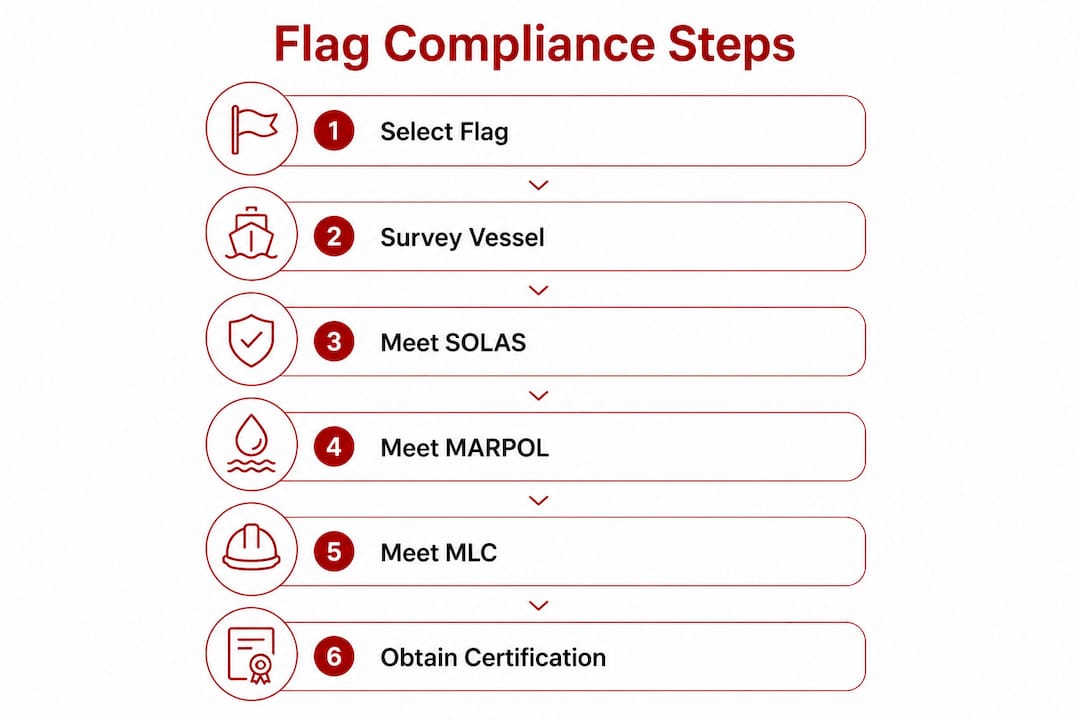
The flag state directly controls whether a yacht can legally conduct commercial charters and in which waters. This is not a technicality. A yacht registered under a flag without a commercial endorsement cannot legally take paying guests aboard, regardless of the owner’s intentions.

VAT treatment is one of the most financially significant variables. In EU waters, a yacht’s flag and ownership structure together determine VAT liability on charter income and on the vessel itself. The Maltese flag, when combined with Maltese corporate ownership, provides a recognized VAT framework that many Mediterranean charter operators use to manage their tax exposure. Owners planning Mediterranean charter operations should treat flag and corporate structure as a single decision, not two separate ones.
Geographic restrictions also apply. The US Jones Act prohibits foreign-flagged vessels from carrying passengers between two US ports for commercial purposes. A yacht flagged in the Cayman Islands cannot legally charter between Miami and Key West. Owners planning US waters charters must either flag under the US or accept point-to-point restrictions.
The Cayman Islands registry introduced the Yacht Engaged in Trade (YET) certificate in 2017. This certificate allows privately registered yachts to conduct commercial charters in select EU waters for a limited number of days without full re-categorization as a commercial vessel. It gives owners meaningful flexibility without the full compliance burden of a commercial registration.
- Commercial charter authorization is flag-state issued and geographically specific
- EU VAT treatment depends on flag and ownership structure combined
- The Jones Act restricts foreign-flagged vessels in US coastal charters
- Charter broker approval processes often include flag-state vetting
- Port access in some jurisdictions is restricted for certain flag states
What are the financial and reputational stakes of flag choice?
Flag selection is a strategic business decision that directly shapes financing terms, insurance availability, and commercial viability. Lenders and insurers both evaluate flag quality before committing to a deal.
The Paris MOU White List contained 40 flag states in 2025. Insurers impose 5–15% higher premiums for yachts registered under less-regulated registries. That premium gap compounds annually and can represent a six-figure cost difference over a typical ownership period.
Port State Control (PSC) inspections are the enforcement mechanism. Vessels flagged in jurisdictions with poor MLC 2006 enforcement face more frequent detentions in Paris, Tokyo, and US MOU ports. A detention is not just an inconvenience. It generates a public record, alerts charter brokers, and can void insurance coverage for the period of non-compliance.
Charter brokers actively screen flag quality. A yacht on the Paris MOU Black or Grey List will struggle to secure reputable charter listings regardless of its interior finish or crew quality. The reputational cost of a low-tier flag is real and immediate.
Pro Tip: Before selecting a registry, check its current Paris MOU White List status. A flag that drops to Grey or Black List mid-ownership forces an expensive and disruptive reflagging process.
What are the leading maritime flags used in luxury yacht charters?
The four flags that dominate the luxury charter market are Malta, the Cayman Islands, the Marshall Islands, and the Isle of Man. Each carries a distinct profile of costs, permissions, and strategic advantages.
| Flag | Primary Advantage | Charter Suitability | Key Consideration |
|---|---|---|---|
| Malta | EU VAT framework, Mediterranean access | Strong for EU commercial charters | Higher compliance costs than Cayman |
| Cayman Islands | Flexible YET certificate, Red Ensign Group | Private and selective commercial use | Jones Act limits US coastal charters |
| Marshall Islands | Operational efficiency, US market recognition | Private cruising and US-based owners | Less EU VAT optimization |
| Isle of Man | Strong compliance record, VAT flexibility | Mixed private and commercial use | Smaller registry, fewer local surveyors |
The Maltese flag carries annual compliance costs $30,000 to $60,000 higher than Cayman-registered yachts on a comparable 50m vessel. That premium buys EU membership status, a recognized VAT framework, and seamless access to Mediterranean ports. For owners whose primary charter market is the Mediterranean, that cost is often justified.
The Cayman Islands flag sits within the UK Red Ensign Group, giving it strong credibility with insurers and lenders. Its YET certificate option makes it attractive for owners who want primarily private use with occasional charter income. The Marshall Islands flag is widely recognized in US waters and appeals to owners whose cruising plans center on the Atlantic and Caribbean.
- Malta: best for EU Mediterranean commercial charters with VAT planning
- Cayman Islands: preferred for private use with charter flexibility via YET
- Marshall Islands: suited to US-focused owners and private cruising
- Isle of Man: strong compliance reputation with VAT management options
- Flags of convenience: lower upfront costs but carry PSC detention risk and insurer resistance
Most reputable charter operators work exclusively with white-listed registries that align with SOLAS, MARPOL, and MLC 2006. The compliance overhead is higher, but the operational and reputational benefits are not optional in the luxury segment.
How should yacht owners align flag choice with charter goals?
Flag selection requires a structured decision process, not a default choice based on cost alone. The right flag depends on where the yacht will operate, how it will be used, and how it is owned.
- Define the primary use case. Decide whether the yacht will operate as a full commercial charter vessel, a private yacht with occasional charter income, or a purely private vessel. Each use case points to a different flag profile.
- Map the cruising geography. A yacht spending summers in the Mediterranean and winters in the Caribbean needs a flag that works in both regions. Check charter licensing requirements and VAT rules for each target market before committing.
- Align ownership structure with flag compatibility. Corporate ownership in a specific jurisdiction can unlock VAT benefits tied to the flag. Maltese flag benefits are most accessible through Maltese corporate ownership. Misaligning these creates tax exposure.
- Verify lender and insurer requirements. Many marine lenders specify approved flag states in their loan agreements. Insurers maintain approved flag lists and may refuse coverage or impose surcharges for non-listed registries. Confirm both before finalizing the flag.
- Account for reflagging costs upfront. Changing flags mid-ownership is disruptive and expensive. It triggers new surveys, new documentation, and potential gaps in charter licensing. Owners should align flag choice with long-term cruising plans from the start to avoid this cost.
- Engage expert advisory early. Flag selection intersects maritime law, tax planning, insurance structuring, and charter licensing. A specialist advisor who understands all four disciplines prevents the costly mistakes that generalist advisors miss.
The benefits of yacht flags are only realized when the flag matches the owner’s actual operational goals. A flag that is optimal for a private owner in the Pacific is often wrong for a commercial charter operator in the Mediterranean. The decision deserves the same rigor as any other major financial commitment in the ownership structure.
For owners exploring offshore registration options, understanding why yachts register offshore provides useful context on the financial and operational logic behind flag state selection.
Key Takeaways
A yacht’s flag state is the single most consequential legal decision in luxury charter operations, determining jurisdiction, compliance costs, tax exposure, and commercial charter eligibility.
| Point | Details |
|---|---|
| Flag state sets legal jurisdiction | Every compliance obligation, crew contract, and charter permission flows from the flag state. |
| Compliance costs vary significantly | Annual costs for 40–60m yachts range from $80,000 to $250,000 depending on the flag chosen. |
| White List status protects charter value | Paris MOU White List flags attract better insurance terms and avoid PSC detention risk. |
| Flag and ownership structure work together | VAT optimization in EU waters requires aligning flag choice with corporate ownership structure. |
| Reflagging is costly | Owners should align flag choice with long-term goals from the start to avoid disruptive mid-ownership changes. |
Flag choice is more consequential than most owners realize
At Vesselflag, we see the same pattern repeatedly. An owner selects a flag based on registration cost alone, then spends the next three years managing the downstream consequences: higher insurance premiums, PSC inspection delays, and charter brokers who won’t list the vessel. The flag decision feels administrative at the time. It is not.
The luxury charter market has tightened its compliance expectations considerably. Charter brokers now routinely ask for flag state documentation before listing a vessel. Lenders include flag approval clauses in financing agreements. Insurers price flag quality into every renewal. An owner who chose a low-cost registry five years ago is now carrying a reputational and financial burden that compounds annually.
The misconception I encounter most often is that reflagging is a simple fix. It is not. Reflagging triggers new surveys, new documentation, potential charter licensing gaps, and in some cases renegotiation of financing terms. The cost of getting the flag right at the start is a fraction of the cost of correcting it later.
The owners who operate most successfully in the luxury charter market treat flag selection as a founding decision, not an afterthought. They align it with their ownership structure, their cruising geography, their charter ambitions, and their financing terms before the vessel is ever delivered. That alignment is what separates a charter operation that runs cleanly from one that spends every season managing avoidable friction.
— Vesselflag
Vesselflag guides luxury yacht owners through flag registration
Choosing the right flag state is the most consequential decision a yacht owner makes before the first charter guest steps aboard. Vesselflag provides expert advisory and registration support across leading flag states including Malta, the Cayman Islands, the Marshall Islands, and the Isle of Man.
The Vesselflag team handles the full registration process, from initial flag assessment through documentation, survey coordination, and ongoing compliance support. Owners who want to understand their options before committing can start with Vesselflag’s complete yacht registration guide, which covers flag selection, compliance timelines, and cost structures in detail. For owners ready to act, the flag registration service provides a direct path to compliant, charter-ready registration under the flag that fits your operation.
FAQ
What does a yacht’s maritime flag actually determine?
A yacht’s flag state determines its legal nationality and governs all compliance obligations, crew labor law, charter permissions, and tax treatment. Every regulatory requirement onboard flows from this single registration decision.
Which flag is best for Mediterranean luxury charters?
The Maltese flag is the dominant choice for Mediterranean commercial charters because it provides EU membership status and a recognized VAT framework when combined with Maltese corporate ownership.
How does flag choice affect yacht insurance premiums?
Insurers impose 5–15% higher premiums for yachts registered under less-regulated registries. Flags on the Paris MOU White List attract the most favorable insurance terms and the widest coverage options.
What is the YET certificate and why does it matter?
The Yacht Engaged in Trade certificate, introduced by the Cayman Islands registry in 2017, allows privately registered yachts to conduct commercial charters in select EU waters for a limited number of days without full commercial re-registration.
Can any flag state authorize charters in US waters?
Foreign-flagged yachts cannot carry paying passengers between two US ports under the Jones Act. Owners planning US coastal charters must either register under the US flag or structure itineraries that avoid point-to-point domestic routing.