

En bref :
- Choosing the right yacht flag depends on your vessel’s operating area, use case, and compliance needs.
- Flags on the Paris MoU white-list offer lower port friction, better insurance terms, and are recommended for most vessels.
The flags most US-based owners and brokers shortlist come down to three clusters: prestige registries (Cayman Islands, UK Part 1 / Red Ensign Group, Malta), cost-competitive open registries (Marshall Islands, Panama, Palau, Langkawi), and EU-access flags (Malta, Poland). San Marino and the British Virgin Islands sit between those groups, offering lighter compliance burdens with reasonable international recognition. Your choice turns on where you cruise, whether you charter, what your insurer and mortgagee require, and how much PSC friction you can afford.
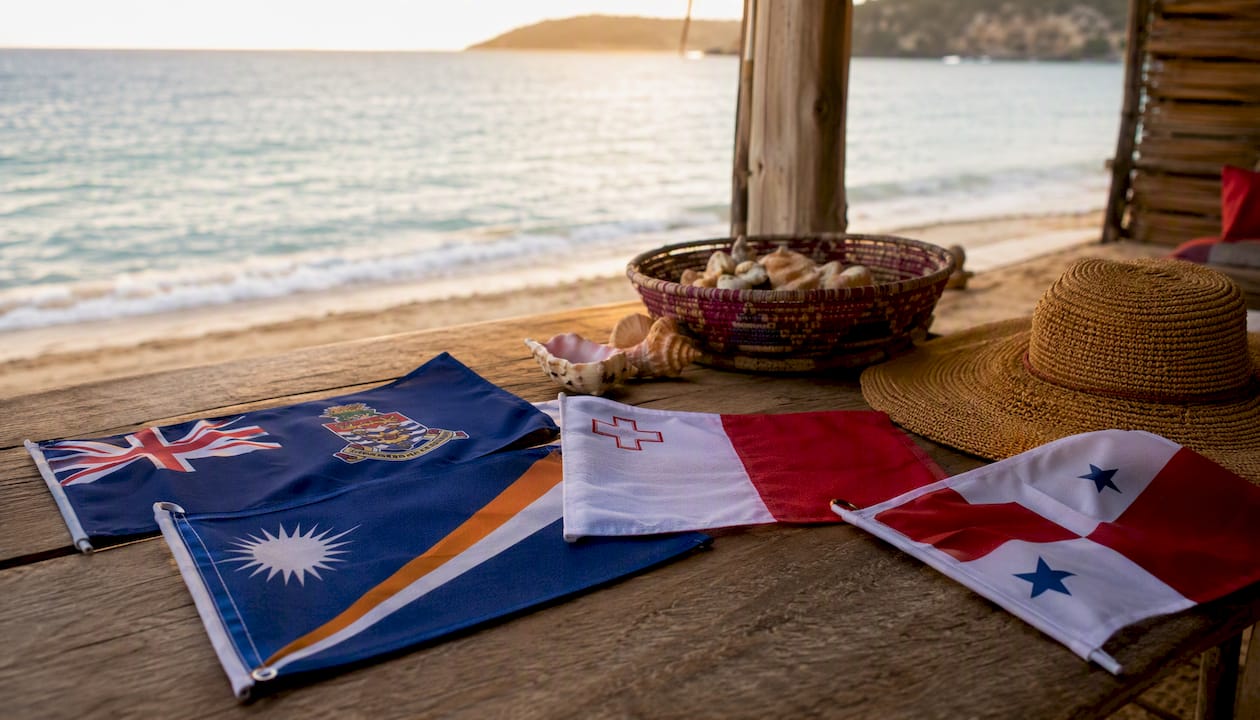
Le flag state is the jurisdiction whose laws govern your vessel’s safety standards, crew employment, and charter permissions. It is not the same as your ownership jurisdiction, and treating them as one decision is one of the most common and expensive mistakes owners make. SOLAS, MARPOL, and STCW are enforced through the flag state, and Port State Control (PSC) officers use the Paris MoU white-list to decide how hard to look at your vessel in port.
Conseil de pro : Shortlist flags by use case first. A private non-charter yacht has very different priorities from a commercial charter vessel operating in EU waters.
Table des matières
- What are the main examples of international flag states for yachts?
- How do you choose the right flag for your vessel?
- What does the registration process actually involve?
- Common mistakes owners make when selecting a flag
- What compliance obligations come with your flag?
- Principaux enseignements
- The trade-offs most owners underestimate
- Vesselflag’s registration services for US-based owners
- Useful sources for verification
- FAQ
What are the main examples of international flag states for yachts?
The table below covers the flags owners most commonly register under, with typical ranges based on publicly available registry information.
| Pavillon | Standard timeline | Expedited option | Up-front fee (approx.) | Annual renewal (approx.) | PSC standing | Best for |
|---|---|---|---|---|---|---|
| Îles Caïmans | 4–6 weeks | 1–2 weeks | $1,500–$2,500 | $800–$1,500 | White-list (Red Ensign) | Large private yachts, insurer-preferred |
| Îles Marshall | 2–4 weeks | 3–5 days | $700–$1,200 | $500–$900 | White-list | Cost-conscious owners, US-based ops |
| Malte | 3–6 weeks | 2–3 weeks | Varies by GT | $10,000–$18,000 (large yachts) | White-list (EU) | EU cruising, VAT-sensitive charters |
| BVI | 3–5 weeks | 1–2 weeks | $800–$1,200 | $400–$800 | White-list (Red Ensign) | Caribbean-based private yachts |
| Panama | 2–4 weeks | 1 week | $500–$900 | $400–$700 | Grey/targeted | Commercial shipping, budget builds |
| Saint-Marin | 2–3 weeks | 1 week | Contact registry | Contact registry | Recognized | Smaller yachts, EU-adjacent ops |
| Pologne | 3–5 weeks | 2 weeks | Contact registry | Contact registry | White-list (EU) | EU flag with lower cost than Malta |
| Royaume-Uni, 1re partie | 4 weeks | 2–4 weeks | Varies by GT | Varies by GT | White-list (Red Ensign) | Global ops, insurer-preferred |
| Palau | 2–3 weeks | 1 week | Contact registry | Contact registry | Recognized | Asia-Pacific cruising |
| Langkawi | 2–4 weeks | 1–2 weeks | Contact registry | Contact registry | Recognized | Southeast Asia ops |
Îles Caïmans carries the full weight of the Red Ensign Group’s reputation, which functions as a quality-assurance badge with PSC officers and insurers worldwide. Fees are higher than most open registries, but the reduction in port friction pays for itself on a vessel that moves frequently.
Îles Marshall is the go-to for owners who want white-list standing without Cayman-level fees. The registry has a strong US presence, which shortens document processing considerably. It suits private yachts and commercial operators alike.
Malte is the EU flag of choice for Mediterranean-based yachts. EU registration simplifies VAT treatment and charter permissions within EU waters. Annual costs can run high for larger vessels, but for a charter operation based in the Med, the access is worth it.
Panama is cost-competitive but built primarily around commercial shipping. Its Paris MoU targeting factor runs higher than Red Ensign flags, meaning PSC officers in European ports are more likely to conduct a full inspection. Fine for a vessel that stays in the Caribbean or Pacific; less ideal for regular EU port calls.
Conseil de pro : Verify a registry’s current Paris MoU white-list status at parismou.org before committing. Lists update annually and a flag can move between categories.
How do you choose the right flag for your vessel?
Start with the vessel’s intended use, then layer in cruising grounds and ownership structure.
Use-case map:
- Private non-charter: maximum flexibility on flag choice; prioritize PSC standing and insurer acceptance.
- Occasional charter (Yacht Engaged in Trade / YET): confirm the flag permits YET status and check whether a commercial endorsement is required.
- Full commercial charter: Malta, Marshall Islands, or UK Part 1 are the most commonly accepted by insurers and port authorities.
Decision checklist:
- Where does the vessel cruise? EU waters push you toward Malta or Poland. Caribbean favors Cayman or BVI. Asia-Pacific suits Palau or Langkawi.
- Does your insurer or mortgagee specify an approved registry? Check before shortlisting.
- Is the flag on the Paris MoU white-list? Choosing a flag purely for low fees without checking PSC standing is a documented and costly error.
- Do you need a corporate ownership structure? Some flags require a registered company; others accept individual ownership.
- Is there a US-facing agent? A reliable US-facing agent shortens total time-to-registration by handling legalization, notarization, and concurrent MMSI/AIS setup.
- Are you separating flag state from ownership jurisdiction? Treating them as two distinct decisions often creates better tax outcomes and operational flexibility.
Red flags to watch: opaque or unpublished fee schedules, no listed US agent, any flag on the Paris MoU grey or black list, and registries with known sanctions exposure.
What does the registration process actually involve?
Registration follows a predictable sequence regardless of flag. The steps below apply across most jurisdictions; a commercial vessel registration adds classification society certificates and ISM documentation.
- Ownership proof and title — bill of sale, deletion certificate from prior registry if reflagging.
- Vessel survey / tonnage measurement — required by most flags; a certified surveyor produces the tonnage certificate.
- Corporate formation documents — if the flag requires a company to own the vessel, articles of incorporation and certificate of good standing.
- Classification society certificates — required for commercial vessels; Lloyd’s, Bureau Veritas, DNV, and RINA are widely accepted.
- Power of attorney for agent — authorizes the registry agent to file on your behalf.
- Evidence of insurance — most registries require proof of P&I and hull coverage before issuing the certificate of registry.
- MMSI/AIS licensing — typically handled concurrently by the agent; running this in parallel with document legalization cuts total elapsed time.
Timeline comparison (typical flags):
| Pavillon | Standard (days) | Expedited (days) |
|---|---|---|
| Îles Marshall | 14 jours | 3–5 |
| Îles Caïmans | 28 days | 7–14 |
| Malte | — | 14 jours |
| Panama | 14 jours | 5–7 |
| Royaume-Uni, 1re partie | 28 days | 14 jours |
Cost components to budget: registry fee, tonnage survey, agent fees, corporate formation (if required), notarization and apostille, and any expedited processing surcharge. Fee ranges for the most common flags are: Cayman Islands registration typically $1,500–$2,500 initial and $800–$1,500 annual, Marshall Islands $700–$1,200 initial and $500–$900 annual, BVI $800–$1,200 initial and $400–$800 annual, Panama $500–$900 initial and $400–$700 annual, and Malta can range from $10,000–$18,000 annually for larger vessels.
Common mistakes owners make when selecting a flag
- Choosing by lowest fees alone. A flag with poor PSC standing generates detention risk and higher insurance premiums that quickly exceed the savings.
- Ignoring charter permissions. Not every flag supports YET or commercial charter without additional endorsements. Confirm in writing before registering.
- Skipping insurer and mortgagee sign-off. Some lenders and underwriters maintain approved-registry lists. Registering under a flag they do not accept can void coverage or trigger a loan default clause.
- Missing local agent requirements. Several flags require a locally appointed representative. Failing to appoint one can delay certificate issuance or cause compliance lapses.
- Not verifying the published fee schedule. Registries that do not publish fees openly sometimes add administrative charges at the end of the process.
Conseil de pro : Before committing to any registry, download its published fee schedule and cross-reference the flag against the current Paris MoU performance list. Both checks take under 30 minutes and can save months of operational headaches.
What compliance obligations come with your flag?
The flag state determines the legal and operational framework affecting crew employment, safety standards, and charter ability. The core international conventions every flagged vessel must track:
- SOLAS (Safety of Life at Sea): fire safety, life-saving appliances, navigation equipment.
- MARPOL: pollution prevention, garbage record books, oil record books.
- STCW: crew certification standards; flag state determines which certificates it accepts.
- Code ISM: mandatory for commercial vessels over 500 GT; voluntary but advisable for large private yachts.
- Code ISPS: security plan and ship security officer for vessels calling at international ports.
PSC officers under the Paris MoU, Tokyo MoU, and USCG each run their own targeting algorithms. Red Ensign Group flags consistently appear on the Paris MoU white-list, which reduces the statistical likelihood of a detailed inspection. For the full compliance picture by flag, the inspection regime and certificate requirements vary meaningfully between registries.
Conseil de pro : Keep a physical compliance binder on board with all certificates, survey reports, crew certifications, and record books organized by convention. PSC officers expect to find it immediately — a disorganized binder alone can trigger a more thorough inspection.
Principaux enseignements
The most important single point: flag-state selection shapes every operational and financial outcome for your vessel, so PSC standing, charter permissions, and insurer acceptance must rank above registration fees in your decision.
| Point | Détails |
|---|---|
| PSC standing over fees | White-list flags (Red Ensign, Malta, Marshall Islands) reduce port friction and insurance costs. |
| Separate flag from ownership | Treating flag state and ownership jurisdiction as two decisions often improves tax outcomes. |
| Expedited options exist | Marshall Islands can complete registration in a few days with expedited options; Cayman offers expedited processing in about one to two weeks with expedited processing. |
| Charter permissions vary | Confirm YET or commercial endorsement availability in writing before registering under any flag. |
| Vesselflag handles end-to-end | Vesselflag manages registration, MMSI/AIS setup, corporate formation, and ongoing compliance across all major flag states. |
The trade-offs most owners underestimate
The conventional wisdom says pick a prestigious flag and you are covered. The reality is more granular. A Cayman registration on a 40-meter private yacht that never charters and rarely enters European ports is paying a premium for recognition it does not need operationally. Conversely, a Marshall Islands flag on a charter vessel doing regular Mediterranean seasons will face insurer questions that a Malta or Red Ensign flag would have avoided entirely.
The flags worth the premium are the ones that match your actual operating profile, not the most impressive name on paper. For US-based owners, Marshall Islands deserves serious consideration because of its strong US agent network and white-list standing. For anyone planning EU charters, Malta is not optional; it is the practical choice. And for owners whose lender or insurer specifies a Red Ensign registry, Cayman or BVI are the path of least resistance.
Reflagging triggers worth watching: a change in cruising grounds, a shift from private to charter use, a corporate restructure, or a new lender with different registry requirements. Each of those is a legitimate reason to reassess, and the cost of reflagging is almost always lower than the cost of operating under the wrong flag for a full season.
Vesselflag’s registration services for US-based owners
Owners who have read this far know what they need: a firm timeline, a transparent cost breakdown, and someone who handles the paperwork without requiring them to become a maritime lawyer. That is exactly what Vesselflag delivers across all major flag states covered in this guide.
Vesselflag manages the complete yacht registration process from ownership structure and corporate formation through document legalization, MMSI/AIS licensing, and insurance placement. Expedited processing is available for Marshall Islands, Cayman, Panama, Malta, San Marino, Poland, Palau, Langkawi, and UK Part 1. Every quote includes a documented timeline, itemized fee schedule, and assigned US-facing agent. For commercial operators, Vesselflag also covers ISM and ISPS documentation alongside the step-by-step registration package. Request your flag registration quote at vesselflag.com/flag-registration to get a firm timeline and cost estimate for your vessel.
Useful sources for verification
Before committing to a flag, check these primary sources directly:
- Paris MoU Performance List — annual white/grey/black-list rankings for flag states; the definitive PSC targeting reference.
- IMO Flag State Audit Scheme — International Maritime Organization oversight of flag state compliance with SOLAS, MARPOL, and STCW.
- Cayman Islands Shipping Registry — published fee schedule, tonnage tables, and approved surveyor list.
- Marshall Islands Maritime Administrator — registration requirements, fee schedule, and US agent contacts.
- Malta Transport Authority (Transport Malta) — EU flag registration requirements, YET endorsements, and VAT guidance.
- UK Ship Register (Part 1) — Red Ensign Group registration requirements and fee schedule.
- Vesselflag flag registration services — flag packages, timelines, and agent contact for all flags covered in this guide.
FAQ
Which flag state is best for a US-based yacht owner?
Marshall Islands is the most practical starting point for US owners: white-list PSC standing, a strong US agent network, and competitive fees. Cayman Islands suits larger yachts where insurer and mortgagee acceptance is the priority.
Combien de temps dure la procédure d'immatriculation internationale d'un yacht ?
Standard processing runs 2–6 weeks depending on the flag. Expedited options compress that to 3–5 days for Marshall Islands and 7–14 days for Cayman Islands.
Can I charter my yacht under any international flag?
No. Charter permissions vary by flag and vessel category; owners should consult our detailed commercial yacht license guide to understand charter implications. Malta and Marshall Islands both support commercial charter with the correct endorsement; confirm YET or commercial status in writing before registering.
What is Port State Control and why does it matter?
PSC is the system of port inspections that checks vessel safety and compliance. Flags on the Paris MoU white-list face fewer targeted inspections; grey- or black-listed flags face higher detention risk in European and many Asian ports.
Does Vesselflag handle MMSI and AIS setup alongside registration?
Yes. Vesselflag manages MMSI/AIS licensing concurrently with the registration process, which shortens total elapsed time and avoids the gap between certificate issuance and operational readiness.