
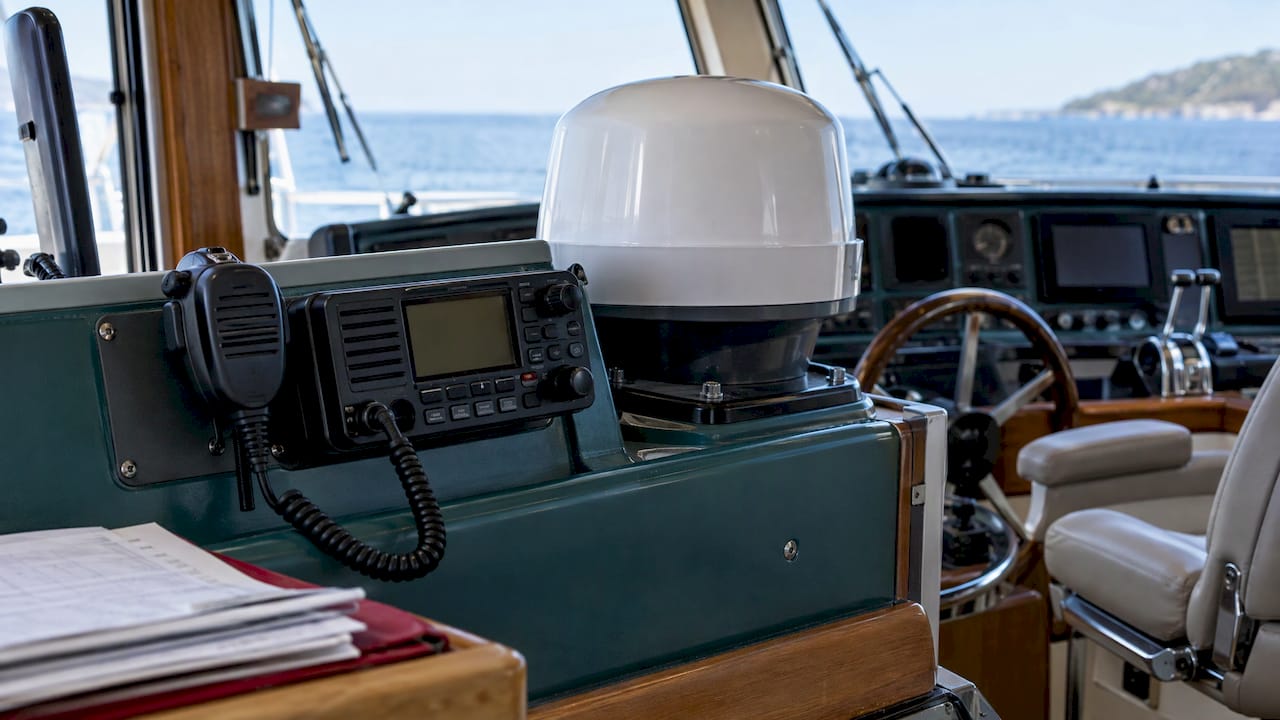
A yacht’s satellite terminal is normally licensed through the vessel’s ship radio licence, issued by the administration of its flag. There is rarely a separate “satcom licence”. The terminal is listed on the ship station licence alongside the VHF, the EPIRB and the rest of the radio fit, and that licence carries the vessel’s call sign and MMSI. The rules, fees and renewal periods differ by flag, so the flag you register under decides most of the paperwork. At Vessel Flag we prepare and file MMSI and ship radio licence applications for owners and brokers, remotely and at published one-off prices. Certificates and licences are issued by the flag authorities, not by us.
TL;DR
- Satellite terminals are normally declared on the ship radio licence, which also carries the call sign and MMSI. The licence is issued by the flag administration.
- Your flag sets the rules, the fees and the renewal cycle. Changing flag means changing the radio identities, including the MMSI.
- Equipment generally needs type approval accepted by the flag, and calls through foreign coast stations need an accounting contract.
- Licence validity ranges from one year to ten years depending on the authority, and operator certificates are a separate matter from the station licence.
- Vessel Flag handles MMSI and ship radio licences: Poland EUR 149, UK EUR 150, San Marino EUR 200, each VAT included with no annual fees.
Table des matières
- What satcom licensing actually covers
- Which authority’s rules apply
- Flag by flag: what the licensing looks like
- Operator certificates are a separate requirement
- Applying: documents and sequence
- Renewals, changes and changing flag
- Before an international passage
- How Vessel Flag helps
- FAQ
- Sources
What satcom licensing actually covers
People search for “satcom licensing” expecting a single document for the dish on the mast. In practice three separate things are involved:
- The station licence. The ship radio licence authorises the vessel to carry and use radio equipment. UK regulator Ofcom’s guidance lists satellite communications equipment among the items a ship radio licence covers, together with MF, HF and VHF sets, radar, SARTs, EPIRBs and earth stations.
- The identities. A call sign and an MMSI (Maritime Mobile Service Identity) are assigned to the vessel. Ofcom explains that the call sign is a unique identifier assigned when the first ship radio licence is issued, and that an MMSI is also unique to that ship. The US regulator describes the same arrangement.
- The people. Whoever operates certain radio equipment may need an operator certificate. This is separate from the station licence and is covered below.
The airtime contract with your connectivity provider is a commercial matter. It does not replace the licence. A terminal that works perfectly on a data plan can still be unlicensed on board.
Why the MMSI matters
The MMSI is what connects your satellite and VHF equipment to rescue services. France’s ANFR notes that its licence records holder and vessel details, including the MMSI and call sign, to help responders in a distress case. That is why the MMSI sits at the centre of the licensing file, and why a wrong or out-of-date identity is a real problem rather than an admin one.
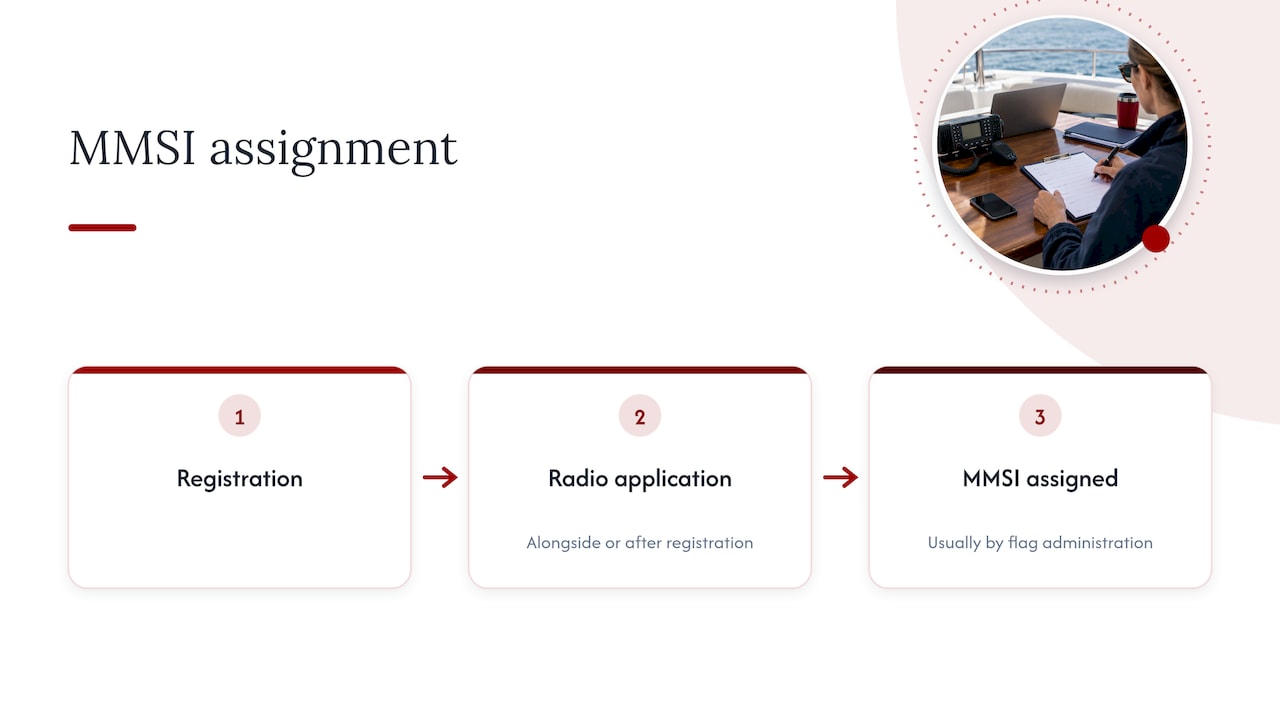
The Marshall Islands registry states that the MMSI is usually assigned by the flag administration as part of the initial radio licensing application. In other words, the radio licence is normally applied for alongside or just after registration, not as an afterthought.
Which authority’s rules apply
The short answer is the authority of the flag the yacht flies. A yacht registered in the UK is licensed by Ofcom. A yacht registered in Malta, San Marino, Poland or the Cayman Islands goes through that administration or its designated radio regulator. A US-flagged vessel deals with the FCC.
The flag state’s rules then interact with three further factors:
- Vessel use. Private pleasure vessels, commercial yachts and charter yachts can fall into different regimes. Ofcom’s application form asks you to classify the vessel, for example as a pleasure ship, and the classification feeds into the licence.
- Equipment. Whether the installed gear is accepted by the flag.
- Operating waters. Coastal cruising and ocean passages place different expectations on what you carry and what you can use. Some owners fit a coastal satcom terminal, others a global one, and the licence has to list what is actually on board.
For SOLAS-class ships, IMO guidance says radio installations should meet IMO requirements and ITU recommendations and be type-approved by the Administration. Most private yachts are outside SOLAS, but flags often borrow the same logic: use approved equipment, and be able to show it.
Type approval: an example
The Cayman Islands is a useful illustration because its regulator publishes the detail. Its Maritime Radio Guide accepts equipment type-approved under the European Marine Equipment Directive (the Wheel Mark), and certain R&TTE-conforming equipment bearing the CE mark, as set out in its 2023 guide. Other flags have their own lists. Before you buy a terminal, check that its approval marking is one your flag accepts, because that is much cheaper to settle before installation than after.
Calls through foreign coast stations
The same Cayman guide notes that to make a call using a foreign coast station, the licensee must hold a contract with a Maritime Accounting Authority. UK application forms ask for the same thing: an accounting authority identification code, if you have an agreement. If you plan to use satellite voice or traffic billed through a coast station, this contract is part of your set-up, and it is worth settling when you apply for the licence.
Flag by flag: what the licensing looks like
The table below summarises the licensing terms for the flags where we publish prices. Prices are our service fees for preparing and filing the application, VAT included, with no annual fees on our side. Registry or regulator fees, where they exist, are set by the authority.
| Pavillon | Our MMSI / radio licence fee | Timing | Notes |
|---|---|---|---|
| Pologne | EUR 149 | 4 to 6 weeks after registration | Ship station permit, MMSI and SRC |
| Royaume-Uni, 1re partie | EUR 150 | 1 jour | Ofcom licence and MMSI |
| Saint-Marin | EUR 200 | Valid 5 years | Licence radio MMSI |
| Malte | EUR 649 (MMSI application) | Depends on registry | Listed on the Malta registration page |
Other flags, including Langkawi, Dutch Zeebrief, Gibraltar and Panama, are handled on request with prices confirmed per case.
UK: Ofcom
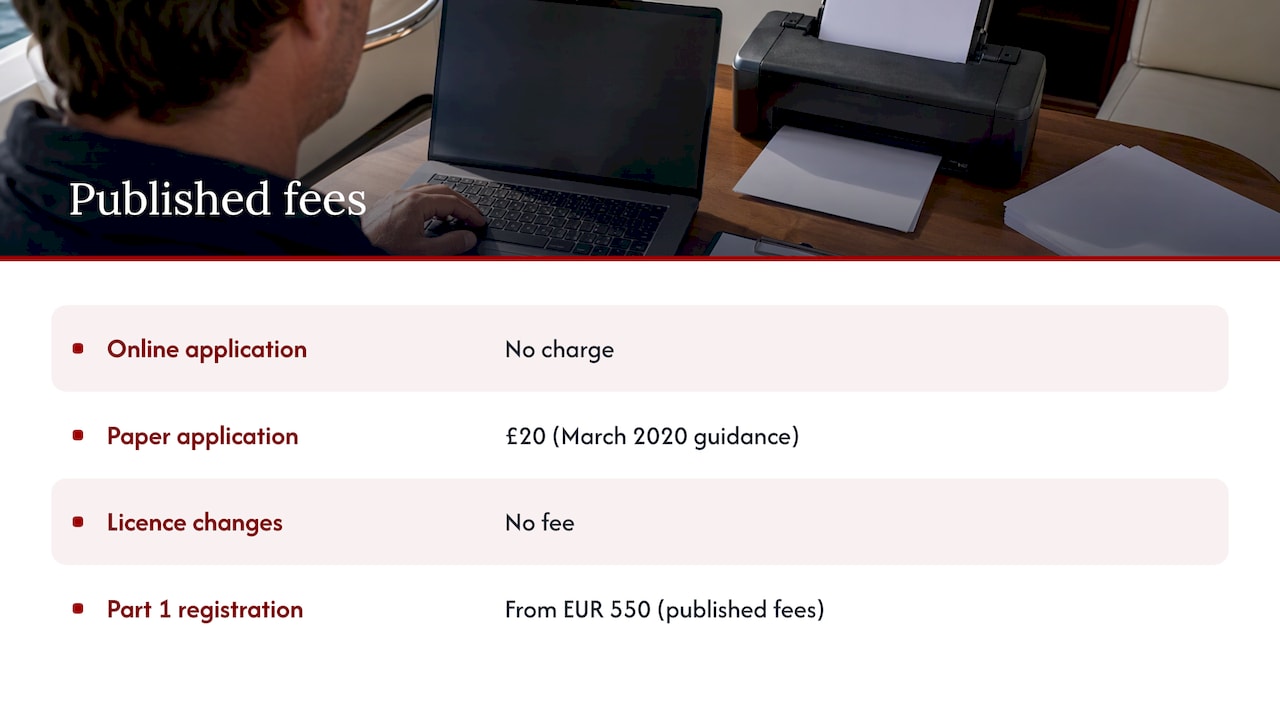
Ofcom’s guidance states that the ship radio licence is applied for through its licensing portal at no charge, while a paper application carried a fee, which the guidance gave as £20 when it was published in March 2020. Changes to a licence, such as new equipment, can be notified without a fee. Check Ofcom’s current pages before you rely on those figures. A UK licence is not transferable: if you sell the vessel, the new owner has to be licensed in their own right.
If you want the UK flag itself, remember that UK Part 1 registration can be held personally if you are eligible, through an existing UK or eligible foreign company such as a Delaware corporation, or through a newly formed UK LTD. A UK company is not always required. Our UK Part 1 yacht registration page sets out the options and the published fees from EUR 550.
Pologne
For Polish-flagged yachts we prepare the ship station permit, the MMSI and the SRC paperwork. Polish provisional papers take 2 to 5 days, and the MMSI licence follows registration, usually taking 4 to 6 weeks. Our guide to the Poland radio licence walks through the documents.
Saint-Marin
San Marino’s MMSI radio licence is valid for 5 years. The provisional certificate for registration takes 2 to 6 days, although that is never guaranteed. Our San Marino MMSI application guide covers requirements and steps.
Malte
Malta’s radio licence forms are a common source of delay when details do not match the registration file. See Malta radio licence for yachts for what to prepare. If you need the vessel afloat quickly, the Malta provisional registration process is worth understanding first.
Îles Caïmans
The Cayman Islands Maritime ICT Licence is valid for one year, or for multiples of one year on application, according to the regulator’s guide. That means a recurring renewal in your calendar, unlike the five-year or ten-year cycles elsewhere.
United States
The FCC says ship station licences are valid for ten years and renewed through its Universal Licensing System. Licensees must keep their mailing address, email address, legal name and emergency contact up to date there during the licence term. Our guide for US owners and the radio operator licence covers that side.
Operator certificates are a separate requirement
A licensed station is not the same as a qualified operator. Depending on the equipment and the flag, the person operating it may need a certificate. The most common is the GMDSS General Operator’s Certificate (GOC). Denmark’s maritime authority, for example, states that a GMDSS-GOC is valid for five years, and renewal requires 12 months of seagoing service in the five years, or three months in the last six months. Other flags set their own terms.
Two practical points for owners and captains:
- Check which certificate your flag expects for the equipment you actually fit, and note the expiry dates in the same planner as the station licence.
- Crew requirements interact with manning. Our guide on minimum safe manning for yachts explains who needs a document and why.
Applying: documents and sequence
The exact forms vary, but the application normally follows the same order.
- Confirm the flag and registration status. The administration needs the vessel’s name, registration details and owner. Many flags will not issue the radio licence before at least provisional registration.
- List the equipment. Make, model and serial numbers of the satellite terminal, VHF, EPIRB, AIS and any other transmitting equipment. Satellite terminals often have their own identifiers, such as a mobile number from terminal activation, which forms ask for.
- Check approval status. Confirm each item carries the approval marking your flag accepts.
- Classify the vessel. Private pleasure use versus commercial or charter use.
- Provide owner details and any accounting authority code. Where you use coast station services, you need that contract in place.
- File with the administration and pay its fees. The authority issues the licence and assigns the call sign and MMSI.
- Keep the licence on board. Ofcom’s guidance notes that marine surveyors in other countries may ask to see the ship’s radio licence to confirm that fitted radio equipment is properly licensed.
The sequence is simple. Delays come from mismatches: a vessel name spelt differently in two documents, an owner entity that does not match the registration, or equipment details left blank. Our remote service takes the application preparation and filing off your hands, so you send the documents once and we handle the form-filling and submission for the licences we cover.
Renewals, changes and changing flag
A licence is a live document. Build a short checklist and revisit it at each of these moments:
- Renewal date. From one year (Cayman Islands) to five years (San Marino MMSI licence) to ten years (FCC), plus whichever cycle your own flag uses.
- New equipment. Replacing or adding a terminal normally means notifying the authority so the licence reflects what is on board.
- Change of owner, name or contact details. The FCC explicitly requires updates to legal name, addresses and emergency contacts. Other authorities expect the same in practice.
- Sale. Ofcom states that licences are not transferable.
- Change of flag. IMO guidance says the identities in the radio licence, including the MMSI, should be changed when a ship transfers to another flag. That also means updating your EPIRB registration, your satellite terminal’s records and any DSC-capable radios.
Flag transfers are where radio licensing most often gets forgotten. We handle transfers between flags and the related MMSI work together, so the identities are changed in step with the registration.
Before an international passage
What to check before you leave home waters:
- The ship radio licence is current and lists every transmitting device on board, including the satellite terminal.
- Call sign and MMSI on the licence match the programming of your VHF-DSC, AIS and EPIRB.
- Equipment carries approval markings your flag accepts.
- Your accounting authority contract is active if you route traffic through coast stations.
- Crew radio certificates are in date.
- A copy of the licence is on board, since inspectors and surveyors abroad may ask for it.
How Vessel Flag helps
We are a private yacht registration consultancy. We prepare and file the applications; the flag authorities issue the certificates and licences. For radio licensing, we arrange MMSI numbers and ship radio licences for yachts under our main flags, with published one-off prices that include VAT and carry no annual fees: EUR 149 for Poland, EUR 150 for the UK and EUR 200 for San Marino. Details sit on our MMSI and ship radio licence page, and our MMSI number registration for yachts guide explains the application in more depth.
If you are also choosing or changing a flag, we can handle the registration and the radio licence together, along with company formation for ownership where it is needed. The whole process is remote, so owners and brokers do not need to travel to a registry.
Our view: licence the vessel once, properly, and keep it current
Owners tend to treat the satellite terminal as a connectivity purchase and the radio licence as a formality for later. We see them as one project. The terminal, the MMSI, the call sign and the flag all need to describe the same vessel, the same owner and the same equipment.
That is why we prefer to deal with registration and radio licensing together. The documents overlap: the owner entity, the vessel particulars and the proof of registration feed both files. Filing them in one sequence removes the mismatches that slow applications down.
It is also why we publish fixed one-off prices. A yacht owner should know what the MMSI and radio licence will cost before starting, not after the first round of questions. And because we work with eight flags, we can look at the whole picture, including whether a later flag transfer is likely and what it will mean for the radio identities.
Our advice to any owner fitting a new terminal: settle the flag, apply for the licence, and only then finalise the installation paperwork, so the licence lists exactly what is on board.
Vessel Flag
FAQ
Do I need a separate licence for my yacht’s satellite terminal?
Usually the terminal is declared on the vessel’s ship radio licence rather than licensed on its own. UK guidance lists satellite communications equipment among the items covered by the ship radio licence. Check your flag administration’s own requirements, as they differ.
Is the MMSI part of satcom licensing?
The MMSI is assigned with the ship radio licence, and it identifies the vessel across radio and distress systems. Flag administrations usually assign it during the initial radio licensing application. If you change flag, the MMSI should be changed too.
How long does a yacht radio licence last?
It depends on the authority. The Cayman Islands Maritime ICT Licence runs for one year, a San Marino MMSI radio licence is valid for 5 years and FCC ship station licences run for ten years. Always confirm your own flag’s term and note the renewal date.
Do I need an operator certificate to use the satellite equipment?
Possibly. Operator certificates are separate from the station licence and depend on the flag and the equipment. A GMDSS-GOC, for example, is valid for five years in Denmark, with specific sea-service rules for renewal. Check what your flag requires for the equipment fitted.
How quickly can Vessel Flag arrange an MMSI?
A UK MMSI licence takes 1 day. The Polish MMSI licence takes 4 to 6 weeks after registration. San Marino’s licence is valid for 5 years once issued. Timings depend on the registry or regulator, and we do not guarantee them.
Sources
- Ofcom: Ship Radio Licences, guidance notes for licensing
- FCC: Ship Radio Stations Licensing
- ANFR: Licence MMSI
- IMO: Harmonization of GMDSS requirements for radio installations
- OfReg Cayman Islands: Maritime Radio Guide, September 2023
- Marshall Islands registry: Vessel Registration and Instrument Recording
- Danish Maritime Authority: Radio certificate
Ready to licence your yacht? See our flag registration and MMSI options or book a consultation and tell us your flag and equipment.
Recommandé
- Certificat d'opérateur radio pour yacht : ce que les propriétaires américains doivent savoir
- MMSI Number Registration for Yachts – From €149
- Licence radio pour yachts à Malte : évitez les retards administratifs, faites-vous inscrire au MMSI.
VesselFlag is a private consultancy that prepares and files yacht registration applications for owners. We are not a government body or flag registry; certificates are issued by the relevant registry. This article is general information, not legal advice.