Minimum safe manning is the smallest crew, by number and by grade, that a flag administration accepts as able to run your yacht safely at sea. It is set out in a Safe Manning Document (SMD, also called a Minimum Safe Manning Document or Certificate). Whether you need one depends on your flag, your yacht’s length and gross tonnage, and whether the yacht is private or commercial. For most large commercial yachts the answer is yes. For private yachts below 500 GT it is often optional, but the rules differ by flag, so check before you register.
TL;DR
- Minimum safe manning is a goal-based IMO framework: the flag decides the crew numbers and grades the yacht must carry when it proceeds to sea.
- Thresholds vary by flag. Commercial yachts of 24 m and over, and private yachts of 500 GT and over, are the common triggers, but some registries set their own lines.
- The owner or manager normally submits a manning proposal, and the flag assesses it against size, propulsion, automation, trading area and rest-hour rules.
- A new proposal is needed after changes that affect manning, and a document can lose validity if you do not report them.
- Choose your flag with manning in mind, because it affects crew cost, qualifications and paperwork from day one.
Table des matières
- What minimum safe manning actually means
- Which yachts need a safe manning document
- How a flag decides your minimum crew
- Qualifications the crew must hold
- Applying for the document
- When the document must be reviewed
- Manning and your choice of flag
- Perspective: where manning fits in a registration
- How Vessel Flag helps
- FAQ
- Sources
What minimum safe manning actually means
The idea comes from the International Maritime Organization. Its Resolution A.1047(27), adopted in 2011, sets a goal-based framework so that ships are sufficiently and efficiently manned for safety, security and protection of the environment. The document that results records the minimum personnel, by grade and capacity, that must be on board when the vessel goes to sea.
In the same guidance, a manning document should state the ship’s name, port of registry, IMO number and gross tonnage, list the grades and capacities of the required crew, and confirm that the ship is safely manned if it carries them.
Two points matter for owners:
- The figure is a minimum, not a recommendation. Guests, charter operations and demanding itineraries can justify more crew than the document requires.
- The document is tied to the yacht’s circumstances. If those change, the document may no longer fit.
Which yachts need a safe manning document
There is no single worldwide threshold. The pattern across flags is that the obligation depends on three things: length or tonnage, commercial or private use, and whether the yacht makes international voyages.
A circular from St Vincent and the Grenadines lists the common categories: ships on international voyages, commercial yachts of 24 metres and over, and private yachts of 500 gross tonnage and over. Other registries draw the lines in different places.
| Pavillon | Who is required to hold the document | Source |
|---|---|---|
| Royaume-Uni | Seagoing merchant vessels of 500 GT or more, and UK-flagged yachts over 24 m regardless of tonnage, excluding pleasure vessels not engaged in trade | GOV.UK |
| Îles Marshall | Commercial yachts, passenger yachts, private yachts on limited charter, yachts engaged in trade, and private yachts of 3,000 GT or more | RMI Marine Notice 7-038-2 |
| Barbade | Vessels on international voyages and commercial yachts of 500 GT and greater | Bulletin 011 |
| Île de Man | Commercial ships of 200 GT or over on international voyages (commercial yachts follow a separate code) | MSN 052 |
The table shows why a general answer is risky. A private yacht of 1,200 GT that needs nothing under one flag could be in scope under another if it takes paying guests.
Private yachts below the threshold
Below the mandatory line you may still choose to hold a document. Under the IMO-based guidance on manning, certification and hours of work, owners of vessels under 500 GT, or of 500 GT and over used solely for pleasure, may elect to hold an SMD. That allows a “range and risk” approach to manning levels. Some owners take this route because a formal document gives the captain, insurer and port authorities a clear reference for how the yacht is crewed.
Private versus commercial: the line that matters most
The single most common reason an owner is caught out is a change of use. A yacht that is registered as private and later chartered, even occasionally, can move into a commercial or limited-charter category with stricter manning and certification rules. Settle your intended use before you pick a flag, not after. Our guide on how to choose the right yacht flag walks through that decision.
How a flag decides your minimum crew
Most flags work from a proposal. The owner, manager or operating company describes how the yacht will be crewed, and the administration evaluates it. Under the IMO framework, an administration may require the operating company to submit a proposal, which it assesses against safety, security, environmental protection, emergency duties, and work and rest requirements.
The factors that drive the number, again from the IMO resolution, include:
- ship size and type
- the type and power of main propulsion and auxiliaries
- level of automation
- trading area
- frequency of port calls
- compliance with work-hour limits and rest requirements
Flags add their own emphasis. The Marshall Islands, for example, expects yacht manning assessments to account for peak workloads and participation in mandatory safety drills and exercises. The Cayman Islands Shipping Registry’s Manning Policy Manual suggests a formal safety assessment as a risk-management tool that owners can use to justify their proposed levels.
A worked example
Take a 40 m motor yacht on a flag that treats it as commercial. Proposed crew: master, chief officer, chief engineer, a second engineer, a deck crew member and interior staff. The flag looks at the engine room (is it periodically unmanned, how automated is it), the itinerary (Mediterranean day hops or ocean passages), and whether the deck team can cover watchkeeping and a drill at the same time without breaking rest-hour limits. If the numbers fail on rest hours, the flag asks for more crew, whatever the owner would prefer.
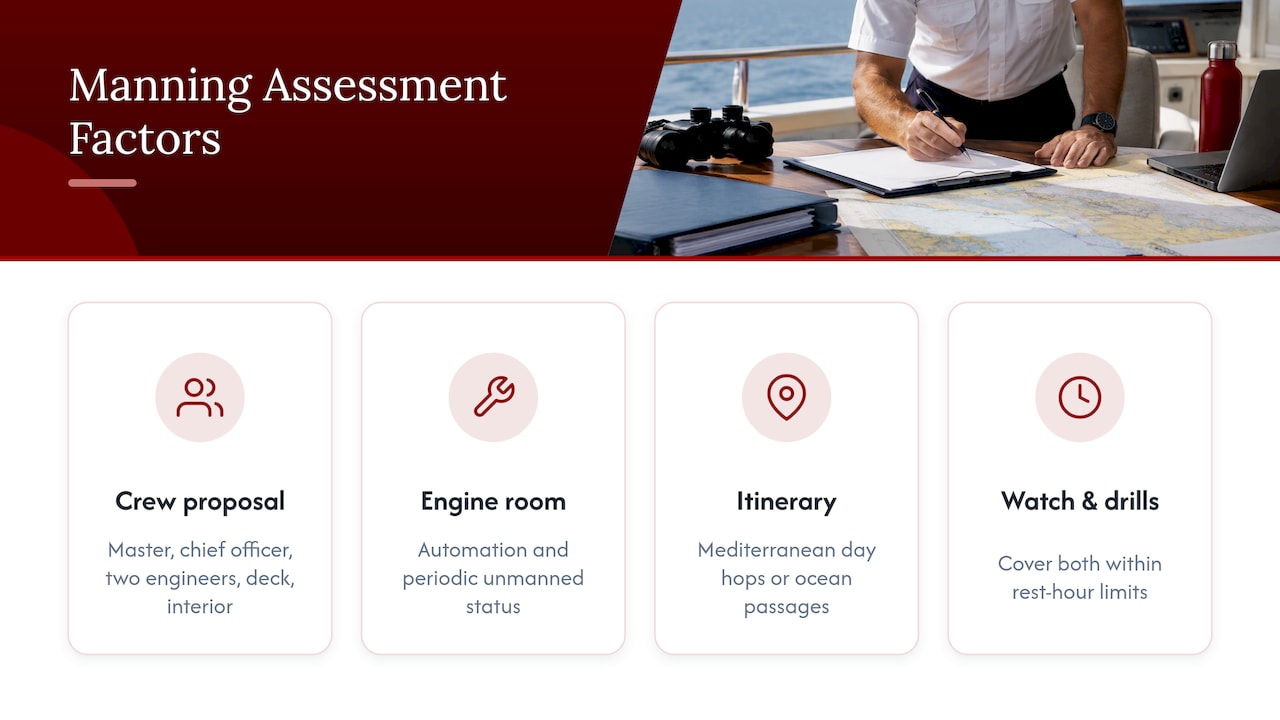
This is an illustration of the method, not a statement of what any flag would approve for a given yacht.
Qualifications the crew must hold
A manning document names grades and capacities, so each person filling a post needs a certificate that matches. In the Cayman Islands, masters and officers on ships or yachts with a minimum safe manning document must hold an appropriate certificate for their capacity, and the relevant STCW certificates must be recognised by the Cayman Islands Shipping Registry.
The practical lesson is the same everywhere: a certificate issued by one country is not automatically accepted by every flag. Before you offer a captain the job, check the flag’s recognition list or ask the registry whether the certificate needs an endorsement.
Applying for the document
The route is set by the flag, but the sequence is usually similar:
- Fix the yacht’s particulars. Name, IMO number if it has one, gross tonnage, length, propulsion and equipment.
- Decide the use. Private, limited charter or full commercial.
- Draft the manning proposal. Grades, numbers, watch pattern, rest-hour plan and the operating area.
- Submit to the flag administration. For UK ships the MCA issues the document. According to the MCA’s large yacht guide, class societies and other private organisations are not permitted to issue these documents for UK ships.
- Carry the document on board and crew the yacht to match it.
Timings and fees vary by registry, so use the flag’s own page for the current process rather than a third-party summary.
When the document must be reviewed
A safe manning document is not set and forgotten. Per the guidance on manning, certification and hours of work, a new application is required after changes in equipment, construction or use that affect manning, and a document can be withdrawn for unreported changes or persistent rest-hour failures.
The IMO guidance names the triggers: changes in trading area, construction, machinery, equipment, operation, maintenance or management. The UK MCA says in its notice that an SMD stops being valid if the owner or operator does not submit a new proposal after such changes, or if the ship persistently fails to meet rest-hour requirements.
Typical events that should make you pick up the phone to the flag:
- a refit that adds a tender garage, crane or major new systems
- moving from Mediterranean seasons to transatlantic or Pacific cruising
- starting charter operations
- changing the management company
If something unforeseen stops you meeting the document, there is a route. In the UK, an owner may apply to the MCA for an exemption when circumstances such as illness or a medical emergency prevent compliance with the minimum crew on the SMD, as set out in the GOV.UK guidance.
Manning and your choice of flag
Manning rules are one of several factors in flag selection, alongside tax position, eligibility of the owner, charter plans, and registration cost. A few ways the two connect:
- Eligibility and ownership structure. Some flags need the yacht held by a company, which affects who is responsible for the manning proposal. For UK Part 1, owners can register personally if eligible, through an existing UK or eligible foreign company (a Delaware corporation, for example), or through a new UK LTD. A UK company is not always required.
- Commercial ambitions. If you plan to charter, look at the flag’s commercial yacht requirements before you register. Moving flag later means a deletion certificate and a transfer.
- Yacht size. Smaller private yachts under a flag’s thresholds avoid most of this paperwork, which is why many private owners choose flags with straightforward private-yacht registration.
For private yachts, registration under Poland, San Marino or UK Part 1 is a common starting point for owners who want a clear, remote process. If a flag outside our published list suits you, such as Langkawi, a Dutch Zeebrief, Gibraltar or Panama, we handle these on request, with the price confirmed per case.
Perspective: where manning fits in a registration
We prepare and file registration applications every week, and manning is the subject owners raise too late. They choose a flag on price or familiarity, then discover that a planned charter season or a refit changes which rules apply.
Our advice is to settle three things before filing: how the yacht will be used, where it will trade, and who will crew it. Once those are clear, the flag choice usually becomes simple, and the manning question has a straightforward answer from the registry.
We are a private consultancy, not a registry. The flag registry sets manning requirements and issues certificates. What we do is prepare the application correctly, match your plans to a flag we know well, and set up the surrounding pieces, from ownership company to MMSI radio licence, so that nothing holds up your first voyage.
Vessel Flag
How Vessel Flag helps
Vessel Flag prepares and files yacht and boat registration applications for private owners, companies and brokers, fully remotely and with published one-off prices. The flag registry issues the certificates.
Published prices for the main flags:
| Pavillon | Prix |
|---|---|
| Pologne | from EUR 320, one-off |
| Saint-Marin | from EUR 290, one-off (5-year all-in package EUR 1,290) |
| Royaume-Uni, 1re partie | from EUR 550, one-off |
| Malte | from EUR 849, one-off |
| Palau | from EUR 700, one-off |
| Îles Marshall | EUR 250 service fee plus registry fees |
| Îles Caïmans | EUR 450 service fee plus registry fees |
Cook Islands registration is quoted per yacht. We can also form the ownership company (company formation for yacht ownership) and arrange your MMSI and ship radio licence: Poland EUR 149, UK EUR 150 and San Marino EUR 200, each VAT included with no annual fees.
FAQ
Does a private yacht need a minimum safe manning document?
Not always. Many flags make it mandatory only for commercial yachts above a size, or for private yachts above a tonnage such as 500 GT. Owners below the thresholds can often hold one voluntarily. Check your flag’s circular, because the lines differ.
Who issues the safe manning document?
The flag administration. For UK-flagged ships that is the MCA, and private organisations may not issue it. Vessel Flag prepares registration applications but does not issue certificates or manning documents.
What happens if I change how I use the yacht?
You should tell the flag and submit a new proposal. Changes in trading area, equipment, operation or management can affect manning, and a document may stop being valid if you do not report them.
Is minimum manning the crew I should actually carry?
No. It is the lowest crew the flag accepts for safe operation. Charter guests, long passages and rest-hour compliance often justify a larger team, and the captain’s judgement still applies.
Sources
- IMO Resolution A.1047(27), Principles of Minimum Safe Manning
- GOV.UK: How to apply for a safe manning document
- Marshall Islands Marine Notice 7-038-2
- Barbados Maritime Authority Bulletin 011
- Annex G: Manning, Certification and Hours of Work
- Cayman Islands Shipping Registry Manning Policy Manual
- MCA: A master’s guide to the UK flag, large yacht edition
- MCA Merchant Shipping Notice 1868
- St Vincent and the Grenadines circular SOL 029
- Isle of Man Ship Registry MSN 052
Ready to register? See the flag page that fits your yacht, such as UK Part 1 yacht registration, or book a consultation with Vessel Flag and we will match the flag to your plans.
VesselFlag is a private consultancy that prepares and files yacht registration applications for owners. We are not a government body or flag registry; certificates are issued by the relevant registry. This article is general information, not legal advice.