If your vessel measures 24 meters or more in load line length, operates commercially for sport or pleasure, and carries no more than 12 passengers, LY3 requirements apply to you in full. The Large Commercial Yacht Code sets mandatory construction, safety, and operational standards enforced through flag state and Recognised Organisation surveys. Your first move: confirm your declared operational profile matches how the yacht actually runs, then check the status of every current certificate before anything else.
TL;DR:
- Yachts of 24 meters or more in load line length used commercially for sport or pleasure with no more than 12 passengers must fully comply with LY3 standards, including specific certification and safety requirements.
- Proper measurement of load line length by a recognized authority is essential, especially for vessels close to the 24-meter threshold, to ensure correct code application.
- A change from private use to commercial charter, or exceeding 12 passengers, triggers mandatory updates to certification and possibly a new survey, affecting insurance and legal operation.
- Critical documentation such as stability booklets, certificates, and service records must be current and organized to avoid common survey failures.
- Regular pre-survey checks, early coordination with Recognized Organisations, and maintaining accurate registration and compliance records are key to reducing the risk of non-compliance.
Table des matières
- What Vessels Fall Under LY3 Requirements?
- Core Technical and Safety Requirements Under LY3
- How Certification and Surveys Actually Work
- Manning Rules and Crew Certification
- Operational Systems Surveyors Actually Check
- Tracking LY3 Amendments and MGNs
- Pre-Survey Checklist: What to Fix in the Next 90 Days
- Where VesselFlag Fits Into Your Compliance Picture
- Specific Manning Requirement Differences Under LY3
- Environmental Compliance for LY3 Vessels
- Common LY3 Non-Compliance Issues and How to Fix Them
- How LY3 Requirements Affect Operating Costs and Maintenance Budgets
- What Actually Trips Up LY3 Compliance
- Ready to Reduce Survey Risk? Here’s Where to Start
- Official LY3 Documents Worth Bookmarking
- Sources
- FAQ
What Vessels Fall Under LY3 Requirements?
LY3 draws its boundary at a specific measurement, not a rough estimate of size. The code applies to yachts of 24 meters and over in load line length, a technical measurement distinct from overall length or gross tonnage, that are in commercial use for sport or pleasure and carry no more than 12 passengers. Get the load line length wrong and you either apply the wrong code entirely or miss requirements a surveyor will flag on day one.
Load line length is calculated under the International Convention on Load Lines, not simply measured from bow to stern. A yacht that reads 23.8 meters on a brochure spec sheet can still land inside LY3’s scope once load line length is properly calculated, and the reverse happens just as often. Owners commissioning a new build or buying a resale vessel close to the threshold should have this figure confirmed by a naval architect or the Recognised Organisation before assuming which code applies.
“Commercial use for sport or pleasure” is the second gatekeeper, and it trips up more owners than the length threshold does. A yacht used exclusively by its owner and guests, with no charter income, no fee-paying passengers, and no commercial contract of any kind, sits outside LY3’s commercial framework even at 40 meters. The moment money changes hands for use of the vessel, whether through bareboat charter, crewed charter, or a corporate hospitality arrangement, the commercial classification kicks in.
The 12-passenger cap matters because it separates LY3 from the far heavier compliance burden that applies to vessels carrying more passengers. Cross that number and you move into passenger ship regulations under SOLAS and related conventions, which is a different compliance world with different survey regimes, different manning scales, and materially higher costs.
Several distinctions determine which rules actually govern your vessel:
- New builds versus existing vessels: LY3 applies its full technical chapters to new construction, while existing vessels converting into commercial use may follow equivalence provisions depending on when they were built and under what earlier code.
- National Annex variations: your flag state can layer additional or modified requirements onto the base LY3 text. The Australian National Annex is a clear example, adjusting survey pathways and referencing local Marine Orders that don’t appear in the UK base document.
- Red Ensign Group nuance: yachts registered under Red Ensign flags (UK, Cayman Islands, British Virgin Islands, and others) generally recognize LY3 as the baseline code, but each administration can apply its own certification pathway on top of it.
- Sailing versus motor yacht treatment: certain stability and rigging provisions differ by vessel type, though the passenger cap and length threshold apply uniformly.
If your vessel sits within a meter or two of the 24-meter line, or your charter model is ambiguous (owner use most of the year, occasional paid charter), get a written determination from your Recognised Organisation before you plan a survey around assumptions.
Core Technical and Safety Requirements Under LY3
LY3 requirements are organized into chapters that mirror how a surveyor actually walks the vessel, from structure through to lifesaving equipment. Knowing which chapter governs which system lets you audit your own yacht before an official ever steps aboard.
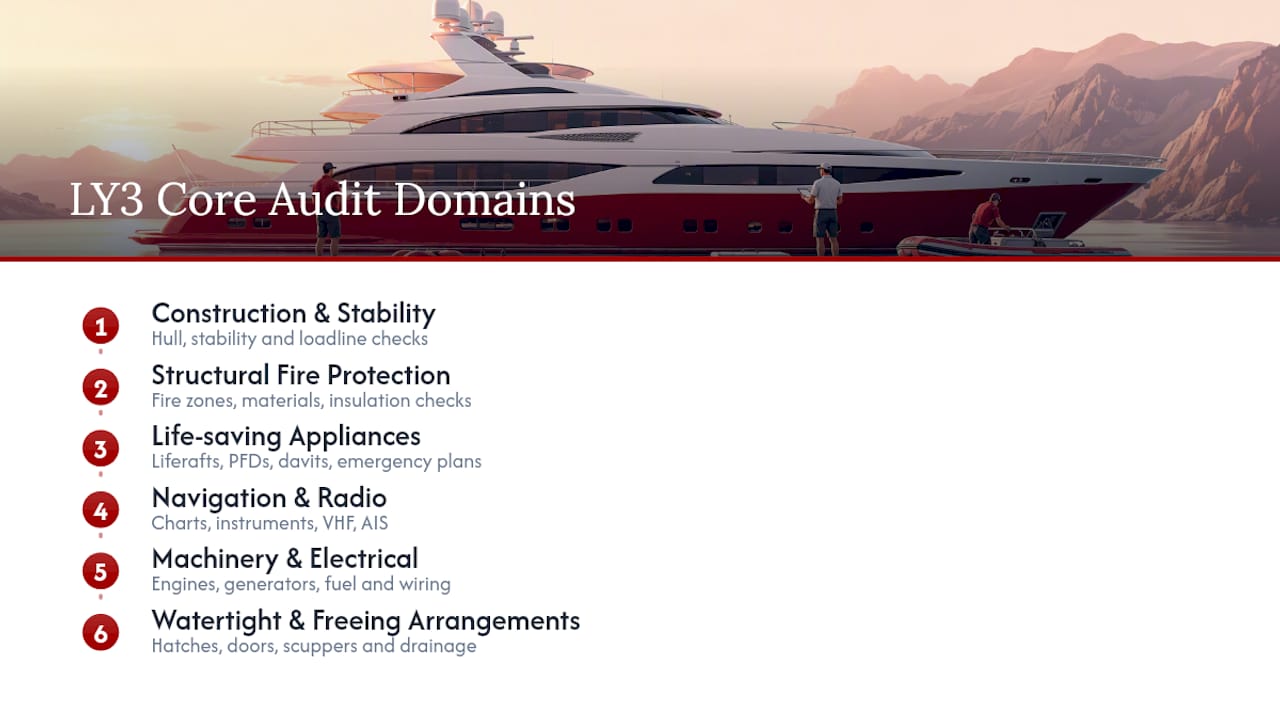
Construction and stability
Every LY3-compliant yacht needs an approved stability booklet on board, reflecting both intact and damage stability calculations specific to that hull. This document isn’t paperwork for its own sake. Surveyors treat the stability booklet as one of the first things they examine at survey, because it proves the vessel’s loading condition has been mathematically validated against the code’s stability criteria.
Construction requirements are generally satisfied through classification with a Recognised Organisation rather than direct MCA inspection of every plate and weld. Class societies apply their own structural rules, which LY3 recognizes as meeting the code’s construction chapter, provided the classification remains current and unbroken. If your vessel underwent any structural modification, a lengthening, a superstructure addition, a hull repair after grounding, the stability booklet needs updating and reapproval before the next survey, not after.
Structural fire protection
Fire protection requirements scale with vessel size and passenger capacity, covering fire-resistant divisions between spaces, detection systems in accommodation and machinery spaces, and fixed or portable suppression systems appropriate to each space’s fire risk. Engine rooms typically need fixed extinguishing systems; galleys need appropriate portable extinguishers and, often, wet chemical systems over cooking equipment.
Detection and suppression systems require documented servicing at intervals set by the manufacturer and the Recognised Organisation, and surveyors ask to see service records, not just working equipment. A fire door that’s been wedged open for crew convenience, or a fire damper painted shut during a repaint, are common findings that stall surveys.
Life-saving appliances
This chapter covers everything from liferafts and lifejackets to distress flares and man-overboard equipment, with minimum carriage numbers tied to the vessel’s certified capacity of crew and passengers combined. Liferafts require periodic servicing at approved stations, generally annually, and the service certificate needs to be current and on board, not simply filed at the manufacturer’s depot.
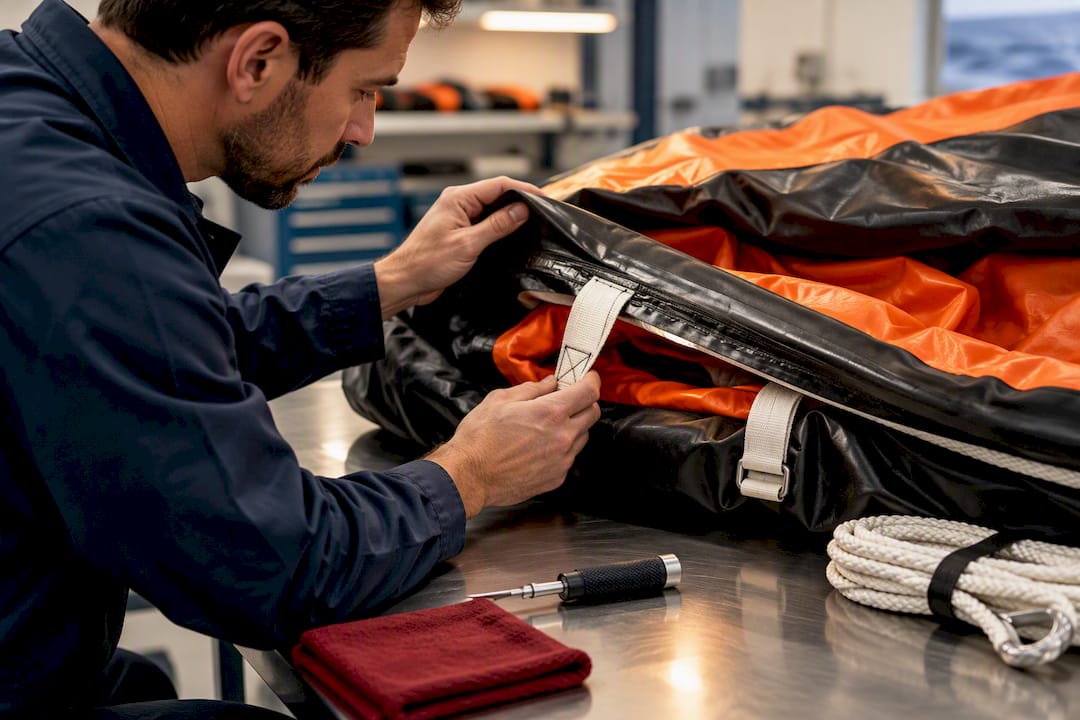
Stowage matters as much as carriage. Liferafts need to be positioned for rapid launch, lifejackets need to be accessible without unlocking multiple compartments, and immersion suits, where carried, need correct sizing records matched to crew and typical passenger profiles. Recordkeeping around servicing dates, drill participation, and equipment replacement forms part of what a surveyor cross-checks against the physical inventory.
Navigation and radio
Bridge navigation equipment requirements follow SOLAS-equivalent standards scaled to vessel size, covering radar, GPS, AIS, and, above certain size and area-of-operation thresholds, ECDIS. Radio requirements split along a size line: yachts over 300 gross tons carry full SOLAS and GMDSS obligations, including specific VHF, MF/HF, and satellite communication fits depending on the sea areas the vessel is certified to operate in. Smaller yachts under that tonnage threshold still carry functional radio obligations under LY3 and the applicable national annex, just calibrated to a lighter equipment scale.
An MMSI number and the correct ship radio license underpin all of this. Without a valid MMSI registration matched to the vessel’s flag, GMDSS-capable equipment can’t transmit a properly identified distress call, which is a gap surveyors and port state control both check early.
Machinery and electrical systems
Main engines, generators, and auxiliary machinery generally need to satisfy the Recognised Organisation’s class rules rather than a separate LY3-specific machinery code, since the code defers heavily to established class society standards here. Periodically unattended machinery spaces (common on modern yachts running reduced engineering watches) require additional automated monitoring and alarm systems to compensate for the absence of a continuous human watch.
Emergency power is a frequent survey failure point. LY3 requires an independent emergency source capable of running essential systems, navigation lights, emergency lighting, radio equipment, and, on larger vessels, fire pumps, for a specified duration if main power fails. Battery banks supporting this emergency supply need documented testing, not just a visual check that the battery exists.
Watertight integrity and freeing arrangements
Every opening in the hull and weather deck, from hatches to portlights to engine room doors, needs to maintain watertight or weathertight integrity appropriate to its location. Freeing ports and deck drainage need sufficient capacity to clear water from the deck within the code’s specified timeframes, calculated against the vessel’s freeboard and deck area.
Coamings around hatches and machinery space openings need minimum heights set by the code, and it’s common to find these reduced during a refit when a hatch gets replaced with a lower-profile unit for aesthetic reasons. That’s a compliance gap disguised as a design upgrade, and it surfaces almost every time at the next renewal survey.
How Certification and Surveys Actually Work
Your flag state issues the Large Yacht Code Compliance Certificate, but it rarely does the inspection work itself. Instead, the flag state delegates survey authority to a Recognised Organisation, commonly Lloyd’s Register, DNV, Bureau Veritas, RINA, or ABS, which conducts the physical surveys and reports compliance back to the flag administration. The flag state retains ultimate legal authority and can override or audit the RO’s findings, but day-to-day survey work sits with class.
The survey cycle follows a predictable rhythm once a vessel is in commercial service:
- Initial/construction survey: conducted before the certificate is first issued, covering the full range of LY3 chapters against the as-built vessel.
- Annual survey: a lighter-touch inspection confirming the vessel remains in the condition certified, checking lifesaving equipment, fire safety systems, and general structural condition.
- Intermediate survey: a more detailed inspection roughly midway through the certificate’s validity period, often digging deeper into machinery and safety systems than the annual check does.
- Renewal survey: a full re-examination equivalent in scope to the initial survey, conducted before the existing certificate expires, resulting in a new five-year certificate cycle if the vessel passes.
Outside this fixed schedule, three events force an unscheduled survey: damage significant enough to affect structural or watertight integrity, any modification to the vessel that could affect its certified condition, and a change of operation. That last trigger catches more owners off guard than the other two combined. Moving from private use to charter, adding paid guest capacity, or extending the vessel’s certified area of operation all count as a change of operation requiring notification to the flag state and, typically, a fresh survey before you can legally operate under the new profile.
The consequences of skipping this step reach beyond the certificate itself. Insurers routinely tie coverage validity to a current, accurate compliance certificate, and port state control officers in any jurisdiction can detain a vessel found operating outside its certified profile. A yacht surveyed as private-use-only that starts running paid charters without updating its certificate isn’t just non-compliant on paper, it’s potentially uninsured the moment a claim arises.
Conseil de pro : Keep a single physical folder and a digital backup on board containing the current compliance certificate, the last three survey reports, and your stability booklet. When a port state control officer or charter broker asks for evidence, producing it in under two minutes says more about your operation than any amount of verbal reassurance.
Manning Rules and Crew Certification
Every LY3-certified yacht operates under a Minimum Safe Manning Document that specifies the exact crew composition, by number and by certificate, required to run that vessel safely. The MSMD isn’t a suggested staffing guideline; it’s a legal instrument, and operating below the numbers or qualifications it specifies can lead to detention and, separately, can invalidate insurance coverage if an incident occurs during understaffed operation.
Key certificate requirements to verify against your MSMD:
- The master must hold an STCW certificate of competency appropriate to the vessel’s tonnage and area of operation, not simply a generic yacht master qualification.
- The chief engineer needs an engineering certificate scaled to the vessel’s engine power, with additional endorsements for periodically unattended machinery spaces where fitted.
- All crew need basic safety training (STCW Basic Training covering firefighting, first aid, personal survival techniques, and personal safety and social responsibility) before joining, regardless of their specific onboard role.
- Passenger carriage often triggers additional manning above the base crew requirement, since passenger safety duties (muster coordination, lifeboat/liferaft assignment, evacuation assistance) add workload the base crew number may not cover.
Watchkeeping standards apply on passage in the same way they do on any commercially certified vessel: rest hour regulations under the Maritime Labour Convention framework limit how watches can be structured, and a captain running a lean crew on a demanding charter schedule needs to plan watches that satisfy both operational needs and legal rest requirements. Surveyors and port state control both ask to see watchkeeping and rest hour records during inspections, and gaps here are treated as seriously as a missing fire extinguisher service tag.
Operational Systems Surveyors Actually Check
A Safety Management System underpins day-to-day compliance on any commercially operated yacht, documenting how the vessel handles everything from routine maintenance to emergency response. Vessels above certain size and operational thresholds fall under full ISM Code requirements, while smaller commercial yachts typically operate a scaled-down SMS that still needs to demonstrate the same core discipline: documented procedures, assigned responsibilities, and a paper trail proving those procedures are actually followed rather than just written down.
Medical stores need to match the vessel’s certified capacity and area of operation, with scale and content specified by the flag administration and checked against a current inventory list. Crew responsible for medical care need training appropriate to the store’s complexity, ranging from basic first aid to more advanced medical care certificates on vessels operating further from shore-based medical support.
Recordkeeping ties every operational system together, and it’s where surveys are won or lost on documentation grounds alone:
- Maintenance logs covering machinery, safety equipment, and structural inspections, dated and signed, not reconstructed from memory the week before survey.
- Drill records showing regular fire, abandon ship, and man-overboard exercises with crew names and dates, not a single drill logged the day before the surveyor arrives.
- Liferaft and lifejacket servicing certificates matched to the physical equipment on board.
- Radio log entries documenting equipment checks and any distress or urgency traffic.
- The current stability booklet, all valid certificates, radio licenses, and the MSMD, ideally in one accessible master file.
Conseil de pro : Build your maintenance and drill logs as a running digital record updated weekly, not a document assembled retroactively before survey. Surveyors can often tell the difference between a log built in real time and one built the night before, and the latter invites closer scrutiny of everything else on board.
Tracking LY3 Amendments and MGNs
LY3 isn’t a static document frozen at publication. It replaced the earlier LY2 code effective August 20, 2013, and the MCA continues to issue Merchant Shipping Notices and Marine Guidance Notes that clarify, amend, or phase in specific requirements over time. LY3 functions as an equivalent standard to international convention requirements, and MGNs are where the MCA explains practical interpretation of how that equivalence works in specific scenarios.
National Annexes add a second layer of change to track, since a flag administration can update its own annex independently of when the MCA updates the base LY3 text. The Australian National Annex, for example, references local Marine Orders that get amended on Australia’s own regulatory timeline, separate from any UK-driven update to LY3 itself.
Practical monitoring doesn’t require constant vigilance, just a few consistent habits:
- Subscribe to GOV.UK notifications for Merchant Shipping Notices and Marine Guidance Notes relevant to large yachts.
- Follow circulars issued by your Recognised Organisation, since class societies typically flag relevant regulatory changes to their certified fleet directly.
- Maintain a simple compliance calendar noting survey due dates, certificate expiries, and any known upcoming regulatory deadlines, reviewed at least quarterly.
- Ask your class surveyor directly, at every survey, whether any amendments affecting your vessel’s category have been issued since the last inspection.
Pre-Survey Checklist: What to Fix in the Next 90 Days
Most survey failures trace back to a handful of recurring gaps, not exotic technical problems. Working through this list 60 to 90 days before a scheduled survey catches the majority of them with time to spare for remedial work.
- Verify document currency first. Confirm the stability booklet reflects the vessel’s current configuration, check that all certificates (compliance certificate, radio license, MSMD) show valid dates through the survey period, and pull together the last two years of maintenance and drill logs into one accessible file.
- Walk the fire safety systems physically. Check every fire door closes and seals correctly, confirm dampers aren’t painted or wedged, and verify extinguisher service tags are current and match the inventory list, not just present.
- Confirm lifesaving equipment service dates. Liferaft service certificates need to be current, not expiring during the survey window, and lifejacket and immersion suit counts need to match certified crew and passenger numbers exactly.
- Test emergency power under load. Don’t just confirm the emergency generator starts; confirm it actually carries the emergency electrical load, including radio equipment and emergency lighting, for the duration the code requires.
- Coordinate timing with your Recognised Organisation early. Surveyors book weeks or months in advance during busy seasons, and remedial work discovered mid-survey often needs a follow-up visit. Booking early gives you room to fix findings without missing your certificate renewal deadline.
Conseil de pro : Ask your surveyor, before the survey even starts, what the three most common findings were on similar vessels in the last twelve months. Class societies see patterns across their fleet, and a five-minute conversation can save you a failed inspection over something entirely predictable.
Where VesselFlag Fits Into Your Compliance Picture
Meeting LY3 requirements is a technical and safety exercise, but the paperwork underneath it, flag registration, MMSI licensing, and documentation collation, is where Vesselflag’s work directly supports your survey readiness. A correctly registered vessel with a current MMSI number and properly organized documentation gives your Recognised Organisation surveyor a clean starting point instead of a scavenger hunt through outdated files.
Specialized providers handle flag registration across multiple jurisdictions, MMSI and AIS setup, and documentation packages that align registration paperwork with what a survey actually requires on the day. For an owner juggling a refit schedule, a charter calendar, and a survey deadline, having a dedicated agent manage the administrative side reduces the chance that a missing certificate or an unregistered radio license derails a survey you’ve spent months preparing for otherwise. Scoping this kind of engagement typically starts with a review of current flag status and existing paperwork against what the next survey will demand.
Specific Manning Requirement Differences Under LY3
Manning scales aren’t a single fixed number across every LY3 vessel; they shift based on tonnage, passenger certification, and area of operation, which is why two 30-meter yachts can carry genuinely different MSMD requirements. A yacht certified for coastal operation with a small paid charter guest count typically carries a lighter manning scale than one certified for unrestricted ocean passages with a full 12-passenger complement.
Passenger certification is the biggest single variable. Adding passenger capacity, or extending from occasional day charter to overnight charter with sleeping guests, generally increases the manning scale beyond what a purely private-use or crew-delivery voyage requires, because passenger safety duties (muster stations, evacuation assistance, medical response) need dedicated crew capacity on top of navigation and engineering roles.
Area of operation matters just as much as passenger count. A vessel restricted to coastal or sheltered waters can often run with a smaller MSMD-specified crew than one certified for unrestricted ocean service, since offshore operation demands additional watchkeeping depth and engineering coverage for extended periods without shore support.
The practical takeaway: never assume your MSMD from a previous certification cycle still matches your current operational reality. If you’ve added charter guests, extended your certified area, or changed your itinerary pattern to include longer offshore legs, request a manning review from your flag state or Recognised Organisation before your next voyage, not after an incident forces the question.
Environmental Compliance for LY3 Vessels
Environmental rules sit alongside LY3’s safety chapters rather than inside them, but Recognised Organisations increasingly check environmental compliance during the same survey visit, and port state control certainly does. MARPOL conformity, covering oil discharge, garbage management, and sewage treatment, applies to LY3 vessels based on tonnage and equipment fit, with national annexes often clarifying exactly which MARPOL annexes apply at your vessel’s size.
Sewage treatment plants and oil-water separators need to meet the discharge standards specified for your vessel’s certified area of operation, and record-keeping here mirrors the safety documentation discipline surveyors already expect: an Oil Record Book, garbage management plan, and any sewage discharge records need to be current and consistent with what’s physically installed on board.
Emissions compliance is becoming a more active area of scrutiny as ports tighten fuel sulfur content rules within designated emission control areas. Yachts operating in or near these zones need to carry compliant low-sulfur fuel or appropriate exhaust treatment, and bunker delivery notes proving fuel compliance are increasingly requested during port state inspections, not just class surveys.
Owners planning a refit or new build have a genuine opportunity here: incorporating updated waste treatment and emissions equipment during scheduled yard time is considerably cheaper than retrofitting under regulatory pressure later, particularly as environmental requirements tend to tighten rather than relax over a vessel’s operating life.
Common LY3 Non-Compliance Issues and How to Fix Them
The same handful of problems show up across survey reports year after year, which means most are entirely preventable with the right pre-survey attention.
Mismatched operational profile. A vessel certified for private use that’s quietly running paid charters is the single most consequential non-compliance issue, because it invalidates both the certificate and, typically, insurance coverage simultaneously. The fix is straightforward but not free: notify the flag state of the change of operation, undergo the required survey for the new profile, and update the MSMD if manning needs to increase.
Expired or missing service certificates. Liferafts serviced late, extinguishers past their inspection date, or immersion suits without current condition checks are recurring findings. The remedy is procedural: build a servicing calendar tied to equipment expiry dates, not to when someone remembers to check.
Compromised watertight integrity. Hatches replaced during a refit with lower coamings, or fire dampers painted shut, quietly erode compliance without anyone intending to break a rule. Fixing this means restoring original specifications, or getting written class approval for any deviation before the survey, not after a surveyor finds it.
Stability booklet out of date. Any structural modification, weight addition, or layout change since the last approved stability calculation creates a document that no longer reflects reality. Commission an updated stability assessment from a naval architect and submit it for Recognised Organisation approval before the next survey window opens.
How LY3 Requirements Affect Operating Costs and Maintenance Budgets
Compliance isn’t a one-time cost absorbed at registration; it shapes ongoing maintenance planning for the life of the vessel. Annual and intermediate surveys, liferaft servicing, fire system inspections, and stability documentation updates all carry recurring costs that need to sit in an annual operating budget rather than getting treated as unexpected expenses each time they come due.
The biggest cost driver isn’t the scheduled survey itself, it’s the unscheduled one triggered by a change of operation or an overlooked deficiency that escalates into a failed inspection. A vessel that fails a survey typically faces both the direct cost of remedial work and the indirect cost of lost charter days while repairs happen, which routinely dwarfs what proactive maintenance would have cost.
Smart owners build compliance costs into a rolling five-year maintenance plan tied to the certificate renewal cycle, budgeting for the renewal survey’s more intensive scope well before it arrives rather than treating each survey as an isolated event. This also means timing major refit work to coincide with scheduled survey windows when possible, since yard time already booked for a haul-out or paint job is a logical moment to address stability documentation updates or watertight integrity repairs at the same time, rather than paying for two separate periods out of service.
Insurance premiums also respond directly to compliance history. A clean survey record with no detentions or major deficiencies typically supports better renewal terms than a history littered with remedial notices, making consistent compliance a cost-control tool in its own right, not just a regulatory obligation.
What Actually Trips Up LY3 Compliance
Having worked through registration and compliance paperwork across dozens of large yacht operations, the pattern that causes the most damage isn’t a missing extinguisher or an expired flare. It’s owners who let their declared operational profile drift away from reality, adding charter income quietly, extending an itinerary offshore without checking the certified area of operation, and assuming the paperwork will catch up eventually.
It doesn’t catch up on its own. The second recurring failure is deferral: owners who spot a stability booklet gap or a coaming height issue during a refit and decide it’s a “next season” problem. That decision almost always costs more later, in lost charter days, in insurance disputes, or in a failed survey that forces the exact same fix under far more pressure. Fix the small drift before it becomes the survey finding.
— VesselFlag
Ready to Reduce Survey Risk? Here’s Where to Start
Getting LY3-compliant paperwork right starts with getting your registration right, and that’s where a scattered approach costs owners the most time. Vesselflag is the alternative to piecing together registration, MMSI licensing, and documentation across separate providers. Instead, you get one point of contact managing the full paper trail your Recognised Organisation will actually check.
For yachts operating under a British flag structure, UK Part 1 Yacht Registration pairs with UK Part 1 MMSI (OFCOM) registration to give you a documented, survey-ready radio license alongside your title registration. Current prices are available on the pricing page. If your operation suits a different jurisdiction, Enregistrement des bateaux à Malte offers an established large yacht flag with its own MMSI application pathway. Current prices are available on the pricing page. Both routes come with the same end-to-end paperwork handling that keeps your certificate, license, and registration documents consistent with each other, which is exactly what a surveyor wants to see on day one.
Beyond registration, Vesselflag’s insurance, transport, and design services round out the operational side of getting a large yacht survey-ready. Reach out through the relevant flag registration page to scope what your vessel specifically needs before your next survey window closes in.
Official LY3 Documents Worth Bookmarking
Keep these primary sources close at hand rather than relying on secondhand summaries, since interpretation gaps usually start when owners work from outdated commentary instead of the current text.
- The full LY3 code document from GOV.UK, worth printing and keeping on board alongside the digital copy.
- MSN 1851, announcing LY3’s replacement of LY2 and its effective date.
- Your flag administration’s National Annex, such as the Australian National Annex, if your vessel flags outside the UK.
- Voyage planning resources like Nausika’s nearshore wave planning guide for practical seamanship alongside regulatory compliance.
Sources
- LY3 – the large commercial yacht code (MCA)
- MCA Large Yacht Code (LY3): What Owners Must Comply With
- MSN 1851 (M) — Announcement of LY3 and replacement of LY2
- Australian national annex to LY3 (AMSA)
FAQ
What Size Yacht Needs to Meet LY3 Requirements?
LY3 requirements apply to yachts of 24 meters and over in load line length used commercially for sport or pleasure, carrying no more than 12 passengers. Load line length is a calculated technical measurement, not the vessel’s overall length, so borderline cases need verification by a naval architect or Recognised Organisation.
How Often Does an LY3 Yacht Need to Be Surveyed?
LY3 vessels follow annual and intermediate surveys within each five-year certificate cycle, plus a full renewal survey before the certificate expires. Unscheduled surveys are also triggered by damage, modification, or a change of operation, regardless of where the vessel sits in its normal cycle.
What Is a Minimum Safe Manning Document and Why Does It Matter?
The Minimum Safe Manning Document specifies the exact crew numbers and certifications a vessel must carry to operate legally. It’s a legal instrument, and operating below its requirements can lead to detention and can invalidate insurance coverage.
Does Changing From Private Use to Charter Affect My LY3 Certificate?
Yes. Moving from private use to commercial charter counts as a change of operation, which typically requires notifying your flag state and undergoing a fresh survey before you can legally operate under the new profile. Skipping this step can invalidate both your compliance certificate and your insurance coverage.
Can VesselFlag Help With LY3 Documentation and Registration?
Vesselflag supports flag registration, MMSI and AIS licensing, and documentation packages that align with what LY3 surveys require, including UK Part 1 Yacht Registration and Malta Yacht Registration. Current pricing and service details for each flag option are available on the respective registration pages.