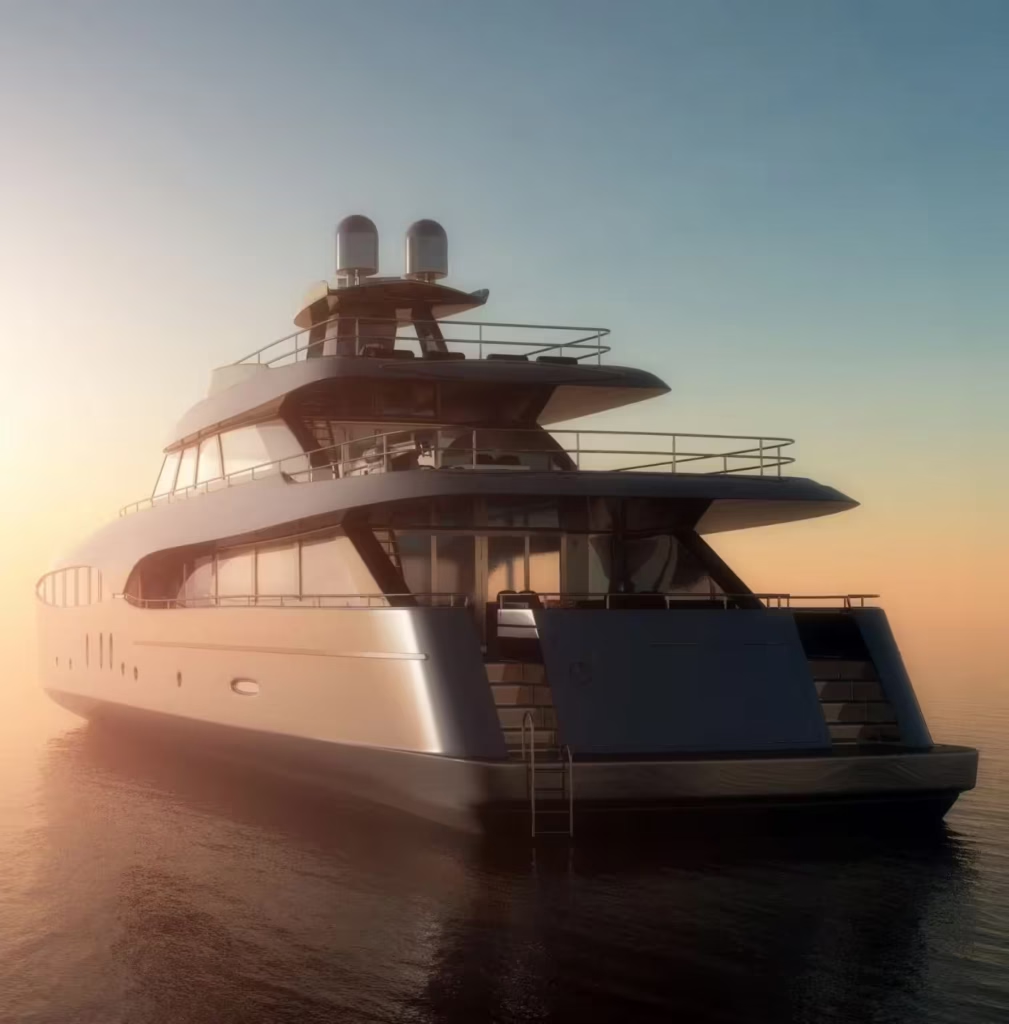
Charter yacht coding is the safety certification process that a vessel must pass before it can legally carry paying passengers, and any commercial use of a yacht triggers the requirement. The MCA’s MGN 280 is the reference document most UK-linked owners will hit first, but the underlying principle holds across flags: take money for a trip, and the boat needs a code.
You need coding if guests pay for a charter, if the vessel operates commercially in any capacity, and in some cases if a club or association pays toward running costs even without a direct charter fee. Private use with no money changing hands generally sits outside these rules, but the line gets blurry fast, and getting it wrong carries real legal exposure.
If you’re planning to charter, start here:
- Complete the certifying authority’s application form (in the UK, that’s the SCV1 through the RYA)
- Book a certifying surveyor early, since good ones book out weeks in advance
- Inventory every piece of safety equipment now, before a surveyor tells you what’s missing
Principaux enseignements
Charter yacht coding is a legal requirement for any commercial charter, and passing survey on the first attempt depends more on equipment paperwork than on the vessel’s mechanical condition.
| Point | Détails |
|---|---|
| Coding is mandatory for paid charters | Any commercial use, including club-funded trips, generally requires a valid code before carrying passengers. |
| Category sets your operating limits | Categories 0 through 4 define distance from a safe haven, from unlimited to 20 miles in favorable weather only. |
| Timelines run 4 to 8 weeks | Delays almost always trace back to expired flares, missing stability data, or slow equipment orders. |
| Certificates need annual inspection | A certificate valid for up to five years still lapses if you skip its yearly inspection. |
| Flag choice shapes requirements | The MCA and the Bahamas Small Charter Yacht Code carry different equipment, crew, and processing expectations. |
Table des matières
- What Charter Yacht Coding Categories Actually Limit
- How Long Does Charter Yacht Coding Take to Complete?
- The Safety Equipment Charter Coding Actually Requires
- Crew Certification Requirements for Coded Yachts
- Renewals, Inspections, and What Triggers a Re-Survey
- Passenger Limits and the 24-Meter Rule Explained
- Flag State Differences: MCA, BSYC, and Choosing Your Route
- Your Pre-Survey Checklist and When to Bring in a Specialist
- Why the Coding Conversation Needs to Start Earlier
- Sources
- FAQ
What Charter Yacht Coding Categories Actually Limit
Coding categories aren’t a bureaucratic label. They set the maximum distance your yacht can operate from a safe haven, defined as a place a vessel can reach and shelter within a set time in deteriorating weather. Get the category wrong and you’ve either paid for equipment you don’t need or bought a certificate that won’t cover the routes your clients actually want.
Under the MCA framework, the categories break down roughly like this:
- Category 0: unlimited worldwide operation, the standard for ocean-crossing charter yachts
- Category 1: up to 150 miles from a safe haven, common for coastal cruising itineraries
- Category 2: up to 60 miles, the most frequently used category for Mediterranean and Caribbean charter fleets
- Category 3: up to 20 miles, suited to day-charter operations close to shore
- Category 4: up to 20 miles but only in favorable weather, a more restrictive daytime category
“Favorable weather” isn’t a vague suggestion. It’s a defined operating condition tied to specific wind and sea-state limits in the code itself. Your category choice cascades into everything else: the life rafts you’re required to carry, the crew certificates your skipper needs, and how an insurer prices your policy. Choose Category 1 when your actual charter route never leaves a sheltered bay, and you’ve overspent on gear that will sit unused.
How Long Does Charter Yacht Coding Take to Complete?
Getting coded runs through a fairly predictable sequence, though the paperwork surprises a lot of first-time owners. In the UK, that means submitting an SCV1 form to a certifying authority. The RYA is one of the bodies approved to issue Small Commercial Vessel Certificates, and it lays out both an out-of-water and an in-water survey as part of the process.
The surveyor’s job is thorough by design. Expect inspection of:
- Hull condition and structural integrity, both above and below the waterline
- Stability data and how it matches the vessel’s actual loading
- Fire safety systems, bilge pumps, and electrical wiring
- Gas installations, if the galley runs on it
- Every item of lifesaving and safety equipment against the code’s checklist
Timelines vary, but 4 to 8 weeks is a realistic window when equipment needs ordering or minor modifications are required. Owners who show up to survey day with expired flares or missing stability booklets routinely blow past that window.
Conseil de pro : Order long lead-time items, life rafts especially, the day you book your survey slot. A six-week wait on a service exchange life raft has killed more coding timelines than any paperwork issue.
A completed SCV certificate typically stays valid for a multi-year period, though that validity means nothing without the annual inspections that keep it active. Miss one, and the certificate lapses regardless of the printed expiry date.
The Safety Equipment Charter Coding Actually Requires
Coding inspectors work from a checklist, not a gut feeling, and knowing what’s on it before survey day saves both time and money.
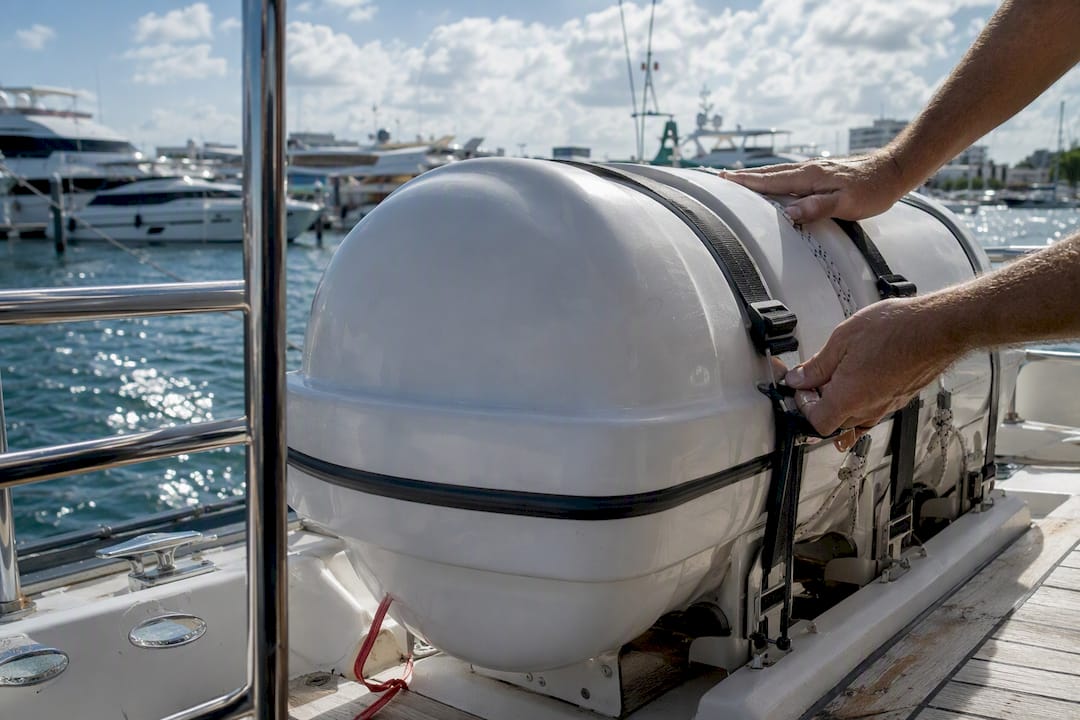
Life-saving appliances top the list: life rafts sized to your passenger capacity, lifejackets for every person aboard, and both need to be within their service intervals. A life raft with an expired service certificate fails the survey the same way a missing one does.
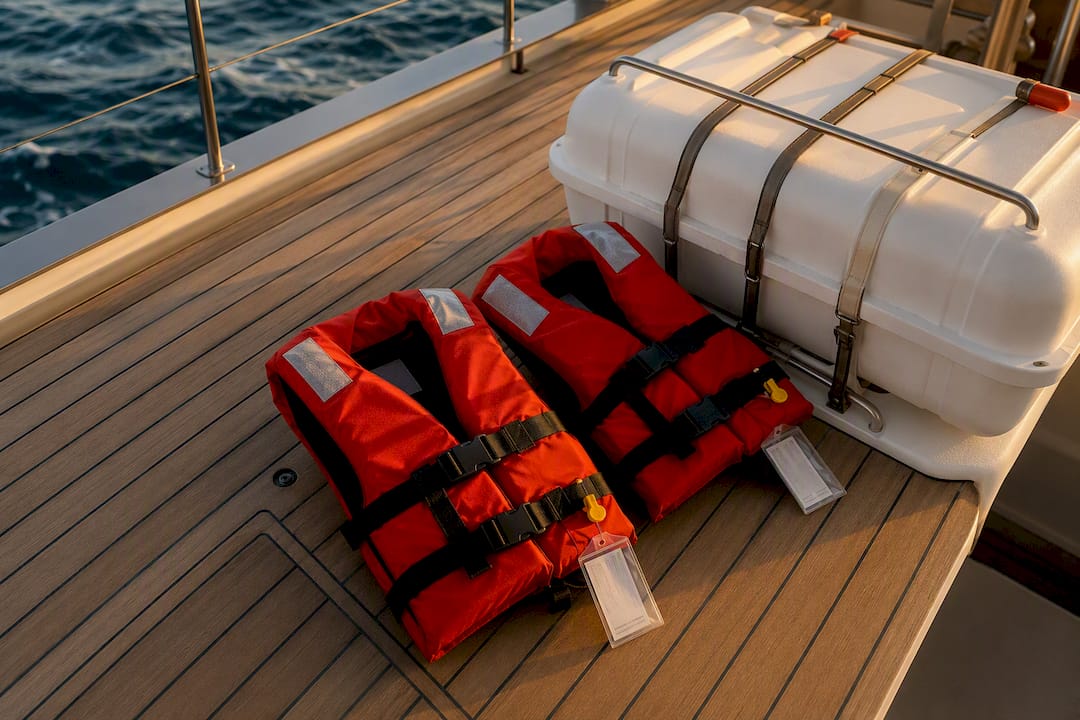
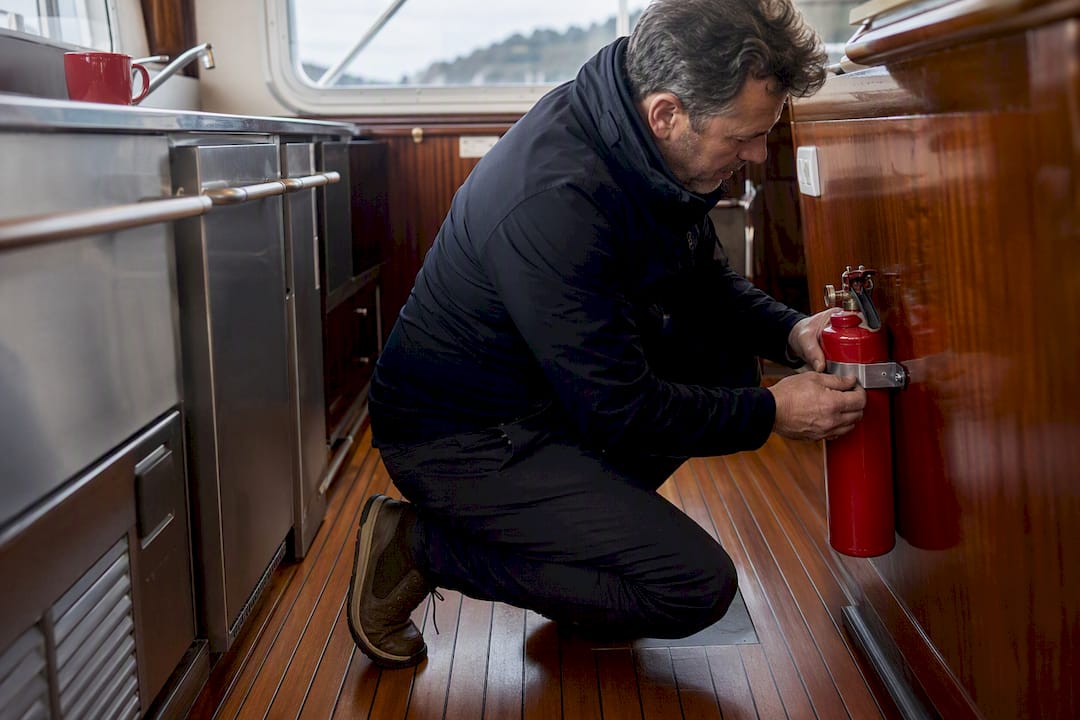
Emergency signaling and communications equipment includes an EPIRB, in-date flares, a VHF radio with DSC capability, and AIS transmission where the category requires it. Fire safety runs to extinguishers rated for the right classes, a functioning bilge alarm, and electrical systems that don’t show the surveyor a rat’s nest of unlabeled wiring. Gas systems, where fitted, need shutoff valves and leak detection. Stability information has to be on board and match the vessel’s current configuration.
Owner-facing guides consistently flag expired flares and missing stability information as among the most common deficiencies that stall a coding survey. None of it is exotic. Most failures come down to paperwork that lapsed quietly:
- Life raft service certificate, current and matching the raft’s serial number
- Flare expiry dates, checked against the survey date, not the purchase date
- Fire extinguisher service tags, visible and current
- EPIRB battery and hydrostatic release unit dates
Crew Certification Requirements for Coded Yachts
A coded yacht needs a coded crew. The skipper generally needs a commercial endorsement on top of a standard qualification, and what that endorsement is called depends on vessel size and operating category. STCW basic safety training covers fire fighting, first aid, and survival techniques, and most certifying authorities expect it for anyone working aboard a coded charter vessel, not just the skipper.
Fit-for-duty medical certificates matter too. A skipper operating commercially typically needs a valid medical fitness certificate, renewed on a set cycle rather than assumed to still apply from years back.
Crew numbers scale with both your category and your passenger count. A Category 2 boat carrying twelve guests needs a different crew complement than a Category 4 day boat carrying six, and the code specifies minimums rather than leaving it to judgment.
Keep the paperwork organized before a port state control officer or a renewal surveyor asks for it:
- Skipper’s commercial endorsement and STCW certificates, originals or certified copies
- Current medical fitness certificates for every crew member working the charter
- Crew list matching what’s declared on the coding certificate
- Proof of competency for any specialized equipment aboard, such as tenders or dive gear
Renewals, Inspections, and What Triggers a Re-Survey
A coding certificate is not a set-and-forget document. Even inside its validity window, annual inspections keep the certificate live, and skipping one lapses your commercial status regardless of what the certificate itself says.
Three things reliably trigger an unscheduled re-survey:
- A refit or significant modification, anything that changes stability, adds systems, or alters the vessel’s layout from what was originally coded
- Damage from grounding, collision, or fire, even when repairs look cosmetic on the surface
- A change of use, such as moving from day charter to overnight charter, which shifts equipment and crew requirements
The owners who sail through renewals without drama tend to run planned maintenance schedules rather than reactive ones. Service life rafts and firefighting equipment on their due dates, not when a surveyor flags them as overdue. Keep a running file of service certificates, survey reports, and equipment invoices, because a complete equipment inventory going into survey is one of the clearest predictors of a clean pass. Renewal surveyors move faster when the paper trail is already assembled rather than reconstructed on the spot.
Passenger Limits and the 24-Meter Rule Explained
Passenger limits aren’t arbitrary. They’re set by the certifying authority based on the vessel’s stability data, evacuation capacity, and life-saving equipment aboard, which is why questions like “the 12-person rule” or “the 10-person rule” show up so often in owner searches. Those numbers usually reflect a specific vessel’s certificate rather than a universal cap. A 15-meter Category 2 yacht might be certified for 12 guests, while a similarly sized boat with a different life raft configuration is capped lower.
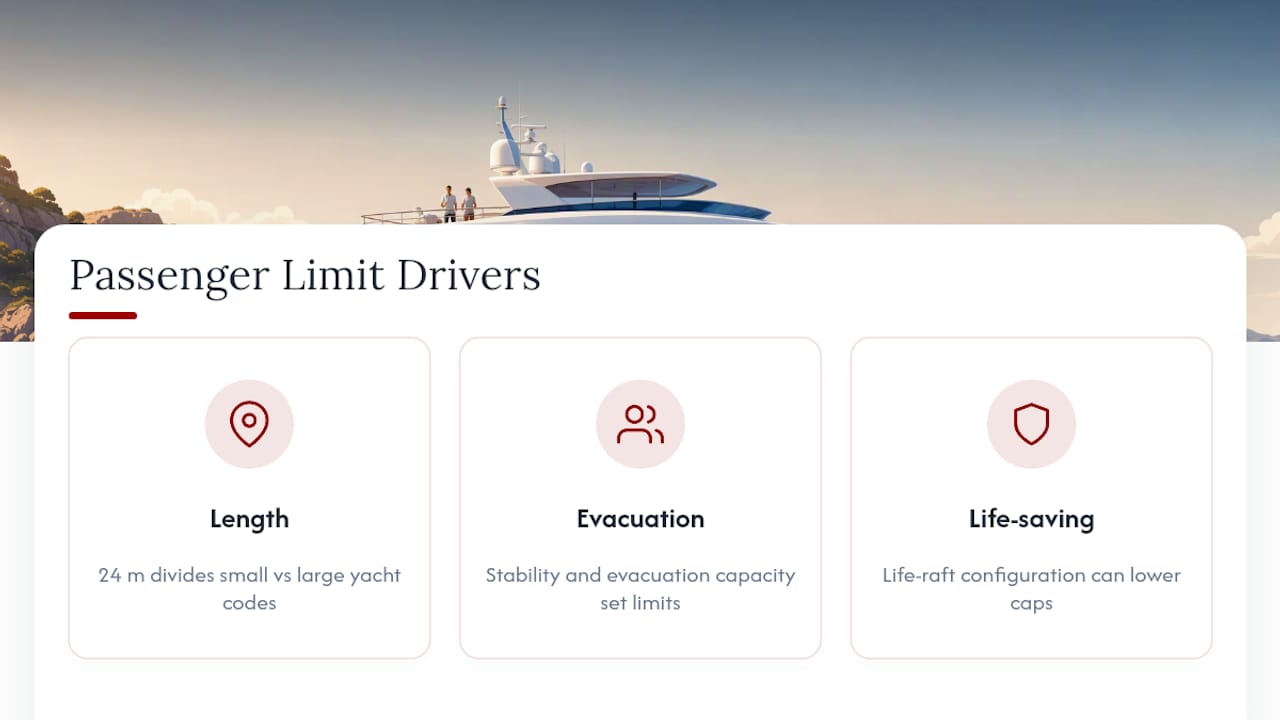
Length matters just as much as headcount. The 24-meter threshold is a genuine regulatory dividing line: yachts under 24 meters typically fall under codes like the UK’s Small Commercial Vessel Code, while vessels at or above 24 meters shift into large commercial yacht regulations with heavier requirements for classification, manning, and survey frequency.
Don’t assume your vessel’s exact passenger limit or which side of the 24-meter line it sits on. Check the flag state’s own documents and confirm directly with your certifying authority, since thresholds and definitions differ by jurisdiction even when the general framework looks similar on paper.
Flag State Differences: MCA, BSYC, and Choosing Your Route
Not every flag codes a yacht the same way, and the differences affect equipment lists, crew requirements, and how fast you can start chartering.
The UK’s MCA framework, delivered through certifying authorities like the RYA, is one of the most widely recognized routes and tends to carry strong credibility with charter clients and insurers alike. The Bahamas Small Charter Yacht Code offers an alternative that many owners operating in Caribbean and international waters choose instead, generally applying to vessels in the 20 to 24 meter range under load line length.
Owners choosing between routes should weigh:
- Planned operating area: a Mediterranean-based charter fleet and a Caribbean one often favor different flags for practical and insurance reasons
- Processing time and cost: some registries move faster than others for equivalent coding outcomes
- Insurance implications: underwriters price risk differently depending on which code and flag stand behind the certificate
- Owner residency and corporate structure: some flags simplify registration for foreign owners, others don’t
Registration and coding are linked but distinct steps, and the flag you choose shapes the specific forms and technical requirements you’ll navigate. Most owners are better served picking one flag and coding route that matches their actual charter market rather than trying to satisfy multiple jurisdictions at once.
Your Pre-Survey Checklist and When to Bring in a Specialist
Walking into a survey unprepared is the single biggest cause of delay. Run through this before you book:
- Full equipment inventory checked against your target category’s requirements
- Expiry dates confirmed on life rafts, flares, EPIRBs, and fire extinguishers
- Stability data on board and matching the vessel’s current configuration
- Crew certificates, medicals, and STCW documentation gathered in one file
- Application forms completed and ready for submission to your certifying authority
Handling coding paperwork alongside vessel registration, MMSI setup, and insurance referrals is exactly the kind of administrative load that eats an owner’s week. A specialist consultancy like Pavillon du navire coordinates that workload directly, from registration documentation to survey scheduling referrals, so the technical and legal pieces move in parallel instead of stacking up sequentially.
Conseil de pro : If you’re coding a first-time charter vessel and juggling registration under a new flag simultaneously, get both processes running side by side rather than sequentially. Waiting for registration to finish before starting coding paperwork routinely adds weeks for no good reason.
DIY coding makes sense for an owner with time, a clear single-flag plan, and an equipment list already close to compliant. Bringing in a consultant earns its cost fast when you’re juggling multiple jurisdictions, a tight charter season deadline, or paperwork you’ve never handled before.
Why the Coding Conversation Needs to Start Earlier
Most owners treat coding as a task that happens right before the first charter booking goes live, and that’s the mistake. The equipment gaps, the stability paperwork, the crew certificate chase, none of it is complicated on its own. It becomes a crisis only when it’s compressed into the six weeks before a client deposit lands.
The conventional advice tells owners to “get coded before chartering,” which is true but useless as guidance. What actually matters is sequencing: pick your category based on the routes you’ll genuinely sail, not the most flexible option available, because overbuying Category 1 equipment for a Category 3 operation wastes real money. Line up registration and coding in parallel rather than treating them as separate projects with separate timelines.
The owners who avoid renewal headaches are the ones running planned maintenance on life rafts and flares year-round, not scrambling before survey day. That habit, more than any single regulatory detail, separates a smooth charter season from one lost to paperwork.
— VesselFlag
Sources
For the legal specifics and downloadable forms, go directly to the certifying bodies rather than secondhand summaries.
- Small Commercial Vessel Coding | Our Services
- What is ‘boat coding’ and why is it so important? – Yacht Charter
FAQ
What is the 12-person rule on a yacht?
There’s no universal 12-person rule. Passenger limits are set individually per vessel based on stability data, life-saving equipment, and evacuation capacity, so a specific yacht’s certificate might cap it at 12 while another with different equipment sits higher or lower.
What is the 10-person rule for yachts?
Like the 12-person figure, a 10-person limit reflects an individual vessel’s coding certificate rather than a fixed regulatory number. Always check the certificate itself rather than assuming a standard cap applies across all yachts.
What is the 24-meter rule for yachts?
Vessels under 24 meters generally fall under small commercial vessel codes like the UK’s SCV framework, while yachts at or above 24 meters move into large commercial yacht regulations with stricter classification, manning, and survey requirements.
How many seasons do yachties work a year?
This depends on the charter market and vessel’s operating region rather than coding rules directly, though a vessel’s coding category can limit which seasons and routes it’s certified to operate in.
Does charter yacht coding affect insurance premiums?
Insurers generally price coded charter vessels differently from private yachts, since a valid code demonstrates surveyed compliance with safety standards, and gaps in coding or lapsed certificates can complicate claims or raise premiums.