TL;DR:
- Commercial vessel insurance includes Hull & Machinery, Marine Cargo, and Protection & Indemnity policies, each covering different risks in maritime operations. Proper documentation and understanding of coverage gaps are essential to prevent denied claims, especially in high-risk areas. Operators should review their full insurance and security procedures regularly to ensure comprehensive protection.
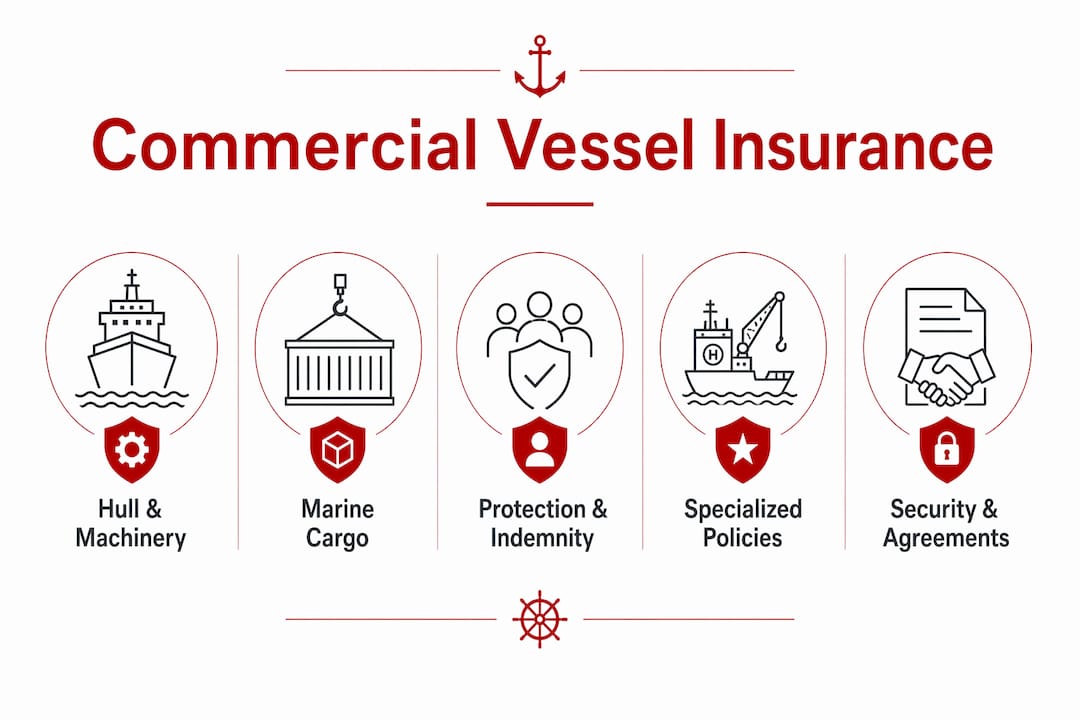
Commercial vessel insurance types consist of three primary categories: Hull & Machinery, Marine Cargo, and Protection & Indemnity (P&I), each covering distinct but interconnected risks in maritime operations. Together, these vessel protection policies form the foundation of any serious risk management program for commercial operators. Understanding where each type starts and stops is the difference between full coverage and a costly gap. This guide breaks down every major coverage category, explains the legal nuances that affect claims, and gives you the practical knowledge to make informed decisions about your fleet.
What coverage do commercial vessel insurance types provide?
The three core commercial vessel insurance types each protect a different layer of your maritime business. Hull & Machinery covers the physical vessel. Marine Cargo covers the goods you carry. Protection & Indemnity covers your legal liabilities to third parties. No single policy covers all three, which is why operators must understand each one separately before building a coverage program.
What does Hull & Machinery insurance cover for commercial vessels?
Hull & Machinery (H&M) insurance is the foundational asset protection policy for any commercial vessel. It covers physical damage to the vessel’s structure, propulsion systems, mechanical equipment, and onboard machinery. Think of it as the property insurance of the maritime world.
Coverage typically includes damage from:
- Storms, heavy weather, and grounding
- Collisions with other vessels or fixed objects
- Fire, explosion, and flooding
- Piracy and malicious damage
- Mechanical breakdown of insured machinery
Two terms every operator must understand are “total loss” and “constructive total loss.” A total loss means the vessel is completely destroyed or unrecoverable. A constructive total loss occurs when the cost of repair exceeds the insured value of the vessel. In that case, the insurer pays out the agreed hull value rather than funding repairs. This distinction matters enormously when negotiating your insured value at policy inception.
H&M policies apply across vessel types: bulk carriers, tankers, container ships, ferries, and charter boats. Insurers set insured values based on market value, replacement cost, or an agreed value negotiated at the time of underwriting. Underinsuring your vessel to reduce premiums is a common and expensive mistake. If a claim arises, the payout is proportional to the declared value, not the actual repair cost.
Pro Tip: Review your vessel’s insured value annually. Shipbuilding costs and secondhand market prices shift significantly year to year, and an outdated valuation leaves you exposed.
How does Marine Cargo insurance protect goods on commercial vessels?
Marine Cargo insurance protects the goods being transported, not the vessel carrying them. Coverage runs from the moment cargo leaves the seller’s warehouse to the moment it arrives at the buyer’s destination, a concept known as “warehouse to warehouse” coverage. Without proper clauses, goods risk coverage gaps during loading and unloading outside ports.
Operators and cargo owners typically choose from three policy structures:
- Voyage policy: Covers a single, defined shipment from one point to another. Best for one-off or infrequent cargo movements.
- Open Cargo policy: A standing policy that automatically covers all shipments within agreed parameters. Preferred by operators with regular, high-volume cargo flows.
- Sales Turnover policy: Ties coverage to the insured’s annual sales volume. Common among trading companies that ship goods continuously.
The distinction between ocean marine and inland marine coverage is a frequent source of confusion. Ocean marine covers the sea leg of a journey. Inland marine extends coverage during land transit, including trucking and rail segments before and after the port. Misunderstandings about ocean versus inland marine coverage cause gaps that operators should address with explicit warehouse-to-warehouse clauses in their policy wording.
On pricing, third-party cargo insurance premiums can be as low as 1% to 1.25% of the declared package value. Carrier-included liability, by contrast, typically pays out far less than actual cargo value and comes with strict conditions. For high-value or time-sensitive cargo, a standalone cargo policy almost always delivers better protection at a competitive price.
| Policy type | Best for | Coverage trigger |
|---|---|---|
| Voyage policy | Single shipments | Per declared voyage |
| Open Cargo policy | Regular, high-volume shippers | All shipments under standing terms |
| Sales Turnover policy | Trading companies | Annual sales volume |
What liabilities does Protection & Indemnity insurance cover?
Protection & Indemnity (P&I) insurance covers the legal liabilities that Hull & Machinery and Marine Cargo policies deliberately exclude. It is the most complex and arguably the most critical of all commercial vessel insurance types. P&I covers crew injuries, passenger claims, pollution, and wreck removal liabilities, all of which can generate claims far exceeding the value of the vessel itself.
Key liabilities covered by P&I include:
- Crew injury, illness, and repatriation costs
- Passenger bodily injury and death claims
- Third-party property damage not covered by H&M
- Pollution cleanup and environmental liability
- Wreck removal and obstruction of waterways
- Cargo damage claims where the carrier is legally liable
One critical coverage gap that P&I fills is the Running Down Clause (RDC) limitation in H&M policies. Standard H&M policies cover only three-quarters of collision liability. P&I picks up the remaining quarter, along with any liabilities that fall outside the RDC entirely, such as damage to fixed structures like jetties and buoys.
P&I insurance addresses liability gaps left by Hull & Machinery’s Running Down Clause, covering the residual quarter of collision liability and all third-party claims arising from crew, passengers, pollution, and cargo damage that standard hull policies exclude. For passenger vessels, minimum P&I limits are often set by port state regulations and flag state requirements, making adequate coverage a legal obligation, not just a business decision.
P&I cover is available on either a fixed premium basis or through mutual P&I clubs, where members pay calls (assessments) based on the club’s annual claims experience. Fixed premium P&I suits smaller operators who need cost certainty. Mutual club membership suits larger fleets that benefit from the club’s legal expertise and global claims handling network. For a deeper look at how P&I fits into your overall coverage structure, the P&I insurance overview from Vesselflag explains the liability layers in practical terms.
Pro Tip: Never assume your H&M policy covers pollution liability. P&I is the correct vehicle for environmental claims, and regulators treat pollution incidents as strict liability events regardless of fault.
What specialized vessel insurance options address additional risks?
Beyond the three core types, commercial operators face risks that standard policies do not cover. Specialized add-on policies exist for each of these scenarios, and ignoring them in high-risk trades is a serious operational error.
- Marine War Risk insurance covers losses from war, terrorism, piracy, and political violence. War Risk insurance is a separate, add-on policy because standard marine policies contain a war exclusion clause. Premiums adjust rapidly based on geopolitical events, so operators in volatile regions must budget for sudden cost spikes.
- Kidnap & Ransom (K&R) insurance covers ransom payments, negotiation costs, and crew support expenses following a piracy incident. K&R is distinct from War Risk and is particularly relevant for vessels transiting the Gulf of Aden, the Gulf of Guinea, and the Strait of Malacca.
- Marine Professional Indemnity insurance protects shipbrokers, surveyors, port agents, and other maritime professionals against claims arising from errors, omissions, or negligence. It covers non-physical loss liabilities that vessel or cargo policies do not address.
- Freight, Demurrage & Defence (FD&D) insurance funds legal costs for commercial disputes, including charter party disagreements, freight recovery actions, and demurrage claims. It does not pay damages but covers the legal expense of pursuing or defending a claim.
Each of these policies targets a specific risk category. Operators should assess their trade routes, cargo types, and contractual obligations before deciding which add-ons are necessary.
How do security practices and charter party agreements affect coverage?
Insurance is a final safety net, not a substitute for physical security. Insurers increasingly require documented Ship Security Assessments (SSA) and implementation of hardening plans before providing coverage or honoring claims. This is not optional paperwork. It is a condition of coverage in high-risk areas.
Best Management Practices (BMP) guidelines, published by the maritime industry and recognized by flag states and insurers, set the standard for anti-piracy procedures. Failure to comply with BMP guidelines can lead to denied or reduced insurance payouts after a piracy or boarding incident. Insurers require documented mitigation efforts and reporting to authorities like UKMTO (United Kingdom Maritime Trade Operations).
Charter party agreements add another layer of complexity. Commercial operators must review charter party agreements incorporating BIMCO VOYWAR or CONWARTIME clauses in volatile regions to allocate war risk premiums and liabilities correctly. These clauses dictate which party bears the cost of additional war risk premiums and define the master’s authority to refuse orders that expose the vessel to unacceptable risk.
Key documentation practices that protect your coverage:
- Maintain a written Ship Security Assessment updated before each high-risk voyage
- Record all “deter, delay, and deny” measures taken, including lookout watches and citadel readiness
- Report all incidents to UKMTO and flag state authorities immediately
- Retain copies of all charter party clauses relevant to war risk and security costs
Pro Tip: A master’s refusal of a dangerous order is legally defensible when backed by a documented, objective risk assessment. That same document becomes critical evidence if an insurer investigates a claim. For a practical checklist on what insurers expect, Vesselflag’s vessel insurance checklist covers the documentation requirements in detail.
Key Takeaways
Selecting the right commercial vessel insurance types requires understanding that Hull & Machinery, Marine Cargo, and P&I each cover distinct risks, and no single policy replaces the others.
| Point | Details |
|---|---|
| Three core coverage types | Hull & Machinery, Marine Cargo, and P&I each protect a different layer of maritime risk. |
| P&I fills critical gaps | P&I covers the liability exposures that H&M and cargo policies deliberately exclude, including pollution and crew claims. |
| Cargo policy structure matters | Choose between Voyage, Open Cargo, or Sales Turnover policies based on your shipment frequency and volume. |
| Specialized add-ons are not optional | War Risk, K&R, and FD&D policies address high-impact risks that standard policies exclude by clause. |
| Documentation protects claims | Documented Ship Security Assessments and BMP compliance are conditions of coverage, not just good practice. |
The coverage gap no one talks about
At Vesselflag, we work with commercial operators across multiple flag jurisdictions, and the same mistake appears repeatedly. Operators buy H&M and P&I, assume they are covered, and then discover a gap only when a claim is denied. The gap is almost never in the policy wording. It is in the documentation.
Insurers are not adversaries, but they are rigorous. A claim arising from a piracy incident in a designated high-risk area will be scrutinized against your Ship Security Assessment, your BMP compliance record, and your reporting history. If those documents are incomplete or absent, the insurer has grounds to reduce or deny the payout regardless of how solid your policy looks on paper.
The second pattern we see is operators treating charter party clauses as a formality. BIMCO VOYWAR and CONWARTIME clauses are not boilerplate. They determine who pays the war risk premium surcharge when a vessel enters a listed area, and they define the master’s legal authority to deviate. Misreading these clauses has cost operators significant sums in unrecovered premium costs and disputed liability.
The practical advice is straightforward: review your full insurance program alongside your charter party obligations at least once a year, and make sure your security documentation is current before every high-risk voyage. Insurance works best when the paperwork behind it is airtight.
— Vesselflag
How Vesselflag supports your vessel registration and insurance readiness
Proper vessel registration is the foundation that makes insurance procurement faster and more straightforward. Insurers require proof of flag state registration, and operators with clean, documented registration records face fewer underwriting delays and better premium terms.
Vesselflag specializes in commercial vessel registration across multiple international flag states, including San Marino, Malta, Poland, UK Part 1, and Palau. The platform guides operators through the full registration process, from documentation to MMSI and AIS setup, with expert support at every step. For operators building or reviewing their insurance program, Vesselflag’s consultancy team can advise on how your flag state choice affects your insurance options and compliance obligations. Book a consultation to get tailored guidance for your fleet.
FAQ
What are the three main commercial vessel insurance types?
The three primary types are Hull & Machinery, Marine Cargo, and Protection & Indemnity (P&I). Each covers a distinct risk category: physical vessel damage, cargo loss, and third-party legal liabilities respectively.
Does Hull & Machinery insurance cover all collision liability?
Standard H&M policies cover three-quarters of collision liability under the Running Down Clause. P&I insurance covers the remaining quarter and any collision-related liabilities that fall outside the RDC.
What is the difference between ocean marine and inland marine cargo insurance?
Ocean marine covers the sea leg of a cargo journey, while inland marine extends coverage during land transit segments. Warehouse-to-warehouse clauses are required to bridge both legs without a coverage gap.
Is War Risk insurance included in standard marine policies?
War Risk insurance is a separate add-on policy. Standard marine policies contain a war exclusion clause, so operators in high-risk regions must purchase War Risk coverage independently, with premiums that adjust based on geopolitical conditions.
How do BMP guidelines affect insurance claims?
Failure to comply with BMP guidelines can result in denied or reduced payouts after a piracy incident. Insurers require documented evidence of mitigation measures and official incident reporting as conditions of honoring claims.