
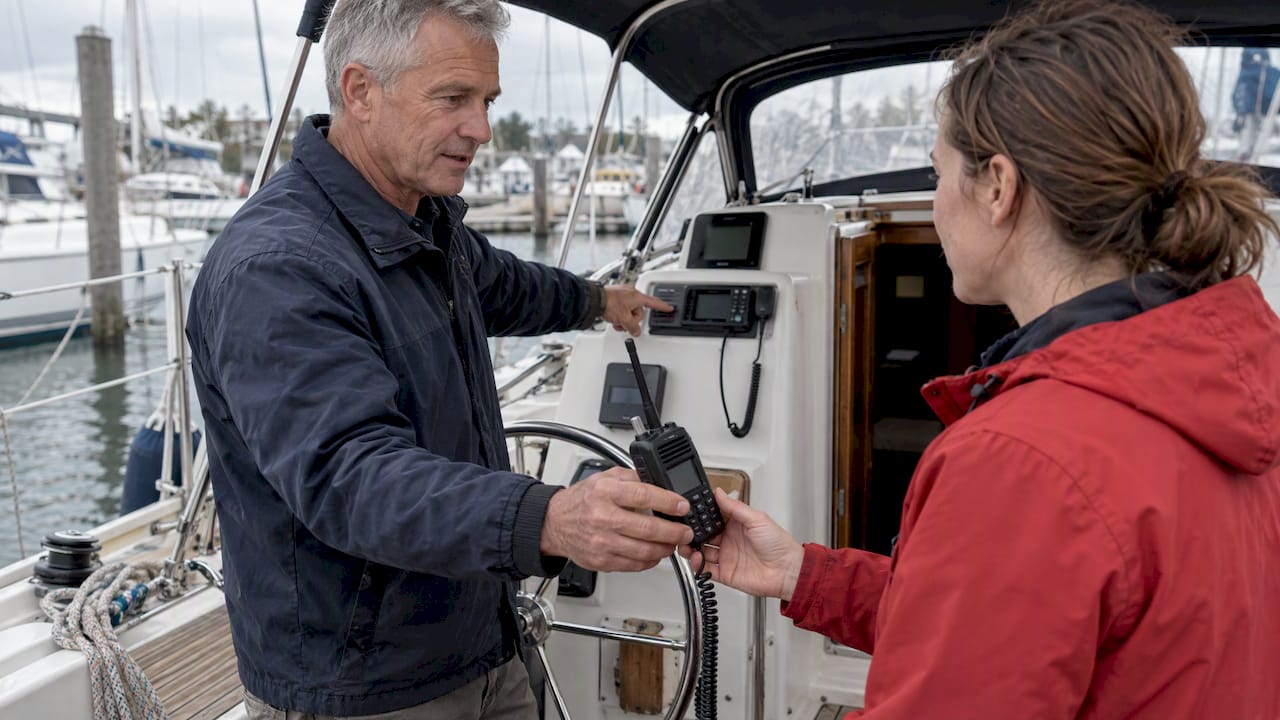
When a boat changes hands, transfer the MMSI registration to the new owner whenever the issuing agency allows it. In the United States, that usually means the seller cancels the FCC ship station license and the buyer files a new application to reuse the same number. If a clean transfer is not possible, cancel the MMSI and have the buyer get a new one or reset the radio, and finish these steps at or before closing to avoid liability for alerts the new owner later transmits.
TL;DR:
- Transferring an MMSI in the U.S. requires canceling the old FCC license and filing a new application to ensure the same number remains associated with the vessel.
- Both seller and buyer must act simultaneously and confirm in writing to avoid orphaned or conflicting MMSI records after a sale.
- In Canada, updating owner contact info through Form AB typically suffices, and foreign vessels may require compliance with local MMSI rules when operating abroad.
- Failing to cancel or transfer the MMSI properly can lead to safety risks and complications during rescue operations, making it crucial to prioritize this step over title transfer.
- Professional assistance simplifies the process, handles documentation, and ensures compliance, especially in complex flag or jurisdictional situations.
Table of Contents
- Step-by-step transfer workflow for sellers and buyers
- United States specifics: FCC ship station licenses explained
- Canada and other-flag notes on MMSI ownership changes
- What to do if the MMSI transfer was missed
- Paperwork and timing checklist for sellers and buyers
- How VesselFlag helps with MMSI and ownership transfer
- Why the MMSI transfer gets treated as an afterthought
- Let us handle your MMSI and ownership paperwork
- FAQ
- Sources
Step-by-step transfer workflow for sellers and buyers
A clean MMSI handoff follows a sequence, not a single phone call. Rushing it, or leaving it for “after the paperwork,” is how numbers end up orphaned in a database with the wrong owner attached.
Before the sale:
- Identify which agency issued the MMSI (FCC, BoatUS, US Power Squadron, Shine Micro, or a foreign regulator) and pull up the current registration details.
- Gather the bill of sale, the hull identification number (HIN), and any state documentation number tied to the vessel.
At the point of sale:
- Decide together whether the MMSI will transfer with the vessel or get canceled outright.
- If transferring, both parties need to act at the same time or provide signed proof of concurrence to the issuing agent, since Navcen guidance notes that transfer typically requires this kind of joint confirmation.
After the sale:
- The buyer files any required ship station license application or updates owner contact details with the issuer.
- The seller cancels their registration or confirms the update went through.
- Both parties power up the radio and AIS unit to confirm the MMSI shows correctly, then save a screenshot or confirmation email from the issuer as proof.
Pro Tip: Do not sign over the vessel until you have written confirmation from the MMSI issuer, not just a verbal agreement with the buyer or seller.
An MMSI belongs to the vessel’s identity, not to a single radio or a previous owner’s account, which is why Navcen treats transfer, rather than cancellation, as the preferred path whenever it is practical.
United States specifics: FCC ship station licenses explained
In the U.S., an MMSI issued through the FCC is tied directly to a ship station license, not to the boat or the owner independently. That link is why a simple handshake transfer rarely works: the FCC’s maritime mobile rules require the previous owner to cancel the existing license first, after which the buyer can file a new station application and request the same MMSI be reissued under their name.
When filing, the FCC typically asks for:
- The vessel’s name, HIN or documentation number, and current MMSI
- The new owner’s contact information and mailing address
- Confirmation that the prior license has been canceled or is being canceled concurrently
One documented path: the FCC’s own process confirms that cancellation followed by a new station application is the standard mechanism for keeping the same MMSI on a vessel that changes hands, according to the FCC.
Leaving an old FCC license active after a sale creates real exposure. If the new owner transmits a distress alert or routine AIS traffic under a number still tied to the previous license holder, that confusion can slow a search-and-rescue response and complicate who is responsible for the signal. Confirm cancellation in writing rather than assuming it processed. If the radio itself still displays the old MMSI after paperwork clears, a manufacturer reset is often the only way to clear it, since many units lock the number against casual editing once programmed.
Canada and other-flag notes on MMSI ownership changes
Rules outside the U.S. vary enough that assuming the American process applies elsewhere is a common and costly mistake.
- In Canada, a buyer who acquires a vessel with its radio equipment generally updates owner and contact information through Form AB with Innovation, Science and Economic Development Canada rather than necessarily changing the MMSI itself.
- If the vessel sells without its radio equipment, the procedure differs, since there is no existing registration tied to a device changing hands.
- For foreign-flagged vessels, confirm local rules before operating in a new country. Some jurisdictions require replacing a foreign-issued MMSI before the vessel can legally transmit under their waters.
- When the issuing organization is unclear, Navcen’s pointers to ITU allotment references help identify who actually holds the record, and a manufacturer reset remains the fallback when that agency cannot be reached.
What to do if the MMSI transfer was missed
Discovering weeks later that nobody canceled or transferred the MMSI is stressful but fixable. Work through this in order:
- Try to reach the other party directly and arrange the transfer retroactively, keeping a record of every attempt, call, text, and email.
- If contact fails, reach out to the MMSI issuer’s help desk immediately. Ask them to note the sale on the record, then cancel the registration if a transfer genuinely cannot be arranged.
- Contact the radio or AIS manufacturer if the device still displays the old number. Some units need a factory reset or physical removal before they will accept a new MMSI.
- Save every bill of sale, email thread, and confirmation screenshot. This paper trail limits your liability and gives search-and-rescue authorities something to work with if the number surfaces during an incident.
Pro Tip: A canceled registration that notes the sale is far better than an active one with the wrong owner’s name on it. Search-and-rescue databases still use canceled records to rule out false leads.
Paperwork and timing checklist for sellers and buyers
Get the legal paperwork and the MMSI steps moving on the same clock. Waiting for one to catch up to the other is where most transfers stall.
- A signed bill of sale naming both seller and buyer, the HIN or documentation number, sale price, sale date, and notarization if your state requires it
- Proof of the sale (photos of the signed document, a scanned PDF) ready to send to the MMSI issuer alongside any transfer or cancellation form
- A duplicate title request filed promptly if the original title is missing or still electronic, since you cannot complete a clean ownership record without it
Florida’s title rule is a useful benchmark even if you boat elsewhere: the state requires buyers to file for transfer of title within 30 days of the sale to avoid a penalty, and sellers must complete the transfer section of the certificate with a printed name and signature, according to the Florida Department of Highway Safety and Motor Vehicles. Treat that same window as your deadline for finishing MMSI paperwork too, so the vessel’s radio identity and its legal ownership record update together instead of drifting apart. For a closer look at how sale timelines affect seller liability, this guide on closing a yacht sale walks through the practical side of a fast, clean handoff.
How VesselFlag helps with MMSI and ownership transfer
For owners who would rather not chase an issuing agency’s help desk themselves, we handle the paperwork directly.
- We assist with MMSI licensing applications, including handling documentation required for a transfer or a new registration.
- We assist with ship station license filings for vessels requiring new U.S. records after a sale.
- We manage flag registration and transfer-of-ownership documentation in multiple jurisdictions.
Hiring help makes the most sense when a flag transfer is complex, when you cannot reach the previous owner to confirm concurrence, or when you simply want someone else managing the back-and-forth with an issuer. Our guide on getting an MMSI license step by step walks through the process in more depth, and our breakdown of why MMSI numbers matter for safety and compliance explains the stakes behind getting this right.
Why the MMSI transfer gets treated as an afterthought
Most advice on selling a boat treats the MMSI as a footnote to the title transfer, something to “sort out later.” That ordering is backward. A title transfer mostly protects a paper record, while an incorrect MMSI can put a real name against a real distress call that belongs to someone else entirely.
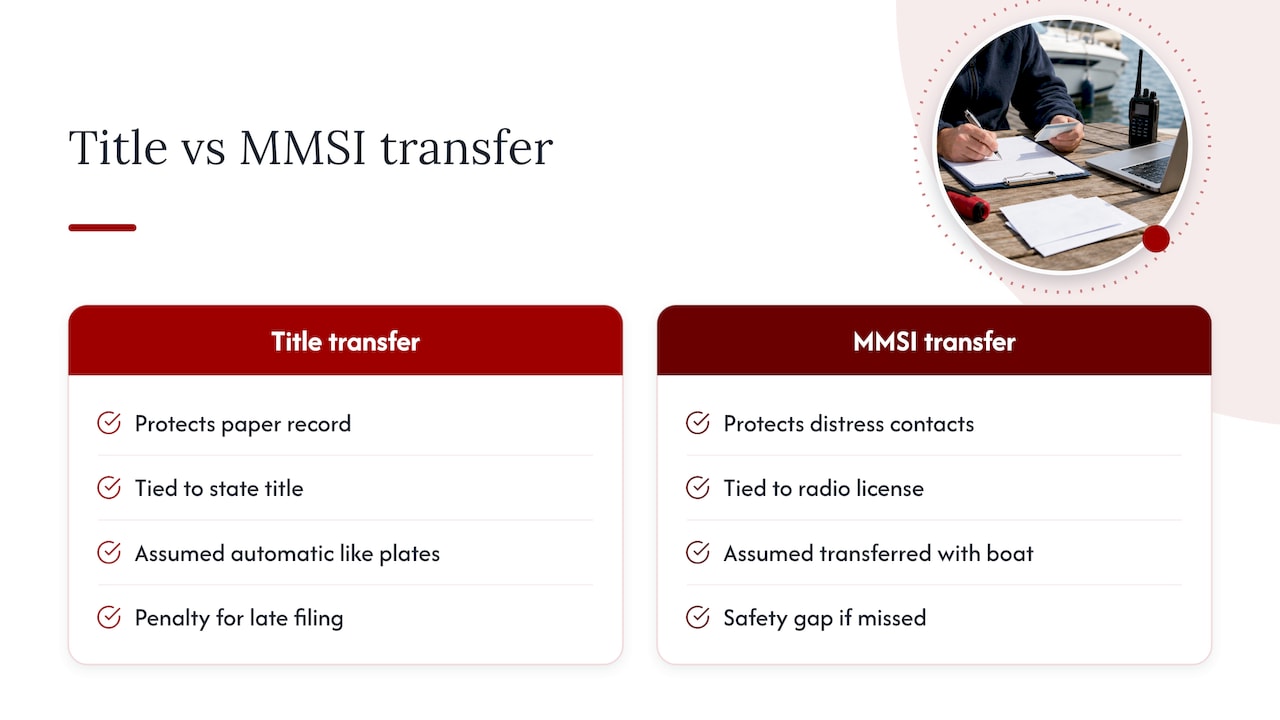
The conventional wisdom also overstates how automatic these systems are. Owners assume that selling the boat somehow sells the radio registration with it, the way a car’s plate might follow the vehicle. It does not work that way in the U.S., where the FCC ties the number to a license, not a hull. Canada’s lighter-touch Form AB process makes people assume every country works the same way, and that assumption causes the most missed transfers we see.
If you take one thing from this, prioritize the issuer confirmation over the state title filing. The title deadline has a penalty attached to it. The MMSI gap has a safety gap attached to it, and that is the one that matters when something actually goes wrong on the water.
— VesselFlag
Let us handle your MMSI and ownership paperwork
We manage MMSI licensing, ship station license filings, flag registration, and transfer-of-ownership documentation so you are not stuck tracking down an issuing agency on your own.
Reach out and we will walk through what your sale needs: a quick consultation, a document checklist specific to your flag and jurisdiction, and a realistic timeline before anything gets filed. If you already know you need licensing support, start with our MMSI Radio License service.
FAQ
What is MMSI in boating?
An MMSI, or Maritime Mobile Service Identity, is a nine-digit number that identifies a specific vessel’s radio and AIS equipment to other boats and to search-and-rescue authorities. It transmits automatically with distress calls and AIS signals, which is why keeping the registered owner accurate matters.
What do I need to transfer a boat title in Florida?
Florida requires the seller to complete the transfer of title section with a printed name and signature, and the buyer must file for the new title promptly after the sale to avoid a penalty, per the Florida Department of Highway Safety and Motor Vehicles. Use that same prompt timeline to finish any MMSI transfer or cancellation steps.
How do I change my MMSI information?
Contact the agency that issued the MMSI, whether that is the FCC, BoatUS, US Power Squadron, or a foreign regulator, and request either a transfer to the new owner or a cancellation if transfer is not possible. If the radio still shows the old number afterward, you may need a manufacturer reset to clear it.
How do I transfer ownership of a boat in Canada?
Canadian buyers who acquire a vessel along with its radio equipment typically update contact information through Form AB with Innovation, Science and Economic Development Canada rather than reassigning the MMSI itself. If the boat sells without its radio, a different procedure applies since there is no existing device registration to update.
Sources
- What to do when Selling or Disposing of your Radio or Radio‑equipped Vessel | Navigation Center
- Maritime Mobile Service Identities – MMSI | Federal Communications Commission
- Vessel titling & registrations | Florida Department of Highway Safety and Motor Vehicles
- MMSI application/management guidance | Innovation, Science and Economic Development Canada