A yacht can be registered in Poland if it falls under the right register for its size and use, the applicant can prove ownership, and the paperwork is in order. Foreign individuals and companies without a Polish PESEL number or a business in Poland can apply through an agent. Recreational and commercial yachts under 24 m go into the yacht register. Vessels over 24 m, vessels carrying more than 12 passengers, and vessels under a maritime mortgage go into the Register of Ships. Registration does not by itself make a commercial yacht legal to operate: safety inspection and a qualified crew are separate requirements.
This guide walks through each eligibility test in order, with a focus on commercial yachts and on owners who live outside Poland.
TL;DR
- Yachts under 24 m are registered in the REJA24 system, which separates recreational yachts (JR) from commercial yachts (JK).
- A commercial yacht in Polish law carries no more than 12 passengers. Above that, the vessel moves to the Register of Ships under the Maritime Code.
- Foreign owners and companies without a PESEL or Polish business can file through an agent.
- A commercial seagoing yacht also needs a Yacht Safety Certificate and a crew qualified to STCW-based standards.
- Our Poland registration service costs €320–€550 one-off, and a Polish MMSI license is €149.
Table of Contents
- The two Polish registers and which one your yacht belongs to
- Does your boat need to be registered at all?
- Who can apply: individuals, companies and foreign owners
- What counts as a commercial yacht in Poland
- Registration is not permission to operate
- How the registration process runs in practice
- Is Poland the right flag for you?
- Perspective: what we see in Polish files
- Registering a Polish-flag yacht with us
- FAQ
- Sources
The two Polish registers and which one your yacht belongs to
Poland does not run a single register for every vessel. The route depends mainly on length, passenger numbers and whether a maritime mortgage is involved.
| Vessel | Register | Basis |
|---|---|---|
| Yachts and other watercraft under 24 m | REJA24 yacht register | Act of 12 April 2018 |
| Vessels over 24 m | Register of Ships (Maritime Chambers) | Maritime Code |
| Any vessel under a maritime mortgage, any size | Register of Ships | Maritime Code |
| Vessels intended for more than 12 passengers | Register of Ships, with passenger ship requirements | Maritime Code of 18 September 2001 |
The REJA24 portal states that vessels intended for more than 12 passengers fall outside the 2018 Act and must be entered in the Register of Ships under the Maritime Code. The Polish Register of Ships is run by the Maritime Chambers (Izby Morskie). According to the guide for sailors and shipowners from the maritime administration, it is mandatory for vessels over 24 m in length and for any vessel subject to a maritime mortgage, whatever its size.
Most private owners and small charter operators land in the first row. The rest of this article concentrates on that route, because it is where the majority of yacht registrations happen.
Does your boat need to be registered at all?
Not every craft has to be registered. Under the consolidated text of the Act on registration of yachts and other watercraft, registration is mandatory for yachts and amateur-fishing vessels longer than 7.5 m, or with mechanical propulsion above 15 kW. It is also mandatory for vessels sailing outside Poland unless they already have another nationality.
The same act exempts several categories:
- Vessels used exclusively for regattas and sports competitions that have a rating class and a valid certificate
- Racing rowing boats
- Human-powered vessels
- Surfboards and windsurf boards
A smaller boat can still be registered voluntarily. If you plan to cross borders or want a clear nationality for insurance, financing or charter, registration is usually the sensible route even when the law does not force it.
Who can apply: individuals, companies and foreign owners
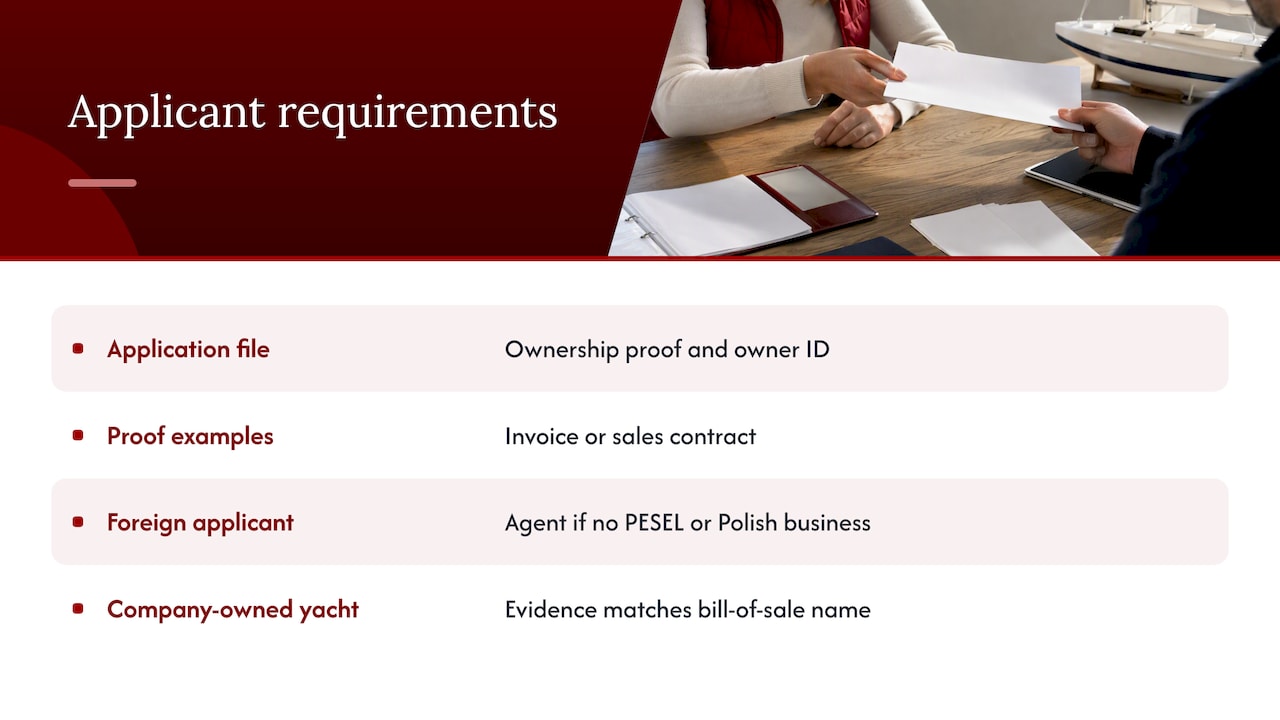
The REJA24 system checks two things about the applicant: ownership and Polish nationality. Proof of ownership is the core of the file. The registration application for yachts under 24 m must include documents proving ownership, such as an invoice or sales contract, together with identification data of the owner, as set out in the Ministry’s regulation of 17 April 2020.
The practical question for most of our readers is different: can someone without a Polish connection register? The Polish Yachting Association explains that foreigners or foreign entities without a PESEL number or a business in Poland may file an application through an agent. That is the standard route for non-resident owners, including US citizens and companies set up abroad for yacht ownership.
If you are a US owner weighing flags, our page on foreign yacht registration for US owners lays out the options side by side. If the boat is held in a company, the same ownership evidence applies at company level, and the paperwork will need to match the name on the bill of sale.
Documents that usually decide the file
The checklist depends on how you acquired the vessel, but the pattern is consistent:
- Proof of ownership: an invoice, sales contract or equivalent, matched to the applicant’s identification data.
- Identification of the owner: personal or company details, depending on who will be named on the certificate.
- Proof of deletion from the previous register: if the vessel was registered in a foreign register, proof of deletion is required, as the Gdynia maritime office describes in its procedure.
- Builder or technical documents: for a new build, a builder certificate is usually the starting point. Our guide to the builder certificate for yachts explains what it contains.
- Translations and address evidence: documents in other languages generally need translating, and registries ask for a proof of address. See what to translate in our yacht document translation guide and what registries accept in proof of address for yacht registration.
If you bought the boat outside Poland, the deletion step is the one that most often slows things down. We cover that sequence in our guide to the Polish flag for a yacht bought abroad.
What counts as a commercial yacht in Poland
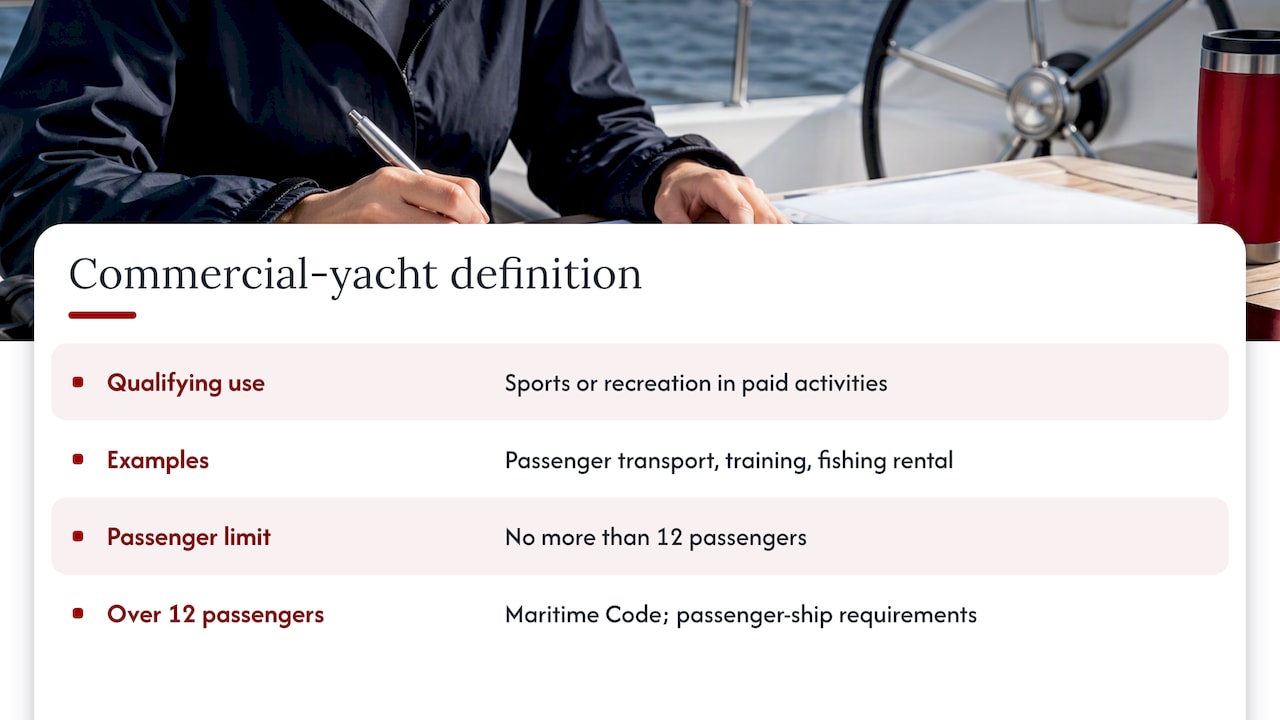
Polish law gives “commercial yacht” a narrow, precise meaning, and that definition drives eligibility. Under the Act of 12 April 2018 (consolidated text, Journal of Laws 2024, item 1536), a commercial yacht is a vessel intended or used exclusively for sports or recreational purposes within paid activities. The Act’s examples are transporting persons, running training cruises, renting the vessel for fishing, or any other commercial use. The condition is that it does not carry more than 12 passengers.
Two points follow from that wording.
Use decides the category, not the vessel. The same hull can be a recreational yacht (JR) or a commercial yacht (JK), as the REJA24 certificate distinguishes. What matters is whether you earn money from it. We wrote a separate piece on this: use, not payment, decides private or commercial registration.
The 12-passenger line is a hard border. Once you plan to carry more than 12 passengers, you leave the yacht regime. The vessel is then treated under the Maritime Code and must meet passenger ship requirements. That is a different, heavier process, and it should be planned from the day you design the business, not after the boat is bought.
Typical commercial uses that fit the yacht regime
- Skippered or bareboat charter with up to 12 guests
- Sailing schools and training cruises
- Paid day trips and sightseeing for small groups
- Fishing charters for recreational anglers
If your business carries more than 12 paying passengers, or the vessel will exceed 24 m, assume the Register of Ships applies and speak to a maritime specialist before you commit to a purchase.
Registration is not permission to operate
This is the point owners most often miss. The REJA24 portal is explicit: registration alone does not permit legal operation. A yacht must meet safety and technical requirements set by Polish law, confirmed by additional documentation, and it must be manned by a properly qualified crew.
Safety inspection and the Yacht Safety Certificate
Commercial seagoing yachts need a Yacht Safety Certificate, issued after a safety inspection. According to the same portal, the inspection checks a class certificate or another document issued after a technical survey, along with the applicable conditions for safe navigation. Poland has also delegated most flag-state surveys and certification for ships under mandatory IMO instruments to four recognized organizations, so the technical survey is typically done by a recognized body rather than by the registry itself.
Plan the inspection like a handover: tidy documents, a vessel in presentable condition, and equipment that works. If you are preparing a boat in the US before shipping or sailing it over, boat detailing professionals can get hull and interior ready so the surveyor sees the vessel at its best.
Crew qualifications
Crew rules for commercial yachts follow STCW standards. The maritime administration’s information on seagoing yacht qualifications explains that qualifications must be verified by qualification documents (CoC, CoP) or sailing certificates, as specified in the Minister of Maritime Economy and Inland Navigation’s regulation of 29 January 2018. The same document notes that foreign crew qualifications can be recognized when they meet STCW requirements and were issued by a state’s maritime administration or under its authority.
Nationality is not the test. The ministry’s guidance on commercial yachts says that for Polish-flagged commercial yachts, crew qualifications must comply with the flag state’s requirements, and nationality is not of fundamental importance. So a Polish-flagged charter yacht does not need an all-Polish crew. It needs a crew whose papers are valid and recognized.
That guidance adds a caution worth remembering: meeting Polish qualification standards does not end the story when you sail into other waters. Additional local requirements may apply in the territorial waters of other jurisdictions. If you plan to charter in Croatia, Greece or the Caribbean, check the rules there as well.
How the registration process runs in practice
The official sources describe the documents and the tests. They say less about the sequence an owner actually follows, so here is how we run it for clients. This is our process, not a statutory timeline.
- Confirm the register. Length, passenger count, mortgage and use decide whether you are in REJA24 or the Register of Ships.
- Choose the category. Recreational (JR) or commercial (JK). Charter income means commercial.
- Collect ownership proof. Invoice or sales contract, identification data, and, for a boat coming from another flag, proof of deletion.
- File through an agent if you are a non-resident. The agent submits the application on your behalf.
- Arrange the safety inspection for commercial use. This is what produces the Yacht Safety Certificate.
- Put the crew documentation in order. Check CoC, CoP or sailing certificates against the STCW-based rules.
- Set up radio. A ship station permit and MMSI are part of getting a vessel on the water. Our Poland radio license guide covers the ship station permit, MMSI and SRC.
If you need to sail before the permanent certificate arrives, our guide to Poland temporary registration explains the provisional route. We have found that provisional registration commonly runs in the range of 1 to 7 days on our files, though exact timing depends on the completeness of your documents.
Obligations after registration
The official pages in our research do not set out a single post-registration checklist, so treat this as practical guidance rather than a legal summary. Owners should keep contact and ownership data current, report a change of owner, and maintain the safety and crew documentation for commercial use. When a vessel is sold or leaves the register, a deletion certificate is needed by the next flag. For the exact current duties, the REJA24 portal and the competent maritime office are the authorities to confirm with.
Is Poland the right flag for you?
Poland tends to suit owners who want a European Union flag, a clear small-yacht register and a registration cost below some of the better-known alternatives. It is not automatically the best fit. Think about:
- Where you will sail. An EU flag helps in European waters, but other jurisdictions can have their own local rules.
- How you will use the vessel. Charter with up to 12 guests fits. A larger passenger business does not.
- Who owns it. A non-resident owner needs an agent. A company structure needs matching documents.
- What you compare it with. We put numbers side by side in San Marino vs Poland yacht flag: 5-year cost. For a wider view of the flag-choice question, see what international yacht flag registration is.
Perspective: what we see in Polish files
We work daily across six major registries, and Poland is one where eligibility questions are usually settled before the application starts. In our experience, three things decide how smoothly a Polish file goes.
First, the use of the yacht. Owners often describe a boat as private while planning paid charter in the second season. Declaring commercial use at the start is cleaner than correcting the category later, and it determines the inspection and crew requirements.
Second, the document trail. A missing deletion proof or a bill of sale that does not match the owner’s identification data causes more delay than any technical issue.
Third, the 12-passenger line. Owners who are building a charter business should decide their capacity before buying the vessel. Crossing the line changes the register, the rules and the cost.
Our view: registration is the easy part when the file is prepared well. The real work is the operating conditions around it.
— VesselFlag
Registering a Polish-flag yacht with us
We handle Polish registration end to end for owners, brokers and operators, including non-residents who need an agent to file. Our Poland flag registration service is priced at €320–€550 one-off, and a Polish MMSI license is €149. We manage the paperwork, check it against the registry’s requirements before submission, and can add insurance and radio licensing to the same order.
If you are comparing several flags, our services page lists the other registrations and related services we handle.
FAQ
Can a US citizen register a yacht in Poland?
Yes, through an agent. Foreigners and foreign entities without a PESEL number or a business in Poland may file via an agent, according to the Polish Yachting Association. You will still need proof of ownership and identification data, and proof of deletion if the boat was on another register.
What is the maximum number of passengers for a Polish commercial yacht?
Twelve. The 2018 Act defines a commercial yacht as one that carries no more than 12 passengers. A vessel intended for more passengers falls under the Maritime Code and the Register of Ships and must meet passenger ship requirements.
Does my yacht have to be registered in Poland?
If you choose the Polish flag, yes. Registration is mandatory for yachts over 7.5 m or with propulsion above 15 kW, and for vessels sailing outside Poland unless they have another nationality. Regatta-only boats with a rating class and valid certificate, human-powered boats and boards are exempt.
Does the crew of a Polish commercial yacht have to be Polish?
No. The ministry’s guidance says nationality is not of fundamental importance. Crew qualifications must meet the flag state’s requirements and STCW standards, and foreign qualifications can be recognized when they meet STCW and come from a maritime administration.
Is registration enough to start chartering?
No. A commercial seagoing yacht also needs a Yacht Safety Certificate after inspection, and a properly qualified crew. Registration alone does not permit legal operation.
Sources
- Requirements and documents, REJA24 portal
- Guide for sailors and yacht owners, maritime administration
- Registration of yachts and other vessels, Polish Yachting Association
- Act on registration of yachts, Journal of Laws 2024, item 1536
- Act on registration of yachts, Journal of Laws 2024, item 79
- Information on qualifications on seagoing yachts
- Information on commercial yachts, Ministry guidance
- Regulation of 17 April 2020, Journal of Laws 2020, item 763
- Ship registration procedure, Maritime Office Gdynia
- VIMSAS final report from Poland