
TL;DR:
- Tender registration is a necessary legal process for small vessels operating independently from the main yacht. It involves registering with the appropriate authority, providing specific documentation, and complying with jurisdictional thresholds and activity limits. Proper crew training, documentation, and awareness of exemptions are vital for maintaining legal compliance and avoiding penalties.
Tender registration is defined as the formal process of recording a small vessel with a maritime authority so it can operate legally as a standalone craft. Every luxury yacht owner who deploys a tender needs to treat this process as a separate obligation from the main vessel’s documentation. Federal documentation of the mothership does not cover tenders. Tenders fall under state motorboat laws and must be registered separately where applicable. This luxury yacht tender registration guide covers who must register, what documents you need, how jurisdictions differ, and how to complete the process without costly delays.
Who must register a yacht tender and when is it mandatory?
Registration becomes mandatory the moment a tender operates as an independent vessel rather than a pure ship’s accessory. The key triggers are size, engine power, operational distance, and activity type.
General thresholds that require registration include:
- Operating independently beyond a defined distance from the mothership
- Engine power exceeding jurisdiction-specific limits
- Length crossing the threshold set by local boating authorities
- Commercial activity of any kind, including charter transfers
Croatia’s 2025 rules illustrate how specific these thresholds get. Tenders over 2.5 meters with engines above 5 kW require navigation permits. When the engine exceeds 15 kW and the tender operates beyond 500 meters from the mother yacht, separate liability insurance is also mandatory. That 500-meter rule is the kind of detail that catches owners off guard during port inspections.
Exemptions exist in many jurisdictions, but they are narrow. A tender qualifies as a ship’s tender exempt from registration only when it serves the mothership exclusively, stays within a close range, and is not used for recreational activities independent of the yacht. Exemptions are voided by recreational fishing, towing water sports equipment, or leaving the tender at a public marina overnight. Enforcement officers evaluate both distance from the mother vessel and the activity being performed.
Pro Tip: Before each season, map your planned tender operations against the regulations of every country you intend to visit. A tender that qualifies for exemption in one port may require full registration in the next.
What documents and certifications does tender registration require?
The documentation package for tender registration has two tiers: standard requirements that apply to most tenders, and SOLAS-grade certification requirements that apply to commercial yachts above 500 GT.
Standard documentation for most tenders
- Proof of ownership (bill of sale or builder’s certificate)
- Vessel measurement certificate confirming length and engine power
- Valid insurance policy meeting the flag state’s minimum coverage
- Completed registration application with owner identification
- Fee payment confirmed by receipt
Registration fees vary widely by jurisdiction, typically ranging from under $10 to several hundred dollars based on vessel length and registration period. Annual, biennial, and triennial registration periods are all common depending on the authority.
SOLAS certification for commercial yachts over 500 GT
Commercial yachts at or above 500 GT face a stricter standard. Their rescue tenders must comply with the IMO Life-Saving Appliance (LSA) Code, which requires two distinct certificates:
| Certificate | Purpose | Issued by |
|---|---|---|
| Type Approval Certificate | Confirms the tender model meets LSA Code design standards | Flag state or recognized organization |
| Production Testing Certificate | Confirms each individual hull meets build standards | Manufacturer with flag state oversight |
Both certificates are mandatory for SOLAS compliance. Flag states do not accept one without the other. This distinction matters enormously when specifying a tender during the yacht build phase, because not every tender builder holds both approvals for every hull size.
Classification societies such as Lloyd’s Register, Bureau Veritas, and DNV play a direct role in verifying these certifications. Owners should request copies of both certificates from the builder before taking delivery of any SOLAS-grade rescue tender.
How do registration procedures differ by jurisdiction and vessel use?
Jurisdiction determines almost everything about how your tender registration works, from the authority you file with to the operational limits placed on the vessel after registration.
The Cayman Islands Shipping Registry sets clear operational boundaries. Tenders for large commercial yachts must operate within 3 miles of land, at speeds no greater than 20 knots, and operators must meet certification and training standards. These limits apply to tenders under 24 meters load line length. Exceeding any of these parameters without additional certification puts the yacht’s commercial license at risk.
The United States applies a federal versus state split that confuses many foreign owners. Federal documentation covers vessels of 5 net tons or more used in commerce or on navigable waters. Typical tenders fall below this threshold. They register under state motorboat laws, which means the process, fees, and display requirements differ from Florida to California to New York.
Private use versus commercial use
The private versus commercial distinction is the single most consequential factor in tender registration complexity.
- Private tenders on non-commercial yachts face lighter requirements. Registration is often straightforward, with state or flag-state numbering and basic insurance.
- Commercial tenders on charter yachts face SOLAS requirements, operator certification mandates, and stricter insurance minimums.
- Mixed-use tenders (private yacht that occasionally charters) must meet the higher commercial standard whenever the yacht operates commercially.
Owners who charter their yachts even occasionally should treat their tenders as commercial vessels for registration purposes. The cost of upgrading documentation is far lower than the cost of a failed port state control inspection.
Pro Tip: Check your 2026 compliance requirements before the season starts. Regulatory updates in the Cayman Islands, Croatia, and several Mediterranean flag states took effect in 2025 and carry over into 2026.
Step-by-step process for registering your luxury yacht tender
The yacht tender registration process follows a consistent structure across most jurisdictions, even though the specific forms and fees differ.
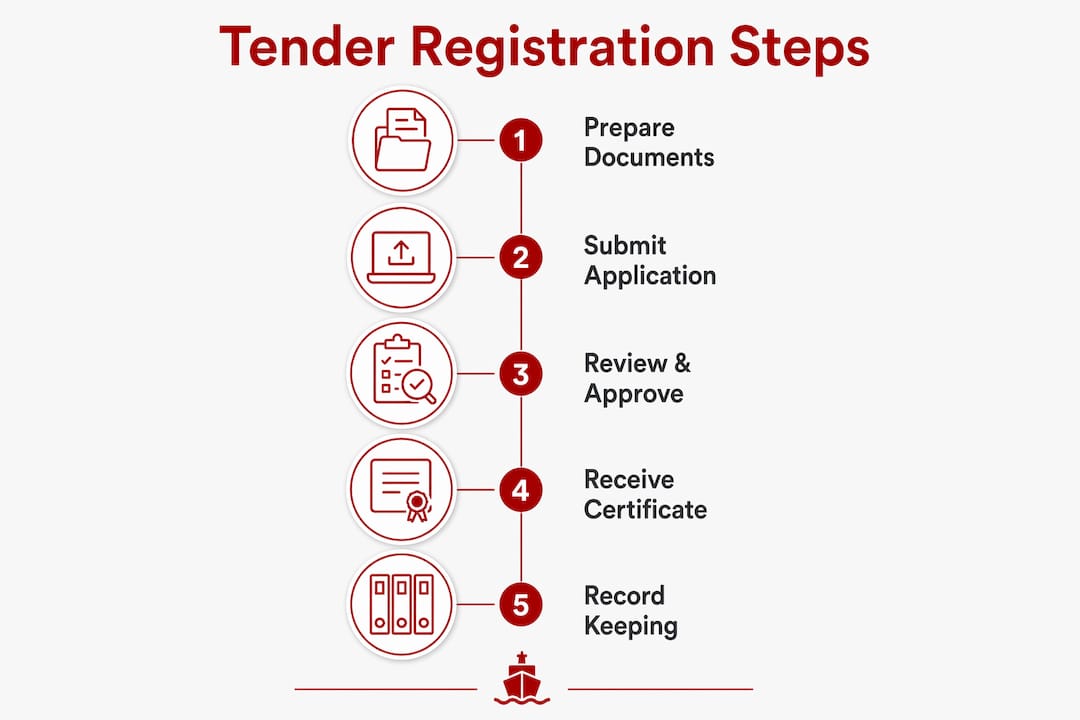
Determine the applicable authority. Identify whether your tender registers under a flag state, a national maritime authority, or a state boating agency. This depends on where the tender operates and the size of the mothership.
Gather all required documents. Collect the bill of sale, builder’s certificate, measurement certificate, proof of insurance, and owner identification. For SOLAS tenders, add the Type Approval Certificate and the per-hull Production Testing Certificate.
Choose the registration period. Most authorities offer annual, biennial, or triennial registration. Longer periods reduce administrative burden but require you to update documentation if ownership or specifications change.
Submit the application and pay fees. Online applications and digital signatures are accepted in many jurisdictions. Fees range from under $10 to several hundred dollars depending on vessel length and registration duration. Keep the payment receipt as part of your vessel file.
Receive and display registration numbers. Most authorities issue registration numbers within weeks of a complete application. Display requirements vary: some require numbers on both sides of the bow, others require a registration plate or certificate on board.
File the certificate with the mothership’s documentation. Keep a copy of the tender’s registration certificate aboard the tender and a second copy in the yacht’s main document file.
Pro Tip: Use a vessel registration checklist before submitting any application. Missing a single document is the most common cause of processing delays.
Common pitfalls and compliance challenges in tender registration
Compliance failures in tender registration almost always trace back to one of a handful of predictable mistakes.
- Operating beyond exemption limits without completing registration. Distance from the mothership and activity type are the two factors enforcement officers check first.
- Letting registration lapse. Registration certificates expire. An expired certificate carries the same legal exposure as no certificate at all.
- Improper marking. Registration numbers must appear in the correct size, font, and location. Incorrect display voids the registration’s legal protection.
- Ignoring SOLAS launch requirements. For commercial yachts, rescue tenders must be launchable by 2 crew members in under 5 minutes. Davits must meet LSA Code safety standards. Failing a drill during a port state control inspection can ground the yacht.
“The most expensive compliance mistake is assuming that what worked last season still works this season. Regulations in Croatia, the Cayman Islands, and several EU flag states changed in 2025. Owners who did not update their tender documentation are operating with voided exemptions and invalid certificates.”
Crew training is not optional for SOLAS tenders. Every crew member involved in tender operations should complete documented drills covering launch, recovery, and man-overboard procedures. Keep drill records in the yacht’s safety management system. Port state control inspectors request these records routinely, and a missing log entry raises immediate red flags.
Record-keeping for tender registration should mirror the standard applied to the main vessel. Maintain a dedicated file with the current registration certificate, insurance policy, builder’s certificate, and any SOLAS certification documents. Review the file at the start of each season and before entering any new jurisdiction.
Key Takeaways
Tender registration is a separate legal obligation from mothership documentation, and the requirements vary significantly by jurisdiction, vessel size, and whether the yacht operates commercially.
| Point | Details |
|---|---|
| Separate registration required | Federal yacht documentation never covers tenders; register under the applicable state or flag-state authority. |
| Exemptions are narrow | Activities like fishing, towing, or marina dockage void exemptions and trigger full registration requirements. |
| SOLAS tenders need two certificates | Commercial yachts over 500 GT must hold both a Type Approval Certificate and a per-hull Production Testing Certificate. |
| Jurisdiction shapes every detail | Croatia, the Cayman Islands, and US state authorities each apply different thresholds, fees, and operational limits. |
| Crew training is a compliance requirement | SOLAS rescue tender drills must be documented; port state control inspectors check these records during inspections. |
What I have learned from years of tender registration work
The part of tender registration that surprises owners most is not the paperwork. It is the operational limits that come with the certificate. Owners spend months specifying a tender, designing the garage, and selecting the davit system. Then they discover that the flag state’s operational rules restrict where and how the tender can be used, which sometimes conflicts with the garage design already built into the hull.
My strongest recommendation is to involve your flag state or a qualified registration agent before the yacht goes into build or refit. SOLAS tender specifications affect the davit load rating, the garage door dimensions, and the fuel system layout. Changing any of these after the hull is closed is expensive. Getting the spec right before the build costs nothing extra.
I have also seen owners accept builder certificates at face value without verifying that the specific hull in their garage holds a Production Testing Certificate. Type Approval covers the model. Production Testing covers the individual boat. Both are required. Verify both before the yacht departs the shipyard.
The final lesson is that crew training documentation is treated as a compliance document, not an internal record. Keep it current, keep it detailed, and keep it accessible. An inspector who cannot find a drill log will assume the drill never happened.
— VesselFlag
Vesselflag handles your tender registration from start to finish
Tender registration involves multiple authorities, jurisdiction-specific rules, and certification requirements that change from season to season. Vesselflag manages the full process for luxury yacht owners and operators, from initial document preparation through final certificate issuance.
Whether your tender requires basic state registration or full SOLAS-grade certification for a commercial superyacht, Vesselflag’s team handles the filing, fee coordination, and flag state communication on your behalf. Owners who need a complete yacht registration guide or want to verify their current documentation against 2026 requirements can connect with Vesselflag directly. The platform also covers flag registration options across multiple jurisdictions, so your tender and mothership can operate under the same compliant flag.
FAQ
Does federal yacht documentation cover the tender?
Federal documentation does not cover tenders. Tenders must be registered separately under state motorboat laws or the applicable flag-state authority.
What triggers mandatory tender registration?
Operating beyond the exemption distance from the mothership, exceeding engine power or length thresholds, or performing independent recreational activities all trigger mandatory registration.
What SOLAS certificates does a rescue tender need?
A SOLAS rescue tender on a commercial yacht over 500 GT requires both a Type Approval Certificate for the model and a Production Testing Certificate for each individual hull.
How long does tender registration take?
Most jurisdictions process complete applications and issue registration numbers within a few weeks. Online submissions with digital signatures speed up the process in many countries.
Can a private yacht tender avoid registration entirely?
A private tender can qualify for an exemption if it operates exclusively as a ship’s accessory, stays within the permitted distance from the mothership, and is not used for independent recreational activities. Any deviation from these conditions voids the exemption.