
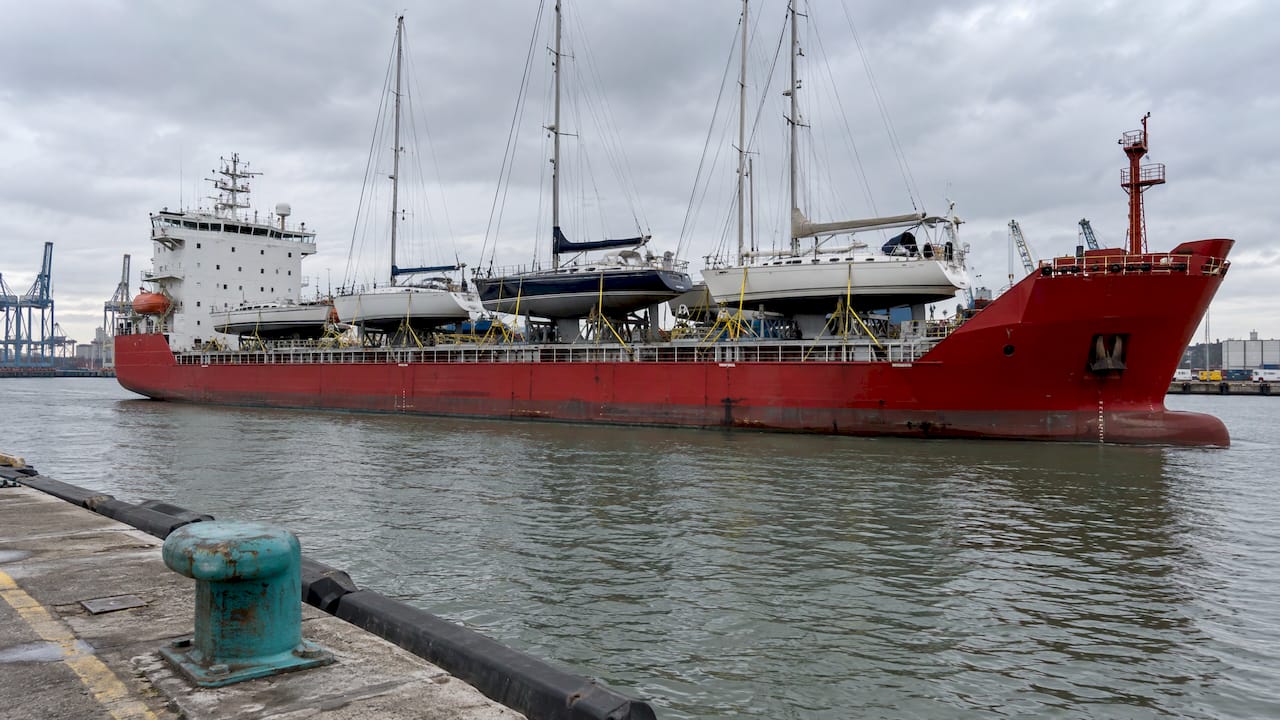
Yacht delivery means the yacht is sailed or motored to the new location by a professional crew. Yacht shipping means she is lifted or floated onto a carrier and travels as cargo. For long ocean routes, tight schedules and owners who want to keep engine hours and rig wear off the hull, shipping is usually the more practical answer, and the gap in price is often smaller than owners expect. Delivery earns its place on shorter coastal legs and on larger, capable yachts. Either way, the paperwork that follows the yacht (flag, MMSI radio licence, ownership structure) should be planned before she moves. This guide sets out how the two methods compare so you can decide with real numbers.
TL;DR
- Delivery moves the yacht on her own keel with a hired crew. It suits short and medium passages and larger, weather-resilient boats, but timing is the hardest thing to predict.
- Shipping puts the yacht on a carrier on a published or chartered sailing. It is typically quicker over ocean distances and spares the engines, rig and hull.
- On a transatlantic example, the two methods came out less than £1,000 apart once fuel, marina fees and crew flights were counted.
- Plan insurance, customs and registration documents before departure, whichever method you choose.
- Vessel Flag arranges yacht transportation and the registration, MMSI and company paperwork around it.
Table des matières
- What the two methods actually mean
- Delivery and shipping side by side
- What each method costs
- Time, weather and predictability
- Preparing the yacht for each method
- The paperwork that travels with the yacht
- Choosing by vessel, route and schedule
- Moving your yacht with Vessel Flag
- Our view on delivery versus shipping
- FAQ
- Sources
What the two methods actually mean
The terms are used loosely, so it helps to fix them.
Yacht delivery is a passage under the yacht’s own power or sail, with a skipper and crew who are not the owner. The cost is built from daily or per-mile crew fees, plus fuel, provisioning, marina fees and the crew’s travel home. The yacht is in the water the whole way, so the voyage adds real hours to engines, sails and running rigging.
Yacht shipping moves the yacht as cargo. YachtBuyer’s overview of transport options describes three main methods:
- LoLo (lift-on/lift-off): a crane hoists the yacht onto a commercial ship, where she is secured in a cradle.
- FoFo (float-on/float-off): the yacht floats onto a semi-submersible ship, and divers fasten her in a cradle.
- RoRo (roll-on/roll-off): smaller vessels are loaded on trailers.
There are also liner-service formats for smaller craft. YachtWorld’s 2026 transport guide lists break-bulk for boats of 12 to 20 m, flatrack for vessels up to 13 m, and containers for a single boat up to 12 to 14 m with a beam under 2.5 m, a method used routinely for 32 to 36 ft racing yachts crossing oceans.
If your yacht is a sailing yacht, the mast question matters. Yachting World’s 2023 guide explains that sailing yachts shipped mast-up go on lift-on/lift-off ships that carry their own cranes and can load and discharge at many ports, including at anchor.
Delivery and shipping side by side
| Criterion | Shipping | Delivery |
|---|---|---|
| Idéal pour | Ocean crossings, long routes, fixed deadlines | Short and medium coastal passages, larger capable yachts |
| Time over long distances | Usually shorter than the same route under sail | Depends on weather, and the hardest figure to predict |
| Wear on the yacht | Engines, rig and hull are not in use | Hundreds of engine or sailing hours, salt exposure |
| Cost structure | One quote, often including cargo insurance and cradle | Crew fees, fuel, provisions, marina fees, crew flights |
| Assurance | Cargo cover for the voyage, normal policy usually suspended in transit | Normal cruising policy, with the insurer approving skipper and plan |
| Scheduling | Loading window set by the carrier | Departure set by weather and crew availability |
The rest of the article explains each row.
What each method costs
Prices move with fuel, exchange rates and demand, so treat every figure below as the published number for its year, not a quote.
Shipping. Yachting World’s December 2023 guide gives ballpark figures of US$27,500 to US$45,000 for a 45 ft monohull from the Caribbean to the UK, including cargo insurance. Catamarans can cost up to 50% more, and a route from Asia to the Mediterranean starts at around US$45,000. The same article notes that oil prices, exchange rates and demand all move the price, and that customs clearance is a further line.
Delivery. Crew are typically paid per mile or per day depending on the skipper’s experience, according to YachtWorld’s January 2026 transport guide. On top come fuel, provisioning, marina fees and return travel for the crew.
A worked comparison. The most useful published example is Yachting World’s 2017 comparison for a £250,000 Jeanneau Sun Odyssey 44DS moving from Antigua to Palma after the ARC:
| Item | Ship | Sail |
|---|---|---|
| Main fee | £12,900 (including insurance and cradle rental) | £8,500 |
| Fuel (estimate) | n/a | £1,400 |
| Marina fees | n/a | £250 |
| Crew return flights (three) | n/a | £1,800 |
| Total | £12,900 | £11,950 |
The difference was under £1,000, and the sailing total does not price the wear on a yacht that has just crossed an ocean. The same article lists satellite communications as a delivery cost that can surprise: one owner reported a bill above £15,000 after a transatlantic delivery. Those are 2017 figures, so use them for the shape of the calculation and ask for a current quote for your own route.
The lesson for owners and brokers is to compare total landed cost, not the headline fee. Add every line on the delivery side, and on the shipping side confirm what the quote includes: cradle, cargo insurance, loading and discharge, and any port charges.
Time, weather and predictability
Two things decide how long a move takes: the speed of the platform and how much weather it has to wait for.
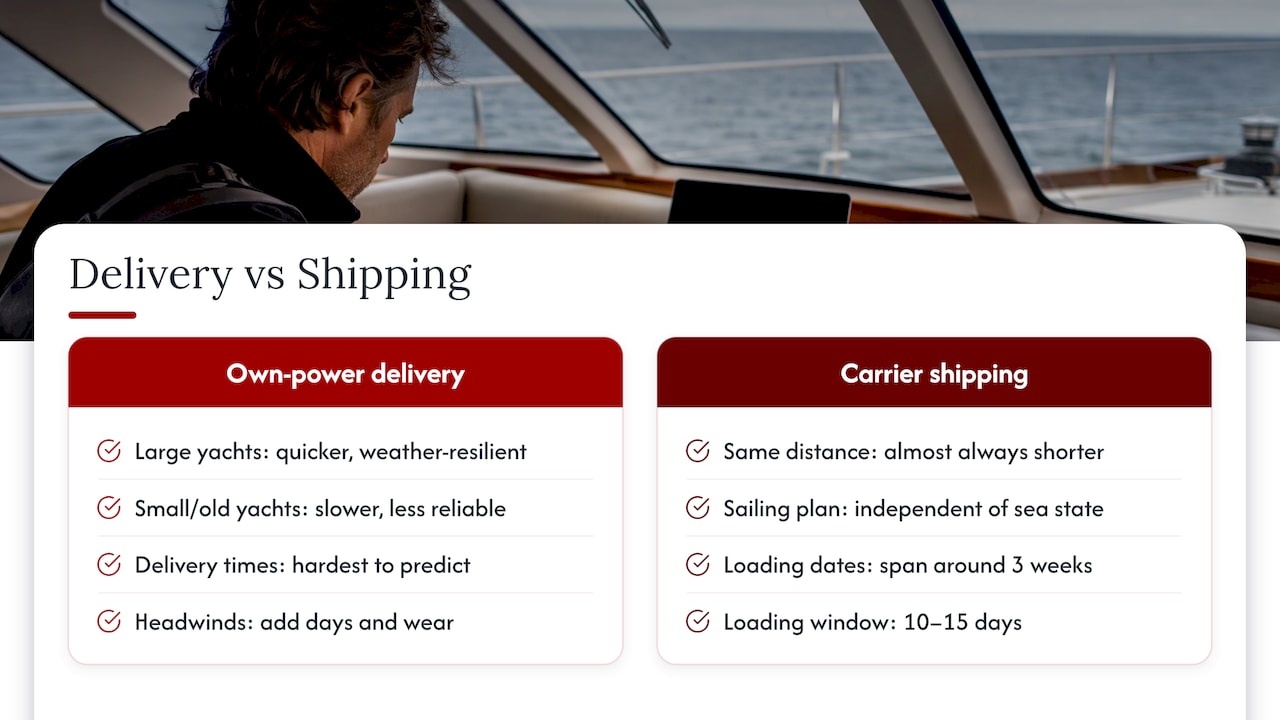
A carrier keeps to a sailing plan regardless of the sea state the yacht would have faced alone, which is why shipping is almost always shorter than the same distance under the yacht’s own power. Delays at either end of a shipped voyage can still add cost, so ask for the expected loading and discharge windows in writing.
Delivery depends on the yacht. YachtWorld’s 2026 guide notes that larger boats favour delivery under their own power because it is quicker and more weather-resilient, while smaller and older yachts are slower and less reliable. Delivery timescales are described as the hardest to predict. Passages into prevailing weather add days and wear, and some boats, catamarans in particular, are not well suited to the North Atlantic route back to Europe, a point made by the director of a major ocean rally organiser in the 2017 Yachting World piece above. The same article records that time-poor owners increasingly ship rather than spend weeks preparing and sailing home via the Azores.
Shipping has its own calendar. Loading dates for a given route typically span around three weeks, and some are set around weather such as the hurricane season, according to YachtBuyer. Yachting World describes a loading window of 10 to 15 days, with a specific time usually given about 24 hours ahead, so you need to be near the yacht and ready to move when the call comes.
Preparing the yacht for each method
Preparing for shipping
The aim is to hand over a yacht that can be lifted safely and arrives in the condition she left. Yachting World’s preparation guide and its 2023 shipping article together point to a consistent routine:
- Strip canvas and sails where possible, and mouse running lines so nothing flaps or chafes.
- Secure the interior with trucking straps and lock down lockers.
- Empty fresh and grey water tanks before approaching the ship.
- Carry minimum fuel, but enough to motor at the arrival port.
- Remove gas bottles, isolate batteries and fuel tanks, and turn off AIS.
- Remove the backstay and topping lift if the lift is on strops.
- Check the contract for delivery guarantees, and confirm insurance covers every stage.
On insurance, an Admiral Marine underwriter quoted in the same guide explains that the yacht’s normal policy is typically suspended while the shipper’s Institute Cargo Clauses (All Risks) cover applies, from the moment the slings attach until offloading. That is why you confirm in writing that nothing falls between the two policies. YachtWorld’s 2026 preparation guide adds photographing and filming the yacht’s condition, confirming lifting points and cradle requirements, and preparing customs, registration, ownership and import or export documents well before departure.
Preparing for delivery
A delivery needs the yacht to be seaworthy for the whole passage, not just for the first leg. A recent engine service with a documented sea trial, a rig and sail inspection, current safety equipment and the ship’s papers aboard are the baseline. Agree a written contract with a signed inventory and photographed condition report, and have your insurer validate the skipper’s qualifications before departure.
The contract should also say who pays for delays caused by weather or mechanical faults. YachtWorld’s older shipping-options article notes that some crews allow one unpaid lay day in a week-long delivery, and recommends checking references. Insurance typically falls to the yacht’s own policy, so the underwriter’s approval of crew and passage plan is part of the job.
The paperwork that travels with the yacht
Moving a yacht across borders is rarely just a transport job. Customs clearance, proof of ownership and a valid registration all have to be in order at the destination, and the right flag can change with the new cruising area, charter plans or tax position.
Three questions are worth settling before the yacht leaves:
- Is the current flag the right one for the new region? If not, a transfer between flags can be planned alongside the move, with a deletion certificate from the old registry where one is needed.
- Does the ownership structure suit the destination? Owners using a company can form a UK LTD, a Delaware LLC or a Marshall Islands company for the purpose. Vessel Flag’s service de création d'entreprise lists UK LTD formation at EUR 485 one-off and Delaware LLC formation from EUR 455, or EUR 605 with apostille.
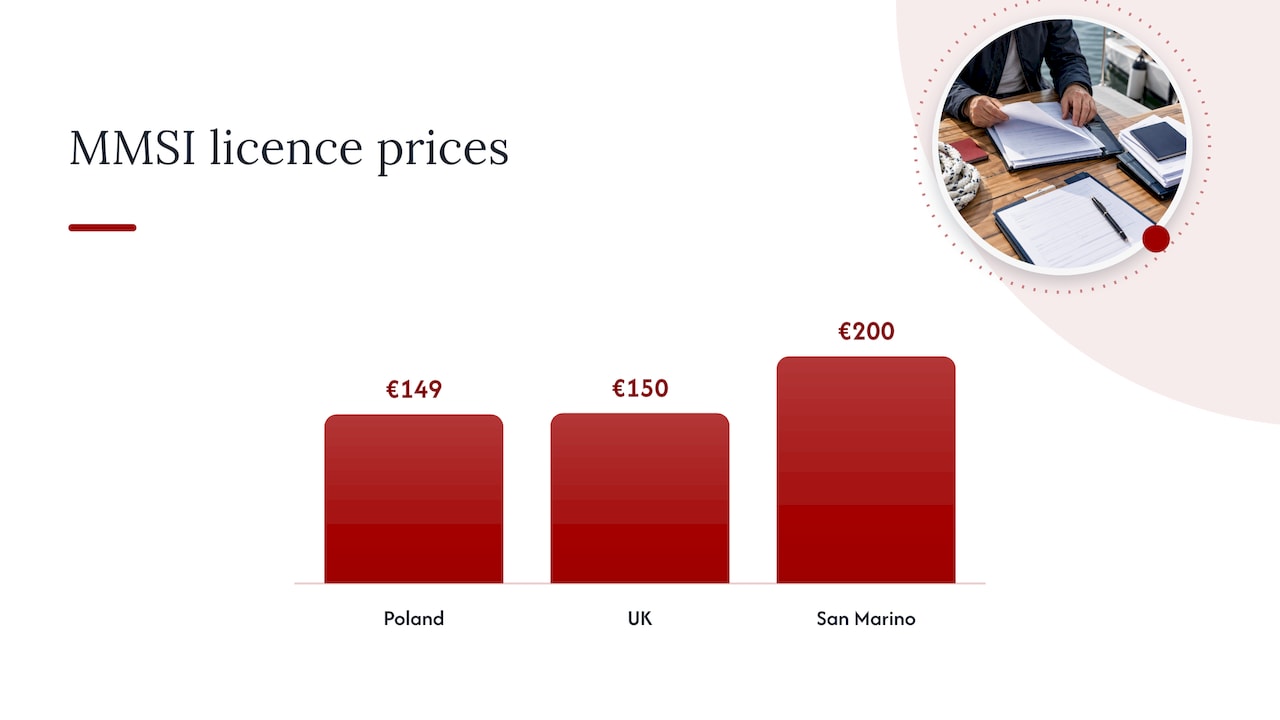
- Will the radio licence be valid where the yacht will sail? An MMSI number is the nine-digit identity used by DSC radios, and it is tied to a ship radio licence. Vessel Flag arranges these at a published one-off price, VAT included and with no annual fees: EUR 149 for Poland, EUR 150 for the UK and EUR 200 for San Marino, with the details on the MMSI radio licence page. The UK licence takes 1 day, and the Polish licence takes 4 to 6 weeks after registration, so the timing is worth building into the schedule.
The registry itself issues the certificate. Vessel Flag is a private consultancy that prepares and files applications; it is not a registry or a government body. Some flags offer quick provisional papers, for instance 2 to 5 days in Poland, and a San Marino provisional certificate takes 2 to 6 days, though that is not guaranteed.
For owners considering a change of flag, our pages cover Poland from EUR 320, San Marino from EUR 290, UK Part 1 from EUR 550 et Malta from EUR 849, all one-off. For UK Part 1, an owner can register personally if eligible, through an existing company (UK or an eligible foreign one, such as a Delaware corporation) or through a new UK LTD.
Choosing by vessel, route and schedule
A short decision path covers most cases.
Choose shipping when:
- The route crosses an ocean or runs a very long distance, such as the Caribbean to the Mediterranean or Asia to the Mediterranean.
- You have a fixed date, for example a charter season start, a boat show or a handover to a buyer.
- The yacht is a catamaran or another type that is not well suited to a hard upwind ocean passage.
- You want to keep hours off the engines and wear off the rig, and arrive with the hull in the condition you handed over.
- The yacht is new or recently refitted and the interior needs protecting.
Choose delivery when:
- The passage is short or coastal, with sheltered stops and easy weather windows.
- The yacht is large and robust, and the insurer has approved the crew and plan.
- The schedule is flexible enough to absorb weather delays.
Brokers have one more consideration. A buyer who takes delivery in another country often needs the yacht transferred to a new flag at the same time, so agreeing the transport method and the registration route in the same conversation avoids a gap between arrival and legal use.
For a closer look at the deck-cargo option specifically, our guide to deck cargo yacht shipping covers how it works, what to prepare and what to check.
Moving your yacht with Vessel Flag
Vessel Flag arranges yacht transportation as part of the same service that handles flag registration, MMSI radio licences, company formation for ownership and flag transfers. Everything is run remotely, and we publish one-off prices for our registration and licensing services. Transport is quoted per case, and you can see the full range on our page des services.
If the yacht needs a new flag at the end of the voyage, we can prepare the application so that it is ready when she arrives. We work with eight flags with published prices: Poland, San Marino, UK Part 1, Malta, Palau, the Marshall Islands, the Cayman Islands and the Cook Islands, and handle others, such as Panama and Gibraltar, on request.
Our view on delivery versus shipping
Owners often ask which method is cheaper. The better question is which method leaves the yacht, the paperwork and the schedule in the best shape on the day she arrives.
The published comparisons show that the cost gap is small once fuel, marina fees and crew travel are counted. The difference that remains is risk and wear. A shipped yacht arrives without the engine hours, and the voyage has a known plan and a cargo insurance policy covering it from lift to offload.
What we see is that the paperwork gets left until last. A yacht that arrives with a flag, an MMSI licence and an ownership structure already in place can start using her new cruising ground immediately. That is why we plan registration and transport together: our registration prices are published one-off, we work with eight flags, and the whole process is remote.
If the route is long, the deadline is fixed or the yacht is a catamaran, we recommend shipping, arranged together with the registration steps the destination needs.
Vessel Flag
FAQ
What is the difference between yacht delivery and yacht shipping?
Delivery moves the yacht on her own keel with a professional crew, so the voyage happens in the water. Shipping loads her onto a carrier as cargo, by crane, floating on to a semi-submersible ship, or on trailers for smaller vessels. The first option adds hours to the yacht, and the second does not.
How much does it cost to ship a yacht?
Yachting World’s December 2023 ballpark for a 45 ft monohull from the Caribbean to the UK was US$27,500 to US$45,000 including cargo insurance, with catamarans up to 50% more. Your cost depends on size, route, season and the loading method, so request a quote for the specific yacht and dates.
Is shipping faster than delivery?
Over ocean distances it usually is, because a carrier keeps to its plan whatever the weather and a yacht under her own power does not. Delays at either end of a shipped voyage can still add cost, so confirm the loading and discharge windows. Loading windows are typically 10 to 15 days, with about 24 hours of notice for the exact time.
Does my insurance cover the yacht during shipping?
Typically your normal policy is suspended while the shipper’s cargo cover applies, from the moment the slings attach until offloading. Confirm in writing that every stage, including loading, transit and discharge, is covered, and ask your insurer or broker about the delivery crew’s qualifications if you choose delivery. Vessel Flag can also arrange boat insurance through its services.
If your yacht is on the move and the paperwork needs to move with her, see the relevant flag page, for example UK Part 1 yacht registration, or book a consultation and we will plan the registration around your route.
Sources
- Yacht Transportation: The Options, YachtBuyer
- Should you ship a yacht to a destination rather than sail it, Yachting World (2023)
- Yacht shipping versus yacht delivery under sail, Yachting World (2017)
- Yacht shipping: How to prepare your boat, Yachting World (2020)
- Boat transport: international shipping, towing and more, YachtWorld (2026)
- Boat Transport Guide: How to Move Your Yacht in 2026, YachtWorld
- Shipping Options: How to Get Your Yacht Where You Want It, YachtWorld
Recommandé
VesselFlag is a private consultancy that prepares and files yacht registration applications for owners. We are not a government body or flag registry; certificates are issued by the relevant registry. This article is general information, not legal advice.