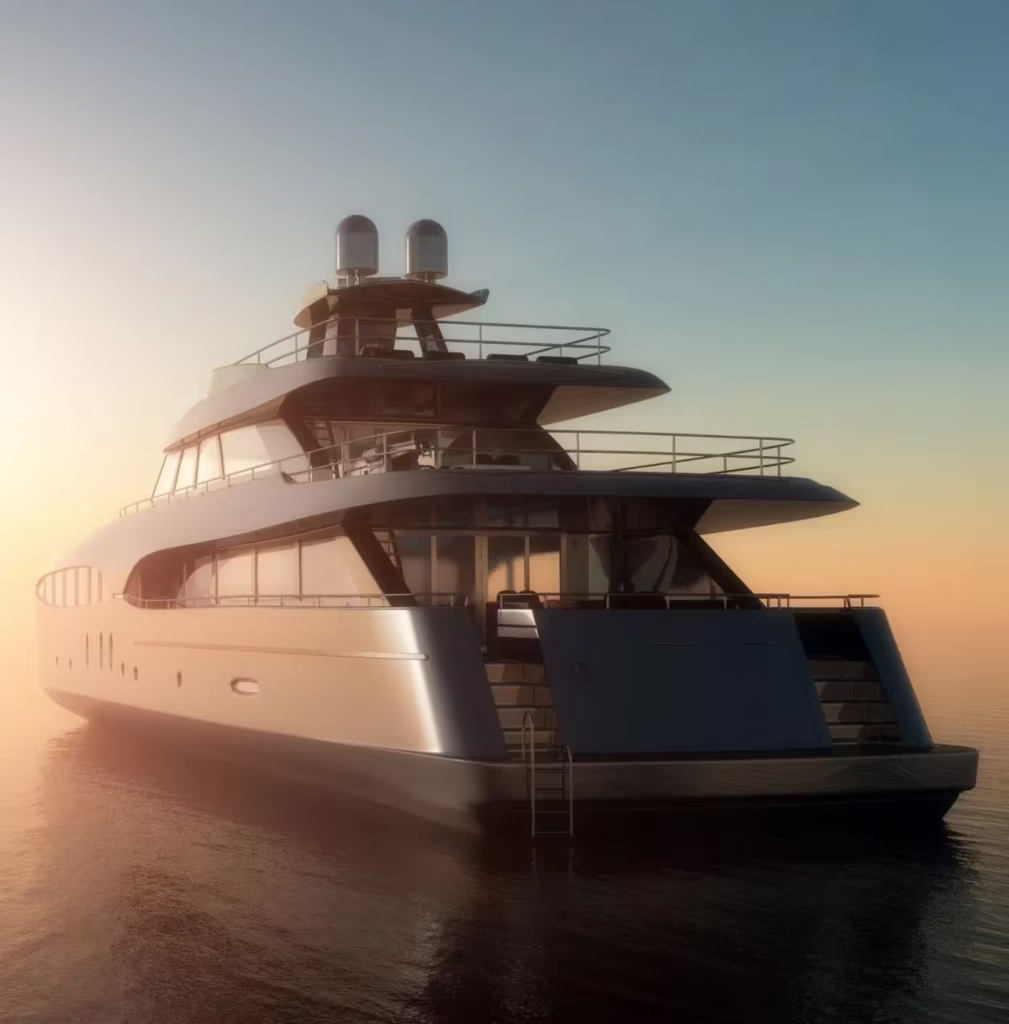

Twelve passengers is the line: stay at or under that number and your yacht sits under LY3 (now REG Part A); carry 13 to 36 and you move into PYC (REG Part B) territory. That single number triggers a cascade of SOLAS-influenced technical and manning requirements that can push crew size, refit scope, and running costs well beyond what an LY3-compliant yacht ever needs. The rest of this guide walks through what each code actually covers, what it costs you in practice, and how to decide which one fits your yacht.
TL;DR:
- Moving from LY3 to PYC typically doubles crew requirements, raising operating costs and impacting guest service capacity if space is limited.
- PYC standards demand higher safety system standards, larger lifesaving appliances, and more certification for officers, often requiring structural modifications.
- For private yachts or those with passenger loads under 12, LY3 (Part A) provides simpler regulations and lower costs, while PYC suits larger commercial operations.
- Changes to passenger capacity or code compliance during build or refit can be costly and time-consuming, so early planning with naval architects and flag authorities is essential.
- Choosing the correct flag registration, like Malta or San Marino, streamlines documentation, with registration times typically ranging from a few days to a couple of weeks.
Table des matières
- LY3 vs PYC: How the Codes Fit Into the REG Yacht Code
- LY3 vs PYC: The Operational Differences That Hit Your Budget
- LY3 vs PYC: Choosing the Right Code for Your Yacht
- How to Plan a Refit Around LY3 or PYC Requirements
- How VesselFlag Supports Your Code and Compliance Decisions
- What Operators Actually Say About Making This Call
- Ready to Register Under the Right Flag?
- Sources
- FAQ
LY3 vs PYC: How the Codes Fit Into the REG Yacht Code
LY3 was the informal shorthand for the Large Yacht Code, the rulebook covering yachts carrying 12 passengers or fewer. PYC, the Passenger Yacht Code, was introduced by the Red Ensign Group as a purpose-built alternative to full SOLAS compliance for yachts wanting to carry between 13 and 36 passengers, using equivalencies designed to make the requirements relevant to yacht operations rather than merchant shipping.
Both have since been folded into a single consolidated framework: the REG Yacht Code. LY3 lives on as Part A, and PYC as Part B. If you want the actual clauses rather than secondhand summaries, the primary documents are public:
- REG Yacht Code Part A (LY3 lineage) covers private and commercial yachts up to 12 passengers.
- REG Yacht Code Part B (PYC lineage) governs yachts carrying 13 to 36 passengers, with technical standards closer to SOLAS.
Here’s the part that trips people up: “LY3” hasn’t been the formal name of anything since the REG consolidation, yet brokers, captains, and management companies still say it constantly. The KRM Yacht Glossary notes that the term persists informally across the industry even though every current certificate references REG Part A. When someone tells you their yacht is “LY3 compliant,” they mean Part A. Worth confirming which document actually governs your build before you sign a contract that uses the old terminology.
LY3 vs PYC: The Operational Differences That Hit Your Budget
The passenger cutoff isn’t just a paperwork distinction. It reshapes how many crew you carry, what certificates they need, how the vessel is built, and how guest service gets delivered.
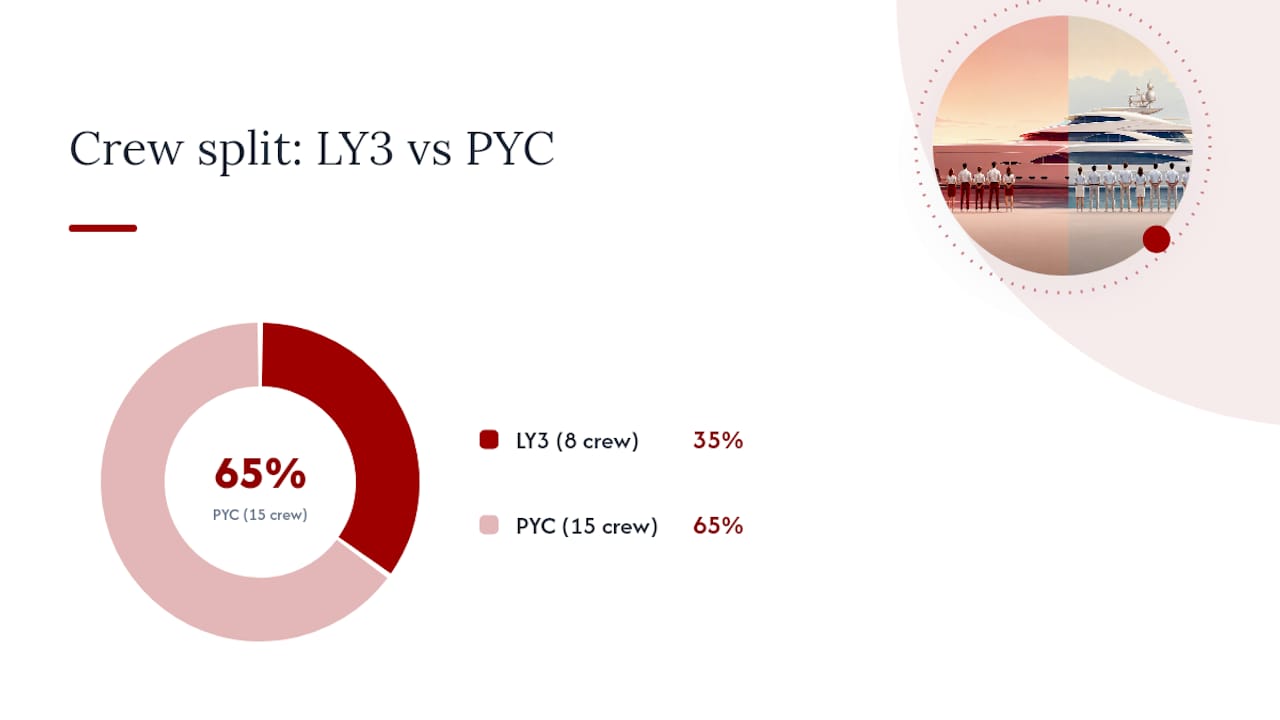
Manning is where the gap shows up fastest. A SuperyachtNews case study tracked a 92-meter motoryacht whose Minimum Safe Manning Document jumped from 8 crew under LY3 to 15 crew once the vessel moved to PYC. That’s not a rounding error. It’s nearly double the certified crew complement, and every one of those additional positions carries salary, accommodation, training, and STCW certification costs.
Four areas typically shift once PYC applies:
- Minimum Safe Manning Document. PYC’s SOLAS-adjacent framework calculates required crew based on passenger numbers, lifesaving appliance operation, and emergency response duties, not just vessel size.
- Officer certification. PYC vessels generally demand higher STCW competency levels among watchkeeping and safety officers, since the code assumes a passenger-carrying, quasi-commercial operating profile.
- Structural and system standards. Fire detection, subdivision, lifesaving appliances, and evacuation arrangements move closer to SOLAS-equivalent standards under Part B, often requiring more lifeboats, more muster stations, and different bulkhead arrangements than an LY3 build.
- Hotel-service staffing ratios. More safety crew doesn’t mean more butlers. Owners frequently find that MSMD-driven headcount eats into the space and budget they expected to spend on guest-facing service staff.
That last point deserves attention because it’s the one owners underestimate most. Operators report that PYC yachts often struggle to reconcile the technical crew numbers the MSMD demands with the five-star hotel experience owners expect their guests to get. You can end up with a crew mess full of qualified officers and not enough cabins left for the stewardesses running afternoon service.
LY3 vs PYC: Choosing the Right Code for Your Yacht
Picking between LY3 and PYC comes down to three questions: how you intend to use the yacht, whether commercial charter is part of the plan, and how you want to position the asset for resale.
If the yacht is staying private, or chartering with a guest count that never exceeds 12, LY3 (Part A) is almost always the pragmatic choice. It keeps crew numbers proportionate to vessel size and avoids the technical redesign PYC often forces. KRM’s yacht glossary frames it plainly: when owners prioritize private use and want to minimize additional operational cost, Part A alignment is the sensible default.
PYC earns its keep when there’s a genuine commercial reason to carry more than 12 guests, whether that’s a charter business model built around larger groups or a resale strategy that values passenger capacity as a selling point to the next owner.
Before committing either way, run through this checklist against your build or refit plans:
- Crew accommodation: does the hull have room for a larger complement without cannibalizing guest or storage space?
- Machinery space: can engineering compartments absorb additional fire suppression and redundancy systems?
- Lifesaving appliance fit: will davits, lifeboats, and muster areas physically fit without a structural redesign?
- Resale market: does your target buyer pool value 13 to 36 passenger capacity, or does it hurt saleability by inflating operating costs for a private buyer?
Conseil de pro : Bring in a naval architect, your classification society, and the flag administration before you finalize passenger capacity on paper. Changing the number after keel-laying is far more expensive than designing for it from day one.
Operators cited by SuperyachtNews generally advise caution with PYC unless commercial intent is clear, because the manning and technical burden can outweigh the benefit for a yacht that will mostly carry family and friends.
How to Plan a Refit Around LY3 or PYC Requirements
A code change, or a new build targeting PYC from the outset, follows a fairly predictable sequence. Skipping steps is how projects blow past their budgets.
- Commission a compliance survey. Get a clear gap analysis between the current build and the target code’s requirements before you touch a design drawing.
- Consult class and flag early. A body like Lloyd’s Register can quantify structural and systems changes before you commit to a budget, and the flag administration confirms what documentation it will expect at submission.
- Revise accommodation and general arrangement drawings. MSMD requirements drive crew cabin count, which almost always means resequencing guest, crew, and storage spaces.
- Upgrade lifesaving and fire systems. Budget for new davits, additional lifeboats, upgraded detection systems, and possibly revised subdivision.
- Submit documentation for class and flag approval. Build in review cycles. Approval rarely happens on the first submission.
Timeline and cost swing heavily on how much structural work the accommodation and lifesaving upgrades demand. Phasing the work around scheduled haul-outs or off-charter seasons is the most reliable way to protect cashflow and minimize downtime. If a refit is on the horizon, coordinating hull and system work with partners like Dust Free Film’s yacht coating systems alongside your class survey can help keep the project on one calendar instead of three.
How VesselFlag Supports Your Code and Compliance Decisions
Once you’ve settled on LY3 or PYC, the next question is which flag administration will process your paperwork efficiently. Vesselflag handles flag registration, MMSI and AIS setup, and documentation packages across multiple jurisdictions, and liaises directly with class and flag on your behalf.
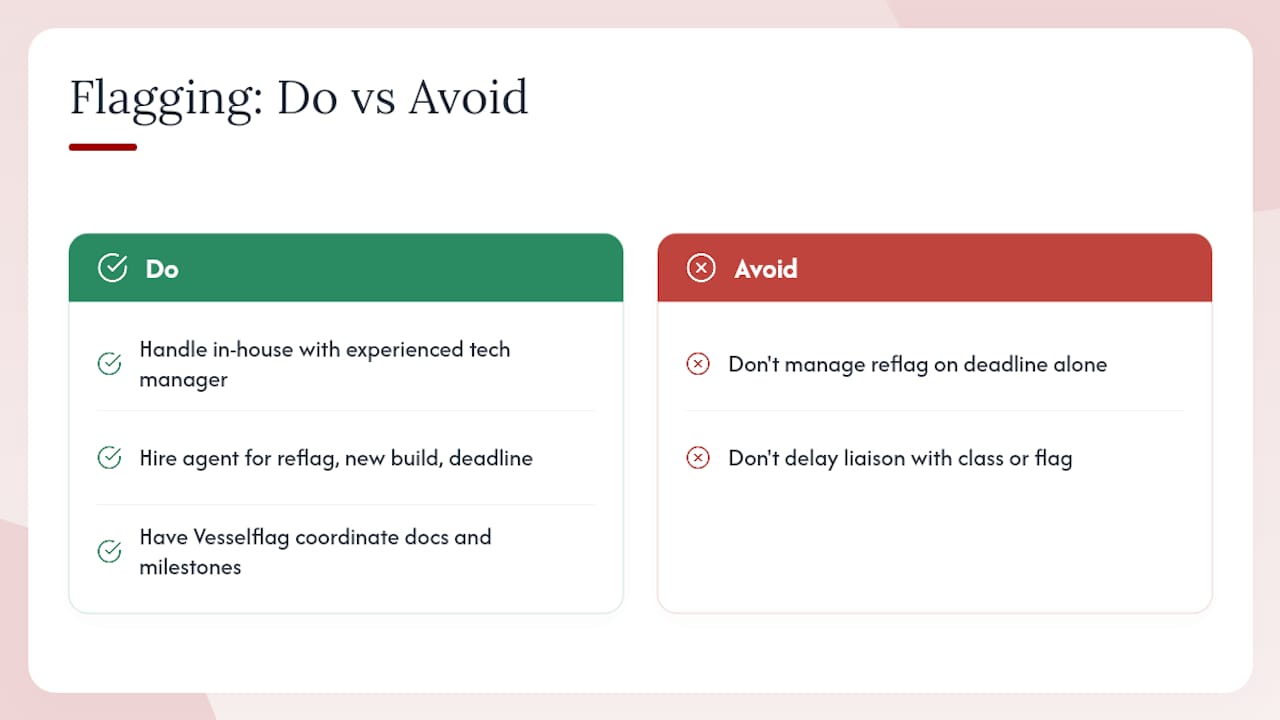
Handling this in-house makes sense if you already have a technical manager with flag experience. Bringing in a registration agent makes more sense when you’re managing a reflag, a new build, or a code transition on a deadline, since Vesselflag coordinates the documentation flow and timeline milestones so nothing stalls waiting on a single office.
What Operators Actually Say About Making This Call
The consistent advice from captains and managers is this: don’t chase PYC unless there’s a commercial reason to carry more than 12 guests. The manning and technical burden is real, and it shows up in your crew budget long before it shows up in your charter revenue. Get naval architects, crew planners, and the owner in the same conversation early. Safety drives the MSMD, full stop, and no amount of owner preference for extra stewardesses changes what the code requires.
— VesselFlag
Ready to Register Under the Right Flag?
Choosing between LY3 and PYC only solves half the problem. The other half is getting the vessel properly registered under a flag that matches your compliance path, your crew nationality mix, and your tax planning, without months of back-and-forth paperwork. Registrations are processed daily across multiple jurisdictions, with provisional registration sometimes completed in a few days and pricing that is fixed rather than hourly.
If your yacht is heading toward a PYC refit, Enregistrement des bateaux à Malte is worth a look given Malta’s established handling of commercial passenger tonnage. Staying under LY3 with private use in mind, Immatriculation des bateaux à Saint-Marin offers a fast, straightforward path with UK LTD and USA LLC ownership structuring available alongside it. Before you contact a registration agent, have your tonnage certificate, proof of ownership, and current flag deletion documents (if reflagging) ready. Reach out for a consultation, and expect a clear timeline and document checklist within the first 7 to 14 days.
Sources
FAQ
What does LY3 mean in text?
In yachting, LY3 refers to the Large Yacht Code, the safety and construction standard for yachts carrying 12 passengers or fewer. The term is now formally superseded by REG Yacht Code Part A, though “LY3” is still used informally across brokerage and crew conversations, according to the KRM Yacht Glossary.
What is the main difference between LY3 and PYC?
LY3 (REG Part A) covers yachts with 12 or fewer passengers, while PYC (REG Part B) governs yachts carrying 13 to 36 passengers under SOLAS-equivalent technical and manning standards. The practical difference shows up in crew size. A 92-meter yacht case study saw its minimum manning requirement rise from 8 crew under LY3 to 15 under PYC.
Does moving to PYC always increase crew costs?
Yes, in nearly every documented case, because PYC’s Minimum Safe Manning Document calculation accounts for passenger safety duties that LY3 does not require. Owners should weigh that added crew salary and accommodation cost against any commercial charter revenue the extra passenger capacity would generate.
Who decides whether my yacht needs LY3 or PYC?
Your intended passenger count decides the code, but your classification society and flag administration confirm the specific technical requirements that follow. Engaging a naval architect and a flag registration specialist like Vesselflag early avoids costly design changes after construction or refit work has started.
Can I switch a yacht from LY3 to PYC later?
Technically yes, but it usually means a significant refit covering crew accommodation, lifesaving appliances, and fire systems, not a paperwork update. Given the cost and disruption involved, most operators recommend deciding on passenger capacity and code path before finalizing the original build or major refit design.