Preparing your paperwork? Use our full yacht registration documents checklist – Vessel Flag prepares all documents for you.
Gather your bill of sale, proof of ownership (state title or previous Certificate of Documentation), a builder’s certification if the vessel is new, and photo ID for every owner, then submit Form CG-1258 through the NVDC eStorefront. That single step, done correctly, is what actually determines how fast you get a Certificate of Documentation back.
Here’s the priority checklist before you touch the application:
- Bill of sale or transfer document showing your name as owner
- Previous state title or registration (or prior Certificate of Documentation, if re-documenting)
- Form CG-1261 (builder’s certification) if the vessel has never been documented or titled
- Proof of removal from a foreign registry, if the vessel was previously flagged abroad
- Government-issued photo ID and citizenship evidence for each owner
Processing fees run modestly and turnaround time typically takes multiple weeks once the file is complete.
Pro Tip: Confirm you’re on a .gov domain before paying anyone. Several private sites mimic official government forms and charge inflated fees for paperwork you can file yourself.
Key Takeaways
Preparing vessel documents comes down to matching your ownership history to the correct title-evidence method and filing Form CG-1258 through the official NVDC eStorefront.
| Point | Details |
|---|---|
| Gather ownership proof first | Bill of sale, prior title, and build evidence (CG-1261) before starting any form. |
| Match your title evidence method | Use the simplified method for short ownership histories, complete chain of title for longer or foreign ones. |
| File through NVDC eStorefront only | Submit CG-1258 via the official dco.uscg.mil eStorefront, never a third-party site. |
| Keep state registration current too | Federal documentation rarely replaces state registration; check your state’s rules separately. |
| Get expert help for complex cases | Vesselflag manages paperwork, title evidence review, and foreign registry removal for owners who’d rather not file solo. |
Table of Contents
- What Is Vessel Documentation and Why Does It Matter?
- Does Your Vessel Qualify for Documentation?
- Step-by-Step Checklist for Your Initial Documentation Application
- How Do You Submit Your Application Through NVDC eStorefront?
- Which Title Evidence Method Applies to Your Vessel?
- Do You Still Need State Registration Too?
- What Mistakes Cause the Most Processing Delays?
- How Do You Renew, Transfer, or Replace Your Documentation?
- Where to Find Official Forms and Guidance
- Sources
- FAQ
What Is Vessel Documentation and Why Does It Matter?
A Certificate of Documentation is the federal government’s record of a vessel’s nationality and ownership, issued by the U.S. Coast Guard’s National Vessel Documentation Center rather than any state agency. It’s the maritime equivalent of a passport for your boat, and it carries endorsements that unlock specific legal rights.
- Registry endorsement: permits use in foreign trade
- Coastwise endorsement: allows transporting merchandise or passengers between U.S. points
- Fishery endorsement: permits commercial fishing in U.S. waters
- Recreational endorsement: covers pleasure use only, with no commercial privileges
Everything downstream, from which forms you file to which fees apply, traces back to 46 CFR Part 67 and the NVDC’s own instructions.
Does Your Vessel Qualify for Documentation?
Generally, any vessel of at least five net tons wholly owned by U.S. citizens qualifies for documentation, and certain commercial trades require it outright. “Net tons” measures internal volume, not weight. It’s a formula tied to hull capacity, so a vessel around 25 to 30 feet with enclosed space often clears the threshold even though it feels small.
Federal law spells out the specifics in a few key spots:
- §67.5 sets the general eligibility standard (U.S. citizen ownership, five net tons minimum)
- §67.7 lists which endorsements different trades actually require
- §67.1 explains the scope and purpose of documentation itself
With millions of recreational vessels registered nationwide, the paperwork trail matters for enforcement, insurance claims, and resale, not just federal compliance. Vessels under five net tons typically skip federal documentation entirely and rely on state title and registration instead.
Step-by-Step Checklist for Your Initial Documentation Application
Work through this in order, and you’ll avoid the back-and-forth that stalls most first-time filings.
- Confirm ownership evidence. Locate your bill of sale, and if the vessel changed hands more than once, gather each prior transfer document.
- Establish title evidence. Decide whether you’ll use the simplified method (recent ownership history) or the complete chain of title (full ownership history back to the builder), based on how many owners preceded you.
- Collect build evidence. For a new build, get Form CG-1261 (Builder’s Certification and First Transfer of Title) signed by the manufacturer, or a Manufacturer’s Certificate of Origin.
- Handle foreign registry cancellation. If the vessel was previously flagged in another country, obtain formal proof of deletion from that registry.
- Fill out Form CG-1258. Complete every field, including vessel dimensions, owner information, and the endorsement you’re requesting.
- Get signatures notarized. Most ownership documents require notarization to be accepted.
- Scan everything as clean, legible PDFs. Name files clearly (e.g., “BillOfSale_Owner1.pdf”) so nothing gets misfiled during review.
A few notes on evidence types you’ll actually run into:
- Simplified method: works when you’re the vessel’s first or second owner and can show a clear, short ownership trail.
- Complete chain of title: required when ownership history is longer, foreign, or has gaps that need documenting.
- Abstract of title: sometimes requested when the NVDC needs to verify past liens or ownership disputes.
Pro Tip: Illegible scans and missing notarization are the two most common reasons files bounce back for correction. Double-check every signature page before you upload.
How Do You Submit Your Application Through NVDC eStorefront?
Access the NVDC eStorefront through the official dco.uscg.mil pages, not a third-party portal, and select “Initial Documentation” or “Exchange/Replacement” depending on your situation.
- Create or log into your eStorefront account.
- Select the correct product (initial documentation, renewal, exchange, or replacement).
- Upload Form CG-1258, Form CG-1261 if applicable, and all supporting evidence as PDFs.
- Pay the applicable fee online.
- Submit and save your confirmation number to track status.
A few technical notes worth knowing before you start:
- Use a current version of Adobe Reader; older PDF readers can corrupt fillable form fields.
- The eStorefront is built for desktop use on Windows or Mac; mobile submission isn’t reliably supported.
- Altered or incorrectly formatted forms get rejected outright, so don’t edit a form outside the official template.
Processing generally takes several weeks after a complete file is received, longer if evidence is missing or the chain of title needs clarification.
Which Title Evidence Method Applies to Your Vessel?
The NVDC accepts a few distinct paths to prove ownership, and which one applies depends on the vessel’s history.
| Method | Typical documents required | When it applies |
|---|---|---|
| Simplified, without build evidence | Bill of sale from current owner, prior state title | Vessel already has clear recent ownership, no new build documentation needed |
| Simplified, with build evidence | CG-1261 or Manufacturer’s Certificate of Origin, first bill of sale | New vessel documented for the first time |
| Complete chain of title | Every bill of sale back to original owner, foreign registry cancellation if relevant | Longer ownership history, foreign-flagged vessels, or coastwise endorsement requests |
Sections §67.53 and §67.57 lay out exactly which evidence satisfies each method. If you’re unsure which applies, the complete chain of title is the safer default. It takes longer to assemble but rarely triggers a request for additional documents.
Do You Still Need State Registration Too?
Federal documentation proves nationality and unlocks endorsements; state title and registration prove ownership within a specific state and permit you to legally operate on that state’s waters, making it essential to consider options like charter yacht brokerage services if you’re exploring yacht ownership or chartering. Most owners need both, not one or the other.
- Documentation replaces state titling in some states, but almost never replaces state registration.
- Check your state’s requirement before assuming documentation alone covers you on the water.
- Florida example: FLHSMV requires titling and registration for motorized vessels on public waterways, accepting a Manufacturer’s Certificate of Origin, bills of sale, or an out-of-state title as proof, even for documented vessels.
What Mistakes Cause the Most Processing Delays?
Most rejected applications share the same handful of problems, and nearly all of them are avoidable with a slower, more careful pass through your paperwork.
- Missing or incomplete notarization on ownership documents
- An unclear or broken chain of title with gaps between owners
- Uploading scanned images instead of proper PDFs, or using outdated PDF software
- Forgetting to remove a vessel from a foreign registry before applying
Verify you’re on an official .gov domain before paying any fee. Private sites routinely charge premium prices for filing tasks that cost far less through NVDC directly. Hiring a paid documentation service makes sense when your chain of title spans multiple owners, when foreign registry removal is involved, or when the vessel is owned through a corporate structure. Straightforward, single-owner purchases are usually fine to file yourself.
How Do You Renew, Transfer, or Replace Your Documentation?
Each life event after initial documentation has its own path, though most route through Form CG-1258 again.
- Ownership transfer: Submit a new bill of sale along with CG-1258; evidence requirements follow §67.59.
- Annual renewal: Renew before your Certificate of Documentation’s expiration date to avoid a lapse; fees are modest compared to initial filing.
- Exchange or replacement: Use CG-1258 if your vessel’s details changed (name, hailing port) or if your certificate was lost or damaged.
- Return to documentation: If a vessel was previously documented, sold, and later reacquired, you’ll need proof of the gap in ownership plus standard title evidence.
Processing times for renewals and replacements tend to run shorter than initial applications, since the NVDC already has your vessel on file.
Where to Find Official Forms and Guidance
Stick to primary sources when you’re gathering forms or double-checking a requirement.
- NVDC eStorefront for submitting applications and ordering replacement certificates
- eCFR Part 67 for the current, searchable text of every section referenced above
- NVDC FAQ page for process questions not covered in the instructions
- FLHSMV vessel titling page if you’re documenting in Florida and need the state-side requirements
Always confirm you’re on a .gov domain, and keep your PDF reader current so fillable fields don’t corrupt on upload.
One Snag That Trips Up Almost Every First-Time Filer
A first-time owner once had an application bounced twice over an ownership gap that turned out to be a bill of sale filed under a maiden name. One corrected document fixed it in a week. Name every uploaded file clearly, and write down your eStorefront confirmation number the moment you get it. That number is your only quick reference if you need to call and check status.

Let Vesselflag Handle the Paperwork You’d Rather Not Chase
If juggling chain-of-title evidence, foreign registry cancellations, and NVDC forms sounds like more friction than you want, Vesselflag manages the entire paperwork trail for you, so you’re not the one tracking down a missing signature three weeks into the process.
Vesselflag’s team reviews title evidence for gaps before submission, handles foreign registry removal correspondence, completes form fields correctly the first time, and sends renewal reminders so your certificate never lapses. For owners weighing a U.S. Certificate of Documentation against an international flag, Vesselflag also walks through how to register a yacht under either path and which one fits your vessel’s use. If your documentation needs go beyond a straightforward single-owner filing, request help with your registration and get a clear answer on timeline and cost before you commit to a method.
Sources
- CFR Title 46, Part 67 — Documentation of Vessels (govinfo)
- USCG Documentation, State Title, and Registration, Explained – The Boat Galley
- Vessel titling and registrations – Florida Department of Highway Safety and Motor Vehicles
FAQ
What documents do I need to prepare vessel documents for shipping or sale?
You need a bill of sale, prior title or registration, proof of citizenship for each owner, and build evidence like Form CG-1261 if the vessel is new or previously undocumented.
What vessels need to be documented?
Vessels of at least five net tons wholly owned by U.S. citizens are generally eligible, and some commercial trades require it under §67.5 and §67.7; smaller recreational boats typically rely on state title instead.
What is a vessel Certificate of Documentation?
It’s the federal government’s record of a vessel’s nationality and ownership, issued by the NVDC, and it carries endorsements such as registry, coastwise, fishery, or recreational that determine what the vessel can legally do.
How do I prepare a vessel for a safety equipment survey?
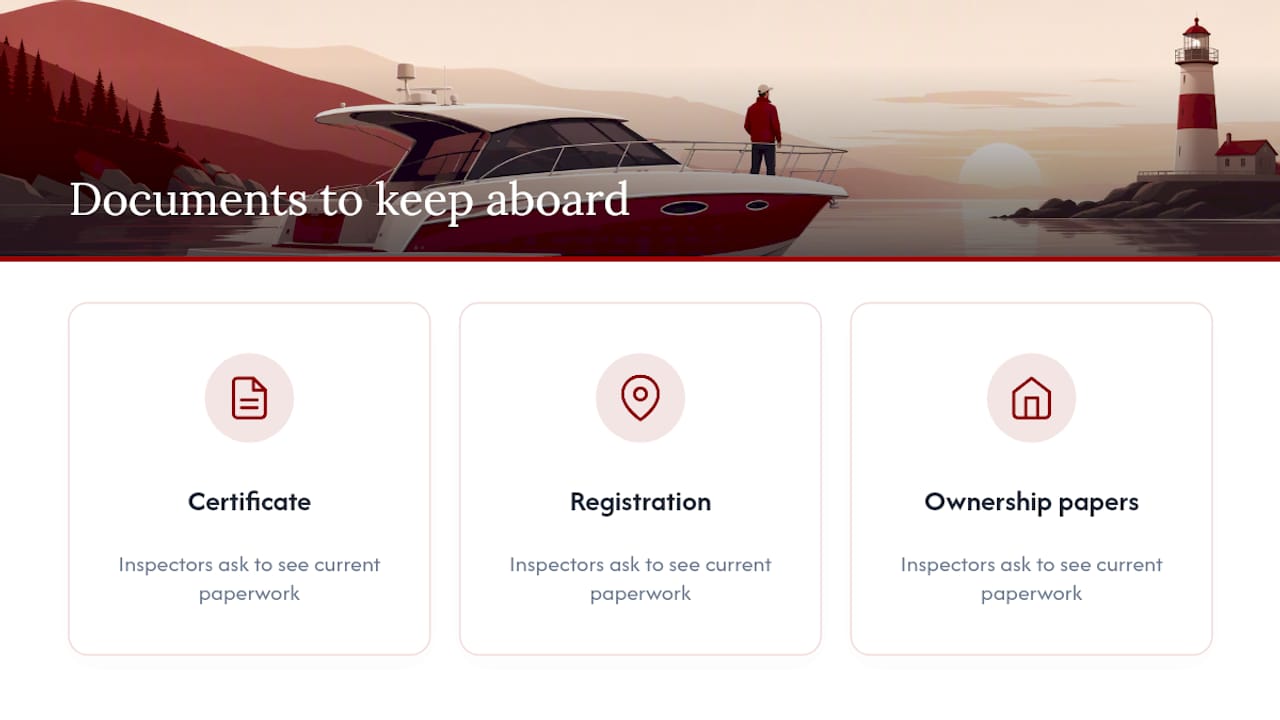
That’s a separate process from documentation, but keeping your Certificate of Documentation, registration, and ownership papers organized and aboard makes any survey or inspection go faster since inspectors often ask to see current paperwork first.
Can I file vessel documentation myself, or do I need a service?
Most single-owner, straightforward purchases can be filed directly through the NVDC eStorefront without help; complex chains of title, foreign registry removal, or corporate ownership are where a paid service like Vesselflag earns its fee.