
TL;DR:
- Your MMSI functions as a vessel’s unique identifier, crucial for emergency rescue and maritime tracking. Proper registration, synchronization across devices, and timely updates are essential for effective safety and compliance. Testing and careful management of MMSI prevent costly errors, ensuring rescue systems work when needed most.
Your MMSI number is the maritime equivalent of a fingerprint. It identifies your vessel in every emergency, guides rescue teams to your exact location, and keeps you legally compliant across international waters. Yet many yacht owners treat it as a one-time checkbox rather than an active safety tool. Getting these essential MMSI tips for yachts right is not just about avoiding fines. It is about making sure that when something goes wrong at sea, the system designed to save you actually works.
Table of Contents
- Key takeaways
- 1. Understand what MMSI actually does for your yacht
- 2. Know the two registration pathways for MMSI
- 3. Double-check every digit when programming your MMSI
- 4. Synchronize MMSI across every onboard device
- 5. Update your MMSI registration after any vessel change
- 6. Test your DSC functionality before every voyage
- 7. Never use an unregistered or borrowed MMSI
- 8. Do not disable your AIS to hide your position
- 9. Integrate MMSI with your full communication safety system
- 10. Handle accidental distress calls immediately
- 11. Know your compliance obligations when sailing internationally
- My take on MMSI management for yacht owners
- How Vesselflag can help you get MMSI right
- FAQ
Key takeaways
| Point | Details |
|---|---|
| Register before you sail | MMSI registration must be completed before programming any onboard equipment or departing on a voyage. |
| Sync across all devices | Program your MMSI into your DSC radio, AIS transponder, and EPIRB consistently to avoid gaps in emergency coverage. |
| Update after any change | Ownership transfers, vessel name changes, and contact updates must be reflected in your MMSI registration promptly. |
| Test before every voyage | Routine DSC test calls confirm your MMSI is active, correctly programmed, and ready when it counts. |
| International sailing adds requirements | Yachts crossing international borders need an FCC Ship Station License rather than a domestic-only registration. |
1. Understand what MMSI actually does for your yacht
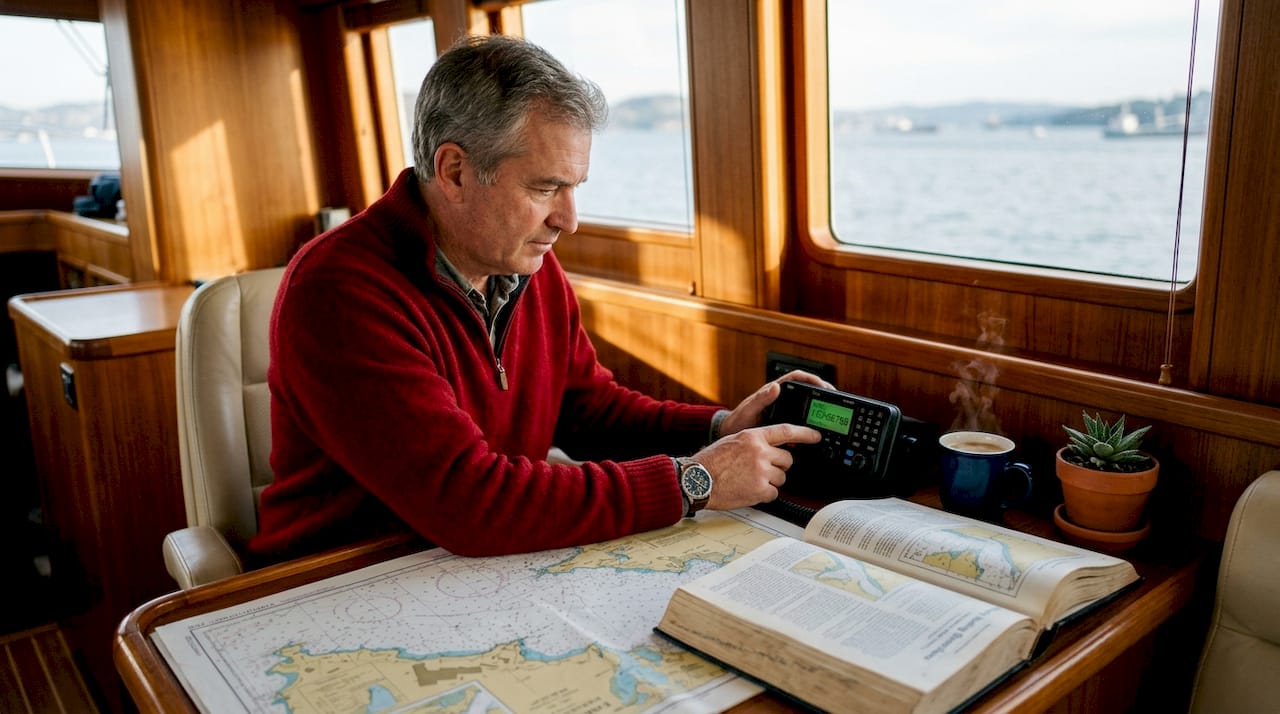
Your Maritime Mobile Service Identity is a nine-digit number permanently assigned to your vessel. Think of it as the maritime equivalent of a phone number and a passport combined. When you press the distress button on a DSC radio, your MMSI and GPS coordinates transmit automatically to the Coast Guard and nearby vessels. Rescue teams know who you are, where you are, and what vessel they are looking for before they even deploy.
The importance of MMSI for yachts extends beyond emergency use. Your MMSI appears in AIS traffic data, allowing port authorities and other mariners to identify your vessel in real time. It also links your EPIRB registration to your onboard safety profile, though it is worth clarifying that EPIRB uses a separate hex identifier that gets cross-referenced back to your MMSI data in rescue databases.
2. Know the two registration pathways for MMSI
Not all MMSI registration is the same, and picking the wrong pathway creates compliance problems down the line.
For domestic US yacht operators: Organizations like BoatUS offer free MMSI registration for members, with non-members paying around $25. The number is issued immediately, making this the fastest route if you stay within US waters.
For international sailors: The FCC requires a formal Ship Station License obtained through the Universal Licensing System (ULS). This costs $160 via FCC application and is a legal requirement for any yacht traveling internationally. Operating in foreign waters without this license is an FCC violation, not just a procedural gap.
Common documentation you will need regardless of pathway:
- Vessel name, length, and hull identification number
- Owner’s name and contact information
- Radio equipment make and model
- Details of DSC, AIS, and EPIRB equipment onboard
Pro Tip: If you plan to ever sail internationally, skip the domestic registration and go straight for the FCC Ship Station License. Upgrading later is possible but adds an extra administrative step you can avoid from the start.
3. Double-check every digit when programming your MMSI
A single transposed digit in your MMSI entry renders your DSC distress call useless to rescue teams. The nine-digit number must be entered identically across every device onboard. Most DSC radios lock the MMSI after initial programming precisely because errors are so costly. Some units require a factory reset to correct a mistake, which means you lose your original programming entirely.
Read the number out loud before confirming it on each device. Then verify it against your registration certificate. This takes thirty seconds and eliminates one of the most common and preventable MMSI errors on the water.
4. Synchronize MMSI across every onboard device
Programming MMSI consistently across your DSC radio, AIS transponder, and EPIRB is not optional. It is the difference between a coordinated rescue and a chaotic one. If your AIS shows one MMSI and your DSC broadcasts another, responders are chasing two different vessel identities simultaneously.
Follow this sequence when setting up a new vessel or new equipment:
- Obtain and confirm your MMSI registration certificate.
- Program the DSC radio first, since most marine radios lock the MMSI after entry.
- Enter the identical MMSI into your AIS transponder.
- Register your EPIRB separately with NOAA’s beacon registration database, linking it to the same vessel MMSI.
- Cross-reference all three against your certificate before powering down.
Pro Tip: Take a photo of your MMSI registration certificate and save it to your phone and a cloud folder. If equipment ever needs to be replaced at a foreign port, you will have immediate access to your number without hunting through onboard paperwork.
5. Update your MMSI registration after any vessel change
If you sell your yacht, change its name, or update your contact information, your MMSI registration must be updated to match. Changes via FCC ULS are free and straightforward, but they are the yacht owner’s responsibility. Rescue teams rely on the database information attached to your MMSI to contact the right people. Outdated records mean they may be calling a previous owner or a disconnected number while you are waiting for help.

When you purchase a used yacht, the MMSI from the previous owner does not transfer to you automatically. You need to register a new MMSI in your name. Never sail on a previous owner’s MMSI, even temporarily.
6. Test your DSC functionality before every voyage
Your MMSI is only as useful as the equipment broadcasting it. Routine DSC test calls confirm that your radio is transmitting your MMSI correctly and that the system is ready for an actual emergency. Most DSC radios have a test mode that does not trigger a full Coast Guard response. Use it.
Check that your AIS is broadcasting and visible on AIS tracking websites before you leave the marina. This takes less than five minutes and confirms your equipment is live and accurate.
7. Never use an unregistered or borrowed MMSI
Using another vessel’s MMSI or operating with an unregistered number is an FCC violation. Operating DSC radios without proper MMSI can result in fines and equipment forfeiture. Beyond the legal exposure, it is genuinely dangerous. If you call for help under the wrong MMSI, rescue teams are searching for the wrong boat with the wrong description.
Some boat owners use a placeholder or test MMSI they found online. Others never clear a factory default number from a second-hand radio. Both situations create the same problem in an emergency: no one knows who is actually in distress.
8. Do not disable your AIS to hide your position
It seems logical that turning off AIS makes your vessel invisible. It does not. AIS blackouts do not fully conceal vessels; satellite monitoring, radar, and third-party maritime data systems can still track your position. What AIS disabling does accomplish is removing your vessel from the safety grid used by other mariners and Coast Guard stations to monitor vessel traffic and respond to incidents.
Running dark also raises red flags with port authorities and maritime security agencies. In a genuine emergency, a vessel that has been invisible on AIS is significantly harder and slower to locate.
9. Integrate MMSI with your full communication safety system
The real value of MMSI comes from how it connects your onboard systems into a single, coherent emergency network. A properly configured setup means a single button press sends your identity and GPS position automatically to every equipped vessel within range and to the Coast Guard simultaneously.
Here is how MMSI-linked equipment compares across your safety setup:
| Device | MMSI function | Coverage range |
|---|---|---|
| DSC VHF radio | Distress call with position | 20-50 nautical miles |
| AIS transponder | Real-time vessel identification | Visible to all AIS-equipped vessels |
| EPIRB | Satellite alert linked to MMSI data | Global via satellite |
Keep firmware updated on all three devices. Manufacturers release updates that affect DSC functionality and AIS data accuracy. Outdated firmware is one of the quieter causes of communication failures offshore.
Pro Tip: Subscribe to your DSC radio manufacturer’s email list or check their website seasonally for firmware releases. A ten-minute update in port is worth more than discovering a bug mid-ocean.
10. Handle accidental distress calls immediately
It happens. A misplaced hand, a curious child, or an unfamiliar crew member triggers a DSC distress call. Accidental alerts must be canceled immediately on VHF Channel 16 with a verbal cancellation message. Failing to do so can trigger official investigations and cost rescue agencies significant resources.
Brief every crew member on where the distress button is, what it does, and how to cancel an accidental activation. This should be part of every pre-departure safety briefing.
11. Know your compliance obligations when sailing internationally
International waters bring additional rules. Yachts operating beyond domestic limits need an FCC Ship Station License, and international MMSI compliance requires you to carry documentation of your registration onboard at all times. Many countries require vessels entering their waters to have a valid MMSI registered to the listed owner.
Some jurisdictions also have their own radio license requirements that layer on top of FCC requirements. Research the specific rules for each country on your itinerary well before departure.
My take on MMSI management for yacht owners
In my experience working with yacht owners across jurisdictions, MMSI is the safety tool most people feel confident about until something goes wrong. I have seen registration records with wrong phone numbers, radios programmed with factory default MMSIs, and vessels that sailed internationally on domestic-only registrations for years. These are not reckless operators. They are people who did the initial setup and never thought about it again.
What I have learned is that MMSI is not a one-time task. It is an ongoing piece of your vessel’s safety infrastructure that needs the same attention you give engine maintenance or flare expiry dates. The mariners who treat it that way and who build MMSI verification into their pre-departure checklist are the ones whose distress calls actually reach help in the right amount of time.
If you are serious about safe vessel operations, get your registration right, sync every device, and test it before you leave the dock. That is the standard I hold myself to, and it is the one I recommend to every operator I work with.
— VesselFlag
How Vesselflag can help you get MMSI right
Getting MMSI registration right from the start saves you from the headaches of corrections, compliance gaps, and equipment reprogramming later. Vesselflag specializes in exactly this. Whether you need to obtain an MMSI radio license for the first time, transfer registration after a vessel purchase, or align your MMSI setup with an international flag registration, the team at Vesselflag handles it with the precision these processes require.
Beyond MMSI, Vesselflag offers full yacht registration services under multiple international flags, including MMSI and AIS setup as part of the process. If you want your vessel fully compliant, properly documented, and ready to sail anywhere in the world, Vesselflag is the place to start.
FAQ
What is an MMSI number and do I need one?
An MMSI is a nine-digit identifier assigned to your vessel for use with DSC radios, AIS transponders, and EPIRBs. Any yacht equipped with DSC-capable radio or AIS should have a registered MMSI.
How do I update my MMSI number after buying a used yacht?
The previous owner’s MMSI does not transfer with the vessel. You need to register a new MMSI in your name through BoatUS for domestic use or the FCC ULS system for international sailing.
Can I use the same MMSI on all my onboard equipment?
Yes, and you should. Your single MMSI must be programmed identically into your DSC radio, AIS transponder, and linked to your EPIRB registration to create a consistent safety profile for rescuers.
What happens if I accidentally trigger a DSC distress call?
Cancel it immediately on VHF Channel 16 with a verbal announcement stating it was accidental. Failure to cancel can trigger an official investigation and misallocate Coast Guard resources.
Do I need a different MMSI for international waters?
Your MMSI number stays the same, but sailing internationally requires an FCC Ship Station License rather than a domestic-only registration, which carries a $160 application fee.