
The fastest route to a good flag decision is simple: pick the cheapest Paris MoU White List registry that actually matches how you’ll use the boat, then confirm that choice with maritime counsel before you sign anything. If you cruise the Mediterranean or North Atlantic, that shortlist usually narrows to a handful of names, among them the Isle of Man Ship Registry, the Cayman Islands Shipping Registry, and Malta. Your next move this week should be a phone call, not a form: check the flag’s current Paris MoU standing and get a maritime lawyer or a specialist like VesselFlag involved before you commit to a jurisdiction you’ll be stuck with for years.
Önemli Noktalar
The right flag choice matches your operational intent to a Paris MoU White List registry, with the ownership structure reviewed by maritime counsel before you register.
| Nokta | Detaylar |
|---|---|
| Define intent first | Decide private, EU charter, or global charter use before comparing any registries. |
| Check Paris MoU status | Confirm White List standing before registering in European, North Atlantic, or Mediterranean waters. |
| Budget full compliance costs | Plan for $80,000 to $250,000 per year for a 40 to 60 meter yacht, not just registration fees. |
| Separate flag from ownership | Align mortgage, VAT, and beneficial-owner documents across both structures before filing. |
| Work with a specialist | VesselFlag executes registration, SPV setup, and MMSI/AIS across Cayman, Isle of Man, Malta, Singapore, Palau, and San Marino. |
İçindekiler
- Flag Selection Tips 2026: What a Flag State Actually Controls
- Core Selection Criteria for Comparing Registries
- Flag State vs. Ownership Jurisdiction: Why They’re Separate
- Why Paris MoU and Port-State Control Performance Matter
- Modeling Realistic Costs and Timelines for 2026
- Step-by-Step Workflow for Choosing and Registering a Flag
- Registry Categories and Which One Fits Your Situation
- Common Mistakes That Cause Expensive Rework
- A Registration Specialist’s View on Where Owners Get Tripped Up
- How VesselFlag Handles the Registration Once You’ve Chosen
- Kaynaklar
- SSS
Flag Selection Tips 2026: What a Flag State Actually Controls
A flag state is not a sticker on the stern. It’s the legal system that governs your crew’s employment terms, decides which safety survey regime applies, and determines whether a bank will even accept your yacht as collateral.
Six domains do the heavy lifting:
- Safety and survey regime — which construction and equipment rules your yacht must meet, and which class society can certify it.
- Crew certification and employment — whether officer credentials are recognized and how the Maritime Labour Convention applies to contracts and working hours.
- Mortgage and registry recognition — whether lenders view the registry’s title system as secure enough to finance against.
- Port-state inspection exposure — how often and how intrusively your yacht gets boarded and checked in foreign ports.
- Environmental certificates — MARPOL compliance documentation and how strictly it’s enforced.
- Customs and VAT status — whether the flag supports temporary admission, VAT leasing, or full import for EU cruising.
A yacht flagged somewhere with weak port-state standing gets boarded more often and scrutinized harder, which insurers notice. That scrutiny shows up as higher premiums or flat refusals from underwriters who keep informal blacklists. On the U.S. side, USCG documentation is a federal system entirely separate from state registration. It establishes nationality, enables preferred ship mortgages, and imposes coastwise trade and crew nationality restrictions that matter a great deal if you plan to charter domestically.
Profesyonel İpucu: Before you fall in love with a registry’s low annual fee, ask your insurance broker whether that flag appears on their approved list. A “no” there costs far more than the fee ever saved.
Core Selection Criteria for Comparing Registries
Start with intent, not price. A private cruising yacht that never leaves the Caribbean has different priorities than a 50-meter yacht doing EU commercial charter six months a year.
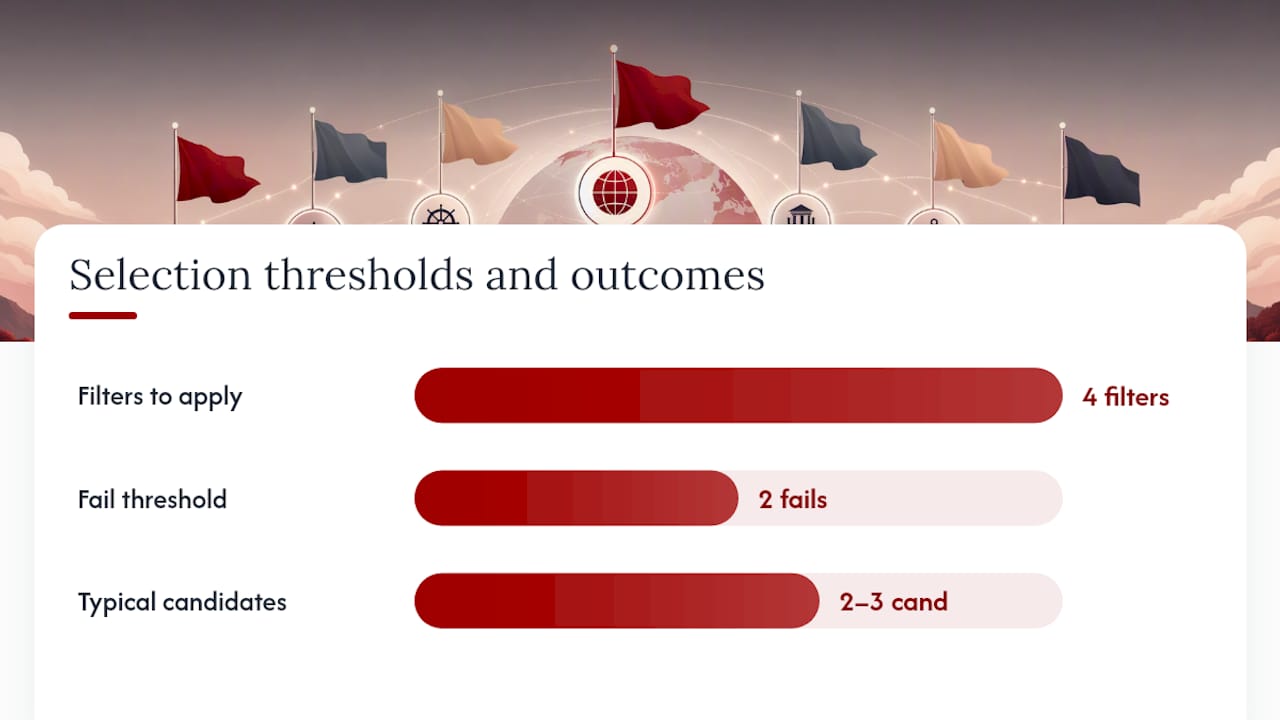
Run your shortlist through four filters:
- Operational profile. Private use, EU commercial charter, or global charter each point toward different registries. Malta, for instance, is commonly chosen for EU-focused commercial charter because of its VAT leasing structures and easy Mediterranean access.
- Registry credibility. Check the flag’s Paris MoU status and ask lenders and insurers directly whether they’ll work with it. Some maintain informal approved-flag lists, and registry performance directly shapes financing terms and premium loading.
- Tax and VAT consequences. Temporary admission rules, VAT leasing schemes, and charter VAT treatment vary widely and interact with wherever your ownership company is domiciled.
- Commercial friction points. Crew nationality quotas, hybrid schemes like the Isle of Man’s Temporary Admission arrangements, and mortgage registration procedures can add weeks to an otherwise straightforward registration.
Profesyonel İpucu: Run each candidate flag against these four filters in a single spreadsheet row. If a registry fails two or more, drop it before you spend legal fees investigating it further.
Most owners land on two or three viable candidates after this exercise, not one obvious winner. That’s normal. The next step is deciding whether the flag and the ownership structure need to live in the same jurisdiction at all.
Flag State vs. Ownership Jurisdiction: Why They’re Separate
The flag state and the ownership jurisdiction answer two completely different questions. The flag governs the vessel’s operation; the ownership structure governs who legally owns it and how tax and liability flow. Owners routinely split the two to get the financing benefits of one jurisdiction and the tax or privacy benefits of another.
A common pairing looks like this: the yacht flies the Cayman flag for its Red Ensign prestige and lender-friendly mortgage regime, while a Jersey or Isle of Man company holds title for tax planning and confidentiality. Neither piece works well alone, but together they cover financing, operations, and ownership cleanly.
Before you finalize either side, align these items across both structures:
- Mortgage recordability in the flag’s registry, matched against the lender’s requirements
- VAT planning for the ownership entity, coordinated with the flag’s charter rules
- Beneficial-owner documentation that satisfies both the flag administrator and the SPV’s home jurisdiction
- Nominee shareholder or director arrangements that don’t conflict with either registry’s disclosure rules
A Jersey or Isle of Man SPV structure, paired with the right flag, generally resolves in weeks rather than months if the paperwork chain is clean from the start.
Why Paris MoU and Port-State Control Performance Matter
Port-state control is the practical filter that separates a paperwork-only flag decision from one that actually holds up at sea.
Paris MoU groups flags into White, Grey, and Black lists based on inspection history, and a White List flag faces meaningfully fewer and less intrusive boardings across European, North Atlantic, and Mediterranean ports. The Paris MoU White List held 40 flag states as of the most recent published ranking, and that standing feeds directly into how lenders and underwriters price risk.
Choosing a flag purely because it’s cheap, while ignoring its Paris MoU standing, is the single most repeated mistake owners make when cruising in these waters. A Grey or Black List flag doesn’t just mean more inspections. It means underwriters price in that risk, and some lenders won’t finance the vessel at all.
Three things worth checking before you register: the flag’s current Paris MoU tier, whether U.S. Coast Guard Qualship recognition applies if you’re moving between U.S. and international waters, and how responsive the registry’s administrator is in an actual emergency, not just on a sales call. A registry that answers calls quickly during a detention or survey dispute is worth more than a marginally lower annual fee.
Modeling Realistic Costs and Timelines for 2026
Registration fees are the smallest number in this equation. The real cost lives in ongoing compliance, and it varies enormously by registry and vessel size.
Industry guides place total annual compliance costs for a 40 to 60 meter yacht in a broad range, commonly cited between $80,000 and $250,000 per year, depending on the flag, class society, and commercial status. That gap is driven mostly by four variables: commercial compliance requirements under the REG Yacht Code or SOLAS if the vessel is chartered, class survey schedules, crew costs tied to MLC standards, and the VAT or charter regime the flag supports.
| Kayıt | Typical Certificate Timeline | Cost Driver to Watch |
|---|---|---|
| Isle of Man Ship Registry | Fast track available for straightforward files | YET/Temporary Admission scheme adds complexity but saves VAT |
| Cayman Islands Shipping Registry (CISR) | Several business days for standard cases | Mortgage registration and lender coordination |
| Malta Gemi Sicili | Days to a few weeks depending on SPV setup | EU VAT leasing structure paperwork |
| Singapore Registry | Weeks, longer for commercial survey coordination | Class survey scheduling for larger tonnage |
| Palau Ship Registry | Days for private, longer for commercial certification | Limited port-state history in some regions |
| San Marino Registry | Days to weeks depending on documentation completeness | Company formation timing |
An SPV formation step or a first-time mortgage registration typically adds one to three weeks to any of these timelines, regardless of flag.
Step-by-Step Workflow for Choosing and Registering a Flag
Treat this as a project with dependencies, not a single form to fill out.
- Define intent first. Decide private use, EU charter, or global commercial charter before anything else, since this decision drives every later step.
- Build a shortlist of two or three flags using the criteria above, checking Paris MoU standing for each.
- Bring in maritime counsel to review tax exposure, VAT treatment, and ownership structure options before you sign a registration application.
- Form the SPV, if one is needed, in the jurisdiction that best supports your tax and financing goals.
- Complete class and technical checks so the vessel meets the flag’s safety and survey requirements.
- Submit registration documents: proof of ownership chain, bill of sale, tonnage certificate, and survey reports.
- Register any mortgage with the flag’s registry if a lender is financing the purchase.
- Set up MMSI and AIS once the registration certificate issues.
Loop in your lender and insurer early, not after you’ve picked a flag. Both can veto a jurisdiction you’ve already spent legal fees investigating, and finding that out at step six instead of step two is an expensive lesson.
Registry Categories and Which One Fits Your Situation
Most flags owners consider fall into a handful of practical groups, and matching your situation to the right group narrows the decision fast.
Prestige Red Ensign registries like Cayman and the Isle of Man suit owners who want lender-friendly mortgage regimes and strong Paris MoU standing without EU-specific VAT complexity. EU operational registries like Malta fit yachts doing regular Mediterranean charter, where VAT leasing structures matter more than global flexibility. Global commercial registries such as the Marshall Islands suit larger commercial vessels needing broad international recognition and bank financing across multiple jurisdictions. Regional and budget-focused registries, including San Marino and Palau, tend to suit private owners prioritizing speed and lower ongoing cost over EU charter access.
| Category | Best Fit | Example Use Case |
|---|---|---|
| Prestige Red Ensign | Financed purchase, private or light charter | Caribbean cruising with a bank mortgage |
| EU operational | Mediterranean commercial charter | Charter yacht based in Southern Europe |
| Global commercial | Larger commercial vessels, cross-border finance | Owner-operator running global charter routes |
| Regional/budget | Private cruising, cost-sensitive owners | Owner who rarely enters EU or U.S. commercial waters |
Your specific route this season should decide the category before you get attached to a particular flag’s name recognition.
Common Mistakes That Cause Expensive Rework
The costliest errors in flag selection almost never show up until months after registration, when it’s hardest to fix.
- Choosing solely for the lowest annual fee, without checking Paris MoU status or lender acceptance.
- Skipping maritime counsel entirely, then discovering the ownership structure doesn’t support the intended VAT treatment.
- Mismatching ownership jurisdiction and flag, which can trigger VAT reassessments on a yacht you thought was properly structured.
- Ignoring crew nationality rules that later block a hire you’d already promised a role.
- Registering before confirming financing terms, then finding the lender won’t accept the flag at all.
The real cost of the wrong flag rarely shows up in the registration invoice. It shows up eighteen months later as a lender refusal, a detention in a foreign port, or an insurer’s non-renewal letter.
Profesyonel İpucu: If a registry’s sales pitch leads with “lowest fees” before asking about your cruising grounds or financing plans, that’s the tell. A registry confident in its Paris MoU standing leads with that instead.
A Registration Specialist’s View on Where Owners Get Tripped Up
Most flag mistakes trace back to sequencing, not ignorance. Owners often pick a flag and only bring in legal counsel afterward, when the SPV structure and the flag’s requirements no longer line up cleanly. Untangling that after the fact costs more in legal fees than getting it right the first time would have cost in advance.
One recurring pattern: an owner registers privately under a low-cost flag, then decides mid-season to accept a few charter bookings. The flag doesn’t support commercial charter certification, the insurer won’t cover chartered guests under the existing policy, and the fix means re-flagging mid-ownership, which is slower and more expensive than doing it right from the start. The lesson isn’t complicated. Decide your operational intent honestly before you register, even if charter is only a maybe for next year.
Getting the SPV and flag structured correctly from day one is rarely about finding a clever loophole. It’s about sequencing decisions so lender, insurer, and flag administrator requirements all point the same direction before you sign anything.
How VesselFlag Handles the Registration Once You’ve Chosen
Once you’ve settled on a flag and structure, the execution work is where most owners lose time: paperwork chains, SPV formation, MMSI and AIS setup, and coordinating with insurers who need proof of registration before binding coverage. VesselFlag handles that execution across every registry discussed here, from Cayman and Isle of Man to Malta, Palau, and San Marino, with fixed-fee packages instead of open-ended hourly legal billing.
That means you get a quoted price and timeline upfront, not a surprise invoice three months into the process. VesselFlag also coordinates the ancillary pieces, including insurance introductions and ownership company setup, so you’re not managing four separate vendors for one registration. If you’ve already narrowed your shortlist using the checklist above, the next step is straightforward: start your yat kaydi with VesselFlag and get a real timeline instead of a guess.
Kaynaklar
- How to choose the best flag state for your superyacht – IQ-EQ
- Best Flag State for a Yacht: A Complete Guide for 2026 | YachtWay Knowledge Center
- Yacht Flag State: Cayman, Malta, Marshall Islands Compared
- Yacht: Flag, VAT, Charter and Crew — wiki private.law
- Superyacht Registration Jurisdictions: Choosing the Right Flag – Asteria Advisory
Check each registry’s own administrator page for 2026 updates before finalizing, since fee schedules and VAT rules shift year to year.
This article is general information, not a substitute for advice from a qualified financial advisor. Consult a qualified financial professional about your own circumstances before acting on anything here.
SSS
What Is a Flag State for a Yacht?
A flag state is the country whose laws govern your yacht’s safety regime, crew rules, mortgage recognition, and customs status, regardless of where the owner lives.
Which Flag Is Best for Mediterranean Charter?
Malta is commonly chosen for EU commercial charter because its VAT leasing structure and Paris MoU White List standing ease Mediterranean operations.
How Much Does Flag Compliance Cost per Year?
Total annual compliance for a 40 to 60 meter yacht commonly falls between $80,000 and $250,000, depending on the flag, class requirements, and charter status.
Can I Register the Yacht Under One Flag and Own It Through a Different Jurisdiction?
Yes. Owners routinely flag the vessel in one jurisdiction, such as Cayman, while holding title through an SPV in another for tax and financing reasons.
How Do I Start the Registration Process?
Confirm your Paris MoU shortlist, consult maritime counsel on structure, then work with a specialist like Gemi Bayrağı to handle documentation and filing.

[…] Choosing the Right Flag State for Your Yacht in 2026 […]