

Gross tonnage is a unitless index of a ship’s internal volume, calculated for regulatory purposes. Displacement is the vessel’s actual weight, expressed as the weight of water it pushes aside, and it changes with how the vessel is loaded. Confusing the two leads owners and buyers to misread a vessel’s size, its fees, or its stability, so the distinction is worth getting right from the start.
Özetle:
- Gross tonnage remains constant once certified, while displacement varies with loading, draft, and water density, affecting stability and cargo planning.
- GT measures internal volume with no weight or length units, whereas displacement reflects the vessel’s actual weight at specific loading conditions.
- You cannot reliably convert GT to displacement because they answer different questions and are influenced by hull design and loading status.
- Port authorities and registries rely on GT for legal and fee calculations, while naval architects depend on displacement for stability and operational safety.
- Always verify tonnage figures with official certificates and documents before registration, especially to avoid discrepancies from outdated or incorrectly carried-over data.
İçindekiler
- What gross tonnage is and how it’s calculated
- How displacement is measured and why it changes
- Why you can’t convert GT to displacement
- When regulators, buyers, and engineers rely on each metric
- Where to find official GT and displacement figures
- Why accurate tonnage matters during registration
- Getting your tonnage documents verified before you register
- SSS
- Kaynaklar
What gross tonnage is and how it’s calculated
Gross tonnage (GT) measures the moulded volume of a ship’s enclosed spaces, calculated under the International Convention on Tonnage Measurement of Ships, known as ITC-69. The formula is GT = K1V, where V is the total enclosed volume in cubic meters and K1 is a multiplier that depends on log10(V), as set out in the UK’s tonnage regulations. Because K1 scales with the logarithm of volume rather than a fixed ratio, GT does not rise in a straight line with size.
GT carries no unit of weight or length. Historically, one gross ton equaled 100 cubic feet of enclosed space under the older register tonnage system, a convention the HMRC tonnage manual still references when explaining how figures like “100 gross tons” originated. Modern GT abandoned that fixed unit entirely, which is why it reads as a plain number with no “tonnes” or “cubic meters” attached.
Authorities use GT for:
- Setting manning levels and safety equipment requirements
- Calculating port dues and registration fees
- Determining which safety conventions apply to a given vessel
- Establishing legal size thresholds for licensing and flag registration
How displacement is measured and why it changes
Displacement describes how much water a floating vessel pushes out of the way, and it comes in two related forms. Displacement volume is measured in cubic meters, while displacement tonnage converts that volume into the weight of the displaced water, expressed in metric tonnes. According to Gard’s guidance on tonnage measurement, that weight equals the vessel’s actual weight at the specific loading condition being measured, which is why a single ship can report several different displacement figures depending on when it was weighed.
Common displacement variants include:
- Lightship displacement: the empty vessel, with no fuel, stores, or cargo
- Loaded displacement: the vessel carrying its normal operating weight
- Full-load or summer load line displacement: the maximum weight permitted under the applicable load line
Draft, water density, and onboard weight all move the number; understanding these factors is crucial in boat characteristics and capacity for stability and planning. A vessel sitting deeper in fresh water than in salt water, for instance, displaces a different volume for the same weight, which is why hydrostatic calculations always specify the conditions behind a figure.
Profesyonel İpucu: Always ask which loading condition a displacement figure reflects before comparing it to another vessel’s numbers.
Displacement figures live in a vessel’s stability booklet and hydrostatic tables, not on a tonnage certificate.
Why you can’t convert GT to displacement
GT and displacement answer different physical questions, and no formula reliably turns one into the other. The reasons line up clearly:
- GT measures enclosed volume; displacement measures weight, and volume does not translate directly into weight without knowing hull form and construction.
- GT stays fixed once a vessel is built and certified; displacement shifts every time fuel, cargo, or passengers come aboard.
- Two vessels with similar hull dimensions can carry very different outfitting, engines, or tankage, producing different displacement despite matching GT.
- Older vessels may carry gross register tonnage (GRT) figures from the pre-1982 system, which used a different measurement basis than modern GT, as the IMO’s ITC-69 overview notes; mixing the two regimes compounds the confusion.
Picture two 20-meter yachts with nearly identical GT figures on paper. One has a lightweight composite hull and minimal fit-out; the other carries a heavier steel hull, extra fuel tankage, and a fully equipped interior. Their GT numbers might sit within a point or two of each other, but their displacement could differ by several tonnes. That gap is exactly why brokers and surveyors keep the two figures separate.
When regulators, buyers, and engineers rely on each metric
GT drives the paperwork side of ship operation. Port authorities, flag registries, and tax offices use it to calculate dues, set manning requirements, and apply safety thresholds, because it gives them a standardized number that does not change with how a vessel happens to be loaded on a given day.
Displacement drives the physical side. Naval architects and ship officers use it for:
- Checking stability margins and metacentric height before a voyage
- Managing draft to clear ports, canals, or shallow anchorages
- Planning fuel, water, and cargo loads against the vessel’s safe weight limits
- Validating hydrostatic calculations against observed performance
Registrars and port officials care most about GT because it feeds directly into fees and legal classification. Naval architects, surveyors, and ship’s officers care most about displacement because it governs how the vessel actually behaves in the water.
Where to find official GT and displacement figures
GT and net tonnage (NT) appear on the International Tonnage Certificate, issued under ITC-69 and carried aboard every vessel subject to the convention. The IMO notes that NT cannot legally fall below 30% of GT, a ratio worth checking when reviewing a certificate for consistency.
Displacement figures come from a different source entirely: the approved stability booklet and hydrostatic curves prepared for the specific hull. UK hydrostatic guidance shows how surveyors compare observed displacement against calculated figures to derive stability parameters like GM and KG, a check that only works when the underlying documents are current and vessel-specific.
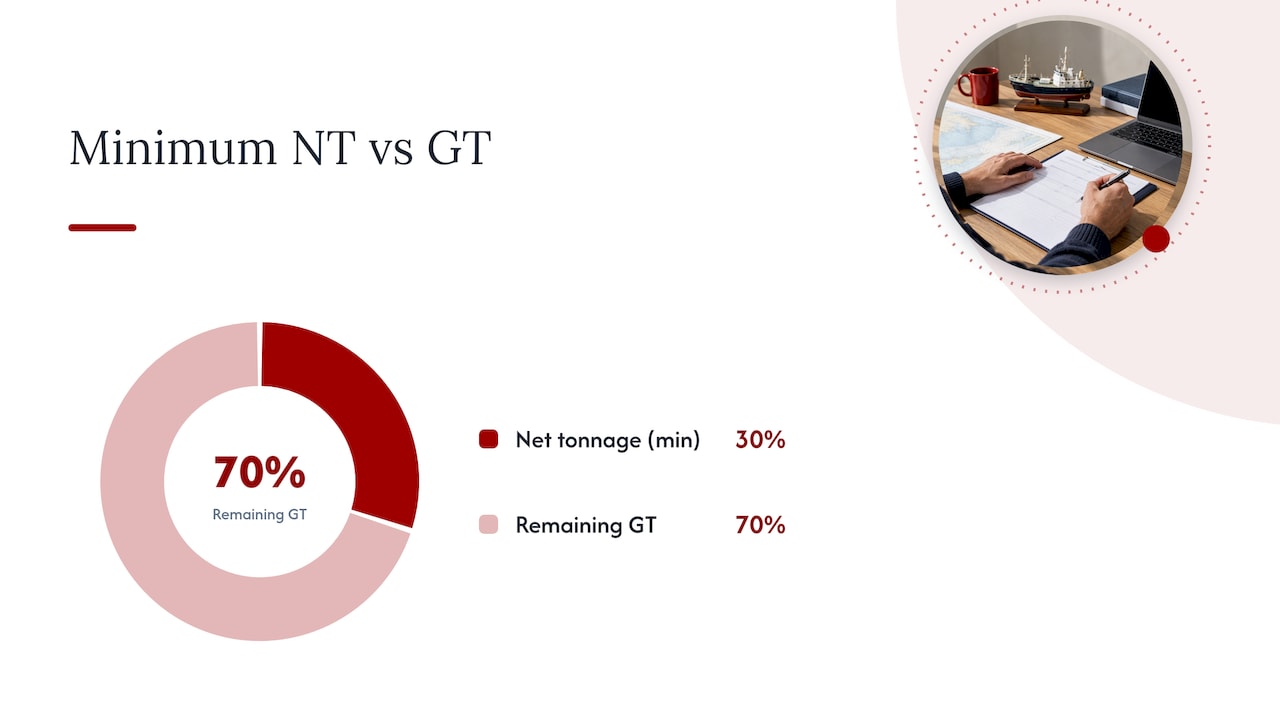
A vessel’s net tonnage can never legally be less than 30% of its gross tonnage under ITC-69, a ratio that offers a quick sanity check when reviewing a certificate.
Before relying on either number, request:
- The International Tonnage Certificate for GT and NT
- The approved stability booklet or hydrostatic curves for displacement
- A recent loading condition report if displacement needs to reflect current operating weight
Our guide to maritime documents and their uses walks through what each certificate covers in more detail.
Why accurate tonnage matters during registration
Checking tonnage figures against official certificates is a routine part of preparing a vessel for flag registration. Mismatched numbers show up more often than owners expect, usually because an old GRT figure from a previous registry got carried forward instead of the current GT value, or because a stability document predates a refit that changed the vessel’s weight distribution. Resolving it means going back to the original tonnage certificate and current hydrostatics rather than estimating. When in doubt, lean on official paperwork and a professional set of eyes before submitting anything to a registry.
— VesselFlag
Getting your tonnage documents verified before you register
Sorting out which certificate shows GT and which booklet shows displacement takes time most owners and brokers would rather spend elsewhere. Our service checks tonnage figures and supporting documentation as part of vessel registration to help ensure the numbers submitted to a registry match the certificates provided.

The service covers:
- Verifying tonnage certificates and hydrostatic documentation before submission
- Handling registration paperwork across multiple flag jurisdictions
- Arranging MMSI licensing and related compliance steps alongside registration
If your next step is registering a vessel, start with our San Marino yat tescili page to see timelines and documentation requirements.
SSS
How big of a boat is 100 gross tons?
“100 gross tons” refers to a volume-based threshold rather than a weight, and under the historical register tonnage system one gross ton equaled 100 cubic feet of enclosed space, according to HMRC’s tonnage manual. Modern gross tonnage uses the unitless ITC-69 formula instead, so a boat described this way should be checked against its actual tonnage certificate rather than assumed to weigh 100 tonnes.
What is the difference between GRT and GT?
GRT, or gross register tonnage, was the older measurement system based on register tons of 100 cubic feet each. GT replaced it under the 1969 tonnage convention, applying to new ships from 1982 and fully replacing GRT for existing vessels by 1994, using the unitless GT = K1V formula instead of a fixed unit conversion.
What is the difference between DWT and displacement?
Deadweight tonnage (DWT) measures the maximum weight a vessel can carry, including cargo, fuel, and stores, while displacement measures the vessel’s total weight at a given moment, including the ship itself. Displacement equals lightship weight plus whatever is currently loaded, so it always sits above DWT alone and shifts with each voyage’s loading condition, as Gard’s tonnage guidance explains.
What is GRT, NRT, and DWT of ship?
GRT (gross register tonnage) and NRT (net register tonnage) are older volume-based measurements from the pre-1969 system, largely superseded by modern GT and NT. DWT (deadweight tonnage) is a separate weight-based figure showing how much cargo, fuel, and stores a vessel can carry at its maximum draft, distinct from both tonnage indexes and from displacement itself.
Kaynaklar
- Merchant Shipping (Tonnage) Regulations 1997 – data.xht
- Tonnage measurement of ships | Gard
- International Convention on Tonnage Measurement of Ships (ITC-69) – IMO
- HMRC internal manual: Tonnage tax – TTM15020
- UK Hydrostatic guidance (excerpts)

[…] breakdown of gross tonnage versus displacement walks through why owners sometimes confuse the two when budgeting for registration […]