

Resumo:
- IMO’s 2026 guidelines demand higher transparency and due diligence in vessel registration.
- Yacht owners must prepare complete ownership documents and use recognized flags to ensure compliance.
- Rushed or incomplete registration now risks delays, increased scrutiny, and potential rejection.
Vessel registration has never been a mere formality, but in 2026 it carries more weight than ever. The IMO’s first international guidelines on ship registration, approved in April 2026, signal a fundamental shift in how registries worldwide must operate. False flag cases, shadow fleets, and fraudulent documentation have pushed regulators to act. For yacht owners and operators, this means the window for quick, low-scrutiny registrations is closing fast. Understanding exactly what is changing and why gives you a real compliance advantage going into the rest of the year.
Índice
- How global vessel registration is evolving in 2026
- Key vessel registration trends impacting yacht owners in 2026
- New compliance requirements and anti-fraud measures
- How to optimize your vessel registration: Strategies for efficiency
- A fresh perspective on registration trends: What most guides won’t tell you
- Simplify yacht and vessel registration in 2026 with expert support
- Perguntas frequentes
Principais conclusões
| Ponto | Detalhes |
|---|---|
| Global oversight is increasing | New IMO guidelines make vessel registration stricter to prevent fraud in 2026. |
| Due diligence is essential | Yacht owners must adapt to enhanced compliance and paperwork requirements this year. |
| Flag choice impacts compliance | Selecting reputable flags and understanding their requirements is crucial for efficient registration. |
| Efficient registration is possible | Using current checklists and strategies can help navigate the 2026 changes with minimal delays. |
How global vessel registration is evolving in 2026
The world’s commercial fleet is enormous. As of early 2025, the global merchant fleet stood at roughly 112,500 ships with a combined 2.44 billion deadweight tonnes. Panama leads in ship numbers at 15.2% of the global count, while Liberia commands 17.4% of total tonnage. These figures set the scale for why vessel registration policy matters so much at the international level.
Yacht owners operate in a related but distinct space. Still, the regulatory forces shaping commercial shipping directly influence the flags, procedures, and paperwork you face. The registration requirements in 2026 have shifted because of three converging pressures:
- Transparency demands: Registries are now expected to verify beneficial ownership more thoroughly.
- Shadow fleet scrutiny: Vessels evading sanctions by operating under false or borrowed flags have drawn intense international attention.
- Digital enforcement: Port state control inspections increasingly cross-reference registry databases in real time.
The IMO guidelines announcement directly targets these problems. While the guidelines are non-binding at this stage, they represent a clear direction of travel. Registries that want to maintain credibility with port states and insurers are already updating their due diligence procedures.
“The emergence of shadow fleets and the misuse of flags of convenience have created an urgent need for internationally agreed standards. These guidelines are a first but important step.” — IMO Secretary-General
For yacht owners tracking yacht registration trends 2026, the message is simple: the era of rubber-stamp registrations is over. Choosing a reputable flag and submitting complete documentation is no longer just best practice. It is rapidly becoming a baseline requirement for operating without disruption.
| Bandeira | Share of global tonnage | Share of ship numbers |
|---|---|---|
| Libéria | 17.4% | ~11% |
| Panamá | ~13% | 15.2% |
| Ilhas Marshall | ~11% | ~8% |
| China | ~9% | ~7% |
The shift toward transparency is permanent. Registries that cut corners are losing standing with insurers, port authorities, and charterers. That is a chain reaction that reaches all the way down to private yacht operators.
Key vessel registration trends impacting yacht owners in 2026
With the global picture clear, here is what matters most for yacht owners this year. Five trends define the 2026 registration landscape.
1. Stricter beneficial ownership disclosure. Registries now require documented proof of who ultimately owns a vessel, not just who holds it on paper. Corporate structures must be transparent.
2. Faster rejection of incomplete applications. Where a registry might have once sent follow-up requests, many now simply reject incomplete filings. First submissions must be correct.
3. Policy-driven fleet growth. India’s experience proves that strong government incentives work. India added 92 vessels totaling 1.58 million gross tonnes to its registry in FY26, bringing its total fleet to 14.2 million GT. That kind of growth, driven by targeted policy, shows how quickly flag states can attract tonnage when conditions are right.
4. Tightening rules on flag fraud. Tightening registration rules are pushing registries to cross-check vessel histories, previous flags, and past detentions before approving new registrations.

5. Digital document verification. Paper-based records are being replaced by digital verification portals. Expect registries to request electronically certified documents rather than scanned copies.
Pro Tip: Start gathering your beneficial ownership documentation before you begin a registration application. Delays almost always come from incomplete ownership records, not from the registry’s processing time.
| Trend | Impact on yacht owners | Urgency level |
|---|---|---|
| Ownership disclosure | More paperwork upfront | High |
| Application rejection | Zero tolerance for gaps | High |
| Digital verification | Certified e-documents needed | Medium |
| Flag fraud crackdown | Registry due diligence checks | High |
| Policy-driven growth | More flag options emerge | Low to medium |
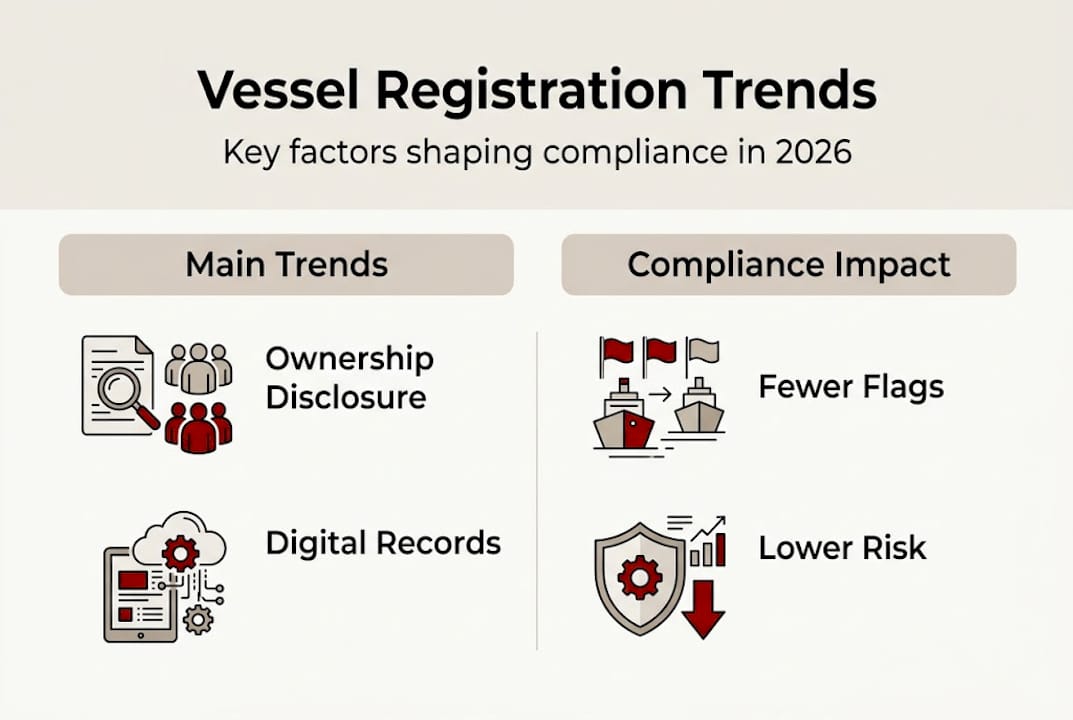
Reviewing commercial vessel registration steps now will help you understand which of these trends applies directly to your vessel type. And checking the latest yacht compliance requirements gives you a concrete list to work from before you file.
New compliance requirements and anti-fraud measures
The April 2026 IMO guidelines did not arrive in a vacuum. Over the past year alone, 529 false flag cases were reported globally. That number shocked many in the maritime industry. It explains why the guidelines focus so heavily on due diligence rather than just paperwork formatting.
For yacht operators, compliance in 2026 means completing a more detailed process than in previous years. Here is a practical numbered checklist:
- Verify your chosen registry’s standing. Check that it appears on recognized white lists and is not currently under investigation or suspension.
- Prepare full beneficial ownership documents. Include corporate certificates, shareholder registers, and government-issued ID for ultimate beneficial owners.
- Gather your vessel’s complete history. Previous registration certificates, bill of sale, and any prior flag state deletion certificates are now standard requests.
- Confirm your MMSI and AIS details are current. Registries increasingly cross-check these against vessel tracking databases.
- Submit electronically certified documents. Scanned images are often no longer acceptable for primary documents.
- Allow extra time in your schedule. Even compliant applications may face longer review periods as registries upgrade their internal verification systems.
“Due diligence is not a bureaucratic obstacle. It is the mechanism that protects legitimate operators from being caught in the same net as fraudulent ones.”
Pro Tip: Review the exact registration timelines for your target flag before committing. Some registries have extended their processing windows specifically to accommodate the new due diligence steps.
Using a detailed lista de verificação para o registo tailored to 2026 requirements reduces the chance of a rejection at first submission. It also protects you from accidentally providing documentation that conflicts with your vessel’s history, which is one of the fastest triggers for a fraud flag.
How to optimize your vessel registration: Strategies for efficiency
Knowing the compliance landscape is only useful if you can act on it. Here are the core strategies for registering efficiently in 2026.
Choose a reputable, recognized flag. The global fleet data confirms that Liberia at 17.4% of global tonnage and Panama at 15.2% of ship numbers remain the dominant choices for a reason. Both operate mature, well-staffed registries with established international standing. For yacht-specific registrations, flags like Malta, Poland, UK Part 1, and Palau offer strong compliance reputations combined with reasonable processing times.
Front-load your documentation effort. The biggest efficiency gain comes from doing the hard work before you submit. Owners who prepare complete files before approaching a registry consistently experience faster turnarounds.
Use a specialist registration service. In a more regulated environment, navigating the vessel registration process without expert support adds unnecessary risk. Specialists know which registries are tightening their intake processes and can help you avoid common documentation errors.
Monitor your registration status actively. Once registered, set calendar reminders for renewal dates. A lapsed registration in 2026 draws far more scrutiny than it would have in previous years because port state control officers are actively flagging vessels with expired certificates.
| Strategy | Time saved | Risk reduced |
|---|---|---|
| Complete documentation upfront | 2 a 4 semanas | High |
| Choosing reputable flag | Varies | Muito elevado |
| Using specialist service | 1 to 3 weeks | High |
| Active renewal monitoring | N/A | Medium to high |
Following registration best practices also means staying current with flag state circulars, since many registries are issuing guidance updates mid-year as the IMO guidelines are interpreted and applied.
A fresh perspective on registration trends: What most guides won’t tell you
Most guides on vessel registration trends focus on speed. Get registered fast, choose the most efficient flag, minimize paperwork. That advice made sense in a low-scrutiny environment. In 2026, it is actually the riskiest approach you can take.
Here is the uncomfortable reality: shortcuts that worked two years ago now leave a paper trail that port state inspectors and insurers actively look for. A registration that appears rushed or incomplete triggers secondary checks. Those checks cost far more time than the thoroughness you skipped upfront.
The yacht owners who will navigate 2026 most successfully are those who treat compliance as a long-term asset, not a one-time hurdle. A clean registration history, complete ownership documentation, and a recognized flag state make your vessel more insurable, more charterable, and easier to sell. Our efficient international flags guide walks through exactly which flags deliver that combination of speed and credibility without compromise.
Transparency costs more time now. It pays back far more later.
Simplify yacht and vessel registration in 2026 with expert support
Navigating 2026’s tighter compliance landscape is significantly easier with the right partner in your corner. VesselFlag.com offers end-to-end support for registo do seu iate under a range of internationally recognized flags, with full guidance on documentation, beneficial ownership disclosure, and digital verification requirements.
Whether you need to confirm registration validity for compliance or you are trying to understand the difference between yacht versus boat registration for your specific vessel type, our team can cut through the complexity. We stay current with registry updates so you do not have to, and we make sure your first submission is your final one.
Perguntas frequentes
What are the biggest regulatory changes in vessel registration for 2026?
The most significant changes are the IMO’s new guidelines requiring stricter due diligence and transparency to combat flag fraud, approved in April 2026.
How do the new IMO guidelines impact yacht registration speed?
Tighter due diligence may cause minor delays, but the new registration rules increase legitimacy and long-term compliance standing for registered yachts operating internationally.
Which flags are most popular for vessel registration in 2026?
Liberia and Panama continue as top choices, with Liberia holding 17.4% of global tonnage and Panama accounting for 15.2% of ship numbers according to the latest fleet data.
What practical steps should yacht owners take to avoid registration fraud?
Owners should verify registry legitimacy against recognized white lists, follow updated compliance documentation standards, and submit complete beneficial ownership records accurately on the first application.
Recomendado
- Vessel Registration Timelines: Fast-Track Compliance Worldwide
- Efficient vessel registration requirements in 2026
- Explicação do processo de registo de embarcações: guia global 2026
- 2026 yacht registration trends: key compliance insights
- Customs compliance best practices: stay penalty-free in 2026 – Worldwide Express, Inc.