

Resumo:
- Vessel registration timelines vary from one day to over six months, depending on the flag and documentation.
- Most delays are caused by incomplete paperwork or survey requirements, not government slowdowns.
- Choosing the right flag and working with specialized agents can cut registration time significantly.
Vessel registration has a reputation for being slow, bureaucratic, and unpredictable. That reputation is only partly deserved. The truth is that timelines vary dramatically, ranging from a single day to well over six months, depending entirely on which flag state you choose and how prepared you are. Some owners wait weeks unnecessarily because they picked the wrong registry or submitted incomplete paperwork. Others are legally operating under a provisional certificate within 48 hours of applying. This guide breaks down exactly how registration works, which flags move fastest, what quietly causes delays, and the practical steps that actually shorten your timeline.
Índice
- How vessel registration timelines really work
- Country-by-country: Registration timelines at a glance
- Hidden factors that slow down vessel registration
- Strategies to fast-track your vessel registration
- The uncomfortable truth: Why most delays are avoidable
- Get expert help with fast, compliant vessel registration
- Perguntas frequentes
Principais conclusões
| Ponto | Detalhes |
|---|---|
| Timeline varies by country | Flag states range from under a day to months for full registration, so choose based on your needs. |
| Provisional certificates speed things up | Most registries issue provisional certificates fast, letting you operate while awaiting permanent approval. |
| Delays are often preventable | Incomplete documents or missed surveys are the main causes of long waits, not always the authorities. |
| Agents save significant time | A professional agent can cut 60 percent off the average registration timeline. |
| Plan for a buffer | You should budget 4-8 weeks after purchase for smooth, compliant vessel registration. |
How vessel registration timelines really work
Understanding why registration takes as long as it does starts with knowing the actual sequence of steps involved. There is no single global standard. Each flag state runs its own process, but most follow a recognizable pattern.
Here is the typical sequence:
- Application submission — You submit your vessel details, ownership documents, and any corporate paperwork if applicable.
- Document verification — The registry reviews everything for completeness and accuracy. This is where most delays begin.
- Vessel survey (if required) — Not every flag mandates a survey, but larger or older vessels often trigger one. Surveyors need scheduling, which adds time.
- Provisional certificate issued — Once basic eligibility is confirmed, many registries issue a provisional certificate.
- Permanent certificate issued — After all checks clear and any outstanding items are resolved, the permanent document follows.
The provisional certificate can arrive in 1 to 14 days, which is critical because it lets you operate your vessel legally while the full process completes. You are not stuck at the dock waiting.
The biggest bottleneck is almost always documentation. A missing bill of sale, an unsigned form, or an incorrect vessel measurement can send the application back to square one. Vessel surveys are the second most common source of delay, particularly for yachts over 24 meters.
One of the smartest moves you can make is working with a specialized registration agent. Using a qualified agent typically reduces your total timeline by around 60 percent. Agents know exactly what each registry wants, catch document issues before submission, and often have direct channels to flag state administrators.
Pro Tip: Before you submit anything, review the crucial registration requirements for your chosen flag state. Catching one missing item before submission saves far more time than correcting it after.
A solid lista de verificação para o registo tailored to your specific flag is worth more than any shortcut. Preparation is the actual fast track.
Country-by-country: Registration timelines at a glance
Not all registries are created equal. The flag you choose shapes your timeline more than almost any other factor. Here is a direct comparison of major flag states and what you can realistically expect.
| Flag State | Provisional Timeline | Permanent Timeline |
|---|---|---|
| Ilhas Marshall | 1 a 3 dias | 2 a 4 semanas |
| Panamá | 1 to 2 days | Up to 2 years |
| St. Kitts & Nevis | Under 24 hours | 2 a 4 semanas |
| Ilhas Caimão | 3 a 5 dias | 3 a 6 semanas |
| Malta | 1 a 2 semanas | Até 6 meses |
The fastest provisional option on the market right now is St. Kitts & Nevis, completing in 24 hours under the right conditions. For owners who need to move a vessel immediately after purchase, that speed is invaluable.
Marshall Islands provisional registration arrives in 1 to 3 days, with the permanent certificate following in 2 to 4 weeks. That combination of speed and reasonable permanent timelines makes it one of the most popular choices for international yacht owners.
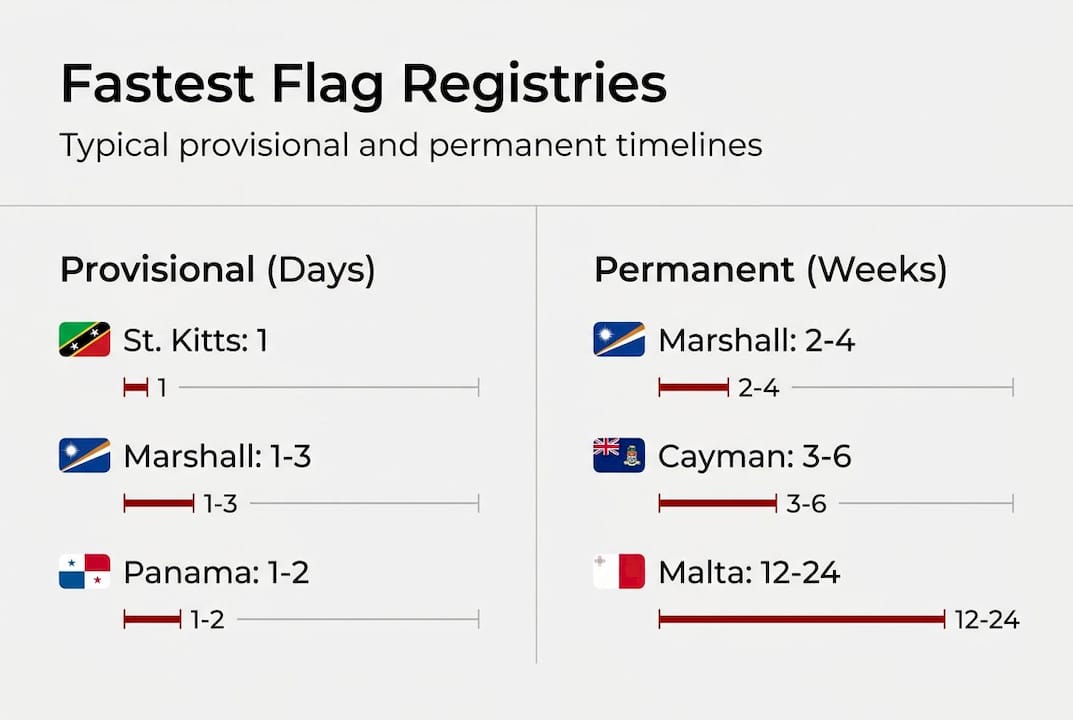
Panama provisional registration is possible in 1 to 2 days, but the permanent certificate can take up to 2 years after full document submission. That is not a flaw so much as a structural feature of the Panamanian system. Many operators simply continue under the provisional while waiting.
Cayman Islands provisional arrives in 3 to 5 days, with permanent certificates in 3 to 6 weeks. It is a strong choice for owners who want a well-respected flag with reasonable timelines.
Malta permanent registration can stretch to 6 months. That sounds daunting, but Malta offers something the faster flags do not: full EU flag status, which opens ports and commercial opportunities across Europe. Speed and EU access rarely coexist.
For a full breakdown of how these flags compare across all variables, the global registration timeline guide e o step-by-step global process walk through each option in detail. If you are specifically weighing speed against compliance benefits, Marshall Islands details e Malta registration cover both ends of the spectrum thoroughly.
Hidden factors that slow down vessel registration
Even experienced owners get caught off guard by delays they did not anticipate. The obvious causes are well-known. The hidden ones are where timelines quietly collapse.

Vessel size matters more than people expect. Yachts over 24 meters almost always trigger mandatory surveys, and larger yacht surveys add weeks to the process. Surveyors must be scheduled, travel to the vessel, complete their inspection, and submit their report before the registry can proceed. In remote cruising locations, that alone can add two to four weeks.
Common hidden delay triggers:
- Ownership documents that reference a company name different from current records
- Vessel measurements that do not match the builder’s certificate
- Missing deletion certificate from a previous flag state
- Incorrect or expired seafarer documentation for the owner
- Country-specific compliance requirements that were not researched in advance
Malta is a useful example here. As an EU flag, it requires stricter compliance documentation than most open registries. Owners expecting a quick process often underestimate the due diligence requirements and lose weeks correcting them.
One important reality about timelines: no official registry publishes exact processing times. The numbers circulating in the industry come from consistent reporting by agents and operators who track actual outcomes. This means your experience can vary from the benchmark, especially if your application hits during a busy period or a staff shortage at the registry.
“Treat published timelines as best-case scenarios. Build your schedule around realistic estimates, not the fastest outcome someone else experienced.”
Pro Tip: Use the compliance delays checklist before submission to identify flag-specific requirements you may have overlooked. Also factor in the cost of registration delays, which goes beyond inconvenience when a vessel cannot operate commercially. For a broader look at what trips owners up, registration and compliance challenges covers the most common patterns.
Strategies to fast-track your vessel registration
Knowing what causes delays is useful. Knowing how to prevent them is what actually moves the process forward.
Here is a practical sequence that consistently produces the fastest outcomes:
- Choose your flag state before you close on the vessel. The flag decision affects what documents you need at purchase. Making that choice late creates unnecessary scramble.
- Hire a specialized registration agent. As noted earlier, agents cut timelines by roughly 60 percent. They know what each registry actually wants versus what the checklist says, and they catch issues before submission.
- Build in a 4 to 8 week buffer post-purchase. Even the fastest registries can hit unexpected delays. A 4 to 8 week buffer after closing gives you room to absorb the unexpected without disrupting operations or charters.
- Pre-arrange any required survey. If your vessel is likely to need one, contact a certified surveyor before you apply. Waiting until after you submit the application adds weeks.
- Stay responsive. Registry queries move fast when the owner is available. Going silent for a few days when the registry has a question can stall the entire process.
On flag selection: fast flags like Marshall Islands, Panama, and St. Kitts are ideal when speed and operational flexibility are the priority. EU flags like Malta make more sense when your cruising area centers on European waters and you need the commercial credibility that comes with EU registration.
For a full walkthrough of the process from start to finish, step-by-step international registration covers individual owners specifically. Commercial operators should also review the commercial vessel registration guide, which addresses the additional compliance layers involved.
The uncomfortable truth: Why most delays are avoidable
After working through hundreds of vessel registration cases, one pattern becomes impossible to ignore: the vast majority of timeline complaints have nothing to do with government bureaucracy. They trace back directly to the owner.
Missing documents are the number one cause. Not government slowness. Not registry backlogs. Owners who submit incomplete applications and then blame the flag state for their delay. It is a frustrating cycle because the fix is entirely within the owner’s control.
The second biggest factor is agent selection. Owners who use generalist brokers or handle registration themselves almost always take longer than those working with specialists. The difference is not marginal. It is measured in weeks.
Conventional wisdom says to choose your flag based on tax benefits or prestige. We say: choose based on your readiness level and operational needs first. A prestigious flag you cannot navigate efficiently costs you more than a simpler one processed quickly.
The fast-track registration checklist is the single most practical tool for collapsing your timeline. Spend an extra hour on preparation upfront, and you will save weeks later. The owners who complain about slow registration are almost always the ones who skipped that step.
Get expert help with fast, compliant vessel registration
Navigating flag states, document requirements, and shifting timelines is exactly what VesselFlag.com was built to handle. Whether you are registering a private yacht or a commercial vessel, having the right support makes the difference between a smooth process and a costly stall.
Start by clarifying what you actually need. Are you choosing between a fast open registry and a compliant EU flag? Not sure whether your vessel qualifies as a yacht or a commercial boat? The yacht vs boat registration page clears that up immediately. For owners ready to move forward, the complete yacht registration guide walks through every decision point, and our flag registration services connect you directly with the flag state expertise you need to get it done right and fast.
Perguntas frequentes
How fast can you get a provisional vessel registration?
Many flag states issue provisional certificates within 1 to 14 days when documents are complete. St. Kitts & Nevis completes in 24 hours, and Marshall Islands provisional arrives in 1 to 3 days under normal conditions.
What causes most registration delays?
Incomplete documentation is the primary cause, followed by required vessel surveys for larger yachts and overlooked country-specific requirements that vary by flag state.
Posso utilizar o meu iate enquanto aguardo o registo definitivo?
Yes. A provisional certificate grants legal operating authority while the permanent paperwork is processed, so you are not sidelined during the wait. Provisional certificates allow legal operation from day one of issuance.
Which flags are best for fast registration?
Marshall Islands, Panama, and St. Kitts & Nevis consistently offer the fastest processing. Fast flags like Marshall, Panama, and St. Kitts prioritize efficiency over complex compliance layers.
How much time should I plan after buying a boat?
Allow 4 to 8 weeks after purchase as a realistic buffer. A 4 to 8 week post-purchase window accounts for survey scheduling, document corrections, and registry processing cycles.

[…] Vessel Registration Timelines: Fast-Track Compliance Worldwide […]