
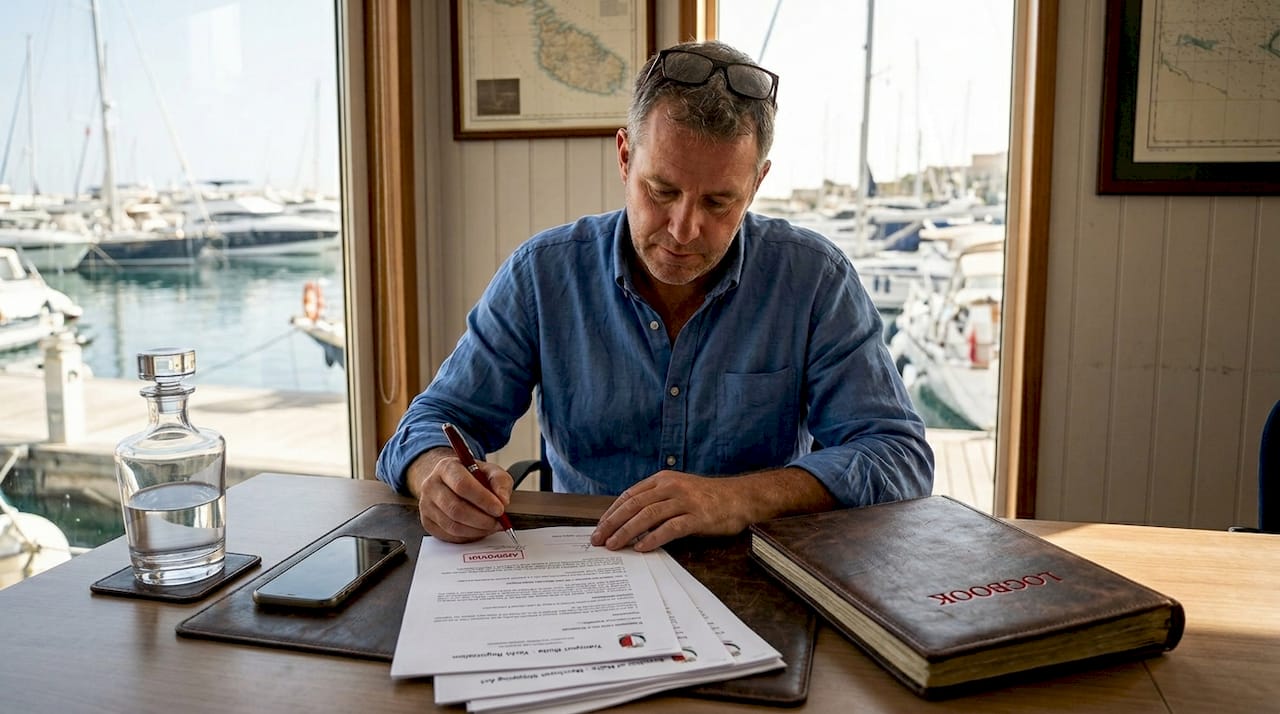
Ready to register under the Malta flag? Vessel Flag handles everything – private yachts from €849, commercial from €2,500, provisional certificate in 2–3 days. See Malta yacht registration prices and requirements →
Kurz gesagt:
- Malta’s registry has attracted nearly 600 superyachts, offering EU credibility, tax predictability, and global port acceptance. Its strategic advantages benefit owners with high-value vessels, commercial operations, and EU-focused cruising, supported by a competitive tonnage tax regime and extensive tax treaties. However, Malta involves more bureaucracy and costs than simpler offshore options, making it ideal for sophisticated, high-value, and EU-oriented owners but less suitable for those seeking speed or minimal administration.
Nearly 600 superyachts have registered under the Maltese flag, generating an estimated €171.5 million in VAT over the past decade. That number surprises many owners and brokers who assume Malta’s registry is reserved for mega-yachts or the ultra-wealthy. The truth is far more practical: Malta offers a combination of EU legitimacy, tax predictability, and global port acceptance that serves a wide range of vessel types and ownership structures. This guide walks you through the real advantages, the honest limitations, and exactly who benefits most from choosing Malta as a flag state.
Inhaltsübersicht
- Understanding Malta’s status as a vessel flag state
- Taxation benefits and the Malta tonnage tax regime
- Compliance differences: private yachts vs commercial/charter vessels
- Common myths and hidden costs in Malta registration
- Who should register in Malta? Matching benefits to real-world scenarios
- Our take: Why the Malta flag works (and when it doesn’t) for yacht owners
- Explore your best yacht registration options
- Häufig gestellte Fragen
Wichtigste Erkenntnisse
| Punkt | Einzelheiten |
|---|---|
| Strong EU compliance benefits | Malta’s registry is internationally recognized and trusted for EU operations and global cruising. |
| Tax efficiency advantages | Qualifying vessels often benefit from predictable taxation and favorable VAT treatment. |
| Private vs commercial distinction | Yacht category (private or commercial) directly alters compliance obligations and costs. |
| Hidden cost considerations | Owners should evaluate total cost—including paperwork and ongoing administration—not just registration fees. |
| Market adoption indicators | Empirical data shows Malta’s approach attracts a significant portion of luxury and superyacht registrations. |
Understanding Malta’s status as a vessel flag state
Malta’s position among global flag states is not accidental. It has spent decades building a registry that satisfies international maritime standards while leveraging EU membership as a credibility multiplier. That matters enormously in practice, not just on paper.
When you fly a Maltese flag, port authorities across the Mediterranean, Northern Europe, and beyond immediately recognize it as a reputable, compliant registry. This is the direct result of Malta meeting the standards of the Paris MOU (Memorandum of Understanding on Port State Control), which evaluates flag states on vessel detention rates and safety records. Malta consistently performs well. For yacht owners and brokers who care about smooth port entry, this is a tangible operational advantage.
Die Malta Yacht Registrierung framework draws its strength from several specific pillars:
- EU membership: Access to EU waters without the friction that non-EU flags sometimes face
- IMO compliance: Full alignment with International Maritime Organization safety and environmental standards
- Double taxation treaties: Malta has over 70 active tax treaties that can benefit commercially registered vessels
- STCW recognition: Crew certification under the Standards of Training, Certification and Watchkeeping is fully recognized
- Insurance friendliness: Major marine insurers are familiar with Malta’s registry, making cover easier to arrange
As Malta’s registry itself demonstrates, global recognition combined with EU standing creates a dual advantage that few alternative flags can match.
“Choosing a flag state is really choosing your vessel’s legal identity. Malta gives you an EU identity that opens doors other flags simply can’t.”
This credibility factor also extends into the shipping industry, where reputation and compliance track records directly affect operational efficiency and business relationships. The Maltese flag advantages go well beyond simple paperwork, shaping how your vessel is perceived and treated worldwide. For brokers working with clients who plan to cruise widely, this reputational layer is often the deciding argument. Explore what the Malta flag reputation specifically means for your situation before committing to any jurisdiction.
Taxation benefits and the Malta tonnage tax regime
Reputation is important, but tax predictability and transparency are the next big motivators for Malta’s popularity. The tonnage tax regime is the centerpiece of Malta’s financial appeal, and it works differently from standard corporate tax systems.
Under most tax systems, a vessel-owning company pays tax based on its profits. If the company has a good year, the tax bill grows. If costs are high and revenue is unpredictable (as it often is in charter operations), forecasting becomes difficult. Malta’s approach changes this entirely.
Malta’s tonnage tax replaces profit taxation for eligible vessels with a predictable charge based on net tonnage. The larger the vessel, the higher the tonnage tax, but the rate is fixed, transparent, and unaffected by revenue fluctuations. For commercial operators running charter programs, this is a significant planning advantage.
| Tax feature | Malta tonnage tax | Standard profit-based system |
|---|---|---|
| Tax base | Net vessel tonnage | Annual profit |
| Predictability | High, fixed rate | Low, variable |
| Revenue sensitivity | None | Directly tied |
| Eligibility requirement | Yes, qualification needed | Nein |
| EU compatibility | Fully compliant | Variiert |
| Long-term planning | Easier to model | More complex |
Pro Tip: Not every vessel or ownership structure automatically qualifies for Malta’s tonnage tax regime. Eligibility depends on the vessel’s use, the company structure, and ongoing compliance obligations. Before assuming you qualify, verify with a maritime tax specialist.
The VAT dimension is equally significant. Malta’s approach to VAT rules for yachts has been structured to attract high-value vessels while remaining EU-compliant. The €171.5 million in VAT revenue generated over a decade reflects genuine adoption, not marketing. Owners registering commercially structured vessels have found that Malta’s system allows predictable VAT treatment that is difficult to replicate under other EU flags. The Malta tax benefits available to qualifying owners represent one of the most compelling reasons to choose this jurisdiction over alternatives like Cyprus or Gibraltar.

Compliance differences: private yachts vs commercial/charter vessels
Taxation can be straightforward, but only if your compliance category is crystal clear. The rules for private and commercial yachts in Malta are not the same, and the differences carry real financial and legal consequences.
A private yacht registered in Malta is used solely for the owner’s personal pleasure. No charter revenue, no commercial passengers, no hire arrangements. The compliance requirements are simpler, the documentation list is shorter, and the ongoing administrative burden is manageable for most owners working with a qualified agent.
A commercial or charter yacht is a fundamentally different legal animal. Commercial registration introduces additional complexity, especially around VAT across EU countries, compared with private use. This includes requirements around safety equipment standards, crew certification, passenger capacity documentation, and multi-country VAT registration depending on where charter operations are conducted.
Here is how the two paths compare across key criteria:
| Compliance factor | Private registration | Commercial registration |
|---|---|---|
| VAT complexity | Lower | Higher, multi-country exposure |
| Safety documentation | Standard | Enhanced, inspected |
| Crew certification | Owner/skipper focus | Full STCW compliance |
| Ongoing administration | Mäßig | Significant |
| Charter revenue permitted | Nein | Ja |
| Annual survey requirement | Periodic | More frequent |
For brokers helping clients structure their ownership, the classification decision is arguably the most important one made at the outset. Getting it wrong is not a minor paperwork issue. Misclassifying a commercial operation as private can trigger backdated VAT liabilities, fines, and potential flag cancellation.
The steps you need to take before finalizing your compliance category:
- Confirm whether any charter or commercial activity is planned, even occasionally
- Review the proposed ownership structure (personal, corporate, trust)
- Assess the operating waters and which EU VAT jurisdictions apply
- Confirm crew certification requirements against planned usage
- Speak with a maritime legal advisor who knows both Malta’s registry rules and EU VAT law
Die Malta compliance requirements framework is well-documented, but interpreting it correctly for your specific situation requires professional input. Real-world yacht operation case studies from comparable Mediterranean operations illustrate how operators have structured both private and commercial fleets to stay compliant. Understanding the full scope of yacht ownership benefits also helps frame whether the commercial route is worth its additional complexity for your particular use case.
Common myths and hidden costs in Malta registration
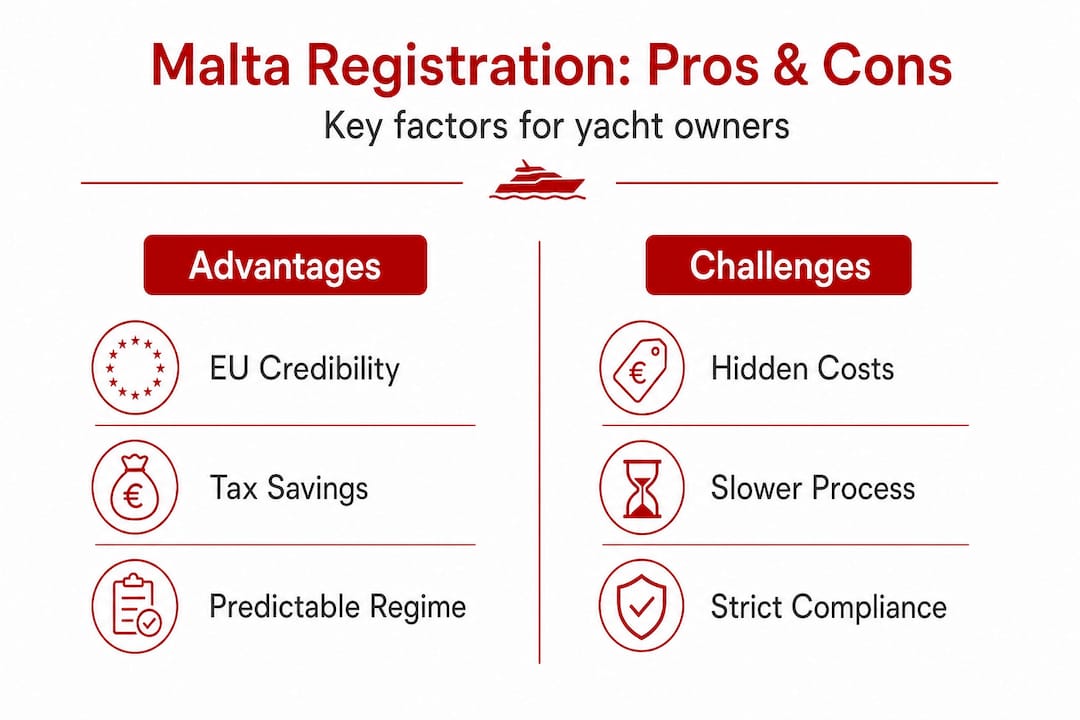
Understanding the compliance categories sets up a realistic look at the myths and real costs associated with choosing Malta. Because Malta is well-marketed as a premier flag state, some owners arrive with inflated expectations and incomplete cost assumptions.
Myth 1: The headline registration fee is the total cost. It is not, by a wide margin. The registration fee covers the official act of registering the vessel. It does not cover the legal fees for preparing ownership documentation, the survey costs, the flagging agent’s service fees, potential corporate structuring costs, or the ongoing annual renewal administration.
Myth 2: Malta processes registrations instantly. Malta is faster than many EU jurisdictions but is not in the same speed category as dedicated fast-flag jurisdictions like Palau or certain offshore registries. Processing time depends on documentation completeness and the vessel’s classification.
Myth 3: EU membership means automatic freedom from all maritime inspections. EU status helps, but Port State Control inspections still occur. A Malta-flagged vessel with outstanding deficiencies will be detained regardless of its flag’s reputation.
Some guides note that Malta may involve more bureaucracy and processing effort compared to certain simpler offshore alternatives, so owners should compare total operational cost and time, not just the headline fee. This is honest advice worth taking seriously.
The actual cost components for most Malta registrations include:
- Official government registration fee (varies by vessel size and type)
- Survey and inspection fees
- Legal and notarial fees for title documents
- Agent or consultant fees for coordinating the process
- Annual renewal fees
- Potential ongoing compliance management costs for commercial vessels
Pro Tip: When comparing Malta to alternative flags, build a five-year total cost model, not just a first-year comparison. Some registries with lower upfront fees have higher annual renewal costs or more frequent mandatory surveys that erode initial savings quickly.
Understanding hidden registration costs before committing to any flag state is essential. And with current registration trends showing increasing regulatory scrutiny across all EU-adjacent jurisdictions, comparing total cost over time is more important than ever.
Who should register in Malta? Matching benefits to real-world scenarios
Now that myths and cost components are demystified, it becomes possible to connect Malta’s pros to real owner/operator scenarios. Not every owner will find Malta optimal. But certain profiles consistently benefit from exactly what Malta offers.
Malta’s VAT approach has attracted nearly 600 superyachts and substantial tax revenue, and that empirical adoption tells you something important: a large, sophisticated pool of experienced operators has concluded that Malta’s total value proposition beats the alternatives for their use case.
Owners and operators who typically benefit most from Malta registration:
- EU and Mediterranean-focused private owners who need seamless access to European waters without flag-related friction at ports
- Commercial charter operators who need the tonnage tax regime to make financial modeling predictable across seasons
- High-value vessel owners who require a flag with global insurance market acceptance and strong legal standing
- Corporate-structured ownership groups that benefit from Malta’s extensive double-taxation treaty network
- Brokers marketing vessels for resale in European markets, where a recognized EU flag often commands stronger buyer confidence
- Owners transitioning from offshore flags who need an EU-credible flag to access EU charter markets
Owners who may find alternatives more suitable include those with very small private pleasure craft, those who need registration within days rather than weeks, and those operating exclusively in non-European waters where Malta’s EU credentials carry less practical value.
Explore the Malta yacht registration process in detail to match your specific vessel, ownership structure, and operational plans against what the registry actually requires and delivers.
Our take: Why the Malta flag works (and when it doesn’t) for yacht owners
Having reviewed both the advantages and the pitfalls, we want to give you the honest industry perspective that most flag-state marketing materials skip entirely.
Malta is genuinely excellent for complex, high-value, EU-focused operations. It delivers on its core promises: global credibility, EU compliance, and a tax regime that rewards sophisticated planning. For a 40-meter charter yacht operating across the Mediterranean and beyond, Malta is very hard to beat on a total-value basis.
But Malta is not right for everyone, and we see three consistent patterns where owners regret choosing it.
First, small private vessel owners who expected simplicity. Malta’s system is built around maritime professionalism. The documentation requirements, the agent coordination, and the ongoing compliance rhythm suit owners who have professional management support. A solo owner of a 12-meter sailboat who just wants simple, cheap registration and minimal administration will likely be better served by a more streamlined registry.
Second, owners who prioritize speed above all else. If you need your vessel legally registered and operational within a week, Malta may not deliver. Certain alternative registries exist specifically to serve that need, and choosing Malta when speed is the primary driver often creates frustration.
Third, operators who assume registration equals automatic compliance across all operating jurisdictions. The Malta flag is your legal foundation. It does not substitute for country-specific compliance requirements in every port you visit.
Our strongest advice to brokers: always benchmark Malta against one or two alternatives using real total-cost and timeline data, not just headline comparisons. The registration benefits for brokers are real and significant, but they are maximized when Malta is chosen for the right vessel, the right use case, and the right ownership structure.
Explore your best yacht registration options
Knowing Malta’s strengths and limitations puts you in exactly the right position to make a confident, well-informed decision. Whether Malta is the right fit or you want to compare it against other flag states, the next step is reviewing your specific vessel profile, intended use, and compliance obligations against concrete registration pathways.
Unter VesselFlag.com, we provide detailed guidance across multiple jurisdictions so you can compare flags objectively rather than relying on one-sided marketing. Start by reviewing our Yacht- vs. Bootsregistrierung guide to confirm your vessel’s legal classification, then work through our full yacht registration guide to understand what the complete process involves. When you are ready to ensure global compliance for your specific operations, our team is ready to help you navigate every step with clarity and speed.
Häufig gestellte Fragen
What are the main requirements for registering a yacht in Malta?
Yacht registration in Malta requires demonstrating legal ownership, passing applicable safety and compliance checks, and correctly classifying the vessel as either private or commercial. Proper compliance for the vessel’s specific category is a non-negotiable prerequisite under Malta’s registry rules.
Does Maltese yacht registration reduce tax liability?
Yacht owners may benefit significantly from Malta’s tonnage tax regime, which can lower or streamline tax compared to profit-based systems. Eligible ships pay tax based on net tonnage rather than actual profits, though eligibility and ongoing compliance requirements must be maintained.
How does commercial registration differ from private registration in Malta?
Commercial yacht registration in Malta is substantially more complex, involving broader EU VAT compliance, enhanced safety documentation, and crew certification requirements that private registration does not trigger. Commercial registration introduces particular complexity around multi-country VAT exposure that private owners never face.
Is Malta always the best registration choice for every yacht owner?
Malta offers strong compliance credentials and EU credibility, but it is not the right fit for every owner, particularly those prioritizing speed, simplicity, or very low administration burden. Malta may involve more bureaucracy than certain offshore alternatives, making a total-cost and timeline comparison essential before deciding.
What role does VAT play in the popularity of Malta for yacht registration?
Malta’s VAT regime is a primary driver of its appeal, having attracted nearly 600 superyachts and generating substantial revenue through its favorable and EU-compliant approach to yacht VAT treatment.

[…] Why register in Malta? Top advantages for yacht owners […]