Registering a yacht does not, by itself, register the jet ski on its deck. Whether the jet ski can ride under the yacht’s papers, needs its own registration, or cannot be registered under your chosen flag at all depends on three things: the yacht’s flag, how the craft is classed (tender or independent craft), and the waters where you use it. Settle those before the yacht is registered, because the flag you pick shapes every later answer. Vessel Flag prepares and files yacht registration applications under eight flags, and the jet ski question is best answered in the same conversation as the flag choice.
TL;DR
- There is no single international rule for jet skis carried on yachts. The yacht’s flag, the craft’s classification and the place of use all matter.
- Some administrations let an unregistered tender use the mother yacht’s mark with limits. Others, such as Massachusetts, require a separate registration for a motorised tender.
- At least one yacht registry, Langkawi, states that jet skis cannot be registered as yachts, so a yacht registration there does not cover one.
- Where a jet ski must be registered, expect proof of ownership, hull and engine identification, ID, and sometimes insurance, a conformity declaration or an inspection.
- Decide the jet ski’s status when you choose the flag, not after the first marina inspection.
Table of Contents
- Why a yacht’s registration does not automatically cover a jet ski
- Three possible statuses for a jet ski on a yacht
- Where you use the jet ski matters as much as the flag
- What you need to register a jet ski when registration is required
- Marking, licences and operating rules
- Choosing the yacht’s flag with the jet ski in mind
- A working routine for owners and brokers
- Our view: settle the jet ski question when you pick the flag
- What we offer for the yacht itself
- FAQ
- Sources
Why a yacht’s registration does not automatically cover a jet ski
A yacht registration attaches to one vessel: the hull identified in the application, its tonnage, its owner and its use. A jet ski is a separate craft with its own hull identification number, its own engine and its own operator. Most administrations treat it as a separate item that either has to be registered itself or has to meet strict conditions to be treated as part of the yacht’s equipment.
That is why owners and brokers get conflicting answers. A skipper who has carried a jet ski through French waters under the yacht’s mark may assume the same applies in the Gulf or in the United States. It does not. One industry guide to tenders and water toys makes the same point: requirements can vary with the yacht’s flag, the tender’s size, whether it counts as mothership equipment and whether it operates independently. Each of those variables is a decision you can make deliberately when you set up the yacht’s registration.
For professionals, the practical consequence is that a jet ski belongs on the same checklist as the yacht’s ownership structure, flag and insurance. Treat it as an afterthought and you risk a craft that cannot legally leave the yacht in the port where your guests want to use it.
Three possible statuses for a jet ski on a yacht
In practice a jet ski ends up in one of three positions.
1. Tender carrying the yacht’s mark
Some administrations allow an unregistered tender to be treated as an extension of the carrier yacht. France is the clearest published example: its maritime administration permits an unregistered tender to carry the carrier yacht’s registration number preceded by the prefix AXE, but only for use within 300 metres of a shelter. France’s guidance on tenders adds that if the craft is detached from the yacht and used independently, it must first be registered as a pleasure craft in its own right.
The lesson is that the tender regime is a restricted association. It covers short hops from the mother ship, not independent use by guests or crew.
2. Registered in its own right
The same French annex says personal watercraft such as jet skis are among the tender types that may be registered on their own, and that they must come with a written declaration of conformity, including for the registration procedure. Elsewhere this is simply the default. Jurisdictions such as California and Massachusetts require the jet ski to carry its own registration regardless of the vessel it travels on.
3. Not registrable under the yacht’s flag
The third position surprises owners most. The Langkawi International Yacht Registry’s September 2025 guidelines expressly say personal watercraft such as jet skis cannot be registered as yachts under that registry. A yacht on that flag therefore needs a separate answer for its jet ski, and the registration of the yacht tells you nothing about it. The Philippines is a different variation: its MARINA circular defines a yacht to include a personal watercraft, yet separately requires domestically owned ships, personal watercraft included, to hold a Certificate of Philippine Registry and a Certificate of Ownership, and it excludes foreign-registered ships temporarily used in Philippine waters from its coverage (MARINA Circular 2013-02).
Where you use the jet ski matters as much as the flag
The yacht’s flag governs the yacht. The coastal state governs what happens in its waters. The examples below, all from official pages, show how far apart the rules sit.
| Place | What the official source says |
|---|---|
| France | Every personal watercraft must be registered to navigate at sea. The Ministry’s guide says the process is free and that the certificate must be carried aboard. |
| California | The DMV states that ski-type personal watercraft, such as Jet Skis, must be registered under Vehicle Code section 9850. |
| Massachusetts | The state’s boat registration FAQ says a motorised tender to a Coast Guard-documented or state-registered vessel still needs its own state registration. Only ship lifeboats are exempt. |
| Western Australia | A tender is exempt only if it is no more than 3.1 metres long, has a motor of no more than 5 horsepower and is used only as a lifeboat or for ship-to-shore transport, per the state’s rules at a glance. A jet ski will not meet that description. |
| Auckland, New Zealand | Auckland Transport says registration is mandatory and lifetime-valid, and directs owners of jet skis carried on visiting foreign-flagged vessels to contact the Harbourmaster rather than use the standard portal. |
| Abu Dhabi | Abu Dhabi Maritime requires recreational crafts in the Emirate’s waters to be registered and to carry registration and clearance documents. Crafts registered in another Emirate need permission if they stay longer than 30 days. |
| Turks and Caicos | The Small Craft Policy of 1 July 2024 makes registration mandatory for small craft but also sets a moratorium on further importation, registration and licensing of jet skis until further notice. |
Two patterns matter for owners. First, most coastal states register jet skis as a matter of course, and a few go further and restrict them. The Turks and Caicos example shows that a registration requirement and a ban on new registrations can exist side by side, so a charter itinerary that includes the islands needs checking against current policy before the jet ski is loaded. Second, visiting foreign-flagged yachts are often handled by a discretionary or case-by-case route. Auckland’s instruction to speak to the Harbourmaster is typical: the answer comes from the local authority, not from your registry certificate.
British owners often assume the UK sets a clear template. It addresses a different question. UK guidance on the Recreational Craft Regulations 2017 covers personal watercraft under 4 metres as products that must conform before they are placed on the Great Britain market, and it says CE marking continues to be recognised in Great Britain, with CE or UKCA markings accepted for covered products. That governs how a craft is sold and supplied, not whether it travels under a yacht’s registration abroad.
What you need to register a jet ski when registration is required
Document lists differ, but they share a core. Gather these before you approach any authority.
- Proof of ownership. An invoice or bill of sale. France asks for the original plus a copy of the invoice or sale instrument. Singapore, Abu Dhabi and the Turks and Caicos all list proof of ownership among their documents.
- Identification of the craft. Hull identification number (HIN), make, model, colour, engine number and engine rating, year of manufacture and builder details. Jamaica’s application form for personal watercraft asks for hull or serial number, engine number, dimensions, horsepower and an ownership declaration. Auckland asks for the HIN, make, model, colour, engine cc rating, purchase date and manufacture year.
- Owner identity and qualification. NSW requires identity proof, a HIN certificate and a fee, in its Personal Watercraft Handbook. Singapore also asks for residence evidence.
- Insurance. Abu Dhabi, Singapore and the Turks and Caicos list it.
- Deletion evidence where the craft was previously registered. The Turks and Caicos policy, Singapore and Abu Dhabi all refer to closing a prior registry.
- Conformity and inspection evidence. France requires a written declaration of conformity for jet skis registered in their own right. Abu Dhabi describes a technical inspection pass certificate for applicable categories, and Singapore lists a survey report.
- Photographs. The Turks and Caicos policy lists craft photographs among its documents.
If you are an owner who also needs the yacht’s paperwork in order, the yacht registration documents checklist covers the yacht side so that the ownership evidence you assemble for the jet ski matches what the yacht’s application says.
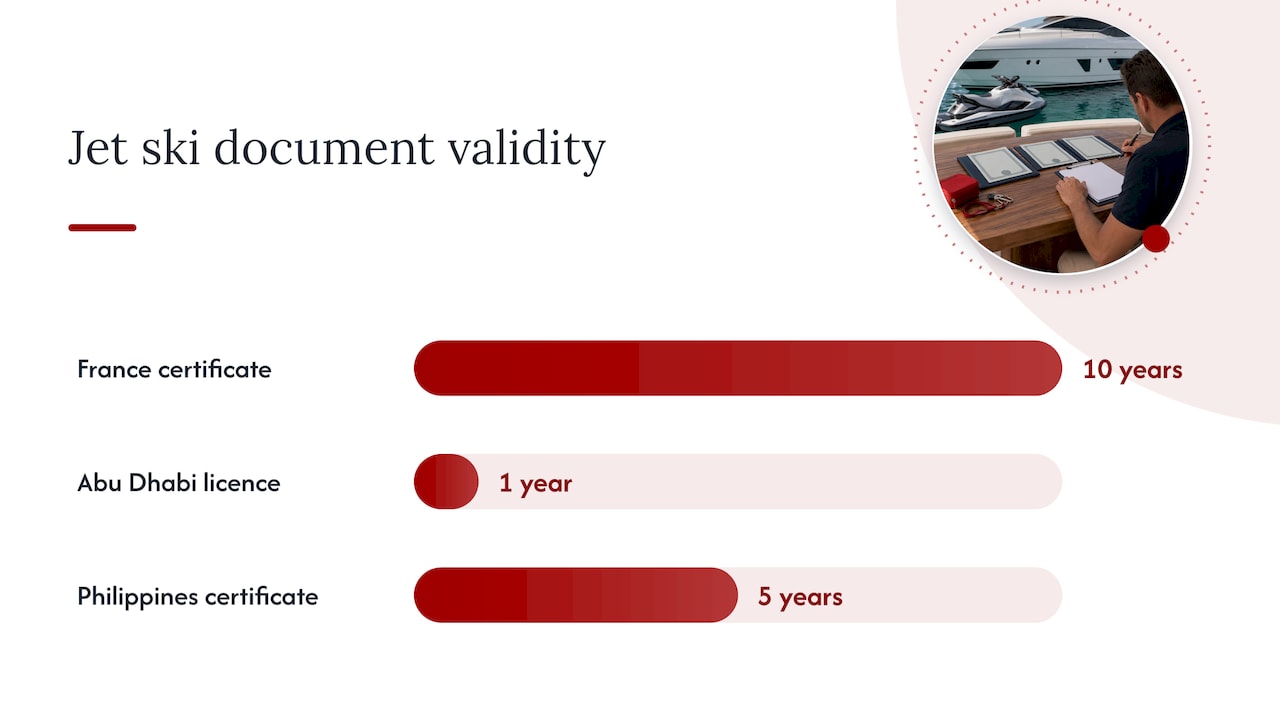
Two cautions about assuming overlap. The Langkawi yacht application asks for title evidence, owner identity, an ownership declaration, previous-registry deletion evidence, photographs and agent documentation, but those are yacht requirements and do not establish registration for a jet ski. And validity periods vary widely: France says its certificate combines francisation and registration and lasts ten years if nothing changes, Abu Dhabi licenses craft for one year, renewable, and the Philippines issues a five-year certificate with transfer rules of its own. Diarise renewals for each craft separately from the yacht’s.
Marking, licences and operating rules
Registration is only the start. Authorities also set how the craft is marked and who may ride it.
- Marking. Auckland requires the assigned number above the waterline on both sides in contrasting-colour stickers. Western Australia and NSW require marks on both sides at least 100 millimetres high, and NSW also requires a behaviour label visible from the steering position.
- Operator licensing. Western Australia requires a Recreational Skippers Ticket for jet ski operators, with extra limits for operators older than 14 but under 16. NSW requires drivers to hold a PWC licence.
- Time and place. NSW prohibits operation between sunset and sunrise and describes local exclusion zones and limits on irregular driving near shore and dwellings.
- Capacity and safety kit. The Turks and Caicos policy requires operators not to exceed the marked maximum capacity, and lifejackets with whistles must be worn by all occupants.
- Penalties. Auckland says operating an unregistered jet ski is illegal and officers may issue a $200 fine.
For a charter yacht, these operator rules are the real exposure. A guest who rides at dusk or without the right ticket can create a problem for the owner and the master, regardless of how tidy the yacht’s own certificate is. Brief guests in writing and put local operator requirements in the charter handover pack.
Saltwater is also the quiet enemy of any craft stored on deck or in a garage. A guide on saltwater protection for boats is a sensible reference for keeping hull markings and registration stickers legible, which matters when marks must be clearly visible.
Choosing the yacht’s flag with the jet ski in mind
Owners usually choose a flag for tax, manning, eligibility and cost. Tenders and water toys rarely feature in that decision, yet the evidence above says they should at least be asked about. A sensible order is:
- Decide whether the yacht will be private or commercial, since use rather than payment drives that classification. Our note on private versus commercial registration explains the test.
- Shortlist flags that fit the owner, the yacht’s size and the cruising area. Our guide to flag state selection sets out how the flag affects obligations.
- For each shortlisted flag, ask how it treats a tender or personal watercraft carried aboard. The Langkawi example shows that the answer can be a flat no.
- Check the cruising area’s own rules, since the coastal state’s registration regime applies in its waters.
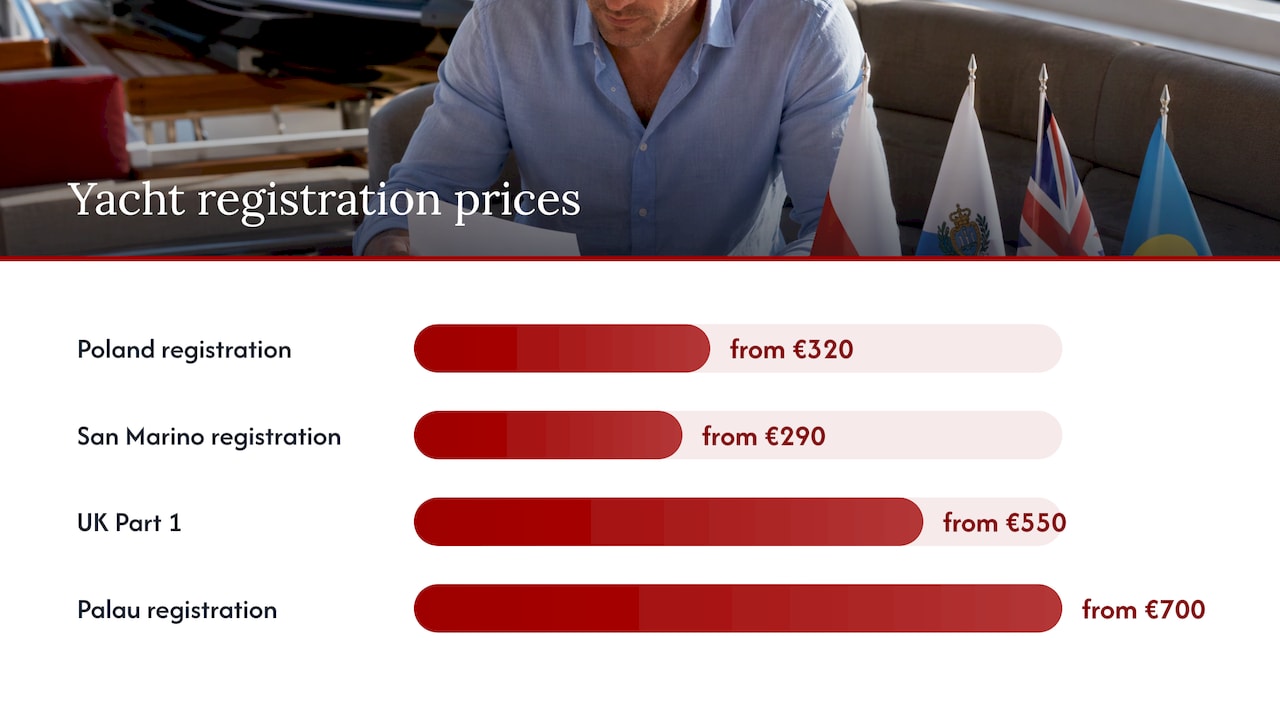
Our published one-off prices let you compare the yacht side of this decision quickly. At the time of writing, Poland registration starts from €320, San Marino from €290 and UK Part 1 from €550. For UK Part 1, owners can register personally if eligible, through an existing company (UK or an eligible foreign one, such as a Delaware corporation) or through a new UK LTD. A UK company is not always required. If a company structure suits the ownership, our company formation service covers UK LTD, Delaware LLC and Marshall Islands formation, with UK LTD at €485 and Delaware LLC from €455 (€605 with apostille).
Malta registration for private yachts under 24 m starts at €1,749 as our service fee, or from €4,900 for commercial yachts, plus Transport Malta government fees. Palau starts from €700. Marshall Islands is a €250 service fee plus registry fees, and Cayman Islands a €450 service fee plus registry fees. Cook Islands is quoted per yacht. Vessel Flag also handles Langkawi, Dutch Zeebrief, Gibraltar, Panama and other flags on request, with prices confirmed per case.
A working routine for owners and brokers
Use this sequence when a yacht is bought, moved between flags or put into charter with a jet ski on board.
- List every powered craft that travels with the yacht. Record make, model, HIN, engine number and engine rating. You need these for any registration form.
- Classify each craft. Is it a small tender used only for ship-to-shore transport, or a jet ski that guests ride independently? Western Australia’s exemption and France’s 300-metre rule show why this distinction matters.
- Check the yacht’s flag. Ask what the flag says about tenders and personal watercraft. Where it says nothing, assume the craft needs a separate answer.
- Check each cruising area. Contact the harbour authority or registry for the coastal state, especially where a visiting foreign-flagged yacht is handled case by case, as in Auckland.
- Assemble the paperwork. Purchase evidence, identification details, owner ID, insurance and any conformity declaration. Keep copies aboard, since France, for example, requires the certificate to be carried on the craft.
- Mark and brief. Fit the registration marks as required and give operators the licence, time-of-day and capacity rules.
- Diarise renewals and transfers. On a sale, the Philippine circular shows that transfers generate new certificates on a deadline, so keep jet ski paperwork in the sale file alongside the yacht’s.
On the yacht side, the procedural aspects of yacht documentation are covered in our guide, and it is worth having that settled before you ask the harder tender questions.
Our view: settle the jet ski question when you pick the flag
Brokers and owners tend to arrive with the yacht registration as the whole project and the toys as a footnote. Our experience across eight flags points the other way: the flag decision should be made with the whole deck in mind.
The official texts agree on very little. One administration lets a tender wear the mother yacht’s mark within a short distance. Another says a motorised tender needs its own registration. Another says jet skis cannot be registered as yachts at all. A flag chosen on tax and cost alone can leave you with an awkward answer on the one craft your guests most want to use.
That is why we prepare the yacht’s application with the cruising plan and the equipment list in front of us. Our fully remote process and published one-off prices let you compare flags such as Poland, San Marino and UK Part 1 early, and we can add the MMSI licence and company formation to the same file. Where a flag is not on our published list, such as Langkawi, Dutch Zeebrief, Gibraltar or Panama, we handle it on request and confirm the price per case.
We are a private consultancy, not a registry. The flag registry issues the certificate, and we prepare and file the application. Our job is to make sure the yacht reaches that registry with the right ownership structure and complete documents, so the questions about its equipment are asked before the yacht sails.
VesselFlag
What we offer for the yacht itself
Vessel Flag prepares and files yacht and boat registration applications for private owners, companies and brokers under the flags of Poland, San Marino, UK Part 1, Malta, Palau, the Marshall Islands, the Cayman Islands and the Cook Islands. We are listed agent with the San Marino and Palau registries, offer a UK local representative service, and can also arrange MMSI numbers and ship radio licences, company formation and flag transfers. In Poland, provisional papers take 2 to 5 days, and in San Marino the provisional certificate takes 2 to 6 days, which is not guaranteed. A UK MMSI licence takes 1 day.
For the radio side, our MMSI and ship radio licence service is priced at €149 for Poland, €150 for the UK and €200 for San Marino, VAT included, with no annual fees. The Polish MMSI licence takes 4 to 6 weeks after registration.
FAQ
Can a jet ski be registered together with a yacht?
Not as a general rule. Some administrations, France among them, allow an unregistered tender to use the carrier yacht’s mark with limits, but a jet ski ridden independently is normally registered in its own right. Check the yacht’s flag and the waters you will use.
Does a Langkawi, Panama or Gibraltar yacht registration cover a jet ski?
Do not assume so. The Langkawi registry’s September 2025 guidelines say jet skis cannot be registered as yachts. We handle Langkawi, Panama, Gibraltar and other flags on request, with prices confirmed per case, so ask us to look at the jet ski when we review the yacht.
What documents do I usually need for a jet ski?
Expect proof of ownership, hull and engine identification, owner ID and, depending on the place, insurance, a conformity declaration, photographs or an inspection certificate. Where the craft had a previous registration, authorities may ask for evidence it has been closed.
Do local rules apply even if the yacht is foreign-flagged?
Yes. Coastal states regulate craft operating in their waters. Auckland tells owners of jet skis on visiting foreign-flagged vessels to speak to the Harbourmaster, and Abu Dhabi requires craft from other Emirates to get permission for stays beyond 30 days.
Sources
- France Ministry: annex on tenders (Les annexes), August 2025
- France Ministry: registering pleasure craft
- Langkawi International Yacht Registry guidelines, September 2025
- MARINA Circular 2013-02, Philippines
- California DMV: vessels required to be registered
- Mass.gov: boat registration FAQs
- Western Australia: boating rules at a glance
- Auckland Transport: registering a jetski
- Abu Dhabi Maritime: requirements for safe operations of marine crafts
- Turks and Caicos Islands Small Craft Policy, 1 July 2024
- Jamaica: application for registration of a personal watercraft
- NSW Transport: Personal Watercraft Handbook
- GOV.UK: Recreational Craft Regulations 2017, Great Britain
- Saltwater protection for boats: a UK owner’s guide
Ready to register the yacht? Start with the relevant flag page, such as UK Part 1 yacht registration, Poland flag registration or San Marino yacht registration, then get a consultation to plan the flag around the whole vessel, jet ski included.
VesselFlag is a private consultancy that prepares and files yacht registration applications for owners. We are not a government body or flag registry; certificates are issued by the relevant registry. This article is general information, not legal advice.