
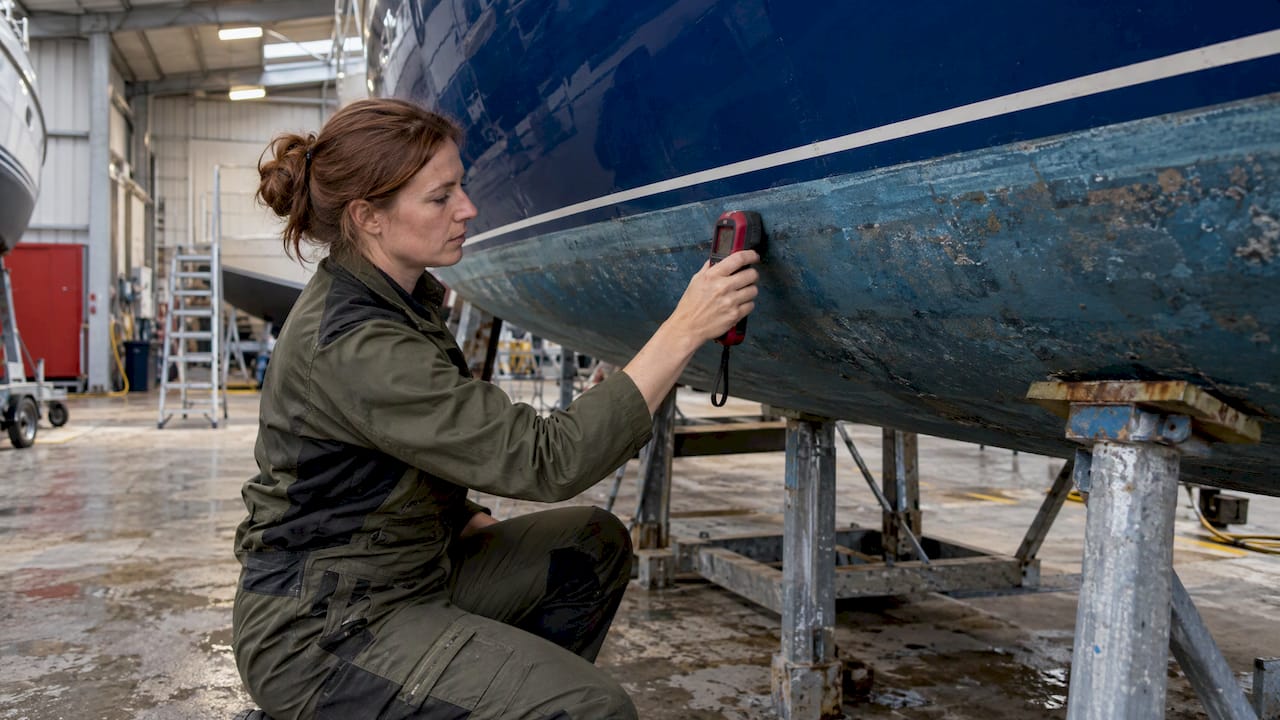
No law says you must have a survey to insure a yacht, but most insurers will ask for one once a vessel passes a certain age, size or value, and for almost every purchase. The details are set by each underwriter, not by a standard rulebook. So the practical job is to know the usual triggers, commission the right type of report from a recognised surveyor, and have it ready before you ask for a quote or before a renewal deadline. This guide covers that for owners, brokers and operators, and shows where the flag you register under fits in.
TL;DR
- Surveys are not generally obligatory, but if you insure or finance a boat the provider will almost certainly want to see an appropriate survey.
- Age is the usual trigger. Insurers often start asking at around 10 years, then repeat every few years. Thresholds and intervals differ by insurer, so ask for yours in writing.
- An insurance survey is a condition and valuation report, narrower than a pre-purchase survey. Ask the surveyor to write it for an underwriter.
- Use a surveyor who belongs to a body such as SCMS, YDSA or IIMS, and keep the report within the validity window your insurer states.
- Your flag and your insurer ask for different things. Settle both early, particularly on a purchase or a change of flag.
Table of Contents
- When insurers ask for a survey
- What an insurance survey actually is
- In-water or out-of-water
- Who can carry out the survey
- How recent the report must be
- What it costs
- Insurance survey, flag survey and port inspection: keep them apart
- A sensible order of work for a purchase or change of flag
- Promo
- Perspective
- FAQ
- Sources
When insurers ask for a survey
There are four situations in which a survey request is normal.
1. New cover on an older vessel. A US marine publication reports an interviewee’s rule of thumb: a boat of 10 years or newer and under 25 feet often escapes the survey requirement, while anything outside those limits needs a current survey to be quoted. That is a US market guide for small craft, not a UK rule. For yachts, assume a survey will be wanted unless the insurer tells you otherwise.
2. A purchase. The same source says most companies will not accept the seller’s survey for a new purchase. If you are buying, commission your own report, and tell the surveyor the insurer will read it.
3. Renewal. Once a vessel crosses the insurer’s age threshold, it will usually ask for a fresh survey at set intervals. A UK insurer’s published guidance says insurers usually require vessels of a certain age to have a full out-of-water survey periodically, with ages and intervals differing by insurer. Expect written notice with a deadline. Missing that deadline is how owners end up with restricted cover or a rushed, expensive haul-out.
4. Unusual circumstances. Survey requests also follow damage since the last survey, unusual construction or a little-known builder, whatever the age. Treat any incident, grounding or major repair as a reason to speak to the insurer before it asks you.
Most threshold figures you will see online come from individual insurers. Use them as a guide to the pattern, then get your own insurer’s number: the age at which they start asking, the repeat interval, and the maximum age of a report they will accept.
What an insurance survey actually is
Brokers often use “survey” as one word, but owners pay for different products. Pre-purchase and condition surveys give a detailed report on condition, defects and repair recommendations, usually with a sea trial, while valuation surveys are what insurers and lenders require.
An insurance and valuation survey focuses on safety, structural integrity and current market value, and its report is formatted for a marine underwriter binding or renewing cover. It also flags items that affect insurability. In practice, that means:
- identification of the vessel: builder, hull number, engines, equipment;
- hull, deck and structure condition, usually with moisture readings on GRP;
- engines, electrics, gas, bilge and steering;
- fire-fighting equipment and other safety gear;
- a valuation figure the insurer can use to set the sum insured;
- a list of recommendations, some of which the insurer may make conditions of cover.
The recommendations section matters most. An insurer may give you a period, often a number of weeks or months, to complete the work and send evidence. Ask the surveyor to grade recommendations by urgency, so you can show the underwriter what is cosmetic and what is safety-critical.
If you are choosing between the two reports on a purchase, the pre-purchase survey is the one that protects you as a buyer. An insurance survey is narrower and, according to one US guide, typically leaves out the sea trial and operational testing. Some owners get one surveyor to produce a pre-purchase report written so the insurer accepts it. Agree that before the survey day, not after.
In-water or out-of-water
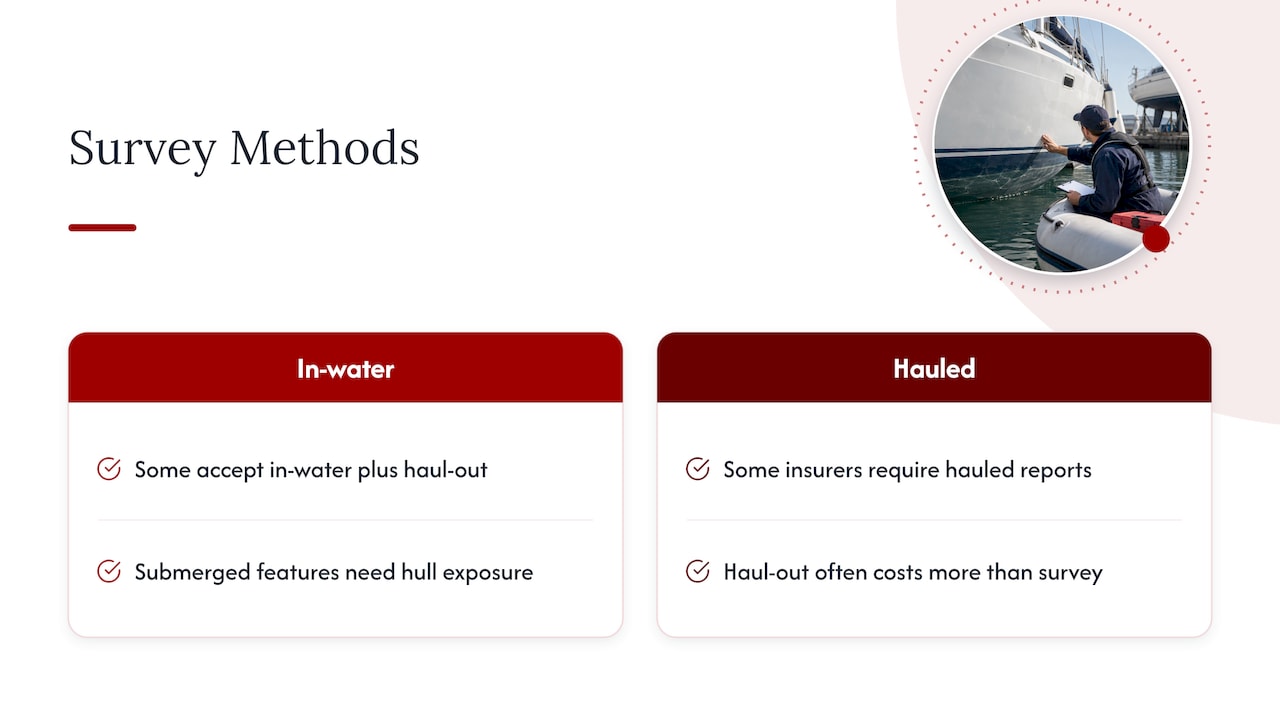
Many insurers want the hull seen out of the water, because moisture, osmosis, keel fastenings, rudder bearings and through-hulls cannot be judged from above the waterline. Some will accept an in-water survey combined with a haul-out inspection. Others accept only a hauled report. Ask which your insurer takes before you book the surveyor and the yard, as the haul-out is often a larger cost than the survey itself.
For steel or aluminium hulls, expect extra deliverables. Some programmes require an ultrasonic thickness (audio-gauge) report on top of the hauled condition survey, as in one US programme’s survey guidelines. Sailing yachts may be asked for a rigging inspection. Whatever your hull type, tell the surveyor what the insurer’s wording requires before the work begins.
A practical tip for owners with several yachts, or brokers managing a fleet: schedule the survey with a planned lift-out for antifouling, so the hull is already exposed and the cost of the haul-out is shared.
Who can carry out the survey
Insurers want an independent, qualified surveyor, and they will usually say which memberships they accept. In the UK, a qualified yacht surveyor belongs to a certifying body authorised by the MCA, including SCMS, YDSA and IIMS. The same guide advises checking the surveyor’s membership level and asking about professional indemnity cover.
Before you instruct anyone:
- send your insurer the surveyor’s name and membership body and get confirmation that it is acceptable;
- confirm the surveyor has experience of your vessel type and size (a motor yacht, a catamaran and a steel ketch need different eyes);
- ask for the report format and whether it includes the valuation and photographs;
- ask how long delivery takes, since a renewal deadline will not wait for a late report.
Outside the UK the names change. US programmes often reference NAMS or SAMS accreditation. If your yacht is based in the Mediterranean or the Caribbean, ask your insurer which local surveyors it already works with, as this avoids a report being rejected on a technicality.
How recent the report must be
Validity windows differ. One US insurance programme says a condition and valuation survey from the past 24 months may be accepted for first-time cover. Another asks for a new survey at renewal every five years, and treats surveys as valid for two years on new policies. These are examples of the range, not UK rules.
Three habits protect you:
- Note the survey date and diarise the insurer’s repeat interval as soon as the report arrives.
- When you buy a yacht, check the age of the existing survey against the insurer’s window. A report that was valid at listing may be stale by completion.
- Keep the full report and the evidence that recommendations were completed, as the next insurer will ask for both.
What it costs
Survey prices are set by individual surveyors, so use published UK rates as a guide and ask for a written quote based on your yacht’s length overall and type.
| Surveyor guidance | Rate | Minimum |
|---|---|---|
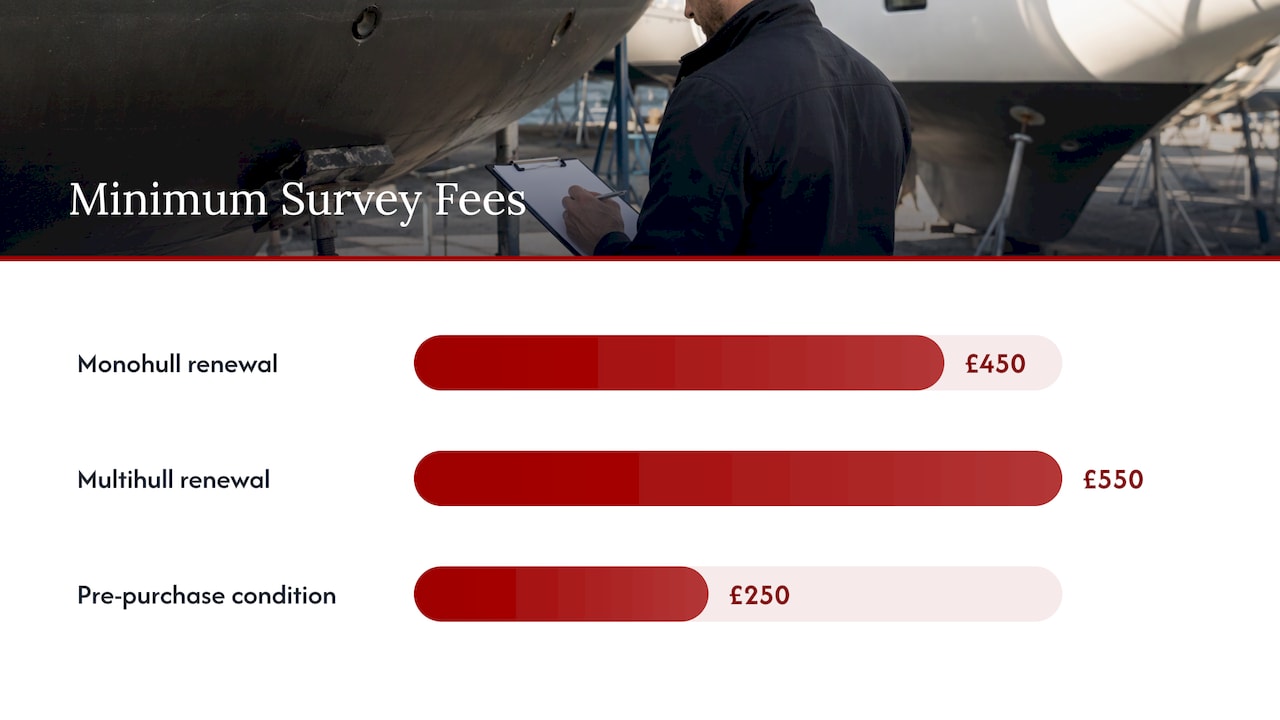
| Insurance renewal survey, monohull (South Coast UK) | £40 per metre LOA, including VAT | £450 |
| Insurance renewal survey, multihull (South Coast UK) | £60 per metre LOA, including VAT | £550 |
| Condition survey, pre-purchase and insurance (UK) | £17 per foot, all inclusive, no VAT | £250 |
As a worked example, a 12-metre monohull at £40 per metre comes to £480 on the first rate card. A 40-foot yacht at £17 per foot comes to £680 on the second. These are the surveyors’ published rates at the time of writing and they change, so confirm before you book. They exclude the haul-out, cradle, crane and yard fees, travel, and any specialist reports such as ultrasonic thickness testing on a steel hull.
The factors that move the quote are length, hull material, number of engines, whether it is a multihull, location, and how much the surveyor must travel. Larger and more complex yachts, and those above commercial thresholds, are priced individually.
Insurance survey, flag survey and port inspection: keep them apart
Owners and brokers often mix up three different checks.
- The insurer’s survey protects the underwriter and sets cover and value.
- A flag’s requirements depend on the registry. Some flags need their own survey or measurement for certain vessel types; others waive them under conditions. Our guide to what flags waive and what still applies on yacht surveys explains the difference.
- Inspections by authorities are a separate matter. Our guide on what port state inspectors check and how to prepare covers that side.
A single survey can often serve more than one purpose if the surveyor knows in advance. Tell them the flag, the insurer and the intended use (private, charter or commercial) when you instruct them. If the yacht is going on a cargo ship for delivery, the loading checks are a different exercise again, described in our guide to load port surveys for yachts.
A sensible order of work for a purchase or change of flag
- Decide the flag and the owning structure first, because the insurer needs the owner’s name, the flag and the intended use.
- Ask the insurer, in writing, for its survey requirements: age threshold, report type, accepted surveyor bodies, report validity, and whether in-water inspection is acceptable.
- Instruct the surveyor with those conditions in hand and confirm the report will be addressed to the owner and usable by the insurer.
- Complete the urgent recommendations and keep invoices.
- Send the report with the application and diarise the next survey date.
- Arrange the radio licence and MMSI, since insurers and registries expect the radio details on the vessel record to be consistent.
If the order is wrong, delays follow. A new owner who buys first and asks about survey age afterwards can find the vessel uninsurable at the time of delivery, so the sequence above matters more than any single document.
Promo
Vessel Flag is a private consultancy that prepares and files yacht registration applications. It is not a registry: certificates are issued by the flag registries. We handle the paperwork under eight flags, remotely and at published one-off prices. Poland starts from €320, San Marino from €290, UK Part 1 from €550 and Malta from €849. We also arrange MMSI radio licences (Poland €149, UK €150, San Marino €200, each VAT included with no annual fees), company formation for yacht ownership, and boat insurance through our services page.
If you are buying a yacht or changing flag and want the registration, ownership structure and insurance requirements lined up before the survey is booked, see our Poland vs San Marino vs UK Part 1 comparison or start with a conversation via our consultation page.
Perspective
Owners tend to treat the insurance survey as a late, separate chore. In our experience of preparing registrations, the cleanest files are those where the questions are answered in the right order: who owns the yacht, under which flag, for what use, and only then what the insurer needs to see.
That order matters because the flag and the owner shape the insurance conversation. A yacht registered under UK Part 1 by a private owner, or through an eligible company, sits in a different position from one under a flag chosen for a corporate structure. We prepare and file the registration and arrange the MMSI and ownership company, so the vessel record the insurer sees is consistent from the start.
Our advice to brokers: give your buyer a single timeline that shows the survey, the registration and the insurance together. It shortens the gap between completion and a vessel that is properly flagged, licensed and covered.
VesselFlag
FAQ
Do I need a survey to insure my yacht?
There is no general legal requirement, but insurers commonly ask for one. Providers will almost certainly want to see an appropriate survey when you insure or finance a boat. Newer, smaller craft are more likely to escape the requirement, so ask your insurer what applies to your yacht.
Can I use the seller’s survey when I buy?
Usually not. One US industry source reports that most companies will not accept a seller’s survey for a new purchase. Commission your own, so the report is addressed to you and meets your insurer’s conditions.
How often will my insurer ask for a new survey?
It depends on the insurer and the age of the yacht. A typical pattern is a first request at an age threshold and then repeat surveys every few years. Ask for the interval in writing and diarise it from the date of your last report.
What is the difference between an insurance survey and a pre-purchase survey?
A pre-purchase survey is a detailed assessment for a buyer and usually includes a sea trial. An insurance survey is a condition and valuation report written for an underwriter, and it typically omits sea-trial testing. If you need both, agree the scope with the surveyor before the day.
Sources
- Everything you need to know about yacht surveys, Motor Boat & Yachting
- Seaworthiness and Insurance, The Log
- Surveys and reports, insurer guidance
- Insurance and valuation survey, SVG Marine
- Yacht survey and sea trial guide, Boat Tomorrow
- Jackline Insurance Program survey guidelines
- Survey and photo requirements, Skippers’ Plan
- Surveys and fees, Sherwood Maritime
- Fees and costs, South Coast Marine Surveyors
Recommended
VesselFlag is a private consultancy that prepares and files yacht registration applications for owners. We are not a government body or flag registry; certificates are issued by the relevant registry. This article is general information, not legal advice.