
For owners focused on succession and privacy, a trust overlay is usually the right starting point. For owners who care most about liability isolation, lender comfort, or running charters, a company structure typically wins. Most wealthy owners end up using both: a trust that holds the membership interest in a Delaware LLC, which in turn holds title to the yacht.
That layered stack, not a single “trust versus company” pick, is the realistic default for high net worth buyers today. A trust alone can leave you exposed if you personally operate the vessel. A company alone does nothing for estate planning or probate avoidance. Combining them, with real documentation and real funding behind each piece, is what actually holds up when a lender, insurer, or tax authority looks closely.
Before you sign anything, take two steps:
- Ask your trustee or estate counsel to confirm the trust will be funded with enough liquidity to cover insurance, dockage, and crew, not just hold paper title.
- Ask your lender or insurer, in writing, whether they will accept a US or Delaware LLC as the titled owner before you form one.
Vesselflag works with owners on the registration and corporate side of this, and the mechanics below explain why the stack looks the way it does.
Önemli Noktalar
Wealthy owners get the strongest outcome by pairing an irrevocable or directed trust with an LLC, using the trust for succession and the LLC for liability, rather than choosing one structure alone.
| Nokta | Detaylar |
|---|---|
| Trusts handle succession | A properly funded trust avoids probate and adds privacy, but does little against liability from personal operation. |
| LLCs handle liability | A US or Delaware LLC isolates the vessel’s risk from personal assets and is what most lenders and insurers expect to see. |
| Fund the trust, not just the yacht | Trusts need liquid reserves for insurance, dockage, and crew, or they may be forced to sell the vessel. |
| Offshore no longer wins on tax alone | Subpart F and GILTI rules have narrowed the tax edge of offshore holding companies for US owners since 2017. |
| Vesselflag supports the registration layer | Vesselflag handles flag selection and corporate registration paperwork once your trust and LLC structure is set. |
İçindekiler
- Yacht Trust vs. Company: Weighing the Real Trade-Offs
- How Do Yacht Ownership Structures Actually Work?
- What Are the Tax and Reporting Consequences?
- Does an Entity Actually Protect You From Liability?
- What Does It Cost to Set Up and Maintain These Structures?
- How Does Ownership Structure Affect Flag Registration?
- How Do You Choose Between a Trust and a Company?
- Vesselflag’s Practical Checklist for Setting Up the Stack
- The Trust-Plus-Company Stack Is the Realistic Default, Not a Compromise
- Let Vesselflag Handle the Registration Side of Your Ownership Structure
- Kaynaklar
- SSS
Yacht Trust vs. Company: Weighing the Real Trade-Offs
A trust and a company solve different problems, and treating them as competing options is where a lot of planning goes wrong. The question isn’t which one is “better.” It’s which risks you’re actually trying to manage.
Trusts are built for succession. A properly drafted trust can avoid probate, keep ownership details out of public court filings, and pass the yacht to heirs according to terms you set years in advance, not terms a probate judge imposes after you’re gone. The costs are real, though: drafting fees, ongoing trustee compensation, and the administrative headache of a jurisdiction whose trust law you may not fully understand if you’re not domiciled where the trust is formed.
Companies are built for liability. An LLC puts a legal wall between the vessel and your personal assets, which matters enormously if a guest is injured aboard or a charter contract goes sideways. Lenders and insurers also tend to prefer dealing with a corporate titleholder over an individual, since it standardizes the paperwork on their end. The downside: LLCs come with reporting obligations, and if you elect or default into corporate tax treatment, you can end up with entity-level tax that a simple LLC or trust wouldn’t trigger.
Here’s how the two typically get combined in practice:
- The trust becomes the sole member of the LLC, rather than owning the yacht directly.
- The LLC holds legal title to the vessel and handles registration, insurance, and vendor contracts.
- Trust terms govern who benefits from the yacht and what happens to it at death or incapacity, while the LLC governs day-to-day liability exposure.
This is the arrangement most estate planners recommend for owners with meaningful net worth, precisely because it isolates two different risks with two different tools instead of asking one structure to do both jobs.
Profesyonel İpucu: Don’t let a single advisor design this alone. Have your trust attorney and your corporate/maritime counsel review the same documents together, since a trust that looks airtight on paper can still fail if the LLC’s operating agreement contradicts it.
How Do Yacht Ownership Structures Actually Work?
The mechanics matter more than the labels. Here’s what each piece is actually doing.
A single-member LLC, usually formed in Delaware or Florida, holds title to the vessel. Delaware is popular because its statutes support directed trusts and dynasty trusts holding LLC interests cleanly, and its courts have decades of case law on LLC governance. You’ll need a registered agent, an operating agreement spelling out who can authorize expenses or sales, and a bank account kept separate from your personal finances.
A revocable trust lets you retain control during your lifetime, amend terms as circumstances change, and pass the LLC interest to heirs without probate. It offers weaker asset protection, though, since you can still access and direct the assets, which courts sometimes treat as your alter ego.
An irrevocable trust gives up that control in exchange for stronger protection and, in the right circumstances, estate tax benefits. A directed trust splits investment or distribution authority from a professional trustee, letting a family member or advisor keep decision-making input. A dynasty trust extends this across multiple generations, which Delaware law specifically accommodates.
The layered version looks like this in practice:
- Trust owns 100% of the LLC membership interest.
- LLC owns the vessel and appears on the registration and title documents.
- A separate operator LLC exists if you charter, keeping charter liability away from the ownership entity entirely.
That separation between ownership and operation isn’t optional paperwork. It’s what lets each entity do its actual job without one messing up the other’s protections.
What Are the Tax and Reporting Consequences?
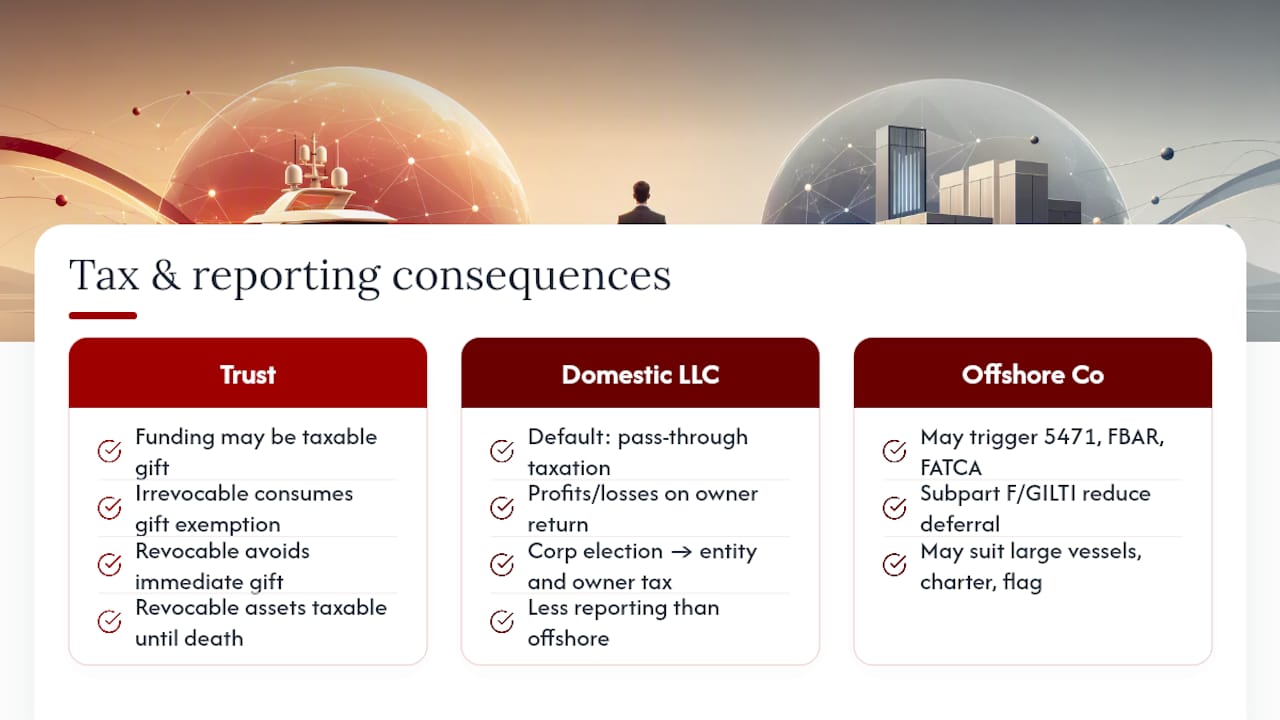
Funding a trust with a yacht (or with the LLC that owns it) can itself be a taxable event. Transferring a highly appreciated asset into an irrevocable trust may count as a completed gift, which starts consuming your lifetime gift tax exemption immediately. A revocable trust avoids that problem during your life but gives up most of the estate tax benefit, since the assets are still considered yours for tax purposes until death.
LLCs default to pass-through taxation, meaning profits and losses flow to the owner’s personal return with no entity-level tax. That changes if the LLC elects corporate treatment or is treated as a C-corp for other reasons, at which point charter income can face tax at both the entity and owner level.
The bigger trap for US taxpayers is offshore ownership. If you title the yacht through a foreign company instead of a domestic LLC, you may trigger Form 5471 reporting, FBAR disclosures, and FATCA obligations, on top of the underlying tax rules.
Since 2017, Subpart F and GILTI provisions have significantly narrowed the tax advantage of offshore holding companies for US owners. That’s a meaningful shift from the pre-2017 planning playbook, where offshore structures routinely deferred US tax on foreign income.
The practical result: US LLCs now often produce comparable outcomes to offshore structures for private-use yachts, with far less annual reporting friction. Offshore ownership can still make sense for larger vessels, cross-border charter operations, or specific flag requirements, but it’s no longer the automatic tax play it once was. Confirm with a tax attorney before assuming an offshore layer saves you anything.
Does an Entity Actually Protect You From Liability?
An LLC’s corporate veil works, but only if you treat the entity like a real business, not a formality. Courts in some states allow a “charging order” remedy that limits how a creditor can reach LLC assets, and lenders generally prefer financing a vessel titled to an entity rather than an individual.
A trust plays a narrower role here. Its protection depends on you genuinely giving up control, an irrevocable trust with an independent trustee holds up far better against creditor claims than a revocable trust you still direct day to day. Critically, a trust does very little to protect you if you personally operate the yacht and cause an injury. Personal operation creates personal liability regardless of who owns the paperwork.
The most common ways this protection actually fails in practice:
- Commingling personal and entity funds, which lets a court pierce the corporate veil.
- Undercapitalizing the LLC so it can’t cover a claim, inviting a court to disregard the entity.
- Skipping formal documentation like signed resolutions, minutes, or a real operating agreement.
- Forgetting to add the LLC as a named insured on the vessel’s insurance policy.
Profesyonel İpucu: Call your insurance broker the moment you retitle a yacht into an LLC or trust. A policy still listing you personally as the insured party can leave a gap exactly when you need coverage most.
What Does It Cost to Set Up and Maintain These Structures?
Formation costs vary widely depending on complexity. A simple US LLC can be formed for a few thousand dollars, with modest annual costs for registered agent fees, state filings, and basic accounting. More complex stacks, offshore companies layered under trusts, or multi-entity structures for chartering, can run into the tens of thousands annually once you account for trustee fees, specialized legal counsel, and multi-jurisdiction compliance.
The number that catches first-time trust users off guard isn’t the setup fee. It’s the funding requirement.
- A trust needs liquid reserves for insurance premiums, dockage, crew payroll, and maintenance, not just the yacht itself as an asset.
- Underfunded trusts sometimes have to sell the vessel just to cover routine operating costs, which defeats the entire point of the structure.
- Escrowed reserve accounts, funded at formation and replenished annually, prevent this scenario far more reliably than hoping cash flow works out.
Budget conservatively. If your trustee can’t show you a funding plan that covers at least a year or two of operating costs beyond the yacht’s market value, the structure isn’t ready to hold the vessel yet.
How Does Ownership Structure Affect Flag Registration?
Your ownership entity and your flag choice are connected decisions, not separate ones. Private-use yachts owned by a US LLC commonly register under flags that recognize LLC ownership cleanly and don’t require local incorporation. Yachts intended for charter often need a flag jurisdiction with established commercial licensing and VAT frameworks, which points toward a different set of flags than a purely private vessel would use.

Registries generally list the titleholding entity, the LLC or the trust directly, on the certificate of ownership and bill of sale, not the beneficial owner behind it. That’s part of the privacy benefit trust and LLC structures offer, but it also means the paperwork has to be internally consistent: the entity named on the registration must match the entity named in your operating agreement and your insurance policy exactly.
Chartering adds another layer. Commercial operation typically requires a separate operator entity, proper VAT registration where applicable, and a flag that supports commercial endorsements, distinct from the private ownership entity holding the trust’s interest. Mixing private and commercial use under one entity is a common mistake that can jeopardize both your liability protection and your flag compliance. Vesselflag’s guide to flag registration options breaks down which jurisdictions fit which ownership pattern.
How Do You Choose Between a Trust and a Company?
Start with five questions, in this order, before you talk to anyone about paperwork:
- What’s the primary goal, keeping the yacht in the family, protecting against a lawsuit, or running a charter business?
- What’s the yacht’s value relative to your total estate, and does it justify a multi-entity structure at all?
- Where are you domiciled, and does that jurisdiction’s law affect how a trust or LLC will be treated?
- Will your lender or insurer actually accept the entity you’re planning to form?
- How much ongoing administration are you willing to fund and manage every year?
Bring these exact questions to any advisor who proposes a structure:
- “Will funding this trust trigger a taxable gift under current exemption limits?”
- “Will my lender or insurer recognize this LLC or trust as an acceptable titleholder?”
- “Can the trust actually be funded with enough liquidity to cover insurance and upkeep, or are we just funding it with the yacht itself?”
- “What reporting forms, domestic or offshore, will I need to file every year?”
Profesyonel İpucu: Treat any advisor who promises “zero tax” or “complete secrecy” without showing you the actual documentation as a red flag. Regulators increasingly test these structures for real substance, and a plan built on paperwork alone won’t survive scrutiny.
Walk away from anyone unwilling to put governance documents, trustee resolutions, and operating agreements in writing before you fund anything.
Vesselflag’s Practical Checklist for Setting Up the Stack
Once you’ve decided on a trust, a company, or the combined structure, the implementation work follows a fairly consistent sequence:
- Draft the trust deed and LLC operating agreement together, so trustee authority and LLC governance don’t contradict each other.
- Fund the trust or LLC with liquid reserves before closing on the vessel, not after.
- Place insurance in the entity’s name, with the trust listed as an additional interest if applicable.
- Set up MMSI and AIS registration under the correct titleholding entity.
- Select the flag jurisdiction that matches your intended use, private or commercial, and file registration paperwork under the entity’s name.
Documents worth having ready before your first planning meeting:
- Signed trust deed and any amendments
- LLC operating agreement and registered agent confirmation
- Draft usage agreement describing who may operate the yacht and under what terms
- Insurance quotes naming the correct entity
Vesselflag handles the registration and corporate setup side of this checklist directly, coordinating flag selection with the entity structure your counsel has already approved.
The Trust-Plus-Company Stack Is the Realistic Default, Not a Compromise
Most articles on this topic present trusts and companies as competing choices, then hedge with “it depends on your situation.” That’s technically true and mostly useless. The research and the practitioner guidance point somewhere more specific: for any owner with real net worth at stake, the layered stack isn’t a compromise between two imperfect options, it’s the structure both sides of the estate planning and maritime law world converge on independently.
What’s underrated is how much the funding conversation gets skipped. Owners spend real money on drafting an elegant trust, then leave it holding a non-liquid asset with no reserve account, which sets up exactly the forced-sale scenario the trust was supposed to prevent. The paperwork isn’t the hard part. Making sure the entity has the substance and liquidity to survive contact with an insurer, a lender, or a tax authority is.
If you take one thing from this: don’t ask “trust or company.” Ask whether your advisors have actually funded and documented the stack, not just formed it.
— Gemi bayrağı
Let Vesselflag Handle the Registration Side of Your Ownership Structure
Once your trust and LLC are drafted, someone still has to translate that structure into a real, compliant registration, matching the entity name across the bill of sale, the flag certificate, and the insurance policy without gaps that a lender or surveyor will flag later. That’s where Vesselflag comes in.
Vesselflag manages flag selection, corporate registration paperwork, and MMSI/AIS setup for owners moving through exactly this kind of trust-plus-LLC stack, coordinating with the entity your counsel has already approved instead of forcing you into a generic template. For owners weighing private-use versus charter registration, the distinction covered in the yacht versus boat registration guide determines which flag jurisdictions and licensing paths actually apply to your entity. If you’re ready to move from planning to paperwork, review that guide and get in touch with Vesselflag for a consultation on registering your vessel under the structure your advisors recommend.
Kaynaklar
- Trust definition and overview — Investopedia
- Financing a yacht purchase or construction — Northern Trust
- Yacht ownership structures: LLC, Maltese, Cayman compared — Yachts For Kings
SSS
Should You Put a Boat in a Trust?
A trust makes sense if succession planning, privacy, or probate avoidance are your priorities, especially for a high-value yacht meant to pass to heirs. It matters less if your main concern is liability protection, where an LLC does more work.
Why Use a Trust Instead of an LLC?
A trust and an LLC solve different problems: a trust governs who benefits from the yacht and controls succession, while an LLC isolates liability. Most owners use a trust to hold the LLC’s membership interest rather than picking one over the other.
What Is the Downside of Having a Trust?
The biggest downside is the funding requirement. A trust needs liquid reserves for insurance, dockage, and crew costs, and without them, it may be forced to sell the vessel to cover ongoing obligations.
How Do Wealthy Owners Use Trusts to Reduce Taxes?
Irrevocable and dynasty trusts, particularly those formed under Delaware law, can reduce estate tax exposure by removing the yacht’s value from the owner’s taxable estate, provided the transfer is structured correctly and doesn’t trigger an unintended taxable gift.
Can Vesselflag Help With Registration After I Set Up My Structure?
Yes. Vesselflag assists with flag selection, corporate registration paperwork, and MMSI/AIS setup once your trust or LLC structure is finalized by your legal counsel.