

Most yacht owners assume compliance is a stack of forms filed once and forgotten. That assumption is expensive. Yacht compliance ensures legal operation, safety, environmental protection, and favorable insurance terms, primarily through adherence to flag state regulations and international conventions like SOLAS, MARPOL, STCW, MLC, and ISM. Get it wrong and you face fines, denied port access, voided insurance, and serious liability exposure. This guide breaks down what compliance actually requires, how it differs between commercial and private yachts, and what 2026 regulatory shifts mean for your operations.
İçindekiler
- What yacht compliance really means
- Core components of yacht compliance
- Compliance in action: commercial vs. private yachts
- The tangible benefits: insurance, efficiency, and reputation
- Navigating 2026 trends and emerging risks
- Secure smooth sailing: expert help for yacht compliance and registration
- Frequently asked questions
Önemli Noktalar
| Nokta | Detaylar |
|---|---|
| Compliance is essential | Staying compliant prevents fines, delays, and legal risks for yacht owners and operators. |
| Know your flag state | Your chosen flag state defines the exact rules and standards your yacht must meet. |
| Commercial vs. private rules | Commercial yachts face stricter regulations than private yachts; both require diligence. |
| Harness digital tools | Use modern digital systems for tracking deadlines and documents to avoid errors. |
| Stay ahead for 2026 | Prepare for evolving EU rules, emissions compliance, and new digital requirements. |
What yacht compliance really means
Yacht compliance is not a single checkbox. It is a living system of legal, operational, and safety obligations that govern how your vessel is registered, crewed, maintained, and operated across international waters. Many owners treat it as background noise until a port state control officer boards and finds deficiencies.
The misconceptions are common and costly:
- Private yachts are exempt from international rules. False. Port state controls apply regardless of whether you charter or cruise privately.
- Registration is the finish line. Registration is the starting point. Ongoing surveys, crew certifications, and documentation renewals are all part of the picture.
- Compliance is just paperwork. It is a framework that directly affects your insurance premiums, your ability to enter ports, and your crew’s legal standing.
- One flag fits all. Different flag states carry different obligations, inspection standards, and reputations with port authorities.
“Yacht compliance ensures legal operation, safety, environmental protection, and favorable insurance terms for owners and operators.”
The spectrum runs from basic vessel registration to full ISM Code adherence for larger commercial yachts. Understanding where your vessel sits on that spectrum is the first step. Explore the yacht registration benefits that come with getting this foundation right, and review registration best practices to avoid common early missteps.
Core components of yacht compliance
Flag state regulations form the backbone of your compliance obligations. Your flag state determines which international conventions apply to your vessel, what inspections are required, and how your crew must be certified. Choosing the right flag is a strategic decision, not just an administrative one.
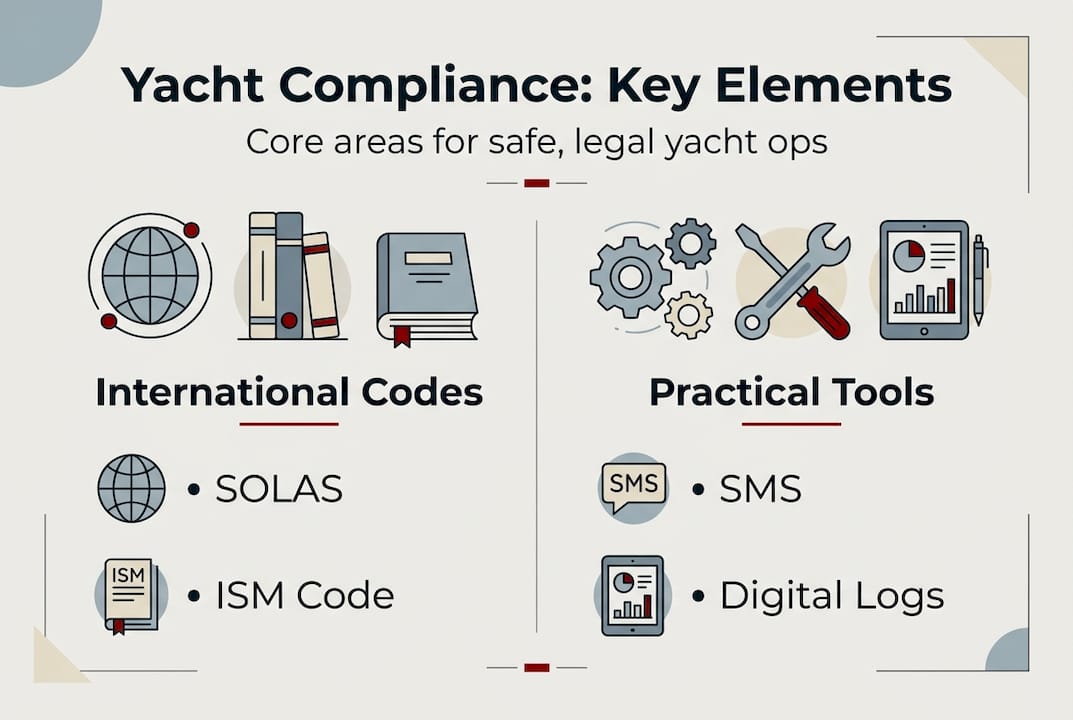
The major international frameworks every owner should know:
- SOLAS (Safety of Life at Sea): Sets minimum safety standards for construction, equipment, and operation.
- MARPOL: Governs pollution prevention, covering oil, sewage, garbage, and air emissions.
- STCW (Standards of Training, Certification and Watchkeeping): Defines crew qualification requirements globally.
- MLC (Maritime Labour Convention): Protects crew rights and working conditions.
- ISM Code (International Safety Management): Requires a documented Safety Management System for vessels over certain thresholds.
Beyond conventions, SMS implementation and classification society inspections are key methodologies. Bodies like Lloyd’s Register and ABS conduct surveys and audits that validate your vessel’s seaworthiness and operational standards. Crew certification records must be current and accessible at all times.
| Framework | Primary focus | Applies to |
|---|---|---|
| SOLAS | Safety equipment and construction | Most commercial vessels |
| MARPOL | Environmental protection | All vessels |
| STCW | Crew training and certification | Professional crew |
| MLC | Crew welfare and labor rights | Commercial yachts |
| ISM Code | Safety management systems | Vessels over 500 GT |
Digital tools are increasingly essential for tracking compliance deadlines, survey dates, and documentation renewals. Review the registration requirements overview for 2026 specifics, and consult the complete yacht registration guide for a step-by-step walkthrough. CISR inspection benchmarks provide useful data on how flag states perform under real-world port state control scrutiny.
Compliance in action: commercial vs. private yachts
The rules do not apply uniformly. Whether your yacht is used commercially or privately changes your regulatory burden significantly, and misclassifying your vessel’s use is one of the most expensive mistakes you can make.
| Factor | Commercial yacht | Private yacht |
|---|---|---|
| Applicable code | Red Ensign Group Yacht Code | Flag state minimum standards |
| Port state controls | Frequent and rigorous | Less frequent but still applicable |
| VAT obligations | Complex, use-dependent | Simpler, but EU rules still apply |
| Crew certification | Full STCW compliance required | Reduced requirements |
| ISM Code | Often mandatory | Generally not required |
The commercial vs. private use distinction affects which rules apply and how they are enforced, particularly around EU customs and VAT. For example, EU Temporary Admission rules allow non-EU flagged yachts to cruise EU waters without paying import VAT, but enforcement is inconsistent. France may require a third-country port call to restart the Temporary Admission clock, while other member states do not. Owner private use on a charter yacht can trigger VAT clawback and input tax deduction denials.
These are not edge cases. They are scenarios that catch experienced owners off guard. Understanding the common pain points in compliance before you encounter them is far cheaper than resolving them after the fact.
Pro Tip: If your yacht is used for both private and charter purposes, document every trip meticulously. The line between private and commercial use is exactly where tax authorities and port state inspectors focus their attention.
The tangible benefits: insurance, efficiency, and reputation
Compliance is not just about avoiding penalties. It actively improves your operations and your bottom line. The numbers back this up.

Proactive SMS and digital tracking yields measurable insurance premium reductions and operational efficiency gains. Insurers reward documented safety cultures with better terms. Underwriters look at your inspection history, your SMS documentation, and your crew certification records before quoting.
On the port state control side, the data is compelling. CISR reported only 3 commercial yacht detentions in Paris MoU inspections in 2022 and zero in 2023 for yachts with strong compliance profiles. Yachts with ISM and SMS frameworks in place consistently show fewer deficiencies during inspections.
The practical benefits of strong compliance include:
- Lower insurance premiums tied to documented safety management
- Faster port clearance with fewer inspector queries and deficiency notices
- Crew retention because certified, well-trained crew prefer compliant vessels
- Resale value protection since buyers and brokers scrutinize compliance history
- Reputation with port authorities that translates into smoother operations season after season
Pro Tip: Build a digital compliance calendar with automated reminders for survey dates, crew certification renewals, and documentation expiry. Missing a single deadline can cascade into a vessel detention at the worst possible moment.
Explore valid registration strategies to keep your vessel’s status current and your operations uninterrupted.
Navigating 2026 trends and emerging risks
Regulatory pressure on yacht owners is intensifying in 2026. Several significant changes are reshaping what compliance looks like, and owners who wait to adapt will face avoidable costs.
Key 2026 developments to track:
- EU ETS and FuelEU Maritime: Stricter EU emissions regulations now apply to large yachts over 5,000 GT operating in European waters, with reporting and cost obligations that require advance planning.
- Anti-money laundering (AML) requirements: High-value yacht transactions face increased scrutiny, with enhanced due diligence now expected for large deals across multiple EU jurisdictions.
- Malta CYC updates: Malta’s Commercial Yacht Code has been updated, affecting owners registered under the Maltese flag who operate commercially.
- Digital PMS adoption: Planned Maintenance Systems that are fully digital are reducing survey deficiencies and becoming an informal expectation during inspections.
- Safety culture audits: Inspectors are increasingly evaluating not just documentation but actual crew behavior and safety culture onboard.
The Mediterranean compliance landscape is also shifting, with charter hubs tightening local enforcement alongside international frameworks. Review efficient registration in 2026 to align your registration strategy with current requirements.
Pro Tip: Update your compliance calendar before peak season, not during it. Regulatory changes announced in early 2026 often have implementation timelines that catch owners mid-charter season without adequate preparation.
Secure smooth sailing: expert help for yacht compliance and registration
Yacht compliance is manageable when you have the right systems and the right support in place. The challenge is that the rules are layered, jurisdiction-specific, and constantly evolving. Trying to track every flag state update, international convention change, and EU customs nuance on your own is a full-time job.
Şu anda VesselFlag.com, we specialize in cutting through that complexity. Whether you are deciding between yacht vs boat registration options, working to maintain registration validity across multiple jurisdictions, or registering your yacht for the first time under a new flag, our team provides expert guidance at every step. We handle the documentation, the flag state coordination, and the compliance tracking so you can focus on your operations. Reach out to us for a personalized compliance review before your next season begins.
Frequently asked questions
What is the flag state, and why does it matter for yacht compliance?
Your flag state sets the legal framework your vessel operates under, including which international conventions apply and what inspections are required. Flag state regulations directly determine your compliance obligations and your vessel’s standing with port authorities worldwide.
Are commercial yachts regulated differently than private yachts?
Yes. Commercial yachts must meet stricter standards including codes like the Red Ensign Group Yacht Code, while private yachts carry lighter obligations. However, commercial vs. private distinctions are enforced inconsistently across EU member states, creating real risk for owners who misclassify their vessel’s use.
What are the main risks of non-compliance for yacht owners?
Non-compliance can result in fines, vessel detention, voided insurance, and denied port access. In the EU specifically, fragmented enforcement creates unexpected VAT liabilities that can reach significant sums for owners who mismanage Temporary Admission rules.
How can digital tools improve yacht compliance management?
Digital systems automate reminders for survey dates, crew certification renewals, and documentation deadlines. Digital tracking tools reduce missed deadlines and give inspectors confidence that your vessel is actively managed rather than reactively patched.
What new compliance trends should owners watch for in 2026?
The biggest shifts involve EU ETS and FuelEU emission rules for large yachts, anti-money laundering requirements for high-value transactions, and the growing expectation of digital planned maintenance systems during port state control inspections.
Tavsiye edilir
- Transparent Compliance: The Anchor of Safe, Efficient Yacht Ownership – Vessel Flag
- Transparent Compliance: The Compass for Confident Yacht Ownership – Vessel Flag
- Yat Kaydı ve Uyumluluğunda Karşılaşılan En Önemli Zorluklar ve Bu Zorlukları Güvenle Aşmanın Yolları - Vessel Flag
- Yacht documentation for compliance and registration 2026
- What is a sailing yacht? A 2026 guide for Mediterranean charters