
A T2L is the document that proves a yacht has Union status: it is treated as an EU-status good, not an import. For a yacht owner, that usually means proof that VAT was settled in the EU. GOV.UK describes it as proof that goods have Union status regardless of their value, and it is now an electronic record held on the Proof of Union Status (PoUS) system, not a stamped paper form. Most owners never need one. When you do, it is because someone has a reasonable doubt about where your boat has been or whether VAT was paid. This guide explains when that happens, what to ask for, and how to apply. At Vessel Flag we prepare yacht registrations and ownership paperwork, so we see how often missing proof of status slows a file down.
Özetle
- A T2L proves that a yacht has Union (EU) customs status. It is not a registration certificate and not a VAT receipt, although it rests on VAT having been paid.
- The European Commission’s 2026 guidance says proof should be requested only in exceptional cases. A yacht kept in the EU is presumed to be Union goods.
- T2L is for movements within the EU customs territory. T2LF is the version for movements involving special fiscal territories.
- Since 1 March 2024 T2L and T2LF applications run through the electronic PoUS system. Paper T2Ls are being replaced.
- A T2L issued before the end of the Brexit transition period is no longer valid. A UK-owned boat lying in the EU needs a fresh request.
İçindekiler
- What a T2L actually proves about a yacht
- When you really need one
- T2L, T2LF and the other ways to prove status
- UK-owned yachts after Brexit
- How to obtain a T2L through PoUS
- The evidence customs look at
- A worked example
- Where Vessel Flag fits in
- Our view on proof of Union status
- SSS
- Kaynaklar
What a T2L actually proves about a yacht
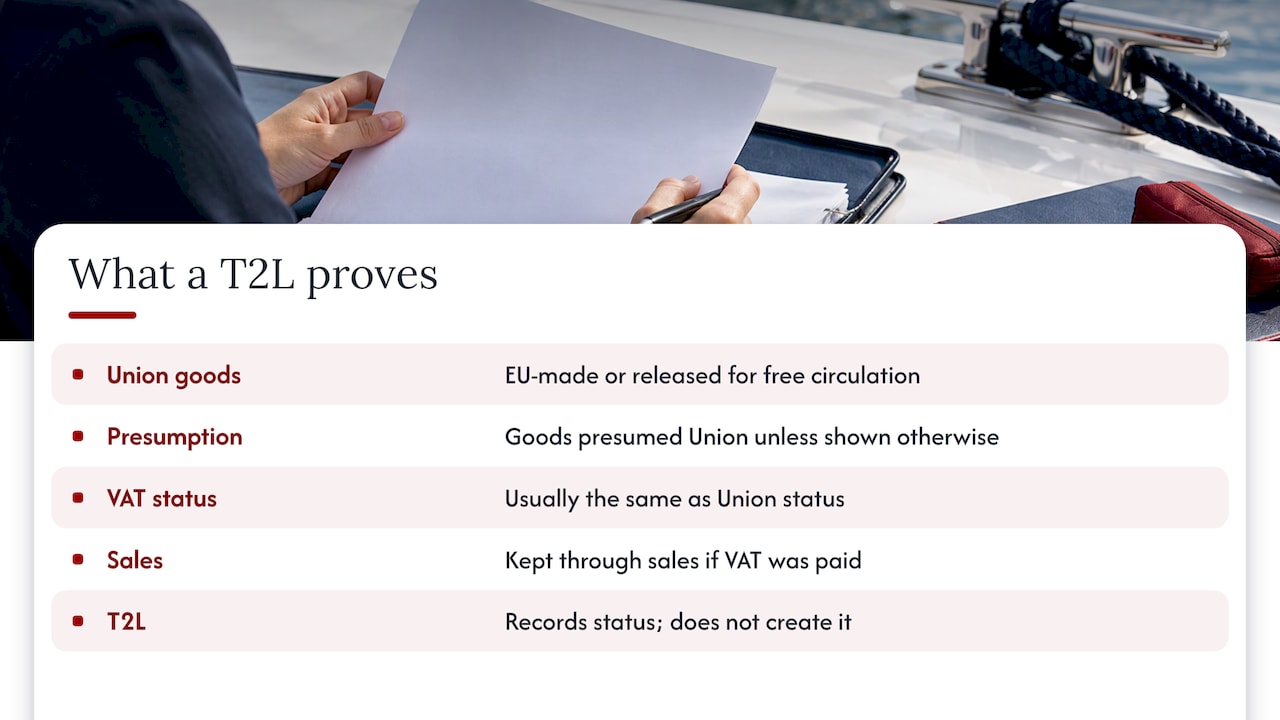
Customs law sorts goods into Union goods and non-Union goods. Union goods are, in short, goods made in the EU or goods that were imported and released for free circulation, meaning duty and VAT were dealt with. The Commission’s Guidance Note for Pleasure Craft (30 April 2026) confirms that pleasure craft in free circulation in the EU27 customs territory have the customs status of Union goods.
The guidance also says that all goods in the EU customs territory are presumed to be Union goods unless shown otherwise. The trade phrase “VAT paid status” is in most cases the same thing as Union status, and a craft keeps that status through repeated sales provided the VAT was paid.
So a T2L is a certificate of something your boat already has. It does not create the status. It records it in a form customs officers will accept.
What it does not prove
A T2L does not show ownership, flag, or insurance. It says nothing about CE marking or RCD compliance. Those are separate questions. If you are bringing a boat across a border and want the whole picture, our guide to RCD compliance for yachts covers the product-safety side that sits alongside customs status.
When you really need one
This is the point most forum threads get wrong. The Commission’s 2026 guidance says owners need to demonstrate Union status only in rare cases. There is no general requirement to prove it after every return to your berthing port, and T2Ls should be requested only in exceptional cases.
The reason is the temporary-movement rule. Union goods lose their status the moment they leave the EU customs territory. But under Articles 154(a) and 155 of the Union Customs Code and Article 119(2)-(3) of the Delegated Act, they may move temporarily outside it without the status being altered. A normal cruise to a non-EU harbour and back therefore does not by itself wipe out your VAT-paid position.
In practice a T2L becomes useful in situations like these:
- You are buying a second-hand yacht and the seller cannot produce the original invoice or proof of VAT.
- The boat is moving between two EU ports by a route through international waters, or being shipped via a non-EU port, so there is a reasonable doubt about its status on arrival.
- The yacht is travelling to or from an EU territory with a different fiscal regime, such as certain islands, where the T2LF applies.
- A customs or harbour officer challenges the boat’s status and you have no other clear evidence.
- A UK-owned yacht lying in the EU needs fresh evidence after Brexit.
If none of these applies, a well-kept document file is normally enough.
T2L, T2LF and the other ways to prove status
The T2L is the best-known tool but not the only one. Article 199 of the Implementing Act, as summarised in the Commission guidance, lists five accepted means:
- a T2L or T2LF document;
- the customs goods manifest;
- a shipping company’s manifest;
- a properly completed invoice or transport document showing only Union goods and carrying the code “T2L” or “T2LF”;
- an original invoice or sales contract with proof of VAT payment.
| Evidence | What it covers | Typical use for a yacht |
|---|---|---|
| T2L | Goods in free circulation moving within the Union customs territory | Second-hand purchase without invoice trail, sea route through international waters |
| T2LF | Goods moving to or from a special fiscal territory of the EU | Yacht going to or from a territory with different VAT rules |
| Original invoice or sales contract with proof of VAT | The status of the boat at the time of that sale | Most owners, when they hold the paperwork |
| Manifest or transport document | Carriage on a cargo ship | Yacht transport on a deck cargo vessel |
The difference between T2L and T2LF matters. GOV.UK explains that a T2LF additionally indicates the goods come from a Special Territory of the EU and may be subject to VAT on arrival in Northern Ireland or elsewhere in the EU. Ireland’s Revenue sets out the same split: the T2L is for goods in free circulation within the Union customs territory, and the T2LF for movements involving special fiscal territories (Revenue PoUS Phase 1 document). Spain’s Tax Agency describes the T2LF as copy No. 4 of the Single Administrative Document, the standard customs declaration form (Spanish Tax Agency manual).
Choosing between T2L and T2LF depends on route and destination. Settle it before the boat sails, not at the quay.
UK-owned yachts after Brexit
For British owners this is the most common trigger. The RYA’s Boating Abroad guidance notes that T2L proofs issued before the end of the Brexit transition period are no longer valid in the EU. The European Commission advised that, for a boat lying in the EU, the person concerned needs to submit a new request to obtain proof of Union status.
Two practical consequences follow:
- A T2L in your old paperwork folder from 2019 or 2020 does not help you now.
- If your boat was in the EU before Brexit and stayed there, the evidence of VAT payment and the chain of ownership matter more than any old form.
If instead you are bringing a yacht into Great Britain from outside, you are dealing with import VAT and duty, not Union status. That route is covered in our guide on how to import a yacht into the UK.
How to obtain a T2L through PoUS
The procedure changed in recent years. The Commission’s PoUS page states that Phase 1, covering T2L and T2LF data, went live on 1 March 2024, and Phase 2, covering the Customs Goods Manifest, on 15 August 2025. The electronic system replaces the paper T2L/T2LF and shipping-company-manifest procedures.
Step 1: Get your access in order
Traders reach PoUS through the EU Customs Trader Portal using the UUM&DS identity system. You need a valid EORI number (the EU customs registration number for a business or person) and the right roles on your account. Spain and Poland use their own national portals or other national means. In Ireland, Revenue’s page on the electronic system adds a ROS digital certificate and an EORI registered for Customs and Excise, and says responsibility can be delegated to a customs representative.
This is the step where private owners lose most time. If you do not already have an EORI number or portal access, ask whether an authorised customs representative should file for you.
Step 2: Create the proof request
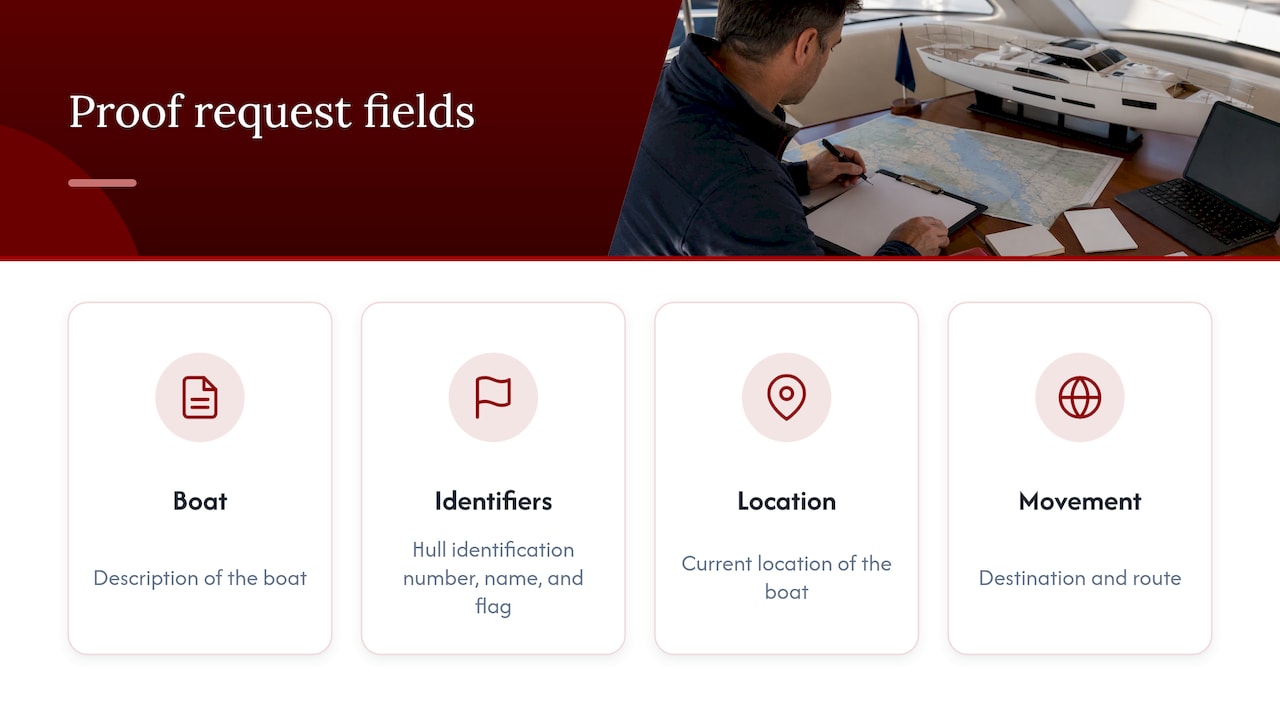
The trader creates a T2L(F) proof request in the PoUS Specific Trader Portal. You describe the boat and the movement: where it is, where it is going, and by what route. Match the identifiers to your registration papers, including the hull identification number and the name and flag shown on the certificate.
Step 3: Customs assesses the request
The Competent Customs Office assesses the request and may ask for further documents or controls. Have the evidence ready (see below). If the controls are satisfactory, the proof is registered and a Master Reference Number (MRN) is issued.
Dutch Customs notes that an authorised issuer receives an MRN after applying in the new system without customs intervention, and that the application status can be looked up (Dutch Customs PoUS Q&A). Most private owners will not hold that authorised status, so expect an assessment.
Step 4: Download and carry the status registration document
Once registered, the trader downloads the Status Registration Document (SRD). Keep the MRN and the SRD with the ship’s papers. Because the record sits in the electronic system, an officer can verify it by the MRN.
The evidence customs look at
There is no single mandatory document for a pleasure craft. In practice the file customs will find convincing contains:
- the original build invoice or purchase invoice showing VAT;
- import declarations, if the boat was ever imported;
- payment records for that VAT;
- the full chain of bills of sale from builder to you;
- the current registration certificate and your own proof of identity and address.
Gaps in the chain are the usual problem on older yachts, particularly when a boat has been through several owners and flags. If you are buying a boat and the seller has no proof of VAT, treat it as a price and timing issue before you sign, not after. Where the purchase is being financed, lenders also look for a clean paper trail, and the vessel financing options available to owners are easier to line up when the vessel’s status is already documented.
Proof of address is a recurring snag in ownership files. Registries and customs offices want recent, matching documents, and our page on Yat tescili için adres kanıtı lists what registries accept. Documents issued abroad may also need legalising before an authority accepts them, which we cover in consular legalisation of yacht documents.
A worked example
A British owner buys a 2005 motor yacht lying in a Mediterranean marina. The seller has the bill of sale but cannot find the original invoice. The owner plans to move the boat to another EU port, with a leg through international waters.
- The owner gathers every document that shows VAT was paid at some point: previous bills of sale, an old survey, marina records and any import papers.
- Because of the route and the missing invoice, the owner decides a T2L is sensible. The route stays between EU ports, so T2L rather than T2LF is the right type, but the owner confirms this in advance.
- The owner, or a customs representative acting for them, submits the request through PoUS and answers any customs queries.
- With the MRN and SRD on board, the passage goes ahead, and the owner has an answer if a harbour officer asks about status.
Note what the owner did not do: pay VAT twice. The T2L is there to demonstrate that VAT is already settled, not to charge it again.
Where Vessel Flag fits in
Customs filing is a step the law gives to the customs authority, so the T2L itself is issued through the official system. Around it, owners need a registered vessel, a sound ownership structure and a tidy paper file. Vessel Flag is a private consultancy: we prepare and file yacht registration applications, and the flag registries issue the certificates. The service is fully remote, with published one-off prices.
- UK Part 1 registration from €550, with owners able to register personally if eligible, through an existing company (UK or an eligible foreign one, such as a Delaware corporation) or through a new UK LTD: UK Part 1 yacht registration.
- Poland from €320 and San Marino from €290, each one-off.
- Company formation for yacht ownership, from €455: şirket kuruluşu.
- MMSI radio licences with VAT included and no annual fees: €149 in Poland, €150 in the UK and €200 in San Marino.
- Insurance, yacht transportation and compliance consultancy through our hizmetler sayfası.
If you are unsure whether your yacht’s papers will stand up to a customs query, send us the registration and purchase documents and we will help you organise the file around the right flag.
Our view on proof of Union status
Owners tend to meet the T2L at the worst moment: a boat is about to move, a buyer is waiting, and the invoice is in a drawer in another country. The Commission’s own guidance says proof should be needed only in exceptional cases, and we agree with the spirit of that. The best protection is a boat whose paperwork was built properly from the start.
That means a registration under a flag that suits how you use the yacht, an ownership structure that matches the way you hold it, and a document file in which every certificate agrees with the others on names, addresses and hull details. Mismatches between documents cause more delay than any customs form.
We prepare and file registrations under Poland, San Marino, UK Part 1, Malta, Palau, the Marshall Islands, the Cayman Islands and the Cook Islands, and we can arrange company formation, MMSI licences and transfers between flags. Doing these together, remotely and at published prices, gives an owner one coherent file that is ready when customs, a broker or a lender asks for it.
Gemi Bayrağı
SSS
Does every yacht need a T2L?
No. The Commission’s 2026 guidance presumes a boat used solely in the EU to be Union goods, and says T2Ls should be requested only in exceptional cases. You need one only when your status is genuinely in doubt, for example after a move through international waters or when you cannot show proof of VAT.
What is the difference between T2L and T2LF?
A T2L is used for goods in free circulation moving within the EU customs territory. A T2LF is used where the movement involves a special fiscal territory of the EU, and it signals the goods may be subject to VAT on arrival. Confirm which one your route needs before you apply.
Can I still use a paper T2L?
The PoUS system, live since 1 March 2024, replaces the paper T2L and T2LF procedures with an electronic record. Apply through the portal for your country, and keep the MRN and Status Registration Document with the boat’s papers.
My UK yacht has an old T2L from before Brexit. Is it valid?
No. T2L proofs issued before the end of the Brexit transition period are no longer valid in the EU, according to the RYA. For a boat lying in the EU, a new request for proof of Union status is needed.
Does a T2L replace my registration or VAT invoice?
No. It proves customs status only. Your registration certificate, issued by the flag registry, and your VAT invoice or equivalent evidence still matter and are what the T2L request is built on.
Kaynaklar
- Get proof your goods have Union (EU) status, GOV.UK
- Guidance Note for Pleasure Craft, European Commission
- Proof of Union Status system, Taxation and Customs Union
- PoUS Electronic System: Phase 1 T2L/T2LF, Revenue Ireland
- Electronic PoUS system for T2L / T2LF, Revenue Ireland
- POUS: questions and answers, Dutch Customs
- T2L or T2LF documents, Spanish Tax Agency
- Entry and Exit Formalities, RYA Boating Abroad
Ready to put the registration side in order? See our UK Part 1 yacht registration page or get a consultation and tell us about your yacht.
Tavsiye edilir
- Yat Belgelerinin Konsolosluk Tarafından Onaylanması: Ne Zaman İhtiyaç Duyarsınız?
- Yat Tescili İçin Adres Kanıtı: Sicillerin Kabul Ettikleri
- Tescil için yat belgesi çevirisi: neler çevrilmeli
VesselFlag is a private consultancy that prepares and files yacht registration applications for owners. We are not a government body or flag registry; certificates are issued by the relevant registry. This article is general information, not legal advice.