
Preparing your paperwork? Use our full yat tescil belgeleri kontrol listesi – Vessel Flag prepares all documents for you.
Most US boat owners do not need an FCC Ship Radio Station License — but three specific situations change that answer immediately. Under FCC rules, you must obtain a license if your vessel (1) is required by law or treaty to carry a radio, (2) travels to foreign ports or communicates with foreign coast or ship stations, or (3) carries radio equipment beyond standard VHF, radar, or EPIRBs — such as MF/HF, SSB, satellite terminals, or certain DSC/AIS setups. If none of those apply, your vessel is likely “licensed by rule” and no FCC filing is required. Applications go through the FCC Universal Licensing System (ULS), and the governing regulation is 47 CFR Part 80.
Önemli Noktalar
A US boat owner needs an FCC Ship Radio Station License if any one of three conditions applies: required by law, traveling to foreign ports, or carrying equipment beyond VHF/radar/EPIRB.
| Nokta | Detaylar |
|---|---|
| Three-trigger test | Required by law, foreign ports/communications, or non-VHF equipment — one “yes” means file Form 605. |
| Forms to file | Complete Form 605 Schedule B in ULS and attach Form 159 for fee payment; missing fees cause dismissal. |
| MMSI and DSC/AIS | DSC-capable VHF, AIS transceivers, and satellite terminals all trigger MMSI assignment through the FCC during licensing. |
| Operator permit (RR) | The Restricted Radiotelephone Operator Permit is a separate, lifetime-valid authorization required for foreign-port operations; no exam needed. |
| Vesselflag assistance | Vesselflag handles ULS filing, MMSI registration, and fleet or transfer applications to reduce rejection risk. |
İçindekiler
- Who must hold an FCC ship station license?
- When you do NOT need a license — exemptions and misconceptions
- What types of ship radio authorizations exist?
- How to apply for a ship radio station license in the FCC ULS
- MMSI, DSC, AIS, and satellite equipment — what triggers separate registration
- Restricted Radiotelephone Operator Permit — who needs it and how to apply
- Fleet licensing, renewals, transfers, and selling a vessel
- On-board operating responsibilities and penalties for unlicensed operation
- Quick checklist: do you need a ship station license?
- When does hiring a licensing service make sense?
- Vesselflag handles the paperwork so you can focus on the water
- Kaynaklar
- SSS
Who must hold an FCC ship station license?
The FCC’s three-item test, codified in 47 CFR Part 80 Subpart B and reflected directly in Form 605 Schedule B, is the official decision gate. Answer “yes” to any one of the following and a license is required:
- Item 1 — Required by law or treaty: The vessel is inspected, certificated, or otherwise mandated by federal law or international treaty to carry radio equipment. This covers inspected passenger vessels, commercial fishing vessels over applicable tonnage thresholds, and vessels subject to SOLAS.
- Item 2 — Foreign ports or foreign communications: The vessel travels to any foreign port (Bahamas, Canada, Mexico, and beyond) or communicates with foreign coast stations or foreign ship stations. Entering a foreign port alone triggers this requirement, regardless of equipment type.
- Item 3 — Equipment beyond VHF/radar/EPIRB: The vessel carries MF/HF radios, SSB transceivers, satellite communication terminals, or DSC/AIS equipment that goes beyond a basic VHF/radar/EPIRB setup.
Real-world examples:
- A weekend recreational boater who stays in US waters and carries only a fixed-mount VHF and a radar unit: no license required. That vessel is “licensed by rule.”
- A cruising yacht with an SSB radio or INMARSAT terminal, even if it never leaves US waters: license required under Item 3.
- A sportfishing boat that runs day trips to the Bahamas with only a VHF: license required under Item 2. The USCG Navigation Center explicitly flags foreign-port travel as a hard trigger.
- A commercial passenger vessel operating on US inland waters that is Coast Guard inspected: license required under Item 1.
Vessels with AIS transceivers also fall under Item 3. The FCC equipment guidance specifies that MF/HF, SSB, and satellite terminals trigger licensing, and that VHF radios must transmit on Channel 16 and at least one other channel and be type-accepted to meet technical requirements.
When you do NOT need a license — exemptions and misconceptions
The “licensed by rule” concept is the most misunderstood part of US ship radio licensing. Here is what it actually means and what it does not.
Myth vs. fact:
- Myth: Every boat with a VHF radio needs an FCC ship station license. Fact: Voluntary domestic vessels using only VHF, radar, or EPIRBs are licensed by rule under FCC regulations and need no individual license for domestic operations.
- Myth: A ham radio license covers marine radio use. Fact: An amateur radio license does not authorize transmissions on marine frequencies and cannot substitute for a ship station license or MMSI registration.
- Myth: Getting an MMSI from BoatUS or Sea Tow means you have an FCC license. Fact: Third-party MMSI providers serve voluntary domestic vessels that do not need an FCC license. If your vessel later requires a license, the FCC issues a new MMSI during that process — the third-party MMSI cannot be used in a ULS application.
- Myth: Your ship station license covers handheld VHF use on land. Fact: A ship station license covers the vessel, not shore-based use. A handheld marine VHF used ashore may require a separate marine utility station license.
Profesyonel İpucu: If you plan to cross into Canadian or Bahamian waters even once, get the license before you leave the dock. Customs officials in foreign ports routinely check for both the ship station license and the Restricted Radiotelephone Operator Permit. Missing either can mean delays, fines, or denial of entry.
Relying on incorrect assumptions about exemptions is a real enforcement risk. The FCC’s rules are not ambiguous on the foreign-port trigger — the moment your keel crosses into foreign waters, the exemption ends.
What types of ship radio authorizations exist?
Not all ship station licenses are the same. The FCC recognizes several authorization types under Part 80, and choosing the wrong one creates filing errors that delay or void your application.
Regular (single-ship) license: Covers one specific vessel, identified by its official documentation number or state registration number. This is the standard authorization for most owners. License term is ten years.
Fleet license: A single application that covers multiple vessels under common ownership. Administratively convenient for operators with several boats — but with a critical restriction. Fleet licensing is not available for any vessel that requires an MMSI (meaning any vessel with DSC-capable equipment or an AIS transceiver). Those vessels must each be individually licensed.
Portable ship station license: Covers portable radio equipment that moves between vessels. Less common, but relevant for operators who use the same equipment on multiple boats without a fixed installation.
Marine utility station: Covers handheld VHF use in certain shore-based or near-shore scenarios. This is the authorization that fills the gap when a ship station license does not cover land use.
| Authorization type | MMSI required? | Ships covered | Typical use case |
|---|---|---|---|
| Regular (single-ship) | Yes, if DSC/AIS present | One vessel | Most recreational and commercial owners |
| Fleet license | Not allowed if DSC/AIS present | Multiple vessels, common owner | Multi-vessel operators without DSC/AIS |
| Portable ship station | Depends on equipment | Equipment, not vessel | Operators sharing portable gear |
| Marine utility station | HAYIR | Shore/near-shore use | Handheld VHF used ashore |
For AIS licensing specifics and how Class A versus Class B equipment affects your filing type, the equipment classification matters before you choose an authorization category.
How to apply for a ship radio station license in the FCC ULS
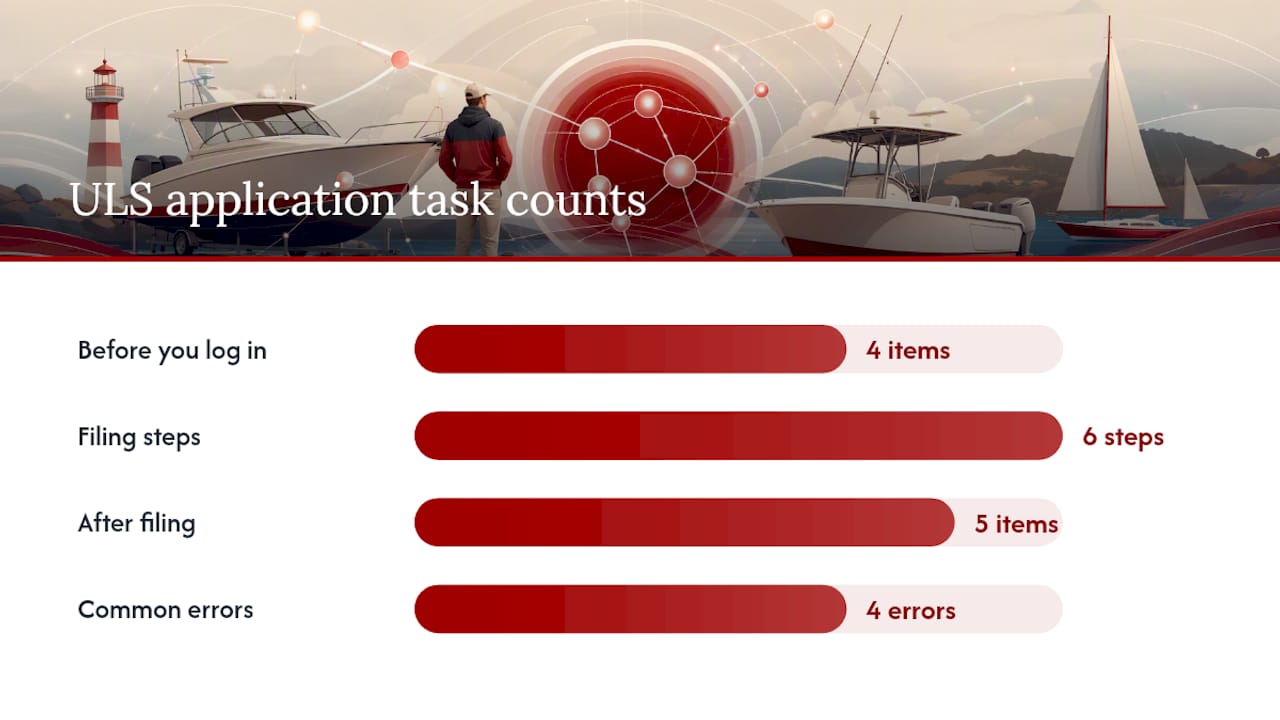
The application process runs entirely through the FCC’s Universal Licensing System. Here is the sequence:
Before you log in:
- Register for an FCC Registration Number (FRN) through the CORES system at fcc.gov if you do not already have one. Every applicant needs an FRN to file.
- Gather your vessel documentation: US Coast Guard documentation number or state registration number, vessel name, call sign (if renewing), and home port.
- List all onboard radio equipment: VHF model and type acceptance number, MF/HF or SSB details, satellite terminal model, DSC capability, and AIS transceiver class.
- Note your MMSI if you already have one from a prior FCC license. Third-party MMSIs are not transferable to ULS.
Filing steps in ULS:
- Log in to ULS and select “Apply for a New License.”
- Choose the Ship Radio Service (Part 80) schedule.
- Complete Form 605 Schedule B — answer Items 1, 2, and 3 accurately. These yes/no answers determine your eligibility and are the most scrutinized part of the application.
- Enter vessel identification details, equipment list, and MMSI/DSC information where applicable.
- Complete Form 159 for fee payment, or pay directly through the FCC fee portal. Missing the fee payment is one of the most common reasons applications are dismissed outright.
- Submit and retain your confirmation number.
After filing:
- The FCC issues electronic authorizations via ULS. No paper license is mailed unless you request one.
- When temporary authority applies, it is valid for 90 days from the filing date.
- The license term is ten years. Renewal windows open 90 days before expiration.
Common ULS errors to avoid:
- Selecting “fleet” when any vessel has DSC or AIS equipment.
- Leaving the fee payment step incomplete (Form 159 omission).
- Using a third-party MMSI in the MMSI field — ULS will not accept it.
- Misidentifying vessel status (voluntary vs. required-by-law) on Item 1.
Profesyonel İpucu: Save a PDF copy of your ULS confirmation and the issued authorization. Keep both onboard at all times — FCC rules require the license to be on the vessel during operation.
MMSI, DSC, AIS, and satellite equipment — what triggers separate registration
The MMSI number is a nine-digit identifier tied to your vessel’s digital radio identity. It is not the same as a ship station license, but the two are linked when certain equipment is aboard.
Equipment that triggers MMSI registration:
- DSC-capable VHF radios (any fixed-mount VHF with a DSC controller)
- AIS transceivers (Class A or Class B)
- INMARSAT and other satellite communication terminals
- MF/HF radios with DSC capability
FCC-issued MMSI vs. third-party MMSI:
When your vessel requires an FCC ship station license, the FCC assigns an MMSI as part of the licensing process. That MMSI is tied to your call sign and ULS record. Third-party providers like BoatUS and Sea Tow issue MMSIs for voluntary domestic vessels that do not need a license — acceptable for domestic-only operation, but those MMSIs cannot be ported into a ULS application if you later need a license. The FCC will issue a new one, and you will need to update your radio equipment with the new number.
For AIS compliance specifics, including how to program a new MMSI into your AIS transceiver and DSC controller, the update process requires direct entry into the radio’s setup menu — most manufacturers require a one-time programming cable or dealer reset for AIS units.
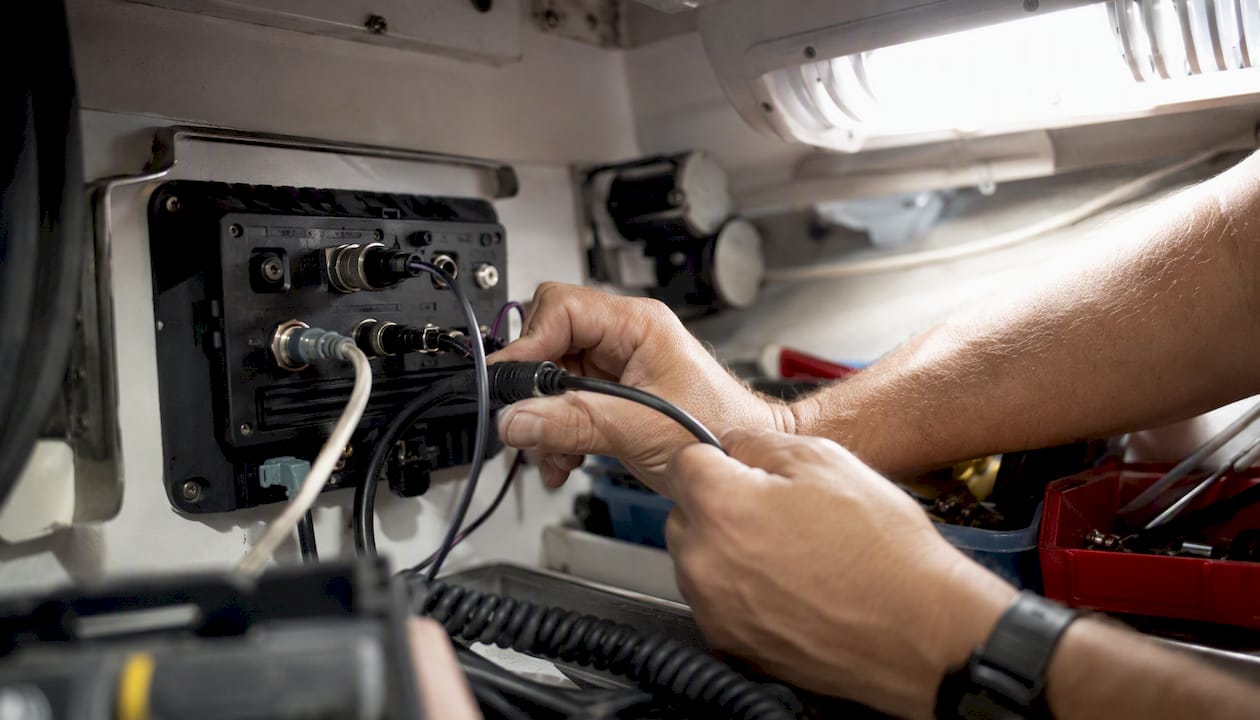
Satellite terminals (INMARSAT, Iridium-based systems) are handled as separate equipment entries in the ULS application. Each terminal’s model and serial number should be listed. INMARSAT terminals also have their own registration with the satellite network operator, separate from the FCC license.
Restricted Radiotelephone Operator Permit — who needs it and how to apply
The Restricted Radiotelephone Operator Permit (RR) is an operator authorization, not a station license. The ship station license covers the radio equipment on the vessel; the RR covers the person operating it in specific circumstances.
Who must hold an RR:
- Anyone who communicates with foreign coast stations or foreign ship stations
- Anyone who docks in a foreign port while operating maritime radio equipment
- Operators of vessels required by law to carry radio equipment
Who does not need one:
- Operators who stay in US waters and only use VHF for domestic communications
- Passengers or crew who do not operate the radio
How to apply:
- File the RR application through ULS, selecting the appropriate operator service category.
- Include Form 159 payment where required.
- No examination is required. The RR is lifetime-valid once issued.
- Carry the physical permit onboard whenever operating in foreign waters. Foreign port officials may request it alongside the ship station license.
The RR and the ship station license are often required together — particularly for any vessel heading to the Bahamas, Canada, or Mexico. Both documents should be stored with the vessel’s other official papers, alongside the call sign and MMSI record.
Fleet licensing, renewals, transfers, and selling a vessel
Licenses do not automatically follow vessels through ownership changes, and missing lifecycle steps creates compliance gaps that surface at the worst times — usually in a foreign port or during a Coast Guard inspection.
Renewals:
- File renewal applications in ULS no earlier than 90 days before the license expiration date.
- Filing after expiration requires a late renewal or a new application, depending on how much time has passed.
- ULS sends email reminders if your FRN account has a current email address on file. Keep it updated.
Transfers and assignments:
- Use Form 603 in ULS to transfer a ship station license when ownership of the vessel changes.
- After the FCC consents to the transfer, the new owner must notify ULS that the transfer has been consummated within 30 days.
- Failing to complete the consummation step leaves the license in limbo and can void the transfer.
Selling a vessel — checklist:
- Notify ULS of the pending sale before closing.
- File Form 603 to initiate the transfer to the new owner, or cancel the license if the buyer will apply fresh.
- Update or cancel the MMSI record associated with the vessel.
- Remove the vessel’s call sign and MMSI from all onboard radio equipment before transfer.
- Keep copies of your authorization records for your own files after the sale.
Fleet license reductions:
If a vessel in a fleet acquires DSC or AIS equipment, it must be removed from the fleet license and individually licensed. File an amendment in ULS to reduce the fleet and file a new single-ship application for the affected vessel.
On-board operating responsibilities and penalties for unlicensed operation
Holding a license is step one. Operating correctly under that license is what keeps you out of enforcement trouble.
Principal on-board duties under 47 CFR Part 80:
- Maintain a watch on Channel 16 (VHF distress and calling frequency) whenever the radio is in use and the vessel is underway, unless the vessel is equipped with a DSC controller that handles automated distress monitoring.
- Relay distress calls from other vessels when received and when you are in a position to assist or forward the call.
- Identify the ship station by call sign or MMSI at the beginning and end of each communication and at least every 15 minutes during extended transmissions.
- Keep the station license and operator permit onboard and available for inspection at all times.
Penalties for unlicensed or improper operation:
The FCC can issue fines, order equipment seizure, or take other administrative enforcement actions against operators who transmit without a valid license, use unauthorized frequencies, or fail to maintain required records. Operating without a license in foreign waters adds a second layer of risk: foreign maritime authorities can detain a vessel, impose local fines, or deny port entry.
If you receive an FCC citation or are subject to an audit, the immediate steps are: preserve all station records and logs, correct any ULS filing errors promptly, and consult a maritime licensing professional or legal counsel before responding to the FCC.
Quick checklist: do you need a ship station license?
Work through these questions in order. One “yes” means you need to file.
- Required by law? Is your vessel inspected, certificated, or mandated by federal law or treaty to carry radio equipment? If yes: file Form 605 in ULS.
- Foreign ports or foreign communications? Does your vessel travel to any foreign port, or do you communicate with foreign coast or ship stations? If yes: file Form 605 in ULS, and apply for the Restricted Radiotelephone Operator Permit.
- Equipment beyond VHF/radar/EPIRB? Does your vessel carry MF/HF, SSB, satellite terminals, or DSC/AIS equipment? If yes: file Form 605 in ULS. Ensure MMSI is assigned through FCC during the process.
If all answers are “no”:
Your vessel is likely licensed by rule. Still, if you have a DSC-capable VHF, register for an MMSI through a third-party provider (BoatUS, Sea Tow) for domestic use. Review the USCG NAVCEN guidance for any updates to operational requirements.
Immediate next steps if you need to file:
- Register for an FRN at fcc.gov/CORES.
- Gather vessel documentation and equipment list.
- Log in to ULS and complete Form 605 Schedule B.
- Attach Form 159 or pay fees through the FCC fee portal.
- Retain your electronic authorization and store it onboard.
When does hiring a licensing service make sense?
Filing in ULS yourself is entirely possible for a straightforward single-vessel application with standard equipment. The process is free of charge beyond the FCC filing fee, and the FCC’s instructions are reasonably clear. That said, several situations make professional assistance worth the cost.
Situations that favor a licensing service:
- Your vessel carries SSB, MF/HF, or satellite equipment and you are unsure how to classify it in Form 605.
- You travel internationally frequently and need both the ship station license and RR in place before departure.
- You manage a fleet of vessels and need to sort out which can be fleet-licensed and which must be individually filed.
- You are buying or selling a vessel and need a clean transfer completed within the 30-day consummation window.
- A prior ULS application was rejected or is in an error state.
Quick self-assessment:
- Do you have one vessel, domestic-only travel, and no DSC/AIS equipment? File yourself.
- Do you have SSB, satellite, or AIS equipment, or plan foreign travel? A service reduces rejection risk significantly.
- Are you managing three or more vessels with mixed equipment? Professional filing handles the fleet/individual split correctly.
The cost of a rejected application is not just the refiled fee — it is the delay, and in a foreign port, that delay has real consequences.
Vesselflag handles the paperwork so you can focus on the water
Sorting through FCC forms, MMSI assignments, and ULS filing errors takes time that most boat owners would rather spend elsewhere. Vesselflag’s MMSI radio licensing service covers the full filing process: ULS account setup, Form 605 completion, MMSI assignment and registration, fleet filing support, and transfer and renewal handling. For owners with SSB, satellite, or AIS equipment, Vesselflag maps each piece of gear to the correct Form 605 entries and flags the DSC/AIS exclusions that trip up fleet applications.
One important note: Vesselflag prepares and submits applications on your behalf, but the FCC issues and approves licenses independently. Approval timelines and decisions rest with the FCC. What Vesselflag eliminates is the risk of a rejected application due to a form error, a missed fee, or an incorrect vessel classification. To get started, visit the MMSI radio licensing service page or review Vesselflag’s maritime documentation checklist to confirm what your vessel needs before filing.
Kaynaklar
This guide maps directly from official FCC and USCG sources to practical checklist steps. Every regulatory claim is drawn from primary sources, not secondary summaries.
- Ship Radio Stations Licensing | Federal Communications Commission
- eCFR :: 47 CFR Part 80 Subpart B – Applications and Licenses
- FCC Radio Licenses – USCG Navigation Center
Regulatory fees and procedural details can change. Verify current fee amounts and any form updates directly on the FCC website before filing.
SSS
Do I need a ship station license for a VHF radio only?
Not for domestic use. Voluntary domestic vessels using only VHF, radar, or EPIRBs are “licensed by rule” under FCC regulations and do not need an individual ship station license as long as they stay in US waters.
Can I use a VHF radio without any FCC license?
Yes, for domestic recreational use on a vessel with only VHF, radar, or EPIRBs. The moment you travel to a foreign port or add DSC/AIS or SSB equipment, a license is required under 47 CFR Part 80.
What is the difference between a ship station license and an MMSI?
A ship station license is an FCC authorization for the radio equipment on your vessel; an MMSI is a nine-digit digital identity number assigned to your vessel for DSC and AIS communications. When your vessel requires an FCC license, the FCC assigns the MMSI as part of that process.
How long does an FCC ship station license last?
Ship station licenses are valid for ten years. Renewal applications can be filed up to 90 days before the expiration date through the FCC ULS portal.
Do I need a separate operator permit to use my ship radio?
Yes, if you communicate with foreign coast or ship stations or dock in a foreign port. The Restricted Radiotelephone Operator Permit (RR) is a separate, lifetime-valid authorization that requires no exam and is filed through ULS.