

Palau yacht registration costs two things added together: the registry’s fee, which depends on the length (or tonnage) of your yacht and a 1, 3 or 5-year term, and the fee of the consultancy that prepares and files the application. Our Palau registration service at Vessel Flag starts from €700, one-off. The registry’s own fee is set by its calculator and is paid once for the whole term, with no annual taxes after that.
This guide breaks the total down for owners, brokers and charter operators: what drives the registry fee, what is already included, what can add cost, and how to plan the figure before you file.
Özetle
- Vessel Flag’s Palau registration service starts from €700, one-off. The registry fee for your chosen term is set by the Palau registry’s calculator.
- Yachts up to 24 m are priced by length and term. Yachts over 24 m are priced by gross tonnage and year of build.
- You choose a 1, 3 or 5-year term and pay for it up front. The registry states there are no annual taxes.
- MMSI registration, call sign and official number are included in the initial registration fee.
- Extra cost usually comes from documents (apostilles, translations, deletion certificate) and, for larger yachts, tonnage measurement.
İçindekiler
- The two parts of the Palau registration cost
- What sets the registry fee
- What the registry fee already includes
- Renewal and annual costs
- Costs that sit around the registration
- Chartering a privately registered Palau yacht
- A recent change worth knowing
- How Palau compares with other flags on cost
- A worked example: budgeting for a 14 m yacht
- Practical steps to a registered yacht
- Promo: Palau registration from Vessel Flag
- Our view on budgeting for Palau
- SSS
- Kaynaklar
The two parts of the Palau registration cost
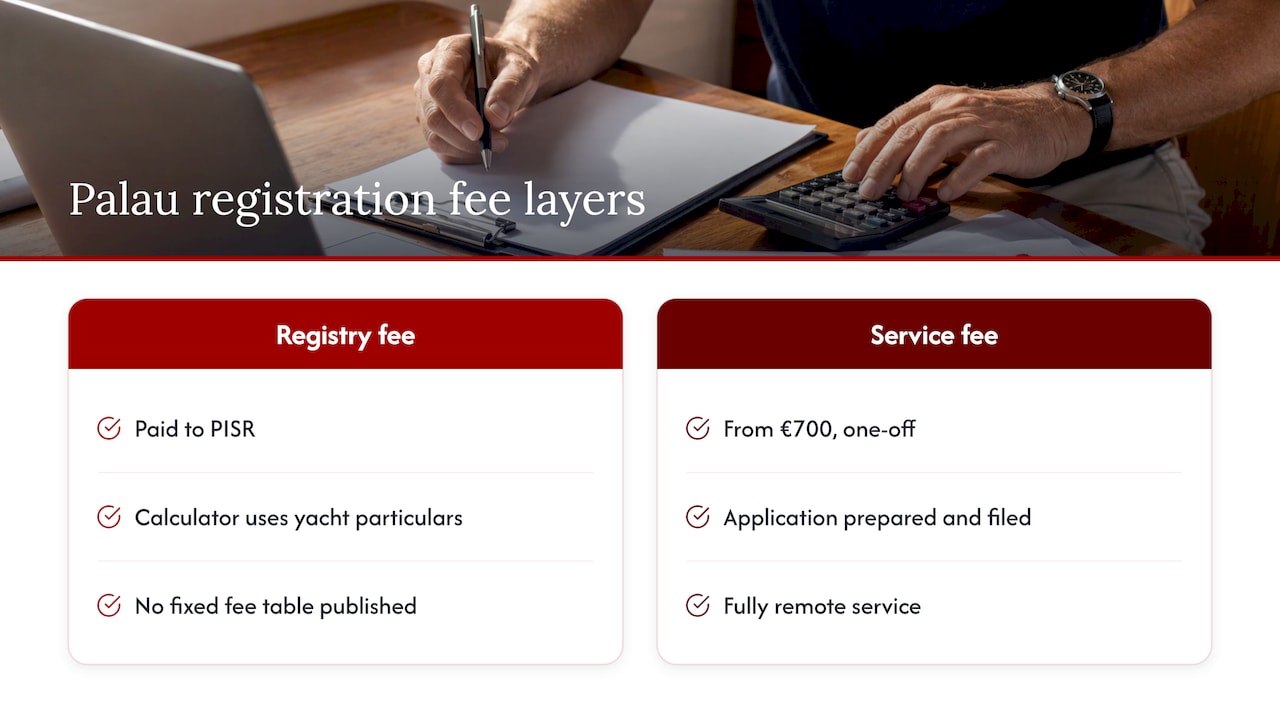
A useful way to budget is to split the total into two layers.
1. The registry fee. This is paid to the Palau International Ship Registry (PISR) and buys the registration itself for the term you select. The official site does not publish a fixed fee table. The registry’s FAQ explains that the amount comes from an online calculator, and the Palau Ship Registry fees page directs applicants to the calculator or a Deputy Registrar for fee enquiries. Because the figure depends on your yacht’s particulars, we calculate it for each vessel rather than quote a single number.
2. The service fee. Vessel Flag is a private consultancy. We prepare and file the application, and the certificates are issued by the Palau registry, not by us. Our Palau registration service starts from €700, one-off. The service is fully remote, so you do not need to travel to Palau or to a registry office.
Keeping the layers separate stops two common mistakes: comparing a consultancy’s fee with a registry’s fee as if they were the same thing, and assuming a low headline number covers the full cost of the chosen term.
What sets the registry fee
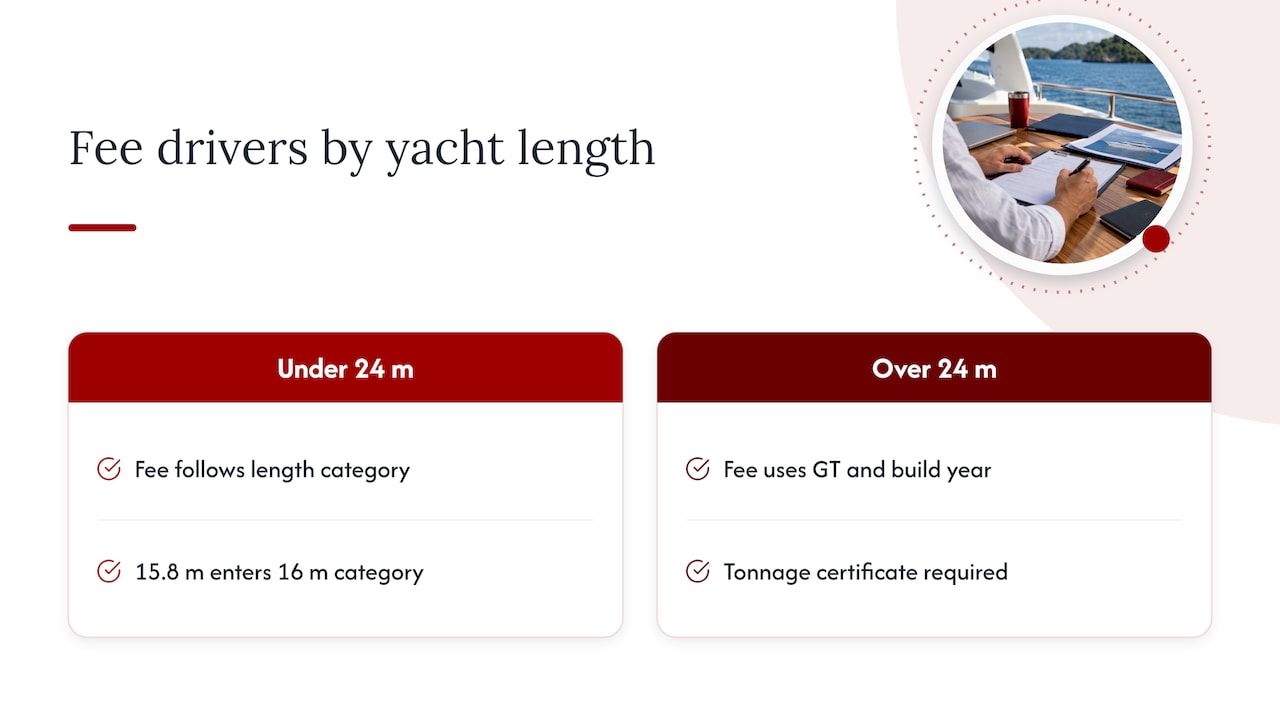
Palau uses four length categories for yachts: up to 12 m, up to 16 m, up to 24 m and over 24 m. Within them, the PISR FAQ (updated 1 October 2025) sets out two pricing logic paths.
| Yacht size | What the registry fee depends on | Term options |
|---|---|---|
| Up to 24 m | Length only | 1, 3 or 5 years |
| Over 24 m | Gross tonnage and year of build | 1, 3 or 5 years |
Source for both rows: PISR FAQ.
Length, tonnage and age
For a motor yacht or sailing yacht under 24 m, the registry fee moves in steps as you go up a length category. If your yacht is 15.8 m, you sit in the 16 m category, so confirm the exact registered length before you budget. A few centimetres over a category line can change the bracket.
Once a yacht passes 24 m, length stops being the main driver. Gross tonnage (GT, the internal volume measure used in ship regulation) and year of build set the fee. An older yacht and a new yacht of identical size can therefore price differently. Gross tonnage also has to be evidenced: a tonnage certificate is required for yachts over 24 m.
The term you choose
You pay for a 1, 3 or 5-year term at registration. A longer term is paid in one go, so it raises the cash you need on day one, but it removes the need to renew. For owners planning to keep the yacht under the Palau flag, a longer term also keeps the cost known from the start. For a short ownership, a 1-year term keeps the outlay smaller. Trade press coverage of the registry’s term options describes the three options as carrying different costs and no annual fee.
What the registry fee already includes
The initial registration fee covers more than a certificate. According to the PISR FAQ, it covers:
- the registration for the selected 1, 3 or 5-year term;
- MMSI registration (the nine-digit identity used by your VHF radio and distress equipment);
- the call sign;
- the official number.
The same FAQ says there are no additional charges for these items and no annual taxes or additional fees for permanent registration. In practice, an owner under another flag who needs a separate radio identity would plan for that as its own cost. Under Palau it sits inside the registration fee, which is one reason the all-in comparison can look better than the headline number suggests.
Palau’s Open Ship Registry law also provides that registration alone does not make the owner a Palau tax resident, and that unpaid fees constitute a maritime lien on the vessel. You can read both points in the Open Ship Registry law (RPPL 8-17). The practical lesson: pay the registry fees on time, because they attach to the yacht itself.
Renewal and annual costs
There is no annual tax to budget. The PISR FAQ says fees for your chosen term are paid at initial registration, and the registration can be renewed for another 1, 3 or 5 years when the term ends. Renewal is a formal application, not an automatic rollover: the registry’s form library lists a separate renewal application alongside the pleasure yacht registration form.
For a five-year ownership plan, put the renewal date in your calendar at the point of registration. If you have registered through us, you can ask us about renewal when the date approaches.
Costs that sit around the registration
The registry fee and our service fee are the core. The items below are what usually move a final total, and they depend on your yacht’s history and where it comes from.
Documents from the previous flag
The PISR FAQ asks for an original application, a deletion certificate from the previous flag, and notarised, apostilled or authenticated proof of ownership. Each of these can carry its own cost:
- Deletion certificate. Proof that the yacht has left its previous registry. If your yacht is moving from another flag, see our guide to the yacht deletion certificate.
- Notarisation and apostille. An apostille is a standard certificate that makes a public document valid in another country that is part of the Hague Convention. Where the issuing country is not part of it, the document may need consular legalisation, which takes longer and costs more.
- Translation. Documents not in English may need a sworn translation.
Tonnage and survey items
For yachts over 24 m, a tonnage certificate is required. The PISR Commercial Yacht Safety Code, effective 12 July 2019, says tonnage measurement for vessels over 24 m must be presented within 30 days of registration and that yachts of 24 m or more in load line length are measured under the 1969 International Tonnage Convention by a Recognised Organisation. A Recognised Organisation is a classification society authorised by the flag to do this work for it, and its fee is separate from the registry’s.
An inspection report may be submitted for a Document of Compliance, and for yachts under 24 m an insurance inspection report may be accepted where there is no inspection report. That can save a separate survey, so tell us which reports you already hold.
Ticari kullanım
If the yacht will be commercial, the registry requires a Minimum Safe Manning application, and for yachts over 24 m a non-encumbrance declaration (a statement that the yacht is free of mortgages and similar claims). Budget time and professional input for both.
Chartering a privately registered Palau yacht
Many owners ask whether a private registration can still earn charter income. ONBOARD Magazine’s Palau Ship Registry feature (13 January 2026) notes a limited charter allowance of 90 days per calendar year for private yachts, without changing the registration category. The PISR FAQ says the same. If the yacht will charter beyond that, the commercial category and its safety code apply, so decide the intended use before you pick the category, since it changes both the paperwork and the cost.
Charter contracts also raise liability questions around crew, passengers and the vessel. Reading up on admiralty and maritime law helps you frame those questions before you speak to a maritime lawyer in your own jurisdiction.
A recent change worth knowing
As of 1 October 2025, the PISR FAQ states that the Port of Registry for all new Palau yacht registrations changed from Malakal Harbor to Koror. It affects the name that appears on the transom and documents of newly registered yachts. Plan any hull lettering and insurance paperwork around Koror.
How Palau compares with other flags on cost
Flag choice is rarely about price alone, but the starting figures help you shortlist. Our published service fees, one-off, are:
| Bayrak | Vessel Flag service fee |
|---|---|
| San Marino | from €290 |
| Polonya | from €320 |
| Marshall Adaları | €250 plus registry fees |
| Cayman Adaları | €450 plus registry fees |
| UK Part 1 | from €550 |
| Palau | from €700 |
| Malta | from €849 |
These are our service fees. Registry fees come on top where stated, and the registry fee for each flag follows its own rules. For a side-by-side view of three popular options, see Poland vs San Marino vs UK Part 1, and for a five-year view of two of them, San Marino vs Poland cost. Where a yacht is not yet decided on Palau, our Malta provisional registration guide shows how a different flag handles the early stage.
A worked example: budgeting for a 14 m yacht
Imagine a 14 m motor yacht coming from another flag. It falls in the 16 m category, so the registry fee depends on that length bracket and the term you choose. A sensible budget has these lines:
- Registry fee for the chosen term, from the calculator (includes MMSI, call sign and official number).
- Vessel Flag service fee, from €700.
- Deletion certificate from the previous flag.
- Notarisation and apostille of ownership proof, plus any translation.
- Insurance, which we can arrange on request through our services page.
A 1-year term keeps line 1 small but means a renewal application next year. A 5-year term moves the whole cost to the start and takes renewal off the agenda. We confirm the registry figure for your yacht when we prepare the application, so you see the full total before you commit.
Practical steps to a registered yacht
- Confirm the use. Private, limited charter or commercial.
- Gather the particulars. Length, gross tonnage for yachts over 24 m, year of build, builder and previous flag.
- Collect ownership documents. Bill of sale or equivalent, with notarisation or apostille as required.
- Obtain the deletion certificate from the previous registry when the yacht is currently registered.
- Choose the term of 1, 3 or 5 years.
- File the application. The registry states that the Provisional Certificate of Registry is issued within 24 hours once all documents are received, so complete documents are what keep the timeline short.
- Complete follow-up items, such as tonnage measurement for yachts over 24 m within 30 days of registration.
Promo: Palau registration from Vessel Flag
We prepare and file Palau yacht and boat registration applications from €700, one-off, and we are a listed agent with the Palau registry. The process is fully remote, and we can also handle the surrounding set-up: company formation for ownership, MMSI and radio licensing, and transfers from another flag. See our Palau boat registration page for details.
If the yacht will be held through a company, our şirket kurma hizmeti covers a UK LTD, a Delaware LLC or a Marshall Islands company, so ownership and flag can be planned together.
Our view on budgeting for Palau
Owners tend to compare flags by the first number they see. We think the better test is the total over the years you intend to keep the yacht.
With Palau, that means looking at the registry fee for the term you choose, plus what is already inside it: MMSI, call sign and official number. It also means counting the document costs around the application, because they are where budgets drift.
We publish our service fees, and Palau starts from €700, one-off. We work across eight flags, so if Palau is not the best fit for your yacht’s size, use or ownership structure, we can say so on the numbers and set up the right flag with you.
The strongest results come from deciding use, term and ownership structure before filing. That is the order we work in, and it keeps the quote you see close to the bill you pay.
Gemi Bayrağı
SSS
How much does Palau yacht registration cost?
Our Palau registration service starts from €700, one-off. The registry’s own fee depends on your yacht’s length, or gross tonnage and year of build above 24 m, and on a 1, 3 or 5-year term. We confirm the full figure for your yacht before you commit.
Are there annual fees after registering in Palau?
The registry states there are no annual taxes. Fees for the selected term are paid at initial registration, and you can renew for a further 1, 3 or 5 years at the end of it. Renewal is a formal application, so note the date.
Is MMSI included in the Palau registration fee?
Yes. The registry says MMSI registration, call sign and official number are included in the initial registration fee with no additional charge. That removes a separate radio identity cost for a Palau-flagged yacht.
What makes the cost higher for larger yachts?
Above 24 m, the registry fee depends on gross tonnage and year of build rather than length, and a tonnage certificate is required. Tonnage measurement must be presented within 30 days of registration, and commercial yachts need a Minimum Safe Manning application.
How quickly can I get a provisional certificate?
The registry says the Provisional Certificate of Registry is issued within 24 hours once all documents are received. The real timeline depends on how quickly your ownership papers and deletion certificate are complete, which is where we help.
Kaynaklar
- Frequently Asked Questions, Palau International Ship Registry
- Fees & Requirements, The Palau Ship Registry
- Open Ship Registry, RPPL 8-17 (FAOLEX)
- PISR Commercial Yacht Safety Code
- Palau Ship Registry introduces new registration options
- Palau Ship Registry, ONBOARD Magazine
- Admiralty and maritime law overview
Ready to register? See the Palau boat registration page or get a consultation and we will confirm the total for your yacht.
VesselFlag is a private consultancy that prepares and files yacht registration applications for owners. We are not a government body or flag registry; certificates are issued by the relevant registry. This article is general information, not legal advice.