
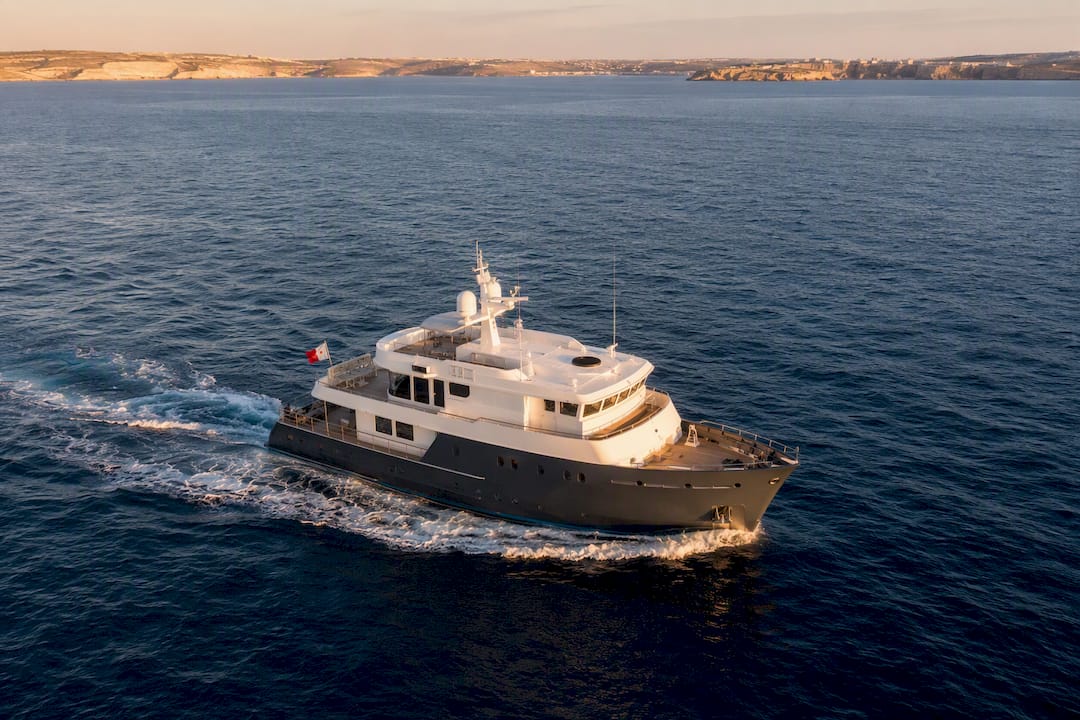
Ready to register under the Malta flag? Vessel Flag handles everything – private yachts from €849, commercial from €2,500, provisional certificate in 2–3 days. See Malta yacht registration prices and requirements →
If your yacht is 24 meters or longer, the Commercial Yacht Code governs it; if it falls between 12 meters hull length and 24 meters, the Small Commercial Yacht Code applies instead, and either way you cannot carry more than 12 passengers. Transport Malta will not issue a Certificate of Compliance to Trade until your vessel clears an initial survey and provisional registration. The next move is simple: pull your ownership and corporate paperwork together and get an Appointed Government Surveyor, Recognised Organisation, or a registration specialist on the phone before you book anything else.
Özetle:
- Yachts measuring 12 to 24 meters fall under the Small Commercial Yacht Code and are limited to carrying no more than 12 passengers, with specific survey and registration requirements.
- Provisional registration lasts six months initially, extendable by another six months, giving owners up to a year to finalize paperwork and pass surveys.
- Yachts over 24 meters face annual surveys and must be classed with a recognized society, while smaller yachts require intermediate surveys during their five-year certification cycle.
- The new CYC 2025 increases the operational distance to 150 nautical miles for extended short range notation and introduces stricter environmental and crew standards.
- Proper documentation, early survey scheduling, and appointed local agents help owners avoid delays and ensure ongoing compliance with Malta’s commercial yacht regulations.
İçindekiler
- Which Malta Commercial Yacht Rules Apply to Your Vessel?
- Registration, Provisional Registration, and Required Documents
- Survey, Certification, and How Long a COC Lasts
- Operational Limits and Manning: Notations and Crew Certificates
- What Changed With sCYC 2024 and CYC 2025
- Practical Checklist for Owners Preparing for Malta Certification
- Safety Equipment Standards for Malta-Flagged Commercial Yachts
- Environmental Compliance Beyond the 2025 Code Updates
- Insurance Requirements for Commercial Yachts Under the Malta Flag
- Changing Ownership or Transferring Registration in Malta
- Penalties for Non-Compliance With Malta’s Commercial Yacht Rules
- Malta Compliance: What Owners Consistently Get Wrong
- How VesselFlag Handles Your Malta Registration Paperwork
- Kaynaklar
- SSS
Which Malta Commercial Yacht Rules Apply to Your Vessel?
The threshold that matters most is length, and Transport Malta measures it two different ways depending on which code you fall under.
The Commercial Yacht Code (CYC) covers commercial yachts of 24 meters and above under its Article 2(8) length definition, with distinct categories kicking in at 24 meters and again at 500 gross tons. The Small Commercial Yacht Code (sCYC), effective since April 1, 2024, catches everything from 12 meters hull length (measured under ISO 8666, not Article 2(8)) up to that 24-meter cutoff. Both codes cap commercial operation at 12 passengers. Cross that number and you are no longer in yacht territory at all. You are running a passenger ship, which triggers an entirely different regulatory regime.
A few categories fall outside both codes entirely:
- Pleasure yachts used strictly for private, non-commercial purposes
- Vessels certified to carry more than 12 passengers commercially
- Commercial vessels under 12 meters hull length, which don’t meet either code’s minimum
Yachts already carrying EU Recreational Craft Directive certification often have an easier path into sCYC, since the small code was written with RCD design categories and CE modules in mind. A boat built to RCD Category A standards, for instance, arrives with documentation Transport Malta’s surveyors already recognize.
Registration, Provisional Registration, and Required Documents
Malta lets you start trading before every document is finalized, but only within limits. Provisional registration runs for six months and can be extended once by another six, giving owners a full year at the outside to close out paperwork and pass survey.
Here’s the typical sequence:
- Submit an application for provisional registration along with proof you qualify to own a Maltese ship (individuals, companies, or trusts each have different eligibility routes).
- Provide evidence of title, either a bill of sale for an existing yacht or a builder’s certificate for a new build.
- File corporate documents if the owner is a company, including certificate of incorporation and good standing.
- Apply for an International Tonnage Certificate and, where the yacht carries radio equipment, a radio station license.
- Appoint a resident agent in Malta if you’re a non-Maltese owner, since Transport Malta requires local representation for service of documents.
- Pay the initial registration fee and the annual tonnage tax, which scales with gross tonnage.
Most delays trace back to one thing: incomplete corporate documentation, especially for yachts owned through layered holding structures. Get your resident agent lined up early, because they often flag document gaps before Transport Malta does.
Profesyonel İpucu: Order your International Tonnage Certificate survey the same week you file for provisional registration. It’s one of the longer lead items, and starting it late is the single most common reason owners burn through their full twelve-month provisional window.
Survey, Certification, and How Long a COC Lasts
Every yacht joining the Malta flag for the first time goes through an initial survey. Pass it, and Transport Malta issues a Certificate of Compliance to Trade valid for five years. That five-year clock doesn’t mean five years of silence, though.
- Yachts under 24 meters undergo intermediate surveys partway through the five-year cycle.
- Yachts 24 meters and above face annual surveys every year of that cycle, not just at renewal.
- Yachts at or above 500 gross tons must be classed with a recognized classification society, no exceptions.
- Owners of smaller yachts can choose to class voluntarily or rely on Appointed Government Surveyors instead.
Survey reports aren’t just a pass/fail stamp. They record the yacht’s operational limits (how far offshore it can legally trade), structural compliance findings, and any conditions attached to continued certification. A Recognised Organisation acting on Malta’s behalf can issue statutory certificates directly, which is often faster than routing everything through a government surveyor, particularly if your yacht is already classed for other reasons.
Operational Limits and Manning: Notations and Crew Certificates
Where you’re allowed to actually take a commercial yacht depends on a navigation notation assigned during survey, not on what the owner hopes the boat can handle.
- Coastal: operation within 20 nautical miles of a safe haven.
- Short range: up to 60 nautical miles.
- Extended short range: up to 150 nautical miles, a notation new to the 2025 code.
- Unrestricted: no distance cap, subject to the yacht’s design category and equipment.
The notation you get isn’t negotiable. It flows from the yacht’s design category, its CE module certification if built under RCD standards, and weather limitations baked into its structural assessment. A yacht designed for sheltered coastal use won’t be certified unrestricted no matter how capable the owner believes it is.
Yachts 24 meters and above also need a Minimum Safe Manning Certificate, which sets the minimum qualified crew complement for safe operation, tied to the vessel’s size, systems, and trading area. Crew certificates issued under STCW are generally accepted, and passenger numbers plus propulsion power limits get recorded directly on the yacht’s statutory certificates, not left to a captain’s judgment call.
What Changed With sCYC 2024 and CYC 2025
Two overlapping updates reshaped Malta’s commercial yacht rules inside a two-year window, and both matter regardless of which one governs your vessel.
The sCYC took effect April 1, 2024, formally splitting small commercial yacht regulation away from the main CYC and replacing what had previously been a single set of rules covering everything under 24 meters. Then CYC 2025, the code’s fifth edition, entered into force July 1, 2025, and existing yachts get a grace period: they must transition to the new requirements by their first renewal survey after December 31, 2025.
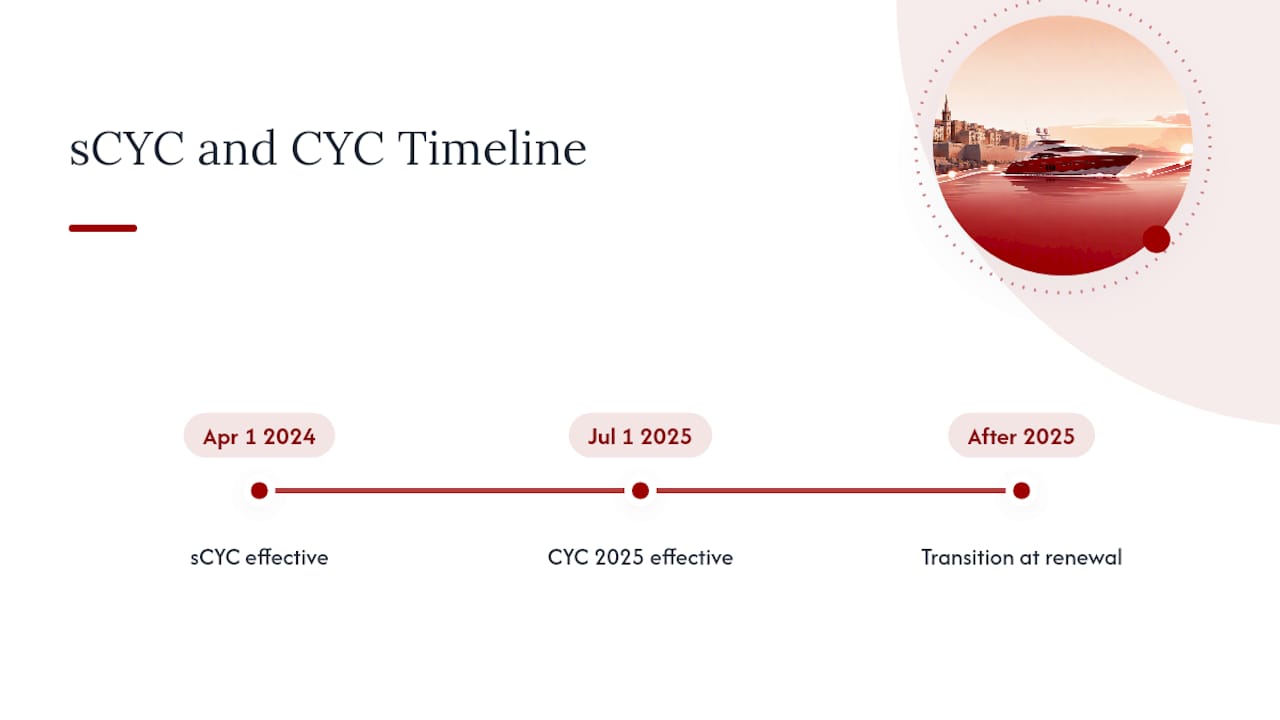
The headline change in CYC 2025 is the extended short range notation pushing the operational band out to 150 nautical miles, sitting between the old 60-nautical-mile short range and full unrestricted certification. Beyond navigation, the new edition tightens environmental standards, updates crew welfare provisions in line with Maritime Labour Convention obligations, and prohibits asbestos in new installations. New builds face closer scrutiny on structural integrity and get explicit support for hybrid and electric propulsion systems, a first for the code.
Practical Checklist for Owners Preparing for Malta Certification
Getting ahead of Transport Malta’s requirements is mostly a documentation and scheduling exercise, not a legal puzzle.
- Gather ownership evidence, corporate documents, and prior survey history before contacting a surveyor.
- Decide early whether to class the yacht through a Recognised Organisation or rely on an Appointed Government Surveyor.
- Book your survey slot as soon as provisional registration is filed. Surveyors book out weeks in advance during peak Mediterranean season.
- Start the radio license application and tonnage tax payment in parallel, not sequentially, to avoid stacking delays.
- Appoint your resident agent immediately if you’re a non-Maltese owner.
- If you charter commercially, set up passenger manifest logs and port-state document folders before your first booking, not after a port inspection catches you unprepared.
Profesyonel İpucu: If your yacht sits near a size threshold, like 23.5 meters, get a professional measurement under both Article 2(8) and ISO 8666 before you file anything. Which code applies changes your survey cycle, your notation options, and your manning requirements.
Safety Equipment Standards for Malta-Flagged Commercial Yachts
Both codes tie safety equipment directly to navigation notation and passenger count, so a coastal-notation yacht and an unrestricted one carry meaningfully different kit even at similar lengths.
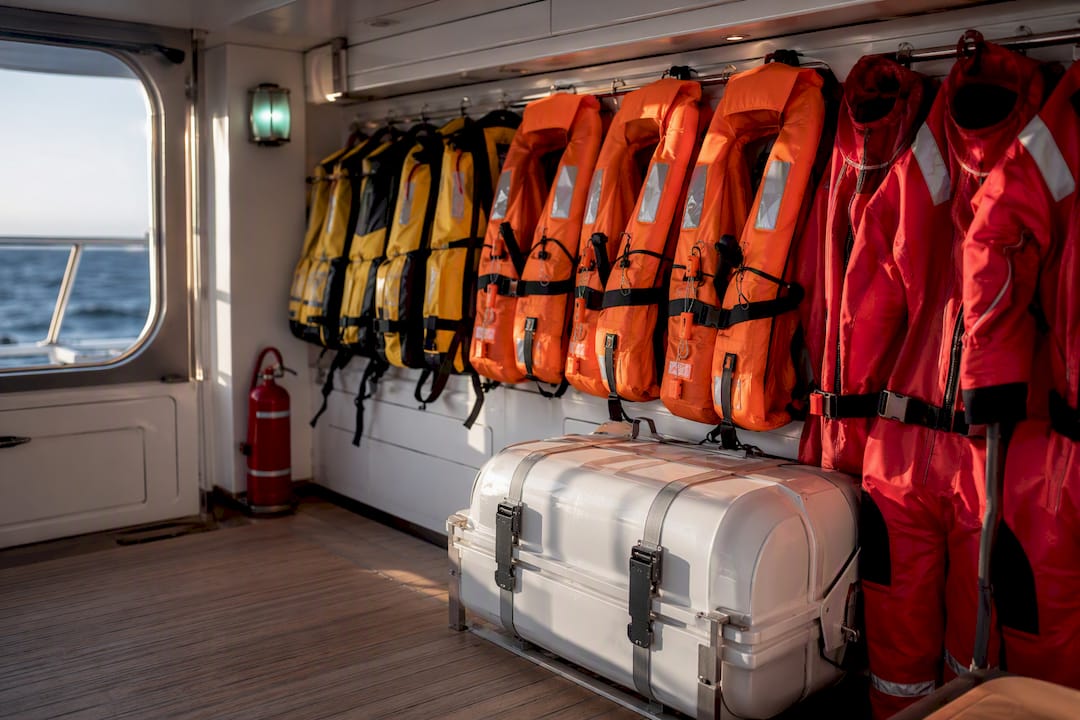
At minimum, every commercial yacht needs life-saving appliances scaled to maximum certified passenger and crew numbers: life rafts with capacity to cover everyone aboard, lifejackets, and immersion suits where the operating area’s water temperature warrants them. Fire detection and firefighting equipment gets assessed against the yacht’s construction materials and engine room configuration, with fixed fire suppression systems required in machinery spaces above certain power thresholds.
Navigation and communication equipment scales with notation. A coastal-notation yacht can often get by with basic VHF and GPS. Extended short range and unrestricted notations require additional redundancy: backup navigation systems, longer-range communication equipment, and in many cases satellite communication capability so the vessel can raise help well beyond VHF range.
Bridge equipment, watertight door integrity, and bilge pumping capacity all get checked during survey and tied to the yacht’s structural fire protection class. Yachts operating under CYC 2025’s extended short range notation face a slightly higher bar here than under the old short range designation, since operators are now certified for open-water conditions further from a safe haven.
None of this equipment list is static once installed. Annual and intermediate surveys reverify that safety gear is present, in-date, and functioning, not just installed at delivery and forgotten.
Environmental Compliance Beyond the 2025 Code Updates
CYC 2025’s environmental provisions get most of the attention, but Malta’s environmental obligations for commercial yachts run wider than the headline updates.
Waste management plans are mandatory for yachts operating commercially, covering sewage discharge, garbage segregation, and oily waste from machinery spaces, aligned with MARPOL requirements that apply to Malta-flagged vessels regardless of code. Yachts fitted with sewage treatment plants need those systems verified during survey, and discharge within port limits or near coastlines is restricted well beyond what many private owners assume from recreational boating experience.
Emissions compliance has become a bigger part of survey scrutiny. Engine emissions standards apply based on engine build date and power output, and yachts undergoing significant refits may find themselves reassessed against current standards rather than grandfathered under whatever applied at original construction. CYC 2025’s push toward supporting hybrid and electric propulsion isn’t a mandate to convert, but it does mean newer builds get a clearer certification pathway if owners want to go that route, where older diesel-only yachts previously had less flexibility on record.
Oil record books, garbage record books, and waste disposal receipts from port facilities all form part of the documentation a surveyor or port-state inspector will ask to see. Charter operators in particular should treat these logs as living documents updated every voyage, not paperwork assembled retroactively before a survey date. Falling behind on record-keeping is one of the more common findings that turns a routine intermediate survey into a longer, more expensive one.
Insurance Requirements for Commercial Yachts Under the Malta Flag
Transport Malta doesn’t run its own insurance scheme, but it does require proof of adequate insurance cover as a condition of maintaining commercial registration, and this gets checked at multiple points, not just once at initial registration.
Protection and Indemnity (P&I) cover is the baseline expectation for any yacht trading commercially, covering third-party liability for injury, pollution, and wreck removal. Hull and machinery cover protects the vessel itself, and most charter operations layer on passenger liability cover specific to the number of guests the yacht is certified to carry. Where the yacht carries more than a handful of charter guests regularly, insurers typically want to see the COC and current survey status before binding cover at all, since the certificate defines exactly what the yacht is legally permitted to do.
Proof of insurance needs to stay current and accessible aboard the vessel, not just on file with the management company ashore. Port-state control inspectors and charter clients alike may ask to see it, and a lapsed policy discovered mid-charter creates liability exposure for the owner and the operating company both.
Resident agents and registration specialists typically flag insurance renewal dates alongside survey and certificate renewal dates, since letting any one of the three lapse can effectively suspend commercial trading rights even if the other two remain valid. If you’re setting up a new commercial registration, get your insurer quotes lined up against your intended navigation notation early. Extended short range and unrestricted notations carry different premium structures than coastal-only cover, and insurers price that difference before, not after, you’ve committed to a notation.
Changing Ownership or Transferring Registration in Malta
Selling a Malta-flagged commercial yacht, or restructuring the owning company, triggers specific administrative steps that differ from a straightforward private sale.
A change of ownership requires notification to Transport Malta along with updated title documents, typically a new bill of sale, and confirmation that the new owner meets the same qualification-to-own requirements the original owner satisfied. If the yacht is owned through a corporate structure and only the shareholding changes, rather than the registered owning entity itself, the notification requirements are lighter, but they’re not optional. Transport Malta still expects to know who ultimately controls a vessel flying its flag.
Existing statutory certificates, including the COC, generally transfer with the vessel provided the underlying survey status remains current and no structural changes have occurred that would affect compliance. A yacht sold mid-cycle doesn’t need to restart its survey clock from zero, which is one of the practical advantages of Malta registration during a resale.
Resident agent appointments need updating whenever beneficial ownership changes, since the agent’s role is tied to the specific owning entity, not the vessel itself. Mortgage registration, if the new owner is financing the purchase, gets recorded against the vessel through Malta’s ship registry, and existing mortgages from a previous owner need formal discharge before a sale completes cleanly. Buyers should confirm mortgage discharge status before completion, not after, since an undischarged mortgage can complicate a transfer significantly.
Penalties for Non-Compliance With Malta’s Commercial Yacht Rules
Transport Malta treats commercial yacht compliance as a condition of continued registration, not a box checked once and forgotten, and enforcement reflects that.
Operating without a valid COC, or trading beyond your certified navigation notation or passenger limit, exposes the owner and operator to fines and potential suspension of the yacht’s commercial registration. A yacht caught trading unrestricted on a coastal-only certificate isn’t just risking a paperwork correction. It’s operating outside its insurance cover too, since most P&I and hull policies are written against the certified notation.
Port-state control inspections, which can happen in any jurisdiction the yacht visits, not just Malta, carry their own enforcement consequences. Deficiencies found during inspection can result in detention until corrected, and repeated or serious deficiencies get reported back through international port-state control databases, which affects how closely future inspections scrutinize the vessel.
Missed survey deadlines are the most common compliance failure Vesselflag sees among owners managing registration independently. Let an intermediate or annual survey lapse and the COC itself can be suspended, which immediately halts commercial trading rights until survey is completed and the certificate reinstated. Because insurance, charter contracts, and berthing agreements often reference valid COC status directly, a lapsed certificate can cascade into breached contracts well beyond the immediate regulatory penalty.
Malta Compliance: What Owners Consistently Get Wrong
Most owners treat Malta’s commercial yacht rules as a one-time registration hurdle rather than an ongoing operating discipline, and that’s the mistake that actually costs money. The code that applies to your yacht on day one doesn’t stay static. CYC 2025 already reset the clock for existing yachts approaching renewal, and it won’t be the last update.
Some specialists have walked owners through provisional registration, survey coordination, MMSI and AIS setup, and resident agent appointments across multiple flag jurisdictions, including Malta. What we see repeatedly: owners who treat documentation as a formality lose weeks to avoidable delays, while those who front load their paperwork and lock in a surveyor early sail through provisional registration inside a few months. If you’re weighing Malta against another jurisdiction, or you’re ready to start, a direct conversation about your yacht’s specific length, use case, and timeline saves far more time than researching code editions alone.
— VesselFlag
How VesselFlag Handles Your Malta Registration Paperwork
Chasing survey slots, resident agent appointments, and tonnage tax filings in parallel is exactly where most owners lose weeks. Commercial yacht registration under the Malta flag can be managed as one coordinated process instead of five separate errands, handling document preparation, survey scheduling, and resident agent placement together so nothing sits waiting on the next step.
Beyond Malta itself, Vesselflag manages MMSI and AIS setup, insurance consultancy, and corporate structuring for ownership, which matters if you’re registering through a holding company rather than as an individual. Whether you’re moving a yacht already trading elsewhere onto the Malta flag or starting commercial registration from scratch, the process benefits from someone who has filed the paperwork before and knows which documents Transport Malta flags most often. Start your step-by-step commercial vessel registration with Vesselflag and get a timeline specific to your yacht’s length, class status, and intended navigation notation.
Kaynaklar
Transport Malta’s own code documents remain the authoritative text on every rule covered here. Consult the Commercial Yacht Code for yachts 24 meters and above, the sCYC 2024 text for smaller commercial yachts, and the synopsis of key CYC elements for survey and certification specifics. Dixcart’s analysis of CYC 2025 offers useful context on the 2025 transition. Always confirm current requirements directly with Transport Malta before filing.
- Commercial Yacht Code – Transport Malta
- sCYC 2024 – Transport Malta (PDF)
- Malta Updates Yacht Code: What the CYC 2025 Means for Owners and Operators – Dixcart
SSS
What Size Yacht Needs the Full CYC Instead of sCYC?
Yachts measuring 24 meters or more under Article 2(8) fall under the full Commercial Yacht Code, while yachts between 12 meters hull length and 24 meters fall under the sCYC.
How Long Does Provisional Registration Last in Malta?
Provisional registration runs for six months initially and can be extended once for another six months, giving owners up to a year to complete surveys and documentation.
How Often Does a Malta-Flagged Commercial Yacht Need Surveying?
Yachts under 24 meters need intermediate surveys during their five-year Certificate of Compliance to Trade cycle, while yachts 24 meters and above require annual surveys.
What’s New Under CYC 2026?
CYC 2025 adds an extended short range navigation notation up to 150 nautical miles, tightens environmental and crew welfare standards, and requires existing yachts to transition by their first renewal survey after December 31, 2025.
Can a specialized service handle my Malta commercial yacht registration?
Yes. Some providers coordinate document preparation, survey scheduling, resident agent appointment, and MMSI/AIS setup for owners registering commercial yachts under the Malta flag.